Showing posts with label Stravinsky. Show all posts

Thursday, November 6, 2014

Stravinsky's Petroushka: Inspired by Steadfast Tin Soldier?

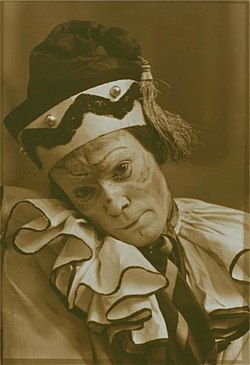
Stravinsky's "Petroushka" was his second ballet, which premiered in 1911, telling the story of a puppet caught on the unfortunate end of a love triangle. I've never heard anyone compare it to the plot of Hans Christian Andersen's "Steadfast Tin Soldier," but to me the similarities are obvious.
Nijinsky, the famous dancer who played the original Petroushka in 1911

Stravinsky's first ballet, "Firebird," was inspired by traditional Russian fairy tales. It's possible that he would have drawn from another fairy tale for his next ballet, but as he was stretching his music in more modern ways, he could have been even subconsciously influenced by Andersen's 1838 fairy tale, which which was also a less traditional story. He was also in the middle of composing a piece based on the Andersen fairy tale, "The Nightingale."
Marcia Brown

Looking at both stories, you can see the parallels:
"Steadfast Tin Soldier" features three main characters; a toy tin soldier, the ballerina he is in love with, and the jack-in-the-box that is his rival.
"Petroushka" features another toy, this time a puppet, who is also in love with a ballerina, and the puppet Moor who is his rival.
Tuscon production of "Petroushka" 

The Tin Soldier embarks on a journey when he falls out of the window, which ends up with him back in the same nursery room, by chance. Petroushka breaks out of his cell to rescue the ballerina from the Moor's seduction, but she does not want to be rescued-the Moor chases Petroushka outside and he finds himself back at the Shrovetide Fair where we first met him performing.
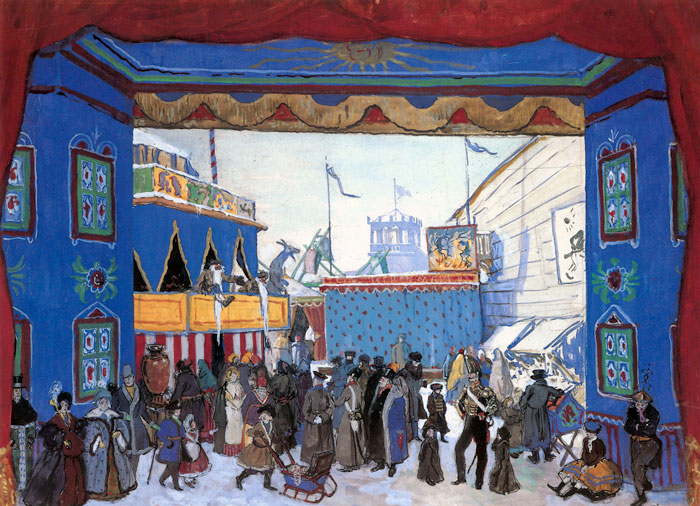
Set for the Shrovetide Fair, by Benois

1911 "Petroushka" souvenir program

Both stories are also characterized by the helplessness of the main characters, and their unfortunate ends. Neither of them can gain the love of the ballerina they desire, and in the end they both die. The Tin Soldier was inexplicably thrown into the fire by the boy who owned him, and the Moor killed Petroushka in front of the Shrovetide Fair crowd. The charlatan (who owns the puppets) showed the crowd that he was just a lifeless puppet, but after the crowd leaves, Petroushka's ghost is seen shaking his fist at the Charlatan, but then collapses on top of the puppet both, "his arms swinging to and fro in the night."
Final scene in "Steadfast Tin Soldier," Marcia Brown

Stravinsky wrote in his autobiography that "in composing the music, I had in my mind a distinct picture of a puppet, suddenly endowed with life, exasperating the patience of the orchestra with diabolical cascades of arpeggios. The orchestra in turn retaliates with menacing trumpet blasts. The outcome is a terrific noise which reaches its climax and ends in the sorrowful and querulous collapse of the poor puppet."  From there, the ballet was further developed by Diaghilev, creator of the Ballet Russes and commisioner of Stravinsky's ballets, and Alexandre Benois, the production designer. Given that Andersen's fairy tales had become famous world wide by the dawn of the 20th century, it's likely that at least one of the men who worked on the ballet would be familiar with the earlier fairy tale. Again, it could have been subconcsious influence, or it could have been coincidence-but the similarities are quite striking.
Design for street dancer by Benois

Friday, April 2, 2010

The Song of the Nightingale


I had planned on doing this post before I even found out it was Hans Christian Andersen's 205th birthday! Thank you, Google Icons. (Find out more about Google's tribute to Andersen at Once Upon a Blog)

Anyway, first the tale "The Nightingale."

In China, long ago, was a nightingale that sang so sweetly, it became famous throughout the land. The Emperor himself requested that the nightingale come and sing for him. Everyone was delighted, and the Emperor put the nightingale in a cage so he could hear him sing whenever he pleased. One day, the Emperor was sent a mechanical bird who would sing as a present. The true nightingale flew away.

At first, the Emperor and his court were saddened by the loss of the nightingale, but they had the mechanical bird. The people liked this even better-he would sing the same tune over and over, and whenever the people wished to hear him.

Yet, one day the Emperor fell sick. He wanted music, but the mechanical bird had grown old and barely worked anymore. Death sat on the Emperor's chest and all seemed lost.
Illustrations by Edmund Dulac

But then, the true nightingale had heard of the Emperor's plight and came to sing to him. The true song of the nightingale healed the Emperor, who was overjoyed to see his friend, but never again took advantage of him.

This is part of a video version of Stravinsky's "The Nightingale." I don't understand the significance of the visuals, I was just trying to find the part where the flute plays the part of the nightingale. I can't find one on youtube though-in the opera version, a soprano sings the nightingale's part-just after 2 minutes.


The opera version was condensed into an orchestral version, "The Song of the Nightingale," which I prefer, but only because I'm more of an orchestra person than opera. But this part highlights the oboe playing the mechanical bird.

Friday, March 19, 2010

Firebird ballet

The story for the "Firebird" ballet comes from a different pieces of Russian folklore--as if someone made a Western tale in which a girl wears a red hood, loses her glass slipper and falls into a deep sleep because of an enchanted apple, to be awakened by the kiss of a Prince.

The story follows Prince Ivan as he tries to find the culprit who keeps stealing his father's golden apples. This turns out to be the Firebird, who gives him one of her feathers to use in time of need in reward for releasing her. The Prince then discovers a group of Princesses all kept captive by the evil Katschei, who can only be defeated when someone breaks the egg which holds his heart. With the help of the Firebird to tame Katschei's evil minions, and of course true love, Ivan succeeds in freeing the maidens and securing the most beautiful Princess for himself.


The music for the ballet was composed by Igor Stravinsky. One of his earlier works, there isn't the avant garde aspect of his later music, but this makes it more accessible to the average listener--which is not at all to say the music is boring. Stravinsky used diatonic music (music that uses the regular notes of a traditional major or minor scale) to represent normal, earthly things, and chromatic music (using all the notes available) to represent the world of magical creatures. Listen to Katschei's slithering, evil theme at the beginning. This version seems to have more emphasis on their beautiful set than on dance, but the Firebird comes in and dances around 6:30 (to a wicked hard flute part!). Listen to the violin harmonics (a very high and eerie sounding effect) around 2:00.

You can follow the links to watch the complete ballet. I'm including the last section as well. This starts with the Firebird's lullaby as she enchants the evil minions into a deep sleep and goes into the joyful finale, one of my favorite moments in classical music. Listeners might recognize the music as also being featured in Disney's Fantasia 2000, as the Spring Fairy overcomes the obstacles to spread spring throughout the land (how appropriate for this time of year).


Enjoy!