Sunday, April 25, 2010

Fairies and ballet

Fairy tales are interwoven into the history of ballet. In the beginning, only men were ballet dancers, until the 1680s when women started dancing as well. They danced in heeled shoes then, and large dresses. As time went on, skirts got higher and higher and evolved into the modern tutu. Marie Taglioni is credited with being the first dancer to dance on pointe-on the very tips of the toes. As difficult as this is today with specialized pointe shoes, the first pointe dancers just stuffed the toes with cotton or fabric.
Marie Taglioni is most famous for her role in La Sylphide, in which she debuted this new style of dancing. David Barber's summary of the ballet: "La Sylphide tells the story of a young Scotsman named James who's about to get married to a woman he's not sure he loves. (She's his cousin and her name's Effie, neither of which may have helped.) The night before their wedding, he falls asleep and dreams of a beautiful winged fairy, a sylphid or sylph, who flies down and tries to lure him away. He follows her into the forest, but thanks to an evil spell by the neighborhood wicked witch, her wings fall off and she dies. At the end of the ballet, some of her sister sylphs fly down to carry her away, leaving James alone in the woods while Effie goes off to marry someone else entirely. Bummer." (Taken from Barber's Tutus, Tights, and Tiptoes: Ballet History as it Ought to be Taught-apparantly really cheap on Amazon).
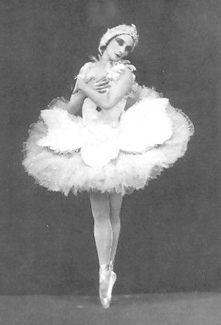

Marie Taglioni dancing the role of the Sylphide. The new technique of dancing on pointe helped convey the otherworldiness of the fairies, as they seemingly floated across the stage.
Since then, fairy tales have popped up as sources for most of the famous ballets. Giselle features a group of Wilis, spirits of dead women who dance men to death. Above picture of the American Ballet Theater. Chopin's Les Sylphides, Stravinsky's The Firebird, and Prokofiev's Cinderella are all examples of standard ballet repertoire that features a fairy tale and/or fairy characters.


Picture by Don McMurdo, Australian ballet, Swan Lake

But the most famous ballets are the three Tchaikovskys- Sleeping Beauty, Swan Lake, and The Nutcracker. The combination of plot, music, costumes and scenery together with dance make all of the above instant classics. It's so unfortunate that both fairy tales and ballet have become culturally associated with little girls, and become something that every girl is interested in and then "grows out of." Ballet is a beautiful and incredibly difficult art form- in fact, few professions (if any...) require the amount of discipline and commitment demanded from a professional ballet dancer.

Thursday, April 22, 2010

Beauty and the Beast: Marvel style

I really love X-men, and I really REALLY love Beauty and the Beast. The two combined is brilliant. I need to get my hands on this somehow.

Henry Bett

I've referenced Henry Bett lately, and that's because I've been reading his book Nursery Rhymes and Tales:Their Origin and History. (Out of print-the link here is to the one copy available on amazon, $153.81). From 1924, it can be a bit shocking to the modern reader in its non-P.C.-ness. For example, Henry Bett quotes an African man who was wondering what is the cause of various forces of nature. Bett claims, "This, of course, represents an unusual level of thought for a savage mind. It is a speculative and sceptical mood rather uncommon in an uncivilized race." Which is not only quite an untrue claim to begin with, but opposes his whole thesis, which is that myths and tales were ancient people's ways of trying to explain natural phenomenon. They wouldn't be trying to explain anything if they weren't first wondering how it came about.


Other than that, Bett has a very interesting book. He not only takes current (or, what was current in 1924) tales and rhymes, but has many related examples through different cultures, and then cites historical facts and customs that relate to the tales and rhymes as we know them today. He claims that our tales and rhymes are rooted in historical fact, which have evolved and become distorted over time. He talks about the practice of burying people alive in the foundations of a house or bridge to appease the devil as the source of the rhyme "London Bridge is Falling Down," (which may or may not have been the case, although there's no reason to think a person was specifically buried under London Bridge,and there are other guesses as to the meaning of the rhyme) as well as the custom of baking pies in such a way that live birds can actually fly out of it when cut, such as in "Sing a song of sixpence."

Most modern analysts of tales assume they hold symbolic meaning. Which is surely partly true, but we can't forget the tales are very much the products of the cultures from which they came. Bett talks about certain fairy tales I've already posted about, Little Red Riding Hood and Bluebeard. For more on the history of nursery rhymes, you can visit this site.

Wednesday, April 21, 2010

Hansel and Gretel overture


Overture to the opera Hansel and Gretel. Composed by Engelbert Humperdinck.

Monday, April 19, 2010

Historical Bluebeard

Usually when we talk about the history of a fairy tale, we mean how the story evolved over time, but not a historical event on which the tale was based. With one of the creepiest fairy tales, Bluebeard, there are actually a couple possible historical precedents.

Kay Nielsen


Henry Bett claims that Gilles de Retz, Sieur de Laval, Marshal of France, was nicknamed "Barbe Bleue," "because of his blue-black beard," and that he believed he could restore his strength by bathing in the blood of young children (an awful resemblance to Countess Elisabeth Bathory bathing in the blood of young virgins to retain her beauty).


I haven't found any concurrence on the nickname or the bloodbaths, but he was a serial killer of young boys who gained pleasure from their pain and humiliation. More about him on wikipedia.

Matt Mahurin

Conomor the Cursed is the other possible candidate for the "real" Bluebeard. Once again, history becomes intertwined with legend. We do know he existed and killed his wives-I can't tell from my sources what are the exact known facts, but there's a whole legend about killing his wives once they got pregnant and how the last one was murdered but brought back to life and became a saint.

Edmund Dulac


If you want to know more about the tale, read the annotated version on Surlalune, or Terri Windling's article. Windling explores the various folkloric versions that predate Charles Perrault's tale, and how many of the heroines were able to outwit their murderous husband on their own, saving their sisters who had been victims-a stark contrast to Perrault's heroine who can do nothing but wait for her brothers to save her. And the moral (Perrault's) which condemns the woman for disobedience, and not the serial killer husband.


Art by Frederic Theodore Lix

Tanith Lee's Red as Blood

Sometimes when I read fairy tales I try to recreate what it might have felt like to read them for the first time-the fear of the villain, the uncertainty of the ending. Reading the stories from Tanith Lee's Red as Blood: Tales from the Sisters Grimmer, I don't have to try to feel fear or curiosity. She blends tradional fairy tale plots with truly horrifying twists.

It's hard to pick a favorite, because they're all excellent, but I couldn't help wishing some filmmaker would make a short version of "Thorns," the Sleeping Beauty, because it has such delightfully macabre descriptions that have the potentially to be visually stunning. I also thought "When the Clock Strikes," the Cinderella tale, was particularly genious. The plot was actually more convincing than the traditional tale.


But, as Beauty and the Beast tales will always be close to my heart, I adored "Beauty." The first time I read this book, I was terrified by the time I got to this last story that it would be twisted beyond recognition like the other tales. I enjoy speculating about Snow White and Rapunzel being Satanic, but Beauty and the Beast is too personal to me-I would hate for Beauty to cast the spell on the Beast, or for the Beast to be a true monster of nightmares. Yet the story, though definitely with a twist, is beautiful and won't offend Batb freaks like me. It is set in the future and is my favorite short story version of Beauty and the Beast, which is saying a LOT, because of all the genres, there are a lot of short story versions out there.


This book isn't for everyone-those who don't like scary movies or having the plots of their favorite tales turned upside down on their heads should stay away. But as far as quality and creativity goes I can't recommend it highly enough-each time I read this book I can hardly put it down.

Saturday, April 17, 2010

Little Red Riding Hood as Sun Myth


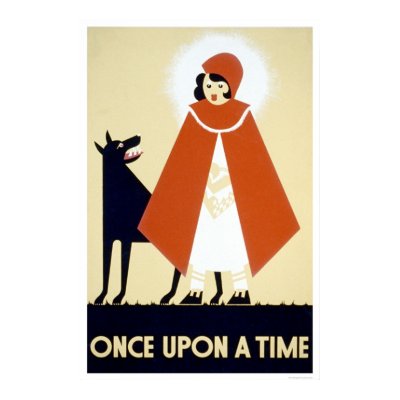
Kenneth Whitley poster

Little Red Riding Hood tends to be over-analyzed, in my opinion. Every branch of folkloric thought believes it has the correct symbolic meaning. Any psychoanalist will tell you the red cloak is OBVIOUSLY blood from menstration and the wolf is OBVIOUSLY a sexual predator. Henry Bett, on the other hand, claims with certainty that Little Red is a myth of sunset and sunrise. Generally sun myths can be applied to anything because anything good is the sun, anything bad is the night. The ultimate triumph of good over evil is the dawn triumphing over night. Congratulations, you have an interpretation for 99% of human stories.

Image by Paul Woodroffe

Yet, after a conclusion that might seem oversimplified, Bett goes on to cite many myths and legends from around the world that are directly related to the moon and sun and have parallels to Little Red-either connecting the color red/red coverings with the sun, or wolves with the night. Even one Melanesian myth where the hero takes a piece of red obsidian and cuts Dawn out of the belly of night. Personally, I can see a red hood as the rising sun more easily than menstration. This would all make a lot more sense if the red cap/hood wasn't added till Perrault's version. But anyone who claims any myth or tale has one specific origin or meaning is making one heck of a claim. Betts himself admits earlier, when critiquing those who interpreted everything as a sun myth, that "It seems to be the fate of every theory in folk-lore to be made ridiculous by being pressed too far." Modern interpretations don't really pay any attention to this sun myth idea and attribute everything to sexual meaning.

Image by Annie Rodriguez

Yet the complex influences of culture and history that created the fairy tales we know today are all fascinating to contemplate. It's true that Little Red has a hold on the imagination-it's one of the few tales that every child knows yet has not been marketed by Disney, with Hansel and Gretel also up there holding it on their own. Folklorists love to quote Dickens when he, reminiscing on his childhood, recalled how he believed that if he should have been married to Little Red Riding Hood, he should have known perfect bliss.

Friday, April 16, 2010

Beauty and the Beast of Cultural Expectations: Prince Desir

Forgive the lame title. I was never really good at coming up with clever titles so I just do whatever comes to mind first.

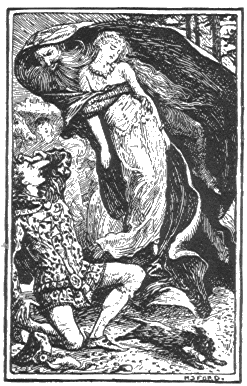
Madame LePrince de Beaument (of Beauty and the Beast fame) has another tale called Le Prince Desir et la Princess Mignonne, in which the Prince is cursed to have a huge nose until he realizes that his nose is unusual. Andrew Lang simplified the tale for his Blue Fairy Book, renaming it Prince Hyacinth, and it can be read online here. (Image from Blue Fairy Book, illustrated by H. G. Ford and G. P. Jacomb Hood).

His whole life, the Prince is surrounded by people and pictures of people with long noses. His nurses and teachers tell him that all the great historical figures had long noses, that a long nose is a sign of beauty, and that a short nose is a horrible thing to have. He falls in love with a princess' portrait despite her short nose, and it's not until he meets a fairy in disguise on his way to save his Princess and tries to kiss the fairy's hand that he realizes how inconvenient his nose really is.

I find this tale very intriguing. Today many people (myself included) believe in the power of embracing your natural, healthy body. While it may seem that to say every woman is beautiful is simply untrue, or that we must at least concede that some women are surely more beautiful than others, I truly believe that there are different forms of beauty and it's up to the viewer to learn to see it, rather than putting all the pressure on girls to conform to our rather narrow cultural standards of what is beautiful.

Yet in this tale, the Prince's salvation isn't embracing his unique nose-because for most of his life he is truly proud of his nose-but the moral is supposedly that pride can blind us to our faults. Which may be true of character, but is a long nose a fault? But the Prince is easily convinced that long noses are beautiful. If long noses were the majority, would we not all also be swayed? Cultures through time and around the world have considered things beautiful that modern Americans don't:

Full, round figures (painting by Titian)


Black teeth


Filed teeth


The tragic bound feet of Asian women

Beaument's story brings up a theme that I love to explore in reading and writing versions of Beauty and the Beast: not only Beauty verses ugliness, but how we perceive each. Tanith Lee explores this expertly in her version, which I will post about very soon. I've come up with a concept on my own (that was probably sunconsciously influenced by Lee) but have never been able to successfully turn it into a story, in which a girl like any of us inhabits a world of hairy beasts, in which long, thick fur is the sign of beauty. We never know if this girl would have been considered beautiful to us or not, because her hairlessness sets her apart as being the beast of that culture. So though Beauty and the Beast don't physically change from our story, their roles flip because of their beauty standards.

Dark music

I love dark fairy tales. Many fairy tale enthusiasts will insist that true fairy tales really were dark in their origins, therefore to describe them as dark is redundant. But in our culture, we definitely have a prevailing view of fairy tales as innocent and specifically for children, even though before many a happy ending are many gruesome trials. Even in the Disney versions, considered by most to be the epitome of fairy tales reduced and simplified, there are scary moments too!

However, for anyone to admit to loving fairy tales enough to research their origins and their "true" nature, there still has to be a sense of vulnerability and childlike appreciation of the magical aspect of the tales as well. Yet the darker, adult versions of these traditional themes and tales provides an interesting juxtaposition of dark and light.

I've found that I like this same juxtaposition in music. I love basically any music in minor, but especially in minor 3/4. Music in 3 has a lilt to it, usually thought of as being waltz-like. Yet with a minor melody, that waltz can become more sinister- a waltz of vampires, or a demented circus-something childlike or innocent gone awry. Any story-or music-that tries too hard to be hardcore without leaving any vulnerability takes away much of the realism and the personal connection.


I adore the waltz from Prokofiev's Cinderella ballet. In minor 3/4, it takes a beautiful waltz but gives it a sinister sense of foreboding. And listen to how he creates the ominous clock ticking and then chiming midnight with a symphonic orchestra!


I love Ravel's "La Valse." (This is only part 2 of 2). It starts off bright and cheery, but towards the end gets wilder and wilder. It makes me think of a dream that starts off pleasant and turns more absurd and perhaps nightmarish. I also think it would be perfect to accompany the Cinderella-at-the-ball scene.

Thursday, April 15, 2010

Beauty and the Beast tv show


I've been sharing some of my favorite versions of Beauty and the Beast, and this show isn't exactly a favorite, it's the only one in the television genre (that I've come across, enlighten me if I'm wrong. Aside from the Syfy version I haven't seen and probably never will).
Ron Perlman and Linda Hamilton star in this modern interpretation from the 80s. The Beast lives underground and saves Catherine (the Beauty) from some thugs one day. They fall in love and run around saving people, mostly each other. A lot of people really like this show, so I hope I don't offend anyone when I say, this show is pretty terrible, it's just so bad it's funny. The Beast (Vincent) has a bond with Catherine such that he can sense whenever she's in trouble and will immediately come to her aid.
Although, I'd be totally lying if I denied that, in between laughing at the script, I secretly enjoy it. It didn't help that my first introduction to this little treasure was a movie version that was edited terribly so that they would make references to past experiences that were in the shows but not in the movie, therefore the audience had no idea what they were talking about.

This isn't Linda Hamilton's only brush with Beauty and the Beast. Embedding has been disabled by request (grrr...) but check out this rather genious recut version of the Terminator movies, entitled "Beauty and the Beastinator".