I had mentioned that the first half of
Franz Schonwerth's Folktales didn't really fit into the category of "fairy tales": they were more like legends and ghost stories. But towards the back there are definitely fairy tales; stories that echo the structure of fairy tales we know, and many that could be considered versions of well-known fairy tales.
For those who need a refresher, Schonwerth collected tales from Bavaria around the same time as the brothers Grimm, but the stories in this book are actually from people native to the region, and remained unaltered throughout the years, unlike the popular Grimm's tales. From my archives, you can read about the
mermaid tales and
witch tales in the collection.
Arthur Rackham
When we think of fairy tale dwarves, we are sure to remember "Snow White and the Seven Dwarfs", and some people may be familiar with "Snow White and Rose Red". From these two tales we see the
dual nature of dwarfs in folklore; they can be helpful and kind, as they were to Snow White, yet rude and ungrateful in the latter story.
Rie Cramer
Dwarves in Bavaria could be secretive and helpful; much like the elves in
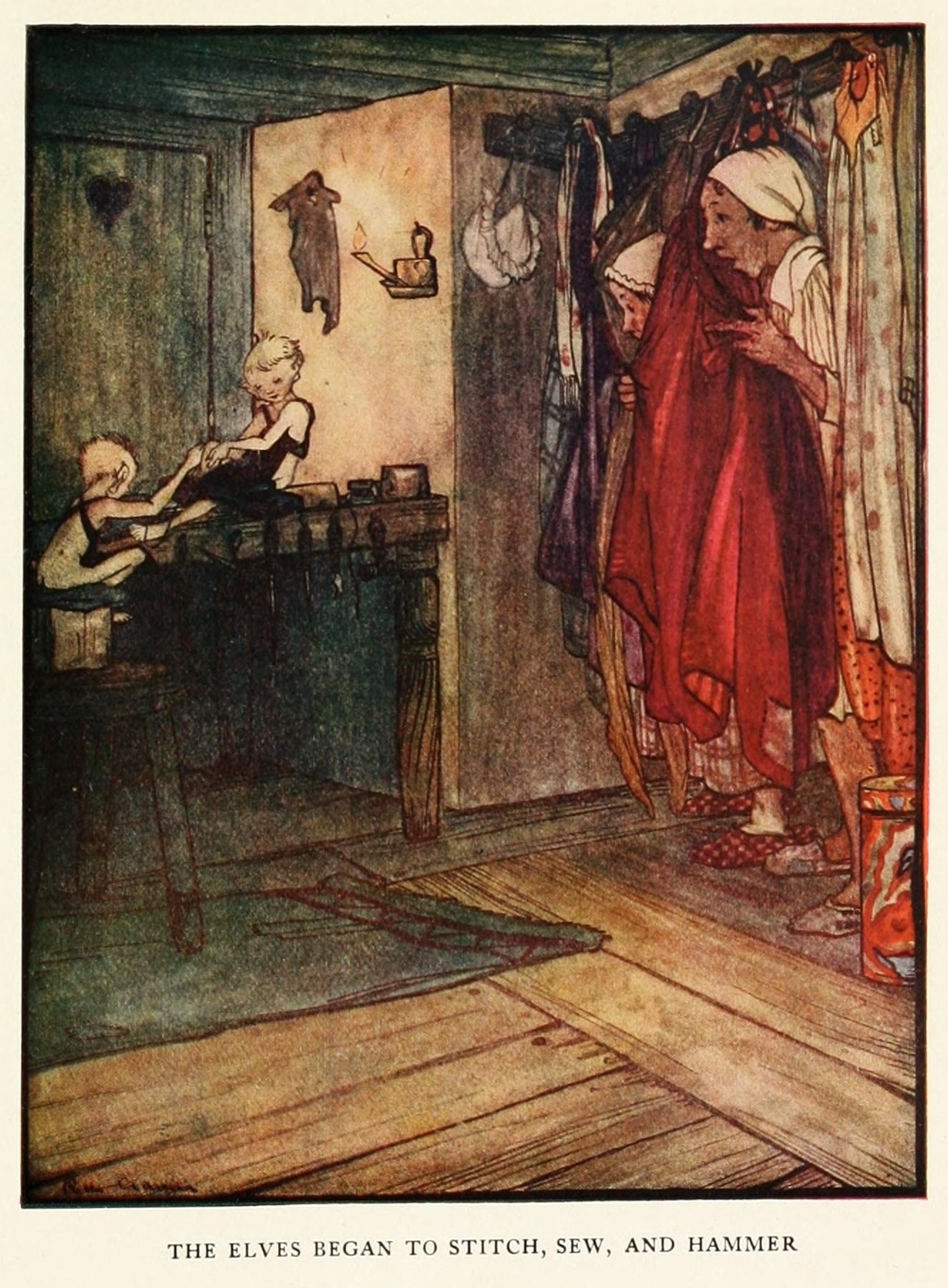
The Elves and the Shoemaker. Many dwarves would inhabit farms and living spaces of humans, and come out at night to do hard work; yet they were so quick and nimble they would accomplish much more than humans could, and produce superior work. Yet the dwarves were incredibly sensitive-if their privacy was broken or any oaths humans made to them broken, they would leave and never come back. They also wouldn't accept gifts of money or clothing-they would interpret anything more than food as a final payment.
Like the dwarves in "Lord of the Rings", dwarves often
lived in mountains, creating a system of tunnels, and were known for their
work with precious metals. In one story they made a necklace that would make anyone who saw it love the wearer-this was for a wife who was afraid she would lose her husband's love. Yet in payment for this treasure, she had to give herself to the Dwarves. When the woman's husband found out what she had done, he left her-ironically bringing about the fate the wife had tried to avoid. The husband did eventually reconcile himself to his wife, but it's a reminder that powerful magic often comes at a price...
Brian Froud
Some d
warves could be very helpful to kind humans-they helped Little Rose gain money to marry her true love in one tale, and assisted a maid named Eve with her chores, and even helped disguise her pregnancy from those around her with magic to avoid her being shamed. They took care of her baby when it was born, gave them gifts, and in both cases the dwarves remained lifelong friends with the women they helped in their time of need.
Yet
not all dwarves were as friendly-one castle was known as haunted; the dwarves there would scatter the sheep at night, causing them to fall off the mountain, so the castle was avoided.
John Batten
Two stories in particular reminded me of traditional fairy tales.
"Beautiful Bertha, the Red Shoe, and the Golden Needle" is essentially a Cinderella tale. A beautiful nobleman's daughter, Bertha, and a shepherd's daughter, Hylde, were switched at birth. Bertha became a maid for Hylde, and being jealous of Bertha's beauty, Hylde gave her the hardest chores, and humiliated her as often as possible. A prince came through looking for a bride, but passed by their castle. But Dwarves came, bringing with them a red shoe and golden needle, saying that the one who owned both things would be the prince's bride. When the shepherdess, Hylde's true mother, revealed the truth, Hylde threw herself from the tower, and Bertha became the prince's wife. So in this story we have the elements of
persecuted heroine, aid from magical helpers, and recognition by a shoe. (I had recently done a post on
red shoes in fairy tales, so we can add this to the list of significant red shoes!)
Anne Anderson
"Tale of the Forest Dwarf" is very similar to Rumpelstiltskin, yet the dwarf in this version seems kinder overall. A very poor man with many children to feed came across a dwarf clad in green, who led him to a cave of treasures. The treasure could all belong to the poor man, if he could guess the dwarf's name in three days. The dwarf was under a spell and had to guard the treasures until someone could guess his name and say it out loud. The man went home and told his wife.
She prayed and went to find the dwarf herself. She overheard him lamenting about how easy it would be for them to guess his name because of his little pointed beard. So she came in her husband's place and guessed, "Little Pointed Beard!", and the dwarf turned into a dove and flew away; the poor family was able to enjoy all the treasures.


 The Dwarf stayed with the young wife, and he and his companions did chores for her, and her work prospered. They attended to Rose in her childbirth and helped watch her children, and asked in return for warm milk three times a day. She even taught the Dwarves and their families to read, and also visited the Dwarf families when they had children. If she wanted the Dwarves to come visit, she just had to call out, "Little men, come to me, the men are gone!" and they would come out from between the floorboards.