Wednesday, October 15, 2014

Jane Eyre: Rewriter of Fairy Tales

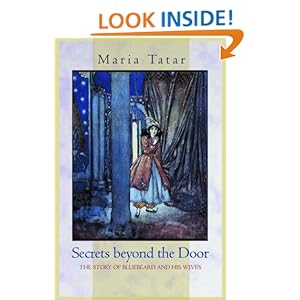
I had written way back in 2010 about how I had found authors alluding to fairy tale references in Jane Eyre, but I had yet to find a full explanation. I've picked up some more references over the years, including Maria Tatar's comparing Jane Eyre's use of fairy tales with Dickens, but in Tatar's book Secrets Beyond the Door: The Story of Bluebeard and His Wives I've found the most thorough discussion yet.
For this post I will assume my readers are familiar with the plot of Jane Eyre, so there will be plot spoilers. If you've never read it or need a refresher, you can brush up on wikipedia (or go read it right now!)

Tatar sees Jane as embodying three fairy tale characters primarily throughout her life: Cinderella, Beauty from Beauty and the Beast, and Bluebeard's wife. Jane grew up hearing stories and tales from her nurse Bessie, and alludes to fairy tales throughout the rest of the story.
Hilary Knight

In childhood, Jane is a Cinderella figure-persecuted by her aunt, who fulfills the stepmother figure, and her two female cousins (as well as a male cousin). Her adoptive family mistreats her, excluding her from activities and pleasures, taunting her and not keeping their dislike of her a secret. Yet "Jane, though initially compliant and self-pitying, takes a defiant stance and refuses to be framed and contained by the role of Cinderella." Jane stands up to her aunt, and with all the passion of a 10-year-old looking for parental love, accuses her of being a terrible guardian and tells her she hates her (Jane will be going away to school soon so this isn't quite as risky as it may seem).

After Jane's schooling, she hires herself out as a governess, where she will be teaching the ward of a Mr. Rochester. At their first meeting, both characters are reminded of fairies and fairy tales.

"When you came on me in Hay Lane last night, I thought unaccountable of fairy tales, and had half a mind to demand whether you had bewitched my horse; I am not sure yet. Who are your parents?"
"I have none."
"Nore ever had, I suppose: do you remember them?"
"No."
"I thought not. And so you were waiting for your people when you sat on that stile?"
"For whom, sir?"
"For the men in green: it was a proper moonlight evening for them. Did I break through one of your rings, that you spread that damned ice on the causeway?"
I shook my head. "The men in green all forsook England a hundred years ago," said I, speaking as seriously as he had done. "And not even in Hay Lane, or the fields about it, could you find a trace of them. I don't think either summer or harvest, or winter moon, will ever shine on their revels more."
By strongstuff on deviantart

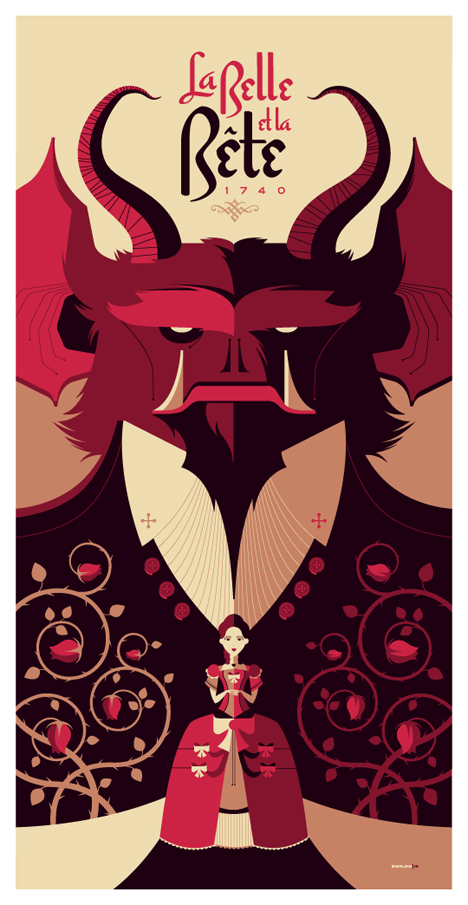
Next Jane enters into the Beauty and the Beast phase of her life. Although Rochester isn't especially ugly at this point, he is described at various points as "shaggy," "metamorphed into a lion," and "some wronged and fettered wild beast, dangerous to approach in his sullen woe." Although human, he is symbolically the wild and untamed man that society dictated must be tamed by a woman. At the end of the story Rochester asks Jane "Am I hideous?" to which she replies, "Very, sir, you always were, you know." Jane's bluntness is reminiscent of this conversation between Beaumont's Beauty and Beast:

"Tell me, do you find me very ugly?"
"Yes, I do," said Beauty. "I don't know how to lie. But I believe that you're very good."

At the end of the story, after Rochester is blinded and disfigured by the fire, he really does embody the Beast, and only then can Jane marry him. But first, she must go through her last fairy tale; Bluebeard.

Even Jane recognizes the connection between Rochester and Blubeard, and refers to the halls of Thornfield Hall as "Bluebeard's corridors." It doesn't take long for her to realize that Rochester and the other servants are hiding something from her, but unlike Bluebeard's wife, Jane shows little to no curiosity. Rochester calls her Eve, who often is symbolically linked to Bluebeard's wife, when she does ask a question, and afterwards she chooses to stay ignorant, which "reveals just how powerfully invested she is in suppressing her real curiosity and avoiding the fate of Bluebeard's wife."
Edmund Dulac

Yet of course, the secret of his first wife is eventually revealed. Rochester pleads with her to marry him anyway, but she will not be his fairy tale fantasy if it means contradicting her own moral code. She herself is skeptical of conventional fairy tale endings; she has contempt for tales that "promise to end in the same catastrophe: marriage" , and later reflects, "Human beings never enjoy complete happiness in this world...I was not born for a different destiny than the rest of my species; to imagine such a lot befalling me is a fairy tale-a daydream."

Yet, Jane's story does end happily, as Bertha kills herself, leaving Rochester available. Tatar concludes, "Jane remodels the fairy tales told to her in her youth and revises conventional notions of romance by producing a radically new cultural script...Making productive use of fairy tales by reacting to them, resisting them, and rewriting them rather than passively consuming them and internalizing their values, Bronte's Jane Eyre offers a map for reading our cultural stories and using them to reflect on individual identity, courtship and romance, and marriage."

Wood engravings: Fritz Eichenberg

Monday, October 13, 2014

What do we expect from Cinderella?

In my post discussing Jane Yolen's essay on how Cinderella was made increasingly more helpless and weepy as she evolved in America, a couple people responded in the comments reminding me that, historically, Cinderella wouldn't have had any other options than to accept her fate. This is absolutely true, and I've actually discussed Cinderella and her historical context quite a bit on here in the past year (Cinderella: A Progressive Victim?, What's With the Princess Hate? and Fairy Tales in Context), but it might seem confusing and contradictory if I seem to be jumping on and off the feminist bandwagon.

Often when people criticize Cinderellas for being passive, they don't actually give us an alternative for what they expect her to do. Sometimes I suspect they haven't really thought through the fact that older Cinderella figures would have few other options, if any, than to accept her servitude.
"Cap O'Rushes"-John Batten

Yet Yolen in her essay did remind us of folkloric versions (most notably "Cap O'Rushes") in which Cinderella does the unthinkable, leaves home, finds herself a new position and ends up gaining a husband and wealth. Because although historical context is important in understanding the world fairy tales came from, fairy tales are hardly restricted to being realistic. Fairy tales are full of characters who defy expectations and are rewarded.

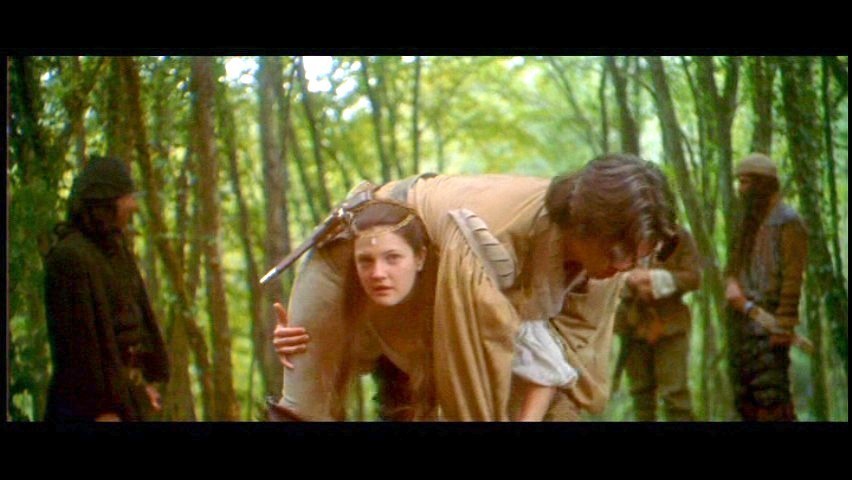
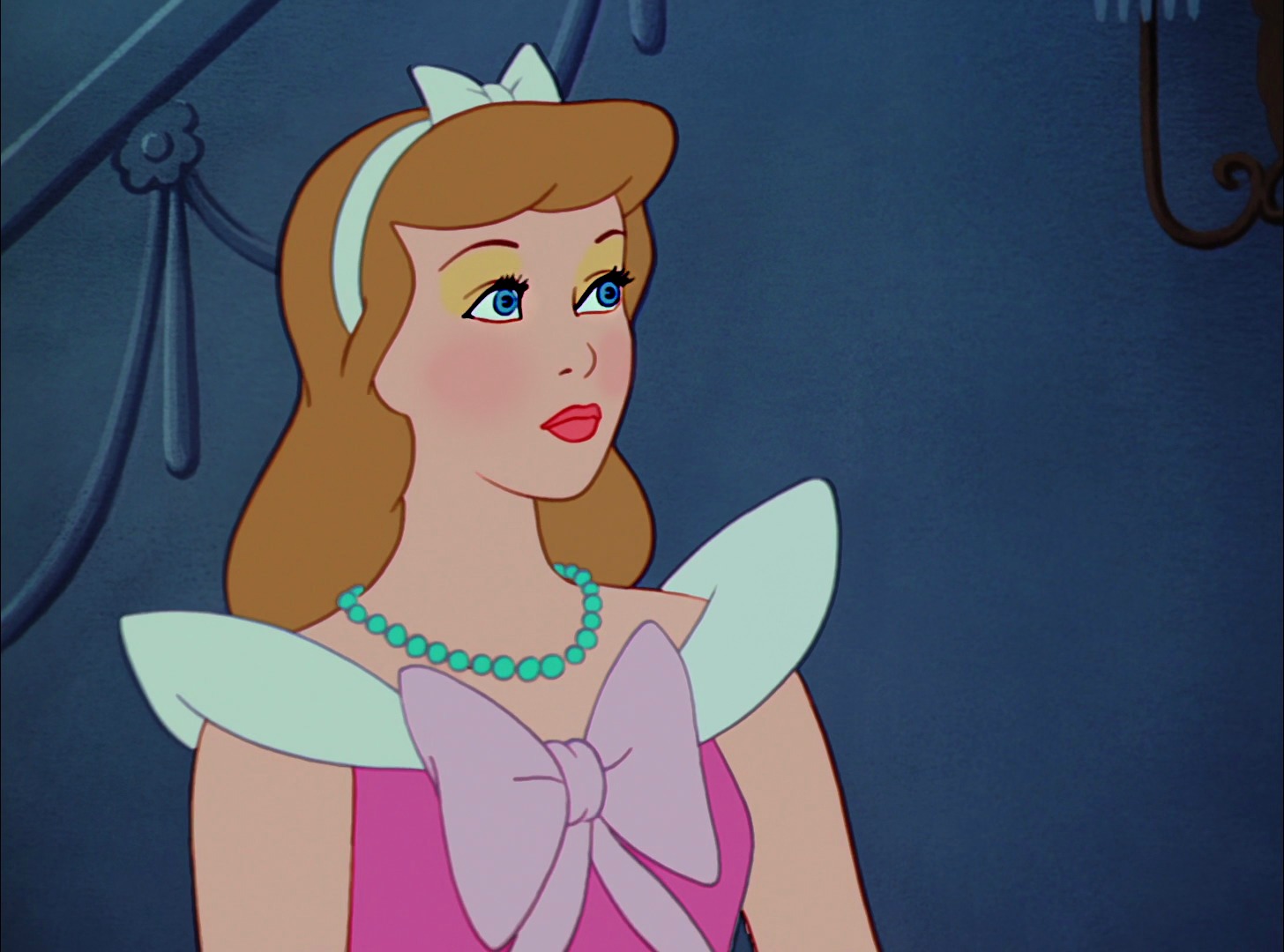
I think a good way to look at how we expect historical Cinderellas to act is by comparing Disney's Cinderella with Danielle from "Ever After". And I'm not bashing Disney at all-in fact his Cinderella reflects all of the storybook versions that had been published in the century previous and we can hardly have expected much different from any version made in the 1950s. So we can think of them in terms of Cinderella from the 1950s verses the 1990s.

In 'Ever After", Danielle still stays subservient to her stepmother until the very end. The one time she does lose her temper and tell her off, she gets a beating, which is, realistically, what would have happened in such a situation.

However, she is a much stronger character than the 1950s Cinderella. Danielle throws apples at someone who is stealing their horses, something I can't picture Disney's Cinderella doing. She's strong and smart, able to banter with the prince in one scene, and lift him up and carry him off from the gypsy camp in another. In the end, she grabs a sword and does rescue herself from that creepy dude. And most importantly (because throwing apples, swordfighting, and lifting princes is hardly the measure of true womanly worth), she is relatable to the audience. I had mentioned to someone in the comments a while back that I think Disney's Cinderella would be more understandable if you saw that she was hurt by her treatment, or a tear trickled down her cheek while she scrubbed her own floors. With Danielle, you can see her fighting her growing resentment and hurt-she shows emotion and we connect with her.
Danielle is an independent tomboy who shows a range of emotions

Disney's Cinderella seems not to mind being her stepmother's slave, until she is unable to go to the ball

In the traditional fairy tale, I'm not too bothered by the fact that Cinderella generally does her chores cheerfully. She has a lame job and a mean boss, which is something we can all relate to in some way, and doing things we don't want to do is just part of life. So if we take the story on a symbolic level, it's not as offensive.

But when you expand the story into novels and movies, Cinderella needs to show more evidence of someone who has undergone mistreatment. Although "Ever After" isn't the most realistic movie in the world, it's still fairly believable for Hollywood, and you can definitely see a huge difference in terms of how a more pro-feminist culture interprets Cinderella-someone who is still kind and compassionate, but also strong. Her courage makes her a good role model, even for those of us who could never in a million years win a sword fight against anybody or aren't considered tomboys.

Hopefully that clarifies things a bit! I'm still trying to sort through all the attacks against passive princesses myself, because while I think many feminist arguments go too far, there is obviously some value in what they have to say.


Saturday, October 11, 2014

Fairy Tales and Fear

An anonymous commenter recently wrote in response to my post on Fairy Tale Endings that people tend to forget, when criticizing fairy tales for being dark and violent, how dark much of classic children's literature is. And it's true-maybe not picture books on the whole, but I remember having a conversation with a friend years ago about how many children fantasize about being orphans. We see this trend in children's literature, as many childhood heroes are indeed orphans-from Hansel and Gretel in their parents' attempts to abandon them in the woods, to well-loved characters such as the Boxcar children, Mary of "The Secret Garden", or the children who enter Narnia (again not technically orphaned, but separated from their parents and I don't think any reference is ever made to their parents except to explain them away at the beginning of the books).
"Hansel and Gretel", John B. Gruelle

Partly, getting rid of parents is the only way to create a child-centered world; a realistic book about children would be pretty limited if they had to ask their parents for permission before going on spectacular adventures. Through orphaned characters, or characters whose parental figures are the enemy, the children can achieve independence and become the central figures of the story, moving the action along instead of responding to a world where all of their actions are dictated by parents and school teachers.
Dark Chamber of [Snow White's] Evil Queen, Tours Departing Daily

Fairy tales deal with our primal fears, such as abandonment, or being prey to wild creatures. G. K. Chesterton defended the scarier elements of fairy tales by saying, "All this kind of talk [of keeping fairy tales away from children] is based on that complete forgetting of what a child is like...if you kept bogies and goblins away from children they would make them up for themselves...One small child can imagine monsters too big and black to get into any picture, and give them names too unearthly and cacophonous to have occurred in the cries of any lunatic...fairy tales do not tell children the dragons exist. Children already know that dragons exist. Fairy tales tell children the dragons can be killed."

Well known authors have reflected on their remembrances of fairy tales in childhood-Samuel Taylor Coleridge remembered reading is father's copy of Arabian Nights over and over again, and how he looked at the book "with a strange mixture of obscure dread and intense desire." Charles Dickens recalled being terrified by his nurse's tales, yet returned to those same tales by alluding to them repeatedly in his works.

Michael Kotzin discusses Dicken's use of fairy tales in his essay, "Charles Dickens and the Fairy Tale as Social Commentary." He says that, in childhood, Dickens recognized the dual aspect of fairy tales-fun and terrifying-and reused those same ideas in his adult writings as he discovered that the real world was the same way. He saw horrors that were the natural, unavoidable way of things-disease and natural disaster-but also horrors that were inflicted by people, or society in general, and used fairy tales satirically to criticize political beliefs or groups of people.

Dickens used fairy tale images to make the ordinary extraordinary-in writing a personal letter about the beauty of the buildings in Paris, he tells a friend that "the Genius of the Lamp is always building Palaces in the night." Using fairy tales as a common frame of reference, his works can have a childlike wonder to them. But though he used fairy tales in fun, he also used them in serious ways at times, in making social commentary. He saw in fairy tales the potential to connect with real world scenarios. He "drew upon fairy tale motifs, narrative patterns, and fairy tale-type characters and settings to help people sense romance in the everyday world and grasp the need for moral improvement. His popularity then and now owes some legacy to the magic and mystery of the traditional fairy tale." (Remember, Dickens is the one who is often quoted as having wanted to marry Little Red Riding Hood as a child.)
William Christian Symons

But of course, you can go too far; you shouldn't push violent and gory stories at very young children. It's one thing for an academic to argue about the value of preserving folklore the way it originally was, and another thing for a parent to be awakened by a child who had a nightmare because of a story they read before bedtime.

But at the same time, fairy tales are wonderful because they provide us with different ends of the spectrum-the terror of tapping into our fears, but the wonder and enchantment of the supernatural, and the possibility of happy endings.

What are your recollections of reading/watching fairy tales as a child, in terms of how scared you were?

Wednesday, October 8, 2014

Jane Yolen on Cinderella in America

Harry Clarke

When I first saw Jane Yolen's essay "America's Cinderella," I wasn't initially interested, because I just recently did a post basically arguing with many of Jane Yolen's points on why Disney's Cinderella is a bad role model. But the essay expands the arguments and takes a look at older versions of Cinderella for comparison, which provides a bigger picture.

As I've mentioned before, if you look at a relatively recent version of a Princess tale, the story on its own usually isn't that offensive. A Cinderella that cries? That's natural and understandable. A Cinderella who is accused of doing nothing? You could say she's biding her time and waiting for the right opportunity (which is what we would probably assume about a male protagonist in the same situation), and for the record, her constant housework is actually really active. It's when we look at the history of a tale that we find patterns which are troubling. 
Gustav Dore

The English tale "Cap O' Rushes" is a Cinderella tale type, which features an incredibly resourceful heroine. When her father kicks her out of the house, she makes herself a disguise, offers her services as a maid, and of her own initiative and efforts goes to the ball in her finery, earning the love of the master's son. Even in Perrault's tale, although the fairy godmother is the one who provides the nice clothes, Cinderella is the one to suggest using a rat for a footman, and goes off to find it herself. Folklore versions of Cinderella very rarely forgive their stepsisters, but allow their punishment to take place without comment. This point makes me a little leery, because forgiveness is obviously a valuable and good trait, but the way it happens in Perrault's tale and many subsequent versions is definitely unrealistic. It's naive on the part of Cinderella to assume that her stepsisters would "never, never" be unkind to her again, after years and years of abuse.
Charles Folkard

But with the advent of books marketed specifically for children, Cinderella characters became weaker and weepier. In the 1870s, a children's magazine called St. Nicholas featured a Cinderella tale in which the character is crying and prostrate, who must be "aroused from her sad revery" by the godmother. When she does meet the prince, she "speaks meekly" and "with downcast eyes and extended hand."

Chapbooks and other children's storybooks over the next decades continued in this trend. Cinderella was increasingly represented as crying and doing nothing else to help herself. Any creative thinking and action disappear entirely. Yolen even states that, although the chapbooks changed all the tales, Cinderella was the most dramatically different in her transition from folklore to print.

Herbert Cole

A quick point about Disney: especially after reading feminist critiques of his movies, we tend to picture him and his team of old, white men gathered around a copy of the Grimm's or Perrault's stories and saying, "Nope, scrap this-we can't have a woman so active, we need her much more passive." Fairy tale scholarship was not what it is today back in the 1950s-who knows what his sources were? Even collections of Grimm tales you find in bookstores today may be inaccurate translations, with misleading illustrations (for example, doesn't Cinderella in the Folkard illustration above look way too happy to be tying her stepsister's sash? That was from 1911). Disney and his team would have been familiar with the versions that were in print at the time which claimed to be from Grimm and Perrault but were much altered. No, Disney wasn't the most forward in terms of gender roles, although he did try to hire a man to make Cinderella more politically correct, but he caved to his team and the gender-forward ideas were never used.

Also, correct me if I'm wrong, but although Yolen only cites American Cinderellas, I believe the tale followed this same pattern in Europe where the heroine becomes more helpless when published in children's books, during the same time period.

Monday, October 6, 2014

Alan Dundes on the Dangers of Ignoring Oral Folklore

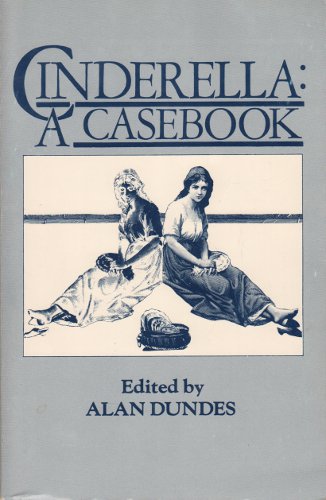
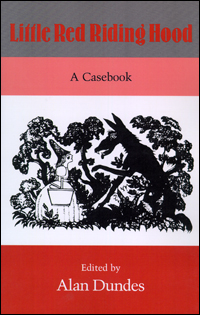
Alan Dundes is the author of two fairy tale Casebooks, one for Cinderella and one for LRRH. The Cinderella one was at my hometown library, and one of the first fairy tale books I read-it was eye-opening to be able to read multiple essays and articles on Cinderella, representing all of the major ways of interpreting the folk tale.

In his essay "Studying the Fairy Tale," Dundes warns about the tendency to only study fairy tales from the brothers Grimm and Perrault. True folktales are orally circulated, therefore any written tales are "only a pale and inadequate reflection of what was originally an oral performance...from this folkloristic perspective, one cannot possibly read fairy tales; one can only hear them."

Sure, there are differences between fairy tales being told and being written and read, but written tales allow us to preserve and spread them much easier. However, when it comes to the traditional fairy tale collections, we have tales that were manipulated and changed, multiple variations spliced together, or chunks added or removed just to please the audience. The issue is that many scholars tend to only analyze these most popular versions of fairy tales, ignoring the folk variants that exist. Thus people too often come to the wrong conclusions when focusing on details that aren't essential to the tale type itself-such as pumpkins and glass slippers in Cinderella, or analyzing the significance of the color red in Riding Hood's cloak.
Herbert Cole

To really understand a tale, its history, how it is shaped by culture and how it shapes culture, you really have to look at multiple versions. However, a major issue is availability. Dundes suggests that you "simply apply" to one of the archives that contain vast collections of unpublished folktales; the majority of tales collected by folklorists over the last centuries remain unpublished (at least in 1986, when he wrote this essay). However, that doesn't really seem feasible unless you're a very serious folklore student, not a blogger doing this as a hobby, or someone mildly interested in learning more about fairy tales.
Fortunately for us, there's the Surlalune book series which collects variants from around the world, as well as the Schonwerth collection. There are, of course, other books of collected folk tales, but if you go to any library or bookstore, you'll find the majority of writings on the Grimms, a little on Andersen and Perrault, virtually nothing on the French salon writers or earlier Italian writers, and very few collections of lesser known tales. To the right you can follow my tags for African, Native American, European, or Asian folklore, but there are relatively few of those compared to information about the Grimms or standard tales. Again, I can only read what's available on the internet, libraries, or reasonably priced books on Amazon-and I do try to keep in mind what readers might find most interesting. Psychologically, people will be more motivated to learn, and more likely to remember, something they already have a mental framework for; that's partly why artists and authors return again and again to the same, standard set of fairy tales.

Plus, it's helpful to have a common frame of reference. You could pull two stories which are technically Cinderella variants but have little in common; it would be very hard to have discussions without forming some sort of "standard" versions that are well known, as long as we avoid calling the Grimms' stories "the originals." 
Edmund Dulac

Clearly, there's danger in remaining ignorant about fairy tales and their sources, but Dundes uses some pretty strong, opinionated language to describe people who only use standard literary collections as their source-they are "deluded individuals who erroneously believe they are studying fairy tales when they limit themselves to the Grimm or Perrault versions of tales." 

The fact is, one of the great things about fairy tales is that they belong to the People. The tales told by peasants around a fire or over household chores are the true folklore. Yet, although the Grimms obviously changed their tales, Dundes also acknowledges that folk tales come in hundreds of variations; no two tellers would give word-for-word the same version of a story. So, among oral tellers and literary writers, change is an integral part of these stories. Just as the Grimms altered their versions to suit their audience, the people who told the stories to them had also changed the stories according to what they remembered, their own personal preferences, and their audience. In fact, those tales that he lauds as true folklore (that were told to the Grimms) were very influenced by the literary tales of Perrault, which had become well known and spread around Europe by the time the Grimms collected their stories, and many of the tales are likely descended from those literary tales. 


Going further back, the tales of Perrault had been told and retold but many of them originated in the literary sources of the Italian writers, Straparola and Basile. (Read more on these Italian writers' influence on fairy tales from Ruth Bottigheimer's theory about the origin of fairy tales). Those stories were influenced by other literary works, and some motifs can be traced back to mythology, which we only know because many myths were written down. It gets very sticky to say that no written tales are true fairy tales, and that oral tales are "better" or "more authentic." There is no clear source, but we know fairy tales have a pattern of being shaped by writers, then the public, then back to writers, in a continuing cycle.

Still, it's important to remember that there is a whole world of fairy tales beyond the Grimms and Perrault (and Disney for that matter), and the variants that were told orally can be surprising to those who only know the most famous fairy tale versions.

Saturday, October 4, 2014

The Runaway Princess

This isn't a new book, but a student of mine had brought Kate Coombs' "The Runaway Princess" to her lesson the other day and of course it caught my attention. She described it as "a mixture of Brave and Rapunzel"-the main character resists arranged marriage and as a result is trapped in a tower.
Rapunzel image by Ellyn Lusis

This excerpt gives us a taste of the book-clearly the heroine is a more modern, feminist-approved and active Princess, although the dialogue seems aimed towards younger readers:


She went to the window again and leaned over the ledge. Below her she could see the pale top of someone's head. Hanak had black hair like Dilly's. "Hello," she called.
      Whoever it was stepped away from the tower wall. "Nort?" Meg said, shocked. "What are you doing down there?"
      Nort held up an oversized spear. "Guarding you. What does it look like?"
      "You are not my guard!" Meg cried.
      "Am too."
      "Are not."
      "Am too."
      Meg paused. "Where's Hanak?"
      "He's busy at the castle," Nort said. "You've got me. Royal orders."
      "I'll give you a royal order, Nort the Short," Meg announced. "Go shoot yourself in the knees with a crossbow!"
      Nort laughed. "Come down and make me."
      With a furious strangled noise, Meg withdrew into the tower. She took a deep breath and surveyed her new domain. There had to be a way to get out of this place.

Seems cute-has anyone read this? Available for Kindle or in hardcover. There is also a sequel, The Runaway Dragon. It features fairy tale elements such as magic carpets, as well as the cast from  Runaway Princess.

Wednesday, October 1, 2014

Sunday, September 28, 2014

Fairy Tale Endings: Happy, Bittersweet, Tragic

Roland Risse

Fairy Tales are often criticized for being simplistic, and for providing unrealistic happy endings. Of course, when you begin to familiarize yourself with more fairy tales, you realize this simply isn't true in all cases; however, many of the most well-known fairy tales do end happily, and happy endings remain true to the "fairy tale formula."
John Batten, "Tattercoats"
Beloved stories like "Cinderella," "Jack and the "Beanstalk," "Sleeping Beauty," "Frog Prince," and so many more end in the most traditional way: usually a wedding, while the villain gets punished. Yet even among the favorites, there are exceptions. There are unhappy versions of Cinderella (see here and here), Andersen originally wanted his Little Mermaid to end with her death and had to adjust the story to please his editors, Perrault's "Little Red Riding Hood" is eaten at the end.

Yet still, fairy tales that have become popularized are predominantly happy.

Kay Nielsen

But the "happily ever after" stories aren't the only form of fairy tales. There's another category I would call "bittersweet." Although there is a form of resolution at the end, it isn't perfect; there is still some physical evidence of trauma left after the story is done. For example, in the tale Juniper Tree; while in the Grimms' version the bird is transformed back into a boy, in other versions, such as the English The Rose Tree or the Scottish "Pippety Pew", the child remains a bird. But they aren't completely tragic stories; the bird is a beautiful creature, who sings a song which reveals the truth, rewards the kind father and daughter, and kills the evil mother. There is still life after tragedy, but the life is different than it was before. There's a sort of comfort and realism in this fact-it's not an empty assurance that things will be fine, but hope that a horrible situation can be redeemed.
Eleanore Vere Boyle

Another fairy tale with a bittersweet ending is "The Wild Swans." The princess is united with the good King and her brothers transformed back into humans-all except the last one, who will forever remain with a wing for an arm; a reminder of their enchanted state, and the fact that curses will often have consequences. Andersen's "Little Match Girl" is another very sad tale in which the Match Girl dies, although the story makes it clear that her life is very unhappy, and in her visions she sees her Grandmother welcome her into Heaven, so even in that unfortunate tale, there is hope.
Anne Anderson

Then, there are the fairy tales that are completely tragic. You won't find these in collections of children's tales, but they abound in the collections of Schonwerth, the Grimms, and Andersen. Hans Christian Andersen just loves to feature helpless creatures with no control over their destiny; besides "Little Mermaid," which I mentioned before, "The Steadfast Tin Soldier" ends with him being burned in the furnace. Throughout the whole tale, he never makes a move or utters a word to help himself; I like to think Andersen was playing on the fact that, while he might have had feelings, at least in the eyes of the child who played with him, he was, ultimately, a toy; incapable of actually doing anything to defend himself.
Kay Nielsen

Along the same vein, a random little story of Andersen's called "The Money Pig" is about a toy piggy bank. After describing some of the games the toys played in the nursery, the money pig falls off the shelf, shatters, and his pieces are swept into the dustbin. The tale leaves you with no sense of purpose or hope.

Of all the tales I've ever read, I still think the creepiest is the Grimms' "How children played Butcher with each other." It's not just that there's a tragic death, which happens in other tales-but there's no villain or motive; it's just children being shockingly ignorant and cruel.

Many of the stories in Schonwerth's collection weren't meant as much to entertain, but to warn people about local superstitions. You might find stories about certain events which were interpreted as foretelling doom or death; warnings about how to recognize Drudes or witches, or stories such as "Death of a Woman in Childbed" in which a woman dared to comb her hair after giving birth, on a Sunday while everyone else was in church, and died because of her unbelief. Or this other, very short and sad tale, "Till Death..."

"A girl had committed herself to being eternally faithful to her beloved; he died serving in the war, and she began a new relationship. One night, her former beloved appeared on a white horse and took her away to his grave where she was found dead in the morning."


Edmund Dulac

I think there's a place and purpose for each kind of tale. Sometime we just need an escape: a happy, predictable tale to comfort or give us hope. Other times we want a little more realism, and sometimes we want send warnings, or just to be a little scared, which is a form of challenging ourselves/having fun with friends and giggling at ghost stories. It's unfortunate, though, that few people realize the spectrum of fairy tales that are out there; some people think fairy tales are too violent and old-fashioned and unsuitable entertainment for children; others think they're too simplistic and perfect, and not realistic enough. But whatever your preferences and purposes, there's always some fairy tale, in some version, that could be helpful.