Wednesday, June 18, 2014

Heather Dixon's Entwined

I recently read Jessica Day George's Princess of the Midnight Ball because I wanted to read more interpretations of "The Twelve Dancing Princesses". I reviewed it and overall found it a light, fun read, pretty much true to the fairy tale but giving an interesting explanation for how the curse came to be.

In the comments, reader Claudia McCarron recommended I check out Heather Dixon's Entwined. It would actually be really interesting to compare and contrast the two novels, they have a lot in common while each takes unique approaches, but I won't give away spoilers or go too much into detail with an audience that hasn't necessarily read either book (although feel free to comment below for a more in depth discussion on either book if you wish!)

The book summary:
Just when Azalea should feel that everything is before her—beautiful gowns, dashing suitors, balls filled with dancing—it's taken away. All of it. And Azalea is trapped. The Keeper understands. He's trapped, too, held for centuries within the walls of the palace. So he extends an invitation.
Every night, Azalea and her eleven sisters may step through the enchanted passage in their room to dance in his silver forest, but there is a cost. The Keeper likes to keep things. Azalea may not realize how tangled she is in his web until it is too late. "Readers who enjoy stories of royalty, romance, and magic will delight in Dixon's first novel."—Publishers Weekly
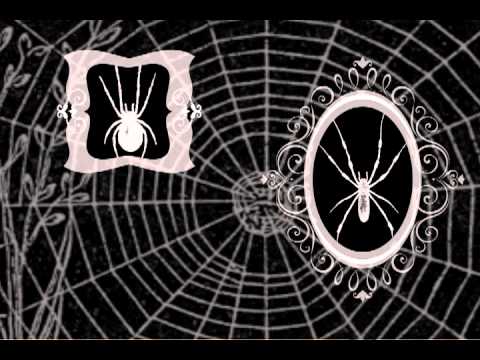
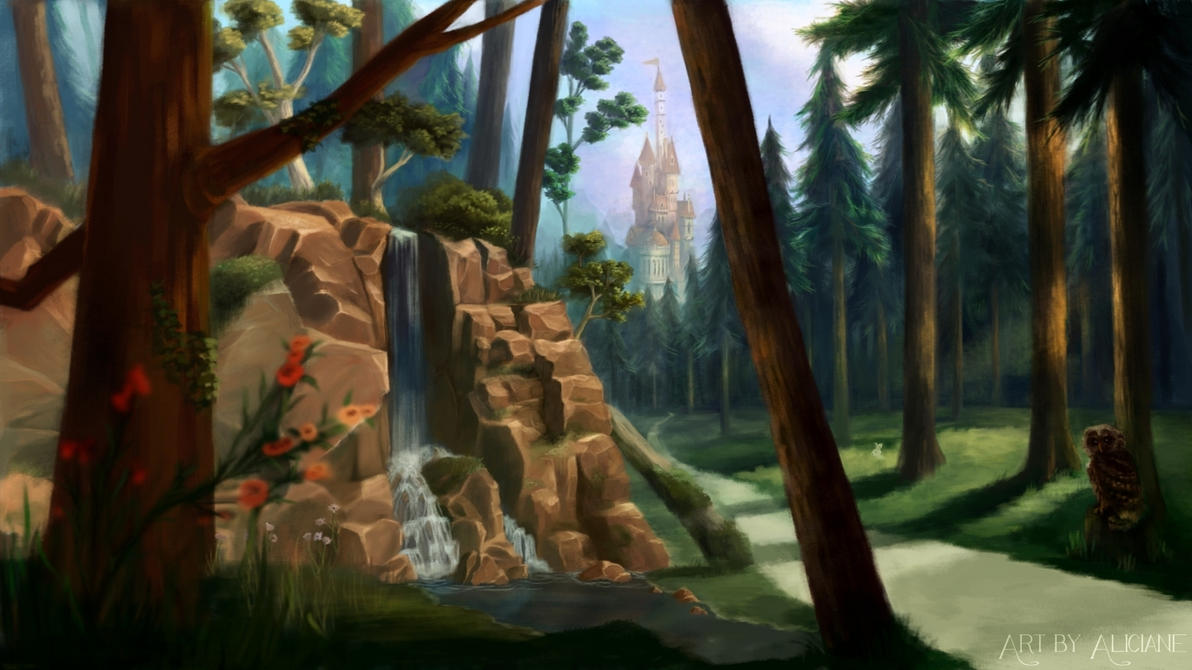
Image from the book trailer

Whereas the fairy tale usually begins after the Princesses have already been going to the underground Kingdom for a long time already, the most intriguing part about this book was that it showed how the sisters discovered it, and why they became trapped in such a dangerous place. It includes a magical history of their castle that is quite dark, but the book also explores familial relationships at the same time we're unraveling the mystery, which gives it added depth.

In my opinion, the weakest part of the book is the final sequence. It became really confusing, and I'm not actually sure what happened to the villain. To be fair, it's incredibly difficult to create a world of magic with structure and consistency.

Overall though it was a really interesting read. It's a little more creepy and complex than Princess of the Midnight Ball, so good for slightly older readers, although they're both categorized as young adult novels.  Also, it appeared to me (from my little knowledge) that Dixon had done research into court dances of Europe, and fun fact-she has four brothers and six sisters. So she more than most of us has an idea of what it would be like to be raised in a family so large.

Any opinions on either book? Any other recommendations?

Monday, June 16, 2014

Stubbe Peeter: Werewolf Trials and Little Red Riding Hood

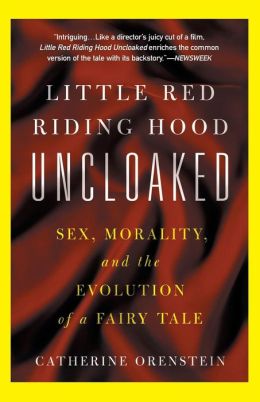
You could call the story of Stubbe Peeter (also known as Peter Stumpp, among other names) a loose Red Riding Hood variant. However, I think the real reason Catherine Orenstein included it in her Little Red Riding Hood Uncloaked: Sex, Morality, and the Evolution of a Fairy Tale, is because it really helps us understand more of the historical context of those who would have been telling and hearing some of the first versions of one of our most beloved fairy tales.

Despite the more common modern interpretation (and when I say "modern" that means the last several hundred years) of LRRH being a cautionary tale about sexual predators, it's likely that the story originated with a more literal intent. In the regions of France where folk LRRH variants were most prevalent, were also the regions where werewolf trials were most common in the medieval age (read more on what I learned about this from Jack Zipes here).

According to four witnesses and "divers others that have seen the same," Stubbe Peeter was a man greatly inclined to evil, so much so that the Devil gave him the ability to transform into a beast. He could become a wolf at will. He had unnatural relations with his own daughter, conceiving a child through her, and took delight in killing that same child once he had grown. 
Image from here-artist/source ???

He killed and destroyed numerous other people and livestock. The inhabitants of nearby towns would find limbs of dead women and children scattered among the fields.

In one reported instance, the wolf attacked a little girl. He meant to grab her throat, but because of the clasp of the child's coat around her neck, he could not kill her. By this time other people had come to frighten the wolf away and the child remained alive.

It's that last part that possibly links Stubbe Peeter to the tradition of Little Red Riding Hood tales and not just another werewolf story-the significance of the coat, and the fact that a young girl of all people was able to escape the clutches of the evil wolf. 
Amber Kenneson

Wolf attacks were rampant in certain rural areas of Europe, as was the belief in werewolves. The Court of Dole had procedures for a wolf sighting: all the villagers, when they heard the alarm, should gather together at the church, and take note of who did not show up-with the assumption that the one missing was under suspicion. Courts of the 16th century regularly sentenced men to death on the accusation that they were werewolves. Both Orenstein and Zipes list specific names of other men who underwent werewolf trials, but the crazy thing is, the records show that they confessed to the crimes of killing and eating animals, children, and babies. 

The fact of their confessions shocked me initially, until I noticed this phrase referring to the unfortunate Gilles Garnier: "confessed without torture." Sadly, fear and not a desire for truth and justice had the power in many courtrooms-men arrested and accused of being a werewolf would be tortured until they confessed (the same went for witch trials and women). Many probably figured, if they were going to be killed either way, they might as well minimize their torture and confess.

Lukas Mayer: Woodcut of the execution of Peter Stumpp

Orenstein also presents a very interesting theory toconsider: in some old English variations of the tale, the wolf is called a "gaffer" wolf, a word that is could simply mean an older person, but was often used to mean a relation. The word may be referring to incest, which was a common accusation at werewolf trials. If we understand the wolf to be Red's own grandfather, this could explain why she seems to have no suspicion and fear when she finds him in her grandmother's bed.

This version is so different from current ideas of LRRH and the wolf it almost makes me angry to scroll through image after image of cute little wolf dolls and toys:

In the words of Catherine Orenstein, "Such spectacles and stories provide a clue to the mental landscape of the past shared by those who told stories on dark winter nights around a fire, with perhaps a wolf or two howling in the background. Fairy tales are far from the reality of the modern reader. But to a sixteenth-century peasant, such plots took place just outside the door. 'Little Red Riding Hood' was not a frivolous fable but a direct warning from a true story. Her villain was real-maybe even a neighbor."

Friday, June 13, 2014

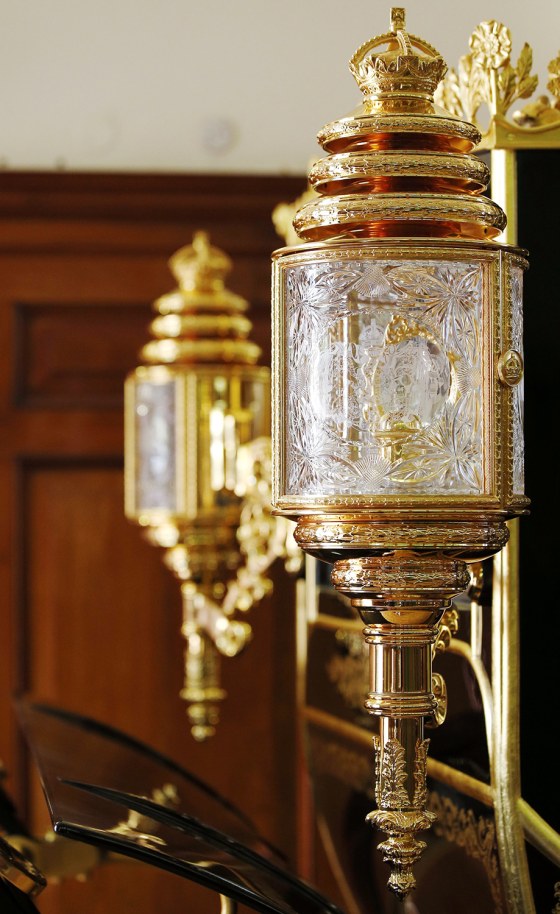
A Real Life Cinderella Carriage


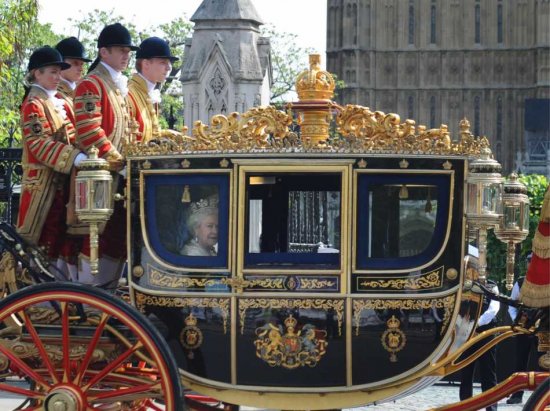
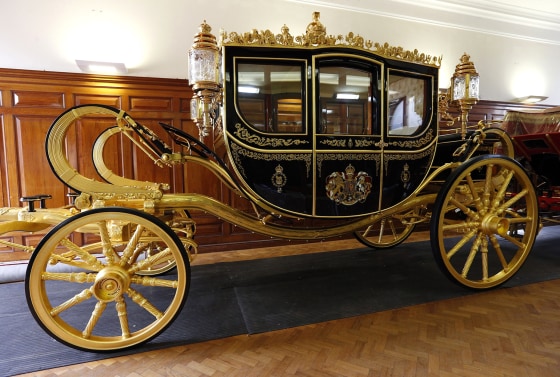
My sister was telling me about the Queen of England's new carriage and I couldn't help but think of Cinderella. It's hard to believe that the old fashioned transportation is still used today, if only for rare occasions.
From today.com
[Designer/builder Jim] "Frecklington used more than a hundred pieces of British history to decorate the interiors and exteriors of the carriage, including fragments of Henry VIII’s warship, the Mary Rose, and Lord Nelson’s ship, the Victory, as well as pieces of wood from Westminster Abbey, St Paul’s Cathedral, Kensington Palace, and even a supposed piece of Sir Isaac Newton’s apple tree. But it also contains modern history in the form of wood from the royal yacht Britannia, on which the queen traveled many times before it was decommissioned in 1997."

The carriage cost about $4.5 million to build and would be worth twice that if sold.  It was funded entirely  by Australian government grants and personal loans (Frecklington is Australian). .
Edmund Dulac

Wednesday, June 11, 2014

How Disney Parks Affect How We View Fairy Tales

I'm back! The trip was fantastic. Exhausting, as I expected, but totally worth it!

After some days of performance we spent a very anticipated day in Disney World's Magic Kingdom. If you think about it, the experience of Disney Parks-from the rides to the shows and characters-are really just a different way of storytelling. In high school I watched Disney's "Snow White" and realized that, if I had ever seen it before, it was so long ago I barely remembered it. But I thought I had seen it-I was familiar with the characters, music, and basic plot. Such is the effect of riding the ride, seeing the characters march by in parades, looking at the merchandise, etc.-viewers are still familiar with the Disney versions of fairy tales even if they've never seen the movie. The rides are such a short, truncated version of the Disney movies-they remind you of the major scenes of the movie in five minutes or less, keeping that specific version prominent in your mind, especially if visitors to the park aren't regularly reading/watching other versions.

The last time I was in Disney World was five years ago so I got to see the new Fantasyland addition for the first time. And as a lifelong Beauty and the Beast fan, it was incredible to see scenes from the movie in life size.


We got to eat in the Be Our Guest restaurant, which allows you to dine in either the library (which looked nothing like the library in the movie, didn't even have any books), the West Wing, or the ballroom. We also walked through the hall of armor and got to take pictures by the stained glass window.

I was thrilled that my buddy for the week was my very good friend Christy, a 17-year old young woman with Down Syndrome, who was actually the junior bridesmaid in our wedding. Long time readers may remember some of her fairy tale artwork or when I blogged about the experience of watching Disney's Sleeping Beauty with her and her reactions. 
Two Beauty and the Beast illustrations done by Christy for me in years past

One thing that was new to me this trip was the whole experience of meeting characters. It was never something my family was really into (the picture of me with Belle and the Beast is an exception). They train each actor with knowledge of the movie they are in, having them mention trivia about their character during your visit, so it  really enhances the feeling that they are real characters with a life even beyond their Disney movie.

Meeting the princesses and heroes was fun for the students in our group, but I really enjoyed visiting Gaston. First of all, we weren't actually in the line, his shift was almost over, so we were just watching. But he saw two adorable girls with Down Syndrome, one in a wheelchair, and when he was done with the people in the line, he came over to us and brought our students over to him! In general the cast members at Disney seem to have a soft heart for people with disablities, but a special thank you to Gaston!

Christy asked him why he was so mean to the Beast. Gaston replied that he wasn't mean; he was the nice one (because he had a nice face). He also had this whole theory-which is actually something that fans and critics of the movie have brought up before-that the Beast was really an imposter, because where did he come from? If he was the Prince, where were his parents, i.e. the reigning King and Queen? How is he a Prince if he apparently has no kingdom? He also called the Beast Belle's dog, and twice insulted my shirt, saying it was horrible:
I was wearing this tank top from Hot Topic last year, no longer available

Hearing Gaston's point of view was interesting for me, and really made Christy think. The rest of the day she kept asking questions, "Why did he say he didn't like your shirt? I don't understand" (even after repeated attempts at explanation) and "Why did he call the Beast a dog? Is the Beast a dog?" She struggles a bit with abstract thinking, but that's what's so great about exposing kids to the fact that, while he might be lying, Gaston would have a different point of view than Belle or the Beast. Christy was great though, continued to challenge him, and when Gaston was showing off his muscles she whipped out her own biceps:

Then, the highlight of the trip: meeting Elsa and Anna. So, Christy has loved Sleeping Beauty for years, but like most other young girls has become OBSESSED with Frozen lately. She knows all the words to all the songs and will tell the plot of the movie, in depth, to anyone who will listen (as well as those who are tired of listening...). So we knew we had to use our fastpasses to skip the three hour line (!!!) to see the characters. 

Now I'm pretty sure Christy doesn't think the characters are actually real, she will ask which people do the voices for some of her favorite cartoon characters and she's seen different plays so she's aware of the concept of actors playing parts. But even if she logically knows, partly, the characters aren't the ones from the movie, she takes them very seriously. All day long she was practicing what things to say to Elsa-she was going to tell her she was her favorite Queen because she has powers, she loves snow, and all her favorite parts of the movie. When it was finally her turn, she excitedly greeted them each by name like they were long lost friends, and ran up to Elsa and gave her a hug. It was so precious I was actually crying as I was snapping pictures...

Here is Elsa noticing her own face on Christy's shirt:
 Anna noticed that Christy also happens to have a gray streak of hair, and was very excited, jumped up and down and said, "we're twins!" Christy LOVED it, the rest of the evening when we saw people from our group she would tell them, "Guess WHAT!! We saw Elsa and Anna, and she saw my HAIR!! We're TWINS!!!"

 I can only imagine what effect this kind of meeting has on a child afterwards. If they were already fans of the character, now he or she will go home and be even more connected to the movie. Christy now has a personal connection with her heroes, who called her by name and noticed similarities between them. She also got a souvenir Frozen storybook from the gift shop and was showing it to everyone, and the next day poring over it in the airport.

And unfortunately for us, meeting the characters in a believable way makes it even harder for kids to accept that the Disney version of a fairy tale is NOT definitive. I didn't bother trying to tell older versions of the fairy tales on this trip; with this audience of mostly concrete thinkers it would be more confusing than anything else, and I didn't want to ruin their special day. Although another day of the trip we were on a lake that had several swans swimming, and Christy was very excited, saying, "It's Swan Lake!" (she's really into ballet too) and we named all the white swans Odette and the black ones Odile.

I'd love to hear from other people-how have your experiences in the Disney parks affected you/young people of your acquaintance, especially in how you thought of fairy tales?

Monday, June 9, 2014

Debussy's Sirens


The third of Debussy's Nocturnes, "Sirens." When I heard this my first thought was sirens, but I'm also aware that my brain is now kind of wired to connect anything and everything to fairy tales and fairy creatures. I was happy to find that in this instance I was right!

This otherworldly and beautiful piece would be the perfect music to accompany reading fairy tales  (not just siren tales!).

Saturday, June 7, 2014

Fairy Tale Fun Facts: Some word definitions

"The term 'Rumpelstiltskin' is a combination of the Middle German 'rumpel', meaning creased or wrinkled, and 'steln', to obtain by illegal means. Adding the suffix kin, signifying small, results in a description of a little man who is 'a wrinkled dwarf that acquires things illicitly.' "

-The Witch Must Die: How Fairy Tales Shape Our Lives by Sheldon Cashdan
Charles Folkard

I don't believe I had heard this before, I always assumed the name "Rumpelstiltskin" was a nonsense word, like his British counterpart Tom Tit Tot and the Scottish Whuppity Stoorie, etc. (He has also got by Trit-a-Trot, Terrytop, and more difficult names such as Holzruhrlein Bonnfurlein or Ferradiddledumday-see a list of related tales at Surlalune)

Adrienne Adams

And although it can be confusing when talking about Snow White from "Snow White and Rose Red" verses the more famous Snow White of the Seven Dwarves variety, in German their names are not actually exactly the same. The Snow White who ends up in a glass coffin is actually "Little Snow White" from the German Schneewittchen. The one with sisterly affection has a slightly different meaning, "White as Snow." (Found in Fairy Tale Rituals by Kenny Klein)

EDIT: Apparently my sources may not have been exactly correct in these above factoids-see the comments for more


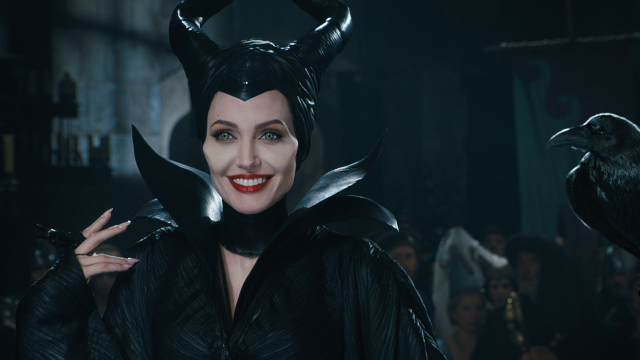
It may be gone by the time this is posted, but right after the release of Disney's "Maleficent", Dictionary.com opened up its main page with a featured link, "what does Maleficent mean?" The definition:

ma·lef·i·cent

  [muh-lef-uh-suhnt]  Show IPA
adjective
doing evil or harm; harmfully malicious: maleficent destroyers of reputations.
Origin: 
1670–80;  back formation from Latin maleficentia maleficencesee -ent

maleficent, malevolent.

I think I always thought it was a combination of "magnificent" with "malevolent."

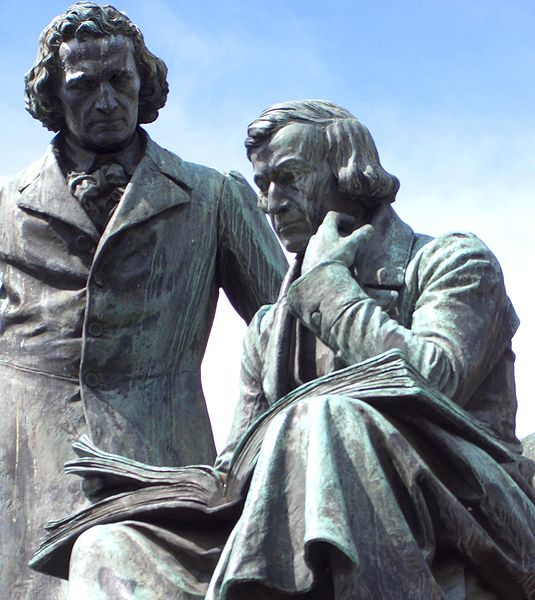
Sculpture by Syrius Eberle; monument to the brothers Grimm in Hanau, Germany

And last but not least-Tony once asked me if our  English word "grim" came from the brothers Grimm. I hadn't thought so but it wasn't out of the realm of possibility. However, again according to Dictionary.com, the origin is from old English, before 900. So the last name of the famous brothers was just a coincidence, but heaven knows there are plenty of puns to go around :)

Thursday, June 5, 2014

Disney Bound!

The time has come-Tony and I are leaving today on the trip I mentioned  a few weeks ago to participate in Make em Smile!

I've scheduled a couple posts to go out while I'm gone, but just wanted to let you know I won't be active in the comments for about a week. If I have any interesting stories from Disney World and how the students on the trip interact with fairy tales there I'll share when I return!


Tuesday, June 3, 2014

Fairy Tales in Castle: Part II

"Maybe all of this is a sign-a sign that ours is a great love story. 'Cause what's a great love story without obstacles to overcome? Every fairy tale has them-terrible trials that only the worthy can transcend. But you can't give up."

From the season finale of ABC's Castle, currently available on hulu. Kate Beckett is mourning that everything they've planned for their wedding seems to be going wrong, and Richard Castle assures her with the above words. I think this is possibly the only pop culture reference to fairy tales I've heard (not including fairy tale themed shows and movies) that doesn't speak of fairy tales as trite children's stories where everything is perfect, but actually acknowledges the fact that, before the happy ending, the characters go through some horrific and traumatic stuff. Perhaps all the recent darker versions of fairy tales that have come into the mainstream are finally helping people to think about fairy tales in a different light?

Later in the episode, Castle and Beckett find themselves tied up (don't worry, that wasn't too much of a spoiler if you were still planning on watching), and they have this conversation:

Beckett: Please tell me this is a fairy tale...
Castle: Looks like the Grimm kind.

Ha! Love the reference and of course the pun ;)

This is the second time this show has been featured here on Tales of Faerie-in 2012 they had a fairy tale themed episode, Once Upon a Crime. (EDIT: the third time-Surlalune had caught an episode that clearly  referenced Goldilocks a few years ago) Perhaps we have kindred spirits in the writing team who also have a respect for fairy tales?

Monday, June 2, 2014

Schonwerth's Fairy Tales: Witches


The region from which Schonwerth collected his fairy tales was one where many witch trials were held and women were found guilty and burned. Although most of these trials were held during the 1500s and 1600s, they continued into the 18th century. The last woman to be sentenced to death as a witch in Bavaria was Anna Schwegelin in 1775. Really not that far back in history, relatively, especially when you consider that Schonwerth was born only 35 years later in 1810, and the first edition of the Grimms collection was published only 2 years later, in 1812.
"Snow White and the Seven Dwarfs," A.H. Watson

So that really affects how we read many fairy tales that feature witches, especially from Schonwerth's collections. Many of them were passed down from generations ago when belief in/fear of witches was widespread, and these fairy tales were often told as histories or warnings. They seem to me like letting people know what attributes to be on the lookout for to identify people as witches.

Another interesting thing about the stories in this collection is that they are challenging my perception of concluding that the outcome of a fairy tale is either a reward or a punishment for the actions that preceded it. Scholars and bloggers alike use thinking along these lines all the time-we bemoan the fact that females like Little Red Riding Hood and Bluebeard's wife are punished for being curious while male protagonists are rewarded, etc. (and in many versions, that moral is clearly spelled out, even if it wasn't necessarily intended in folklore). But this collection presents groups of stories with similar plots but opposite outcomes.
John Batten, "Johnnie and Grizzle" (a Hansel and Gretel tale)

For example, there are two stories that begin almost identically. An innocent woman comes to the house of a person who, unbeknownst to her, is really a witch. She is disturbed to see objects and tools moving around on their own, under enchantments, hardly believing her eyes at first. Finally she reaches the witch, spotting her holding her head in her hands (in the other version the witch is wearing a skull instead of a head). The woman asks the witch about all the strange things she saw-pitchforks fighting, doorbell pulls that are snakes, etc. The witch claims that those were natural things, as if the woman was just imagining things. But when the woman reveals that she also saw the witch herself either holding her head or with a skull for a head, the witch becomes angry, and threatens to rip her apart.

The first version ends suddenly-the witch does exactly as she says and rips her apart. My initial thought was that the story was a warning against either approaching a witch's house if you see enchanted objects, or to not be foolish enough to reveal to the witch that you know what she is. But in the second version, the woman is rescued at the last minute (alas, by three male hunstmen), who shoot the witch, and the servants who had been turned into pitchforks were released. So in that version, if the woman hadn't come and revealed the witch's true nature the servants would still be under a spell.
Anne Andersen, "Rapunzel"

So maybe folktales and fairy tales aren't meant to be a guide for life as many people have thought-they simply represent the fact that you never know what's going to happen, just as in life you can never be sure of the outcome of your actions. Over time we as a culture have pretty much weeded out any folklore that doesn't end happily and we have a skewed version of what fairy tales promise (only happily ever afters) or how to go about thinking about what they mean (that the one version we know as "standard" is the true meaning and that we are meant to learn the same lessons as the main character).

Arthur Rackham, "The Thirteenth Fairy" from "Briar Rose"

By the way, AdamYJ of Fairy Tale Fandom sent me a couple of links in the comments to two of the Schonwerth stories translated into English by storyteller Margaret French, and I wanted to make sure you all got a chance to check them out too. Even if you own/plan on owning this book I've been referencing, I don't believe these are in it (the book contains only a fraction of the total tales Schonwerth collected). You can read Belt and Necklace, another mermaid tale, and The Flying Little Box-a princess in a tower tale somewhat similar to Rapunzel, but also has the Cinderella element of identification by a shoe-only this time to identify the prince.

Also, The Turnip Princess was floating around the internet back when the Schonwerth collection was initially rediscovered, but as long as I'm compiling a link list I thought I'd throw it in.

Sunday, June 1, 2014

Fairy Tale Apps for Kids

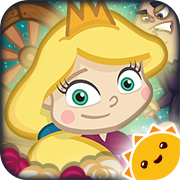
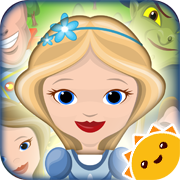
StoryToys has a whole series of fairy tale-themed 3-D pop up apps. These seem like a fun way to get younger kids (and possibly bored adults) discovering traditional, non-Disney versions of fairy tales. (Although...many of the characters' wardrobes/hairstyles are definitely influenced by Disney. But sometimes kids can be deterred when they see a character that looks nothing like the one they are familiar with, so it could help draw kids in)

Grimm's Red Riding Hood

Beauty and the Beast

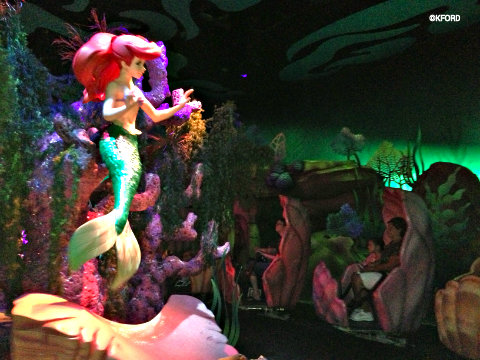
The Little Mermaid

Puss in Boots

Grimm's Snow White

Grimm's Sleeping Beauty

Grimm's Hansel and Gretel

Grimm's Rapunzel

Grimm's Bookshelf (looks like this one allows you to play one game from each book in the fairy tale series)

Thumbelina

Each link will lead you to a video trailer for the app, with story pages and games. The series has gotten good reviews, but keep in mind it does seem geared for pretty young kids. Over the past years, Heidi of Surlalune shared links to a Hans Christian Andersen app and a different Red Riding Hood appGypsy from Once Upon a Blog has featured a Goldilocks story app and recently a Maleficent ibook and that seem geared towards slightly older children.

In addition, a simple google search will lead you to many more fairy tale apps-I really had no idea there were so many since I'm usually a good ten years behind when it comes to technology, and besides have no children and therefore am not looking for apps for kids. Here is a post featuring Four Fantastic Fairy Tale Apps (Including one from the StoryToys featured above, and one for Snow Queen!), and here's a list of fairy tale stories available on Itunes, by Lazy Bird, Inc. Any other discoveries or recommendations?