Thursday, November 6, 2014

Stravinsky's Petroushka: Inspired by Steadfast Tin Soldier?

Stravinsky's "Petroushka" was his second ballet, which premiered in 1911, telling the story of a puppet caught on the unfortunate end of a love triangle. I've never heard anyone compare it to the plot of Hans Christian Andersen's "Steadfast Tin Soldier," but to me the similarities are obvious.
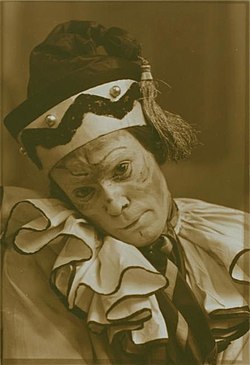
Nijinsky, the famous dancer who played the original Petroushka in 1911

Stravinsky's first ballet, "Firebird," was inspired by traditional Russian fairy tales. It's possible that he would have drawn from another fairy tale for his next ballet, but as he was stretching his music in more modern ways, he could have been even subconsciously influenced by Andersen's 1838 fairy tale, which which was also a less traditional story. He was also in the middle of composing a piece based on the Andersen fairy tale, "The Nightingale."
Marcia Brown

Looking at both stories, you can see the parallels:
"Steadfast Tin Soldier" features three main characters; a toy tin soldier, the ballerina he is in love with, and the jack-in-the-box that is his rival.
"Petroushka" features another toy, this time a puppet, who is also in love with a ballerina, and the puppet Moor who is his rival.
Tuscon production of "Petroushka" 

The Tin Soldier embarks on a journey when he falls out of the window, which ends up with him back in the same nursery room, by chance. Petroushka breaks out of his cell to rescue the ballerina from the Moor's seduction, but she does not want to be rescued-the Moor chases Petroushka outside and he finds himself back at the Shrovetide Fair where we first met him performing.
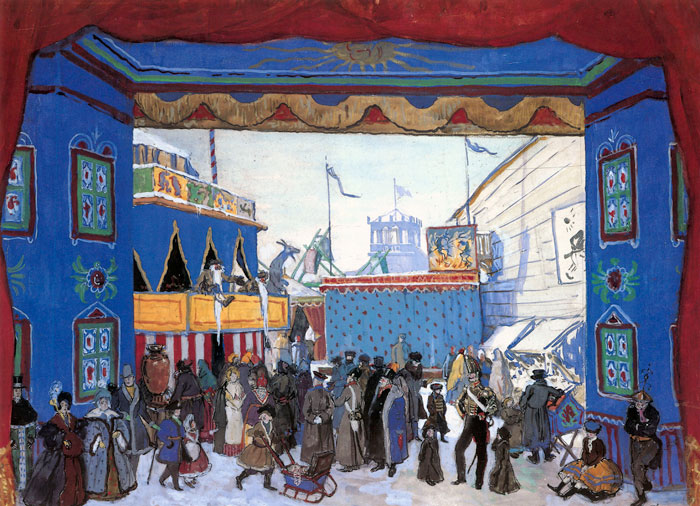
Set for the Shrovetide Fair, by Benois

1911 "Petroushka" souvenir program

Both stories are also characterized by the helplessness of the main characters, and their unfortunate ends. Neither of them can gain the love of the ballerina they desire, and in the end they both die. The Tin Soldier was inexplicably thrown into the fire by the boy who owned him, and the Moor killed Petroushka in front of the Shrovetide Fair crowd. The charlatan (who owns the puppets) showed the crowd that he was just a lifeless puppet, but after the crowd leaves, Petroushka's ghost is seen shaking his fist at the Charlatan, but then collapses on top of the puppet both, "his arms swinging to and fro in the night."
Final scene in "Steadfast Tin Soldier," Marcia Brown

Stravinsky wrote in his autobiography that "in composing the music, I had in my mind a distinct picture of a puppet, suddenly endowed with life, exasperating the patience of the orchestra with diabolical cascades of arpeggios. The orchestra in turn retaliates with menacing trumpet blasts. The outcome is a terrific noise which reaches its climax and ends in the sorrowful and querulous collapse of the poor puppet."  From there, the ballet was further developed by Diaghilev, creator of the Ballet Russes and commisioner of Stravinsky's ballets, and Alexandre Benois, the production designer. Given that Andersen's fairy tales had become famous world wide by the dawn of the 20th century, it's likely that at least one of the men who worked on the ballet would be familiar with the earlier fairy tale. Again, it could have been subconcsious influence, or it could have been coincidence-but the similarities are quite striking.
Design for street dancer by Benois

Monday, November 3, 2014

BATB: Animal Online Resource

A. L. Bowley
If you want to research "Beauty and the Beast", I would wholeheartedly recommend heading over to Surlalune first, where you will find the full text of the Andrew Lang version annotated, as well as pages for its history, illustrations, modern interpretations, similar tales across cultures, and a bibliography (as you will also find for 50 of the most common fairy tales).

But I recently found this page created by Russel A. Peck. It has recommended reading, like Surlalune, but it has a helpful feature in that it has categories based on which animal the Beast is, so if you wanted to find a list of tales in which the animal bridegroom is a pig, or serpent, for example, you  could look at those. The Beast has even been a hedgehog, snail, or snow (Peck includes Snow Maiden tales in the BATB category).
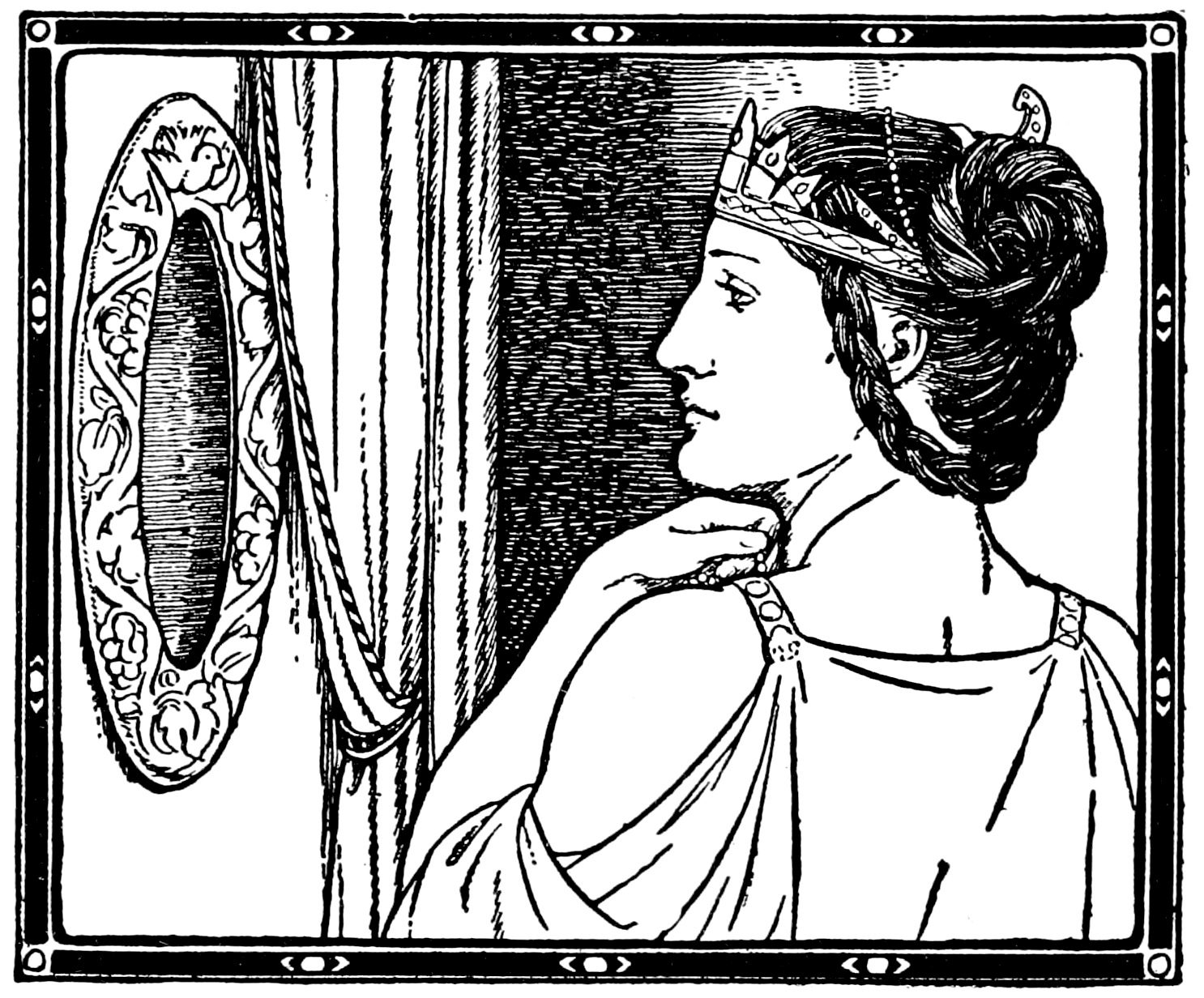
Anonymous illustration for Charles Lamb's poem

The page also includes links to lists of Males transformed, Females transformed, and a few modern variants in which humans are transformed into beasts at the end. Could be a helpful resource for your BATB research!

Most texts don't include specific descriptions of the Beast. Villeneuve describes him as having clanking scales and the trunk of an elephant, most illustrators choose to interpret him in their own way, and we have a wide variety of representations, such as the classic pictures below. (All of the illustrations, by the way, are from Surlalune's BATB illustration index-in fact I get most of my blog images from Surlalune)

In fact, the topic of how the Beast has been thought of and illustrated and how he has evolved over time is an interesting topic in itself. I discussed this a little back in 2010 and here and there over the blog's history, maybe it's time to update my thoughts in a future post...
Anne Anderson
Eleanor Vere Boyle
Walter Crane
Edmund Dulac
H.J. Ford
Margaret Evans Price
W. Heath Robinson
Margaret Tarrant
Jessie Wilcox Smith
Paul Woodroffe


Saturday, November 1, 2014

Von Franz on Individuality in Fairy Tales

Many people have the tendency to try and find moral code in fairy tales. This is often because many of the famous collectors of the tales would make a point of inserting life lessons into the stories, like the Grimms, or outright giving you a rhyming moral at the end, like Perrault.
Perrault's Moral to "Donkeyskin," illustration by Harry Clarke

Yet fairy tales don't always agree with traditional morals. The more you read, the more you realize that often trickery is rewarded, or the hero is stupid and just plain lucky. You will also find, as you read multiple variations of the same tale, that the same happy ending can come about in completely different ways. Those who assume that fairy tales represent a very simplistic and over-idealized worldview often have read very few fairy tales, because they are actually quite complex, and sometimes contradictory.

But when you think about it, this is the only thing that makes sense. Fairy tales come from the people-thousands and millions of storytellers, from generations ago, each crafting and recreating the tales in ways that made sense to them. They come from a multitude of cultures and are reshaped when they visit other countries and when they are brought into new generations of tellers.

In Shadow and Evil in Fairy Tales, Marie-Louise von Franz says, "I have looked at collective fairy tale material for many years, wondering whether it would be possible to find a few general rules of human behavior which would always be valid. I have to confess that I have not found a standard basic rule, or rather, I have found it and I have not found it, for there is always a contradiction!

"I can tell you stories which say that if you meet evil you must fight it, but there are just as many which say that you must run away and not try to fight it. Some say to suffer without hitting back; others say don't be a fool, hit back! There are stories which say that if you are confronted with evil, the only thing to do is lie your way out of it; others say no, be honest, even towards  the Devil, and don't become involved with lying...I disappointedly came to the conclusion that really it should be like that, because it is collective material! How, otherwise, could there be individual action? For if collective material is completely contradictory, if our basic ethical disposition is completely contradictory, only then is it possible for us to have an individual, responsible, free conscious superstructure over those basic opposites...There would be no individuality if the basic material were not contradictory."
Harry Clarke

This passage illustrates the dangers of drawing conclusions from one certain version of fairy tales. So many people are upset that, in their experience, Cinderella and other popular Princesses tend to be too passive. Yet there are many versions, although sadly not as well-known, where Cinderellas and other female characters are more active, courageous, and take risks to find their own positive ending. Yet in our fight to promote more positive female role models, we shouldn't forget that cheerful patience is still a valid way to go about achieving a good outcome!

Fairy tales are symbolic-they are read by all kinds of people who read into them to interpret an infinite number of circumstances. Sometimes the most wise advice is not to give general sweeping statements, but begins with "that depends..." And if you are familiar with the larger body of fairy tales, this is essentially what fairy tales do. They show you that there are multiple ways to find solutions to problems-also multiple ways to bring about problems. In Rumpelstiltskin and other spinning tales, sometimes the central character is hard working and diligent, but other times she is lazy but clever and yet still gets a happy ending. Although Bluebeard's wife is chastised for her curiosity, many versions (such as "Fitcher's Bird") reward the woman for her curiosity, bravery, and ability to trick the villain.
Bluebeard by Harry Clarke

We all face different situations, and we all handle them with different personalities as well. When I hear feminists getting upset about the passivity of females in fairy tales, I start to feel uncomfortable. While I don't let people walk all over me and take advantage of me, I'm a shy, laid-back person. I'm introverted and a natural follower, not a natural leader. I also more recently learned that I am a Type 9 in the Enneagram Personality Test, part of which means that I tend to be a conflict avoider, rather than proactive. It doesn't have to do with my being a woman verses a man. So while it's something to be aware of and potentially work on, there is still nothing inherently worse about being a certain personality rather than another. People at different ends of personality spectrums tend to compliment each other-just as no two people are the same, it makes sense that fairy tale characters act differently in fairy tales, even in different versions of the same tale.

Thursday, October 30, 2014

Schonwerth: Jack-o'-Lanterns

"Jack o' Lanterns are commonly thought of as ghostlike creatures, mostly Poor Souls, who are awaiting redemption. They are like Fiery Men in miniature...When you see them, you are not allowed to talk loudly to them, much less ridicule them, otherwise you will be led astray."

-So say the notes provided by M. Charlotte Wolf in the collection of Schonwerth tales, describing the folklore surrounding Jackolanterns in Bavaria. The collection includes this story:

75. Jack- o'-Lanterns

"A man from the village of Breitenwun near Velburg went home one night from the country fair, rather drunk. On the way, little lights were bobbing along before him, whereupon he called out to them, "If you give me light so that I may find my way home, I will give each of you a Taler [coin]."

Even more merrily the little lights bobbed along before him until the man reached his village. Then he said, "Now you can go home again; I don't need you anymore."-However, the little lights did not go home, but went in front of him, to his house, and from there into his sitting room, and they lighted the farmer's way to bed, and they kept glowing until he fell asleep. And so it happened every night; as soon as daylight faded, they were around him. Then he built a chapel in the village and paid for an eternal flame. As soon as it burned for the first time, the little lights were no longer seen. -The little chapel still stands today, but the eternal flame has gone out."
Arnold Bocklin, painting of will-o'-the-wisp

Versions of Jack-o'-Lantern tales are found all over Europe, but they are thought to originate with "the phenomenon of strange lights flickering over beat bogs", also known as will-o'-the-wisp, according to Wikipedia. You can read a different version from Ireland over at Fairy Tale Fandom.

Again from Wikipedia: "Jack-o-lanterns were also a way of protecting your home against the Undead. Superstitious people used them specifically to ward away vampires. They thought this because it was said that the Jack-o-lantern's light was a way of identifying vampires and, once their identity was known, they would give up their hunt for you."
Happy Halloween!

Monday, October 27, 2014

Godfather Death by Evangeline Allum


Here's a silhouette retelling of the tale about attempting to cheat Death, by Evangeline Allum.

View on Youtube

Friday, October 24, 2014

The Singing Bone: Nature as Truth Teller


The Singing Bone is a lovely little Grimm fairy tale-I especially like it as a flute player. In the story, two brothers go to find and kill a wild boar that has been terrorizing the kingdom. The younger is rewarded for his kind heart when a fairy appears and gives him a spear. He finds the boar and kills it.

But later, his brother sees him carrying the boar home, and decides to kill his brother, take the boar for himself, and tell the King it was he who courageously killed the boar. He does so, and gains the Princess, which was the reward. But a few years later, a herdsmen found one of the bones of the murdered brother and made a flute out of it. Only the flute, when played, sang the words that told of the victim's story:

"Ah! dear shepherd, you are blowing your horn
With one of my bones, which night and morn
Lie still unburied, beneath the wave
Where I was thrown in a sandy grave.
I killed the wild boar, and my brother slew me,
And gained the Princess by pretending 'twas he."

This is one of those bittwersweet fairy tales. Justice is done, as the murdered brother's bones are recovered and given a proper burial, and the older brother is punished with death. But in this tale, the innocent dead man does not come back to life and gain the Princess.
Hello Kitty's "The Singing Bone" from McDonalds

 Often in fairy tales, the characters are prevented from telling the truth, and Nature sometimes interferes by revealing the evil deeds that the villains almost get away with. In "Juniper Tree" and "Cinderella", birds tell the truth (the spirit of the murdered boy, in the form of a bird, proclaims "my mother she slew me/my father he ate me" as he rewards the good and punishes the mother; the birds in Grimms' "Aschenputtel" tell the Prince of the blood on the shoes of the false brides).
Artist??-Source

 In "Snow White", it is the Mirror (or, sometimes the Sun or Moon) that fearlessly tells the Queen who is really the fairest in the land. In some stories, such as "Goose Girl", the main character may be bound by a promise not to tell the truth of what happened to them; but by telling their story to an inanimate object, so as not to break their word.
"The Goose Girl," Arthur Rackham

And here, the bones of the victim beg for justice-which is often what symbolically happens in murder mysteries, but here what literally happens. For as the tale says, "these dark deeds are not often concealed, for something happens to bring them to light."

Wednesday, October 22, 2014

Fairy Tale Fragrance

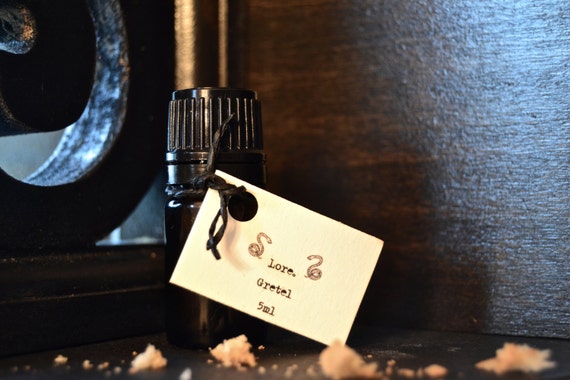
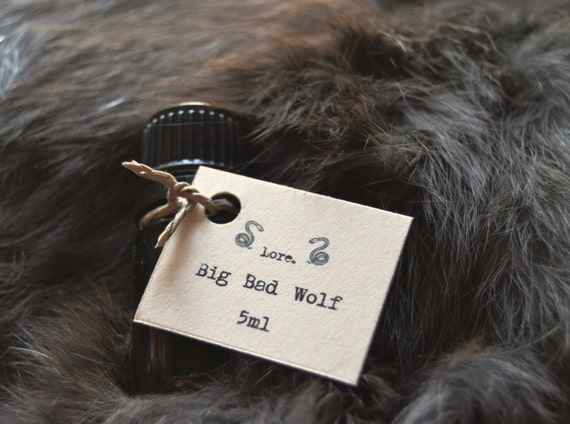
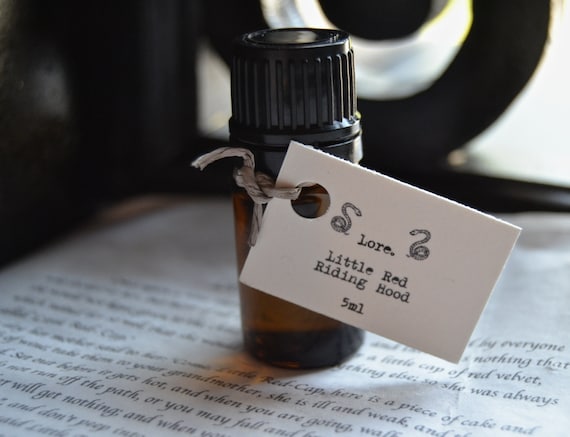
Here's a product I don't think I've seen before: Fairy-tale inspired perfumes and colognes!
"Hansel- The scent of the Black Forest and sweet bread. This fragrance is woodsy but playful with the light scent of freshly baked sweet rolls.

"Gretel- Wild roses and glistening embers. This fragrance is sexy and feminine with a smoky undertone."
"The big bad wolf is an archetype in folklore all over the world. He's antagonized little girls, shepherd boys, familial swine, lambs, etc. From the forests of Germany to the hills and plains of Ethiopia, anywhere you find wolves you will find tales of big bad himself. He's cunning, fierce, and damn if he doesn't make for one hell of a story.

"A powerful, earthy, yet elegant fragrance. Dominating black pepper, the warm bark of cedarwood, and a sensual touch of ylang ylang. This fragrance is suits men, women, beasts, and everything in between. "
"The scent of sweet cakes, the black forest, and a bouquet of wild flowers. Little Red Riding Hood comes in an amber 5ml bottle with a muslin bag."
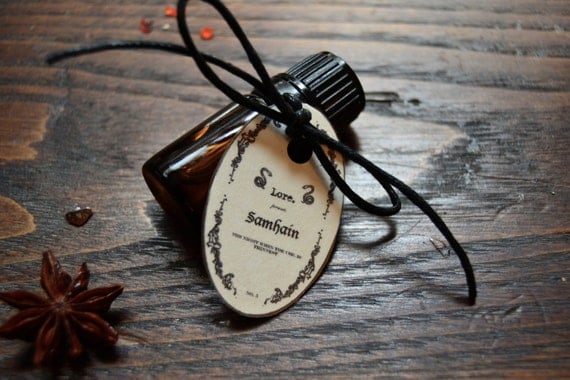
"Samhain- Cool winds whipping through the forest on all souls night and a touch of warm spices. Essential oils combine to create a distinctly autumnal scent. It is in a 5ml amber bottle. Comes with a muslin bag for safe keeping.

"Samhain is the witches new year. It marks the end of the harvest and beckons in the winter. Many believe that it is when the veil between worlds is thinnest. But not just witches and pagans celebrate this ancient festival. You probably do to, just not in the same way. Most people recognize the holiday as Halloween and it is celebrated all over. Many Halloween traditions come from the Samhain traditions, such as setting out pumpkins and sharing sweets."
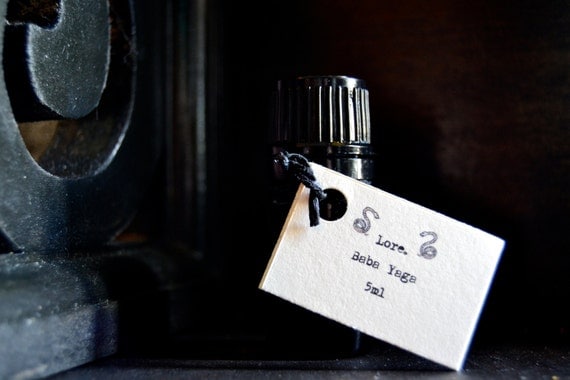
"The Baba Yaga is a witch found in Russian folklore and fairy tales. She is wise but fearsome and extremely powerful. She is depicted as a crone who flies about the forests with the help of her mortar and pestle. Her nose is long and her teeth made of metal. The Baba Yaga has strange comings and goings. In some stories she is shown counting spoons before returning to her house that stands upon chicken legs. Baba Yaga is often regarded as a protector of the Russian forests and the creatures within it.

"The scent of a birch mortar, metal, and the forests of Russia. Baba Yaga comes in a 5ml bottle tucked inside of a muslin bag with the Lore logo for protection. "

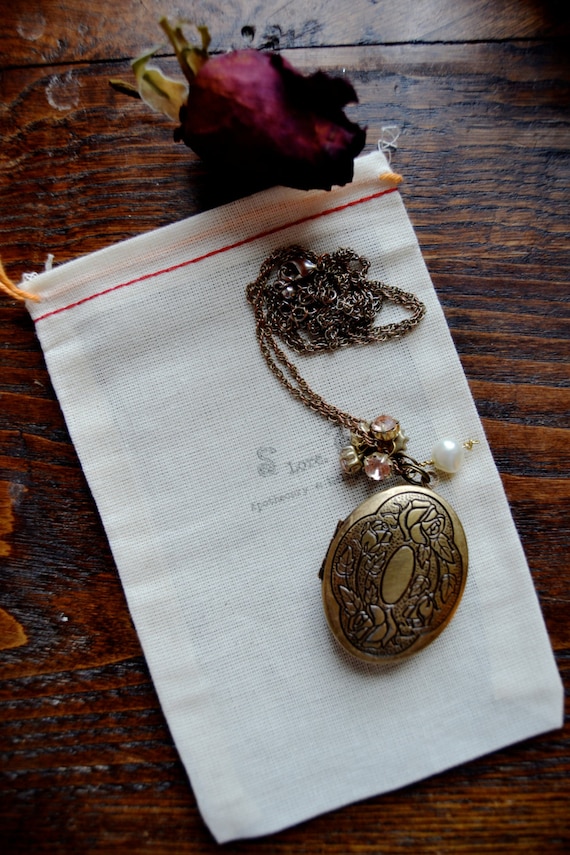
"Vasilisa- Russian wedding cookies and the delicate scent of roses.The solid perfume is made from bees wax, sweet almond oil, and a blend of essential oils. 

"Vasilia's necklace is 32 inches long and will hang just below the bust. Using brass chain and a beautiful rose patterned locket, I created this necklace with the story of Vasilisa in mind. The charms around the locket are a single freshwater pearl and a loop of blush toned crystals. Inside of the locket is Vasilia solid perfume. The part that holds the solid can be removed so that it can be refilled when the perfume is gone. This necklace is perfect for anyone who enjoys delicate things or has a feminine sense of style. "

Available through Etsy seller LoreApothecaries. I had never heard of Samhain before, but how appropriate for this time of year? And how great is the Vasilisa locket-not only for using a lesser known tale as inspiration, but perfume in a pretty locket is a double win! I love to see people using fairy tales not only as inspiration for other stories and art, but playing around with scents and taste (like fairy tale teas or cookbooks).

Monday, October 20, 2014

Scheherezade on Faithful Wives

Rene Bull

One of the most attractive aspects of the Arabian Nights is the frame narrative, that tells of the courage of the young woman Scheherezade. She courageously risked death in becoming the next wife of the Sultan in an effort to save the lives of future victims of the Sultan's rage, and the Sultan himself.

This story, surprisingly feminist especially when considering the time and culture, is impressive; yet many of the tales of the Nights seem to contradict the concepts of women who are creative, courageous, and faithful. In "The Prince of the Black Islands", the villain is a woman who betrayed her husband and took a lover. To further add insult to injury, she imprisoned her husband in stone from the waist down, and came every night to beat him. She also cursed all of his subjects (her husband is a Prince) to become fish. Such cruelty is unusual even among fairy tale witches and villains. She is eventually defeated by a King who passes through, learns of the curse, and tricks the woman into undoing the spells by pretending to be her lover giving her instructions.
H. J. Ford

Why such a bleak picture of women in general, especially wives? The King is already acting out in his hurt and anger over the fact that his own wife was caught having an affair. Despite the character of Scheherezade, do the Nights indicate that no woman is capable of being a faithful wife? Are we to assume that Scheherezade herself, once married to Shahriyar, will in a matter of time commit adultery herself?

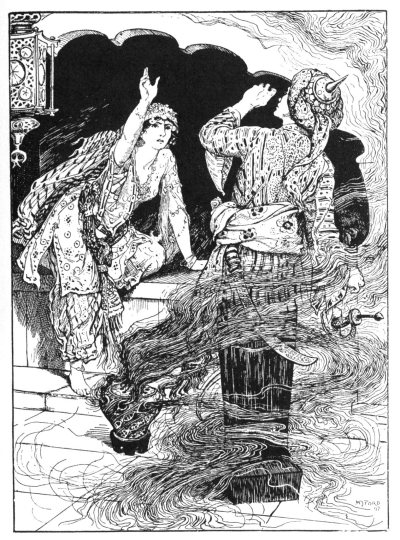
No, according to Marina Warner in Stranger Magic: Charmed States and the Arabian Nights. The truth actually reveals the further cunning of Scheherezade, as well as her compassion. In the first section, many of the tales do include such stories of evil women and unfaithful wives. Scheherezade shows sympathy towards the betrayed Sultan, gaining his trust and showing she can see things through his perspective. Yet as the Nights progress, the characters change. The stories feature wives who are faithful to their husbands, resourceful and smart and able to help bring about the happy endings rather than be an obstacle to them. Warner names examples such as Badoura, Zumurrud, Mariam, and Tawaddud that prove to be positive female role models in later stories (although I must admit I'm not that familiar with the Nights as a whole and don't know the stories of these ladies-yet!).
H. J. Ford 

Scheherezade not only takes her listeners on journeys of adventure, magic, and excitements, but also guides Shahriyar through an emotional journey. She wisely knows he needs to go through a period of feeling anger and hurt, and doing this through experiencing stories is obviously much safer than by killing innocent women. Yet in time she guides him to consider the possibility that not every woman is bound to be cruel, and shows him a different worldview, enabling him to slowly let go of his hatred for women. Scheherezade is a counselor and therapist as well as an expert storyteller. The more I learn about the Nights the more I admire her!

Rene Bull

Friday, October 17, 2014

Magic Mirrors

1916 (Wikipedia, illustrator not credited)

Mirrors factor prominently in the cycle of Snow White tales. They fulfill two main functions; that of assessing the beauty of the women in the world, and then later leading the evil mother/stepmother/sister/wife to the whereabouts of the beautiful girl she thought she had already killed.
Early 20th Century Halloween greeting card reveals a popular belief

Mirrors have long been thought to have magical properties. They were seen as being windows to the soul, sometimes betraying the darker nature of the person who looked into it; other times they were thought of as gateways to another world. In the Victorian age, mirrors were thought to be potential portals into the spirit world. The legend of Bloody Mary has survived to this day (at least, I remember being told the story at sleepovers when I was young). Mirrors were also used by magicians in doing spells, and it's still considered unlucky, if you're superstitious, to break a mirror. (Read more about the properties of mirrors here).
Image, and a supposedly real Bloody Mary story, found here

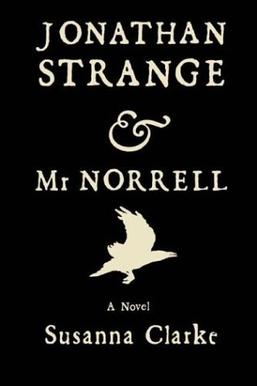
I am intrigued by this idea of mirrors being gateways to the spirit world. It's described in Jonathan Strange*: "There is indeed a path which joins all the mirrors of the world. It was well-known to the Great Mediaevals...The writers I have seen all describe it in different ways. Ormskirk says it is a road across a wide, dark moor, whereas Hickman calls it a vast house with many dark passages and great staircases. Hickman says that within this house there are stone bridges spanning deep chasms and canals of black water flowing between stone walls-to what destination or for what purpose no one knows."

It just makes more sense to assume that a mirror could pronounce a person the fairest in the land if that mirror also had access to every other mirror in the land, as opposed to one who was restricted to the views in one room in one castle only.

Of course, not every version of Snow White has a magic mirror. In Surlalune's collection of Sleeping Beauty tales from around the world, I counted 14 that used magic mirrors. In seven, the question of who is the fairest was directed to the sun or moon-another object that would, theoretically, be able to speak with authority on all the faces in the world.
Helen Stratton

Some versions don't even have a magical object telling the evil woman who is more beautiful-she will either simply be jealous of someone else's beauty on her own, or her jealousy starts when the man in question pays more attention to the daughter or rival. In other tales, the all-knowing voice is attributed to various things including a magical trout, an evil spirit, an eagle, an Arab kept in a locked room, or sometimes the woman simply asks the other people around her if they think she is most beautiful.

Mirror of Claudia Elisabeth von Reichenstein
Some claim that the tale of Snow White has historical precedents. From wikipedia: "German scholar Karlheinz Bartels suggests that the German folk tale "Snow White" is influenced by Maria Sophia Margaretha Catherina von Erthal, who was born in Lohr am Main in 1725.[1] After the death of Maria Sophia's birth mother in 1741, her father Philipp Christoph remarried. Claudia Elisabeth von Reichenstein, the stepmother, was domineering and greatly favored the children from her first marriage.[2] The Queen's iconic mirror, referred to as “The Talking Mirror,” can still be viewed today at Spessart Museum in the Lohr Castle, where Maria Sophia was born. The mirror was likely a gift from Philipp Christoph to Claudia Elisabeth. It was a product of the Lohr Mirror Manufacture (Kurmainzische Spiegelmanufaktur). The mirror “talked” predominantly in aphorisms. The upper right corner of “The Talking Mirror” contains a clear reference to self-love (Amour Propre). Moreover, mirrors from Lohr were so elaborately worked that they were accorded the reputation of “always speaking the truth”. They became a favorite gift at European crown and aristocratic courts.[3]"

There is, of course, the magic mirror from "Beauty and the Beast" (I had a toy just like this when I was a kid, but it didn't talk). Although Disney changed its function, there was a magic mirror in Beaumont's version that showed Beauty her father was sick, which is what prompted her to go home.

*Jonathan Strange and Mr. Norrel is a historical fiction novel, but author Susanna Clarke draws heavily on research of magical beliefs and history to make an incredibly compelling and believable story. It's literally one of the best books to have been written in our lifetimes and you should all go read it, right now.