Showing posts with label Aladdin. Show all posts

Friday, July 29, 2016

From the Archives: Lotte Reineger's Adventures of Prince Achmed


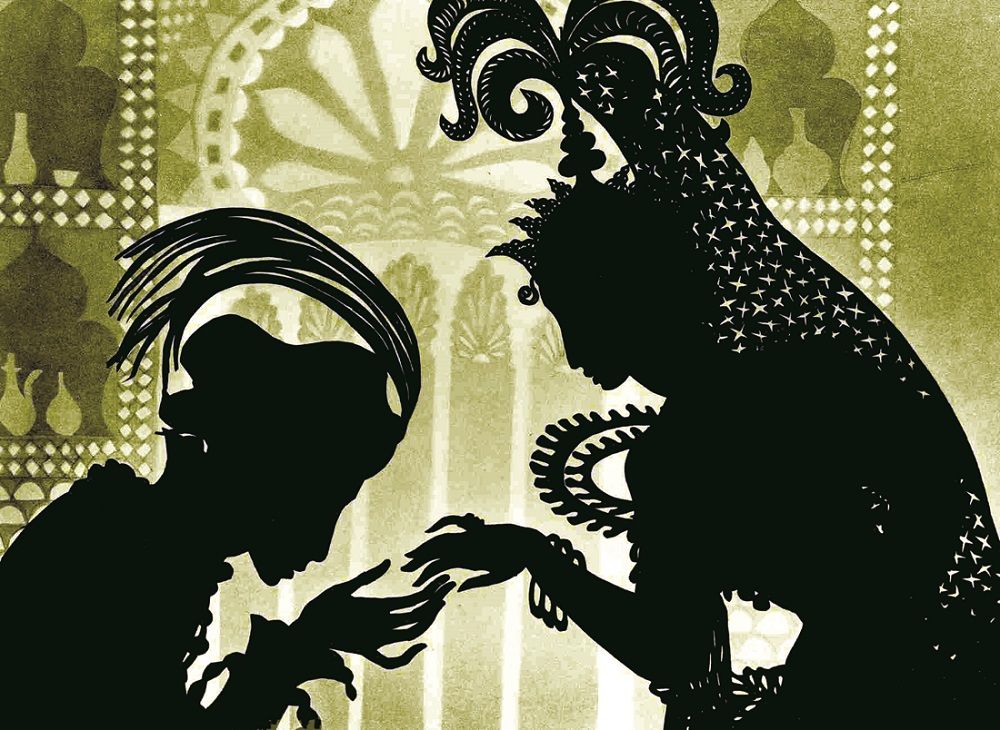
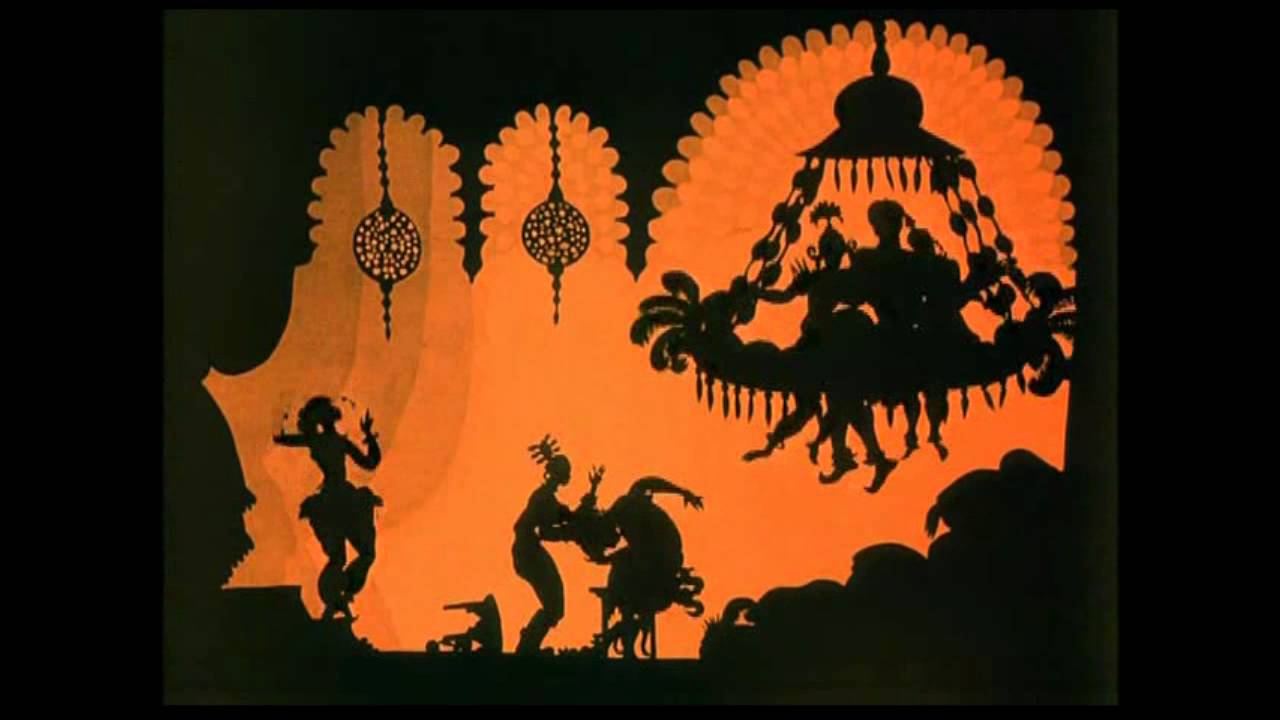
Any Disney book will tell you that Snow White was the first full length animated film, but Lotte Reiniger's The Adventures of Prince Achmed is "considered by many" to be the first full-length animated film. Snow White would undoubtably be the first full-length hand-drawn animated film, but Disney is not meticulous about making this distinction. Reiniger's story is told through enchantingly intricate paper cutouts and premiered in Germany in 1926-beating Snow White by 11 years.

This story is very sexually charged, but as everything is told through silhouettes, it's more subtle. Prince Achmed is the hero, but I hardly think he's more noble than any of the horny villains.


But the film is spellbinding to watch and the music wonderful, if the historical importance weren't reason enough to watch it. And how interesting that fairy tales are so closely linked with the beginnings of animation?


The story is based off of the story of "Prince Achmed and the Fairy" with a little Aladdin thrown in.

Lotte Reiniger has done versions of several fairy tales, including Cinderella, Hansel and Gretel, Thumbelina, and Jack and the Beanstalk. Portions, if not full versions, of all of these can be found on youtube.


Fun fact: According to wikipedia, the character Prince Achmed in Disney's Aladdin is a tribute to this film (Prince Ali and Ja'far are also other characters from Arabian Nights)

"You were born a street rat, you'll die a street rat, and only your fleas will mourn you!"

Monday, February 16, 2015

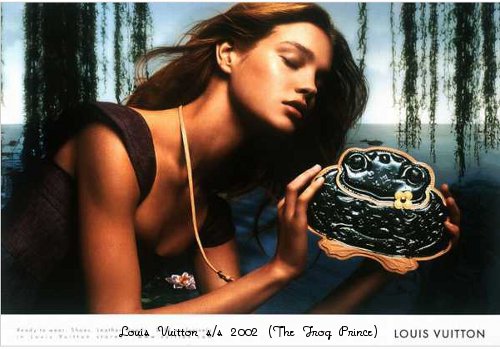
Louis Vuitton and Hermes Fairy Tales

Old images, but new for me-I love when major designers use fairy tales to advertise!

Louis Vuitton S/S 2002


Louis Vuitton Holiday 2009

Hermes S/S 2010


Friday, April 19, 2013

History of Aladdin

Out of all the tales of the Arabian Nights, only a few are familiar with modern audiences, and out of those the most well-known would undoubtably be "Aladdin". The story was very popular among adults and children of the Victorian age as well as today. Somewhat sadly, though, the reason for this popularity can be boiled down to the fact that those tales are the least authentic.

Image from here
 
Arabian Nights (or 1001 Nights)  is a collection of anonymous tales, most of which were orally circulated folktales in the Middle East before being published in the collection. Certain stories, however, were most likely written by one of the French collectors and editors of the tales, Antoine Galland. Other stories that were most likely his creations are "Ali Baba" and "Sinbad," some of the few tales in the Nights average people today could actually name off the top of their heads.

These tales have no known precedents before Galland, and also bear characteristics that are closer to Western fairy tales than the other tales in the Nights. Westerners love their stories to feature protagonists of low birth and status, who find themselves part of an undeserved high destiny which includes marrying outside of their status, and ultimately overcoming their poverty. The multiple scenes and locations of Aladdin also make the story entertaining as the plot keeps changing, and therefore also well suited to the stage, where it was a popular story in Victorian times, as the public loved the spectacles of Oriental scenery and the showmanship of the magical stage tricks.

Image from here
 
Galland's original Aladdin story was 118 pages long, and Marina Warner calls it "one of the key works in the history of exchange between literature of the East and West." However, Robert Irwin criticizes Galland's version for being too long-winded, "hypocritical French moral didacticism," and anti-Semitic. Irwin approves of the Disney version's changes to the story, (which is an unusual academic perspective when dealing with fairy tale history, to like the Disney movie better than the original)-he said it was "less vulgar than Galland's, less obsessed with opulence, less sexist, and not at all anti-Semitic."

Warner points out one very interesting feature of the story and possibly its popularity: the issue of slavery. Aladdin finds himself in posession of a magical ring and a magical lamp, both of which have several genie slaves which then must serve Aladdin. When she first pointed this out, I was reminded of "Beauty and the Beast", and the role reversals found in each: in "Aladdin", the poor boy suddenly becomes the master of powerful slaves; in "Beauty and the Beast", the poor woman is told by a powerful male Beast that she is the mistress of his castle, upsetting gender and social status. It's not surprising to find this similar theme, which was a popular one of Galland, Villeneuve, and their French salon contemporaries.

Edmund Dulac

However, Warner also points to a connection with abolitionism. For a while, versions of the story ended with the genie slaves being freed and the villain who imprisoned them punished (as is also how the very American Disney film ends). In Warner's words, "The concept of an utterly subjugated, volitionless but powerful spirit communicates the soulless, dehumanised condition of enslavement decried by abolitionists."

*Information taken from Marina Warner's Stranger Magic: Charmed States and the Arabian Nights

Thursday, October 11, 2012

Fairy tale retellings and subgenres

I shared once a story in which a friend of mine was baffled at the existence of multiple versions of the same fairy tale, saying, "how can they tell the same story over and over?"

I was reminded of this as I've been perusing The Fairies Return, because the book has so many examples of the different ways the same story can be told "over and over", yet with completely new life each time. If fairy tale retellings is itself a subgenre of fantasy, even within this category are many other sub-subgenres. All examples are found in The Fairies Return unless otherwise noted. These are just classifications I made up:

Expanded fairy tale: True folk tales have a very distinct style, they include the bare essentials of plot, and characters are never developed. Some authors will take those same essential plot points but build a fuller context. A good example of this would be Robin McKinley's Beauty, a novel version of Beaumont's classic "Beauty and the Beast" (and for new readers, my absolute favorite version of my favorite fairy tale). Though the short story limits the development we can get in a novel, I really enjoyed Clemence Dane's "Godfather Death." It's not a fairy tale we often see authors playing around with, but it becomes more real when characters have names and motivations, and we see extra details in setting and passage of time that make it more believable, yet still the same essential story found in the Brothers Grimm.

John B. Gruelle

Alternate explanations: In fairy tales, a character will do something and rarely are we told why; often their actions seem strange, especially when we're separated by culture and time differences. For example, when we think of Snow White being put in a glass coffin this is generally interpreted as creepy and fetish-y, but in Lord Dunsay's "Little Snow White" we find that the miners simply happened to know someone in the glass business who was able to cut glass to the right lengths-they were avoiding going to the police. It is creative details like these that help us see familiar plot details in a new light, and realize that there could be dozens of other explanations for the same actions.
Kay Nielsen

Removal of magic: Lady Eleanor Smith is able to retell The Little Mermaid in such a way that the supernatural is not present, but the parallels are still clear. This heroine was dubbed "little mermaid" by the prince figure because of her excellence in swimming and diving, which years later lands her a role as a bathing beauty in one of his motion pictures, for this Prince is not royalty but a film star.

Expanding on a single element: Anna Gordon Keown's "Aladdin" has virtually nothing in common with its predecessor from Arabian Nights, but this Aladdin manages to accidentally summon a demon who must do his bidding. Only this wish fulfillment is very different-the awkward undertaker finds himself enjoying not the direct benefits of wishes, but increased social status due to his new friend, which he passes off as his brother visiting from an exotic island. This type of fairy tale retelling focuses not on aligning plot points, but on exploring the "what ifs" of a familiar motif

Errol Le Cain

Sequel: Sometimes writers wonder what really happened after the "happily ever after," a personal favorite of mine is the children's story The Frog Prince, Continued, by John Scieszka. Eric Linklater's "Sindbad the Sailor" describes Sindbad's untold, eighth and final voyage, which is quite different from his previous seven. If I understand it correctly, the story contrasts the differences in culture between the heroes of the Arabian Nights, and the then-modern culture, as Sindbad accompanies a modern cruise to some of his previously visited locations. He finds that the modern people are not as easily impressed, and that what was such danger to him before is mere entertainment to other people. He is a little insulted at his lack of respect and (SPOILER ALERT) ends up basically letting the other passengers die at one of the islands, telling the authorities they were devoured by snakes. This may have nothing to do with it, but when I'm not reading up on fairy tales I'm something of a Titaniac, and I was struck by the parallels of a cruise ship designed to entertain the wealthy, who are not scared of any dangers, even when those dangers are quite real-and the trip ends in disaster. I would pass this off as coincidence except for the fact that the book was originally published in 1934, 20 years after the disaster, so all of the authors would have been alive during the shocking sinking which disillusioned the world against overconfidence in technology.

I'm really enjoying the book as I manage to find time during a very busy month at work, I may have a Part II to this post once I've read them all. There are so many other ways to categorize fairy tale retellings, even among the stories I've described here, and again these are NOT official literary terms at all, just me trying to make sense of things.

Monday, August 22, 2011

Isabella's Art


Aladdin and the Magic Lamp


Alice and the Madhatter


The Snow Queen


Little Red Cap and the Big Wolf


The Sandman


Hansel and Gretel and Witch


Candy House


Isabella's Art is an etsy site that features shadow puppets and theaters, with folklore, mythology, and fantasy as inspiration. I found this via Kingdom of Style. Reminds me of the work of Lotte Reiniger...the first one especially makes me want to watch The Adventures of Prince Achmed again...

Thursday, March 3, 2011

The Adventures of Prince Achmed


Any Disney book will tell you that "Snow White" was the first full length animated film, but Lotte Reiniger's "The Adventures of Prince Achmed" is "considered by many" to be the first full-length animated film. "Snow White" would undoubtably be the first full-length hand-drawn animated film, but I from what I've read, Disney is not meticulous about making this distinction. Reiniger's story is told through enchantingly intricate paper cutouts and premiered in Germany in 1926-beating "Snow White" by 11 years.

This story is very sexually charged, but as everything is told through silhouettes, it's more subtle. Prince Achmed is supposed to be the hero, but I hardly think he's more noble than any of the horny villains. The Arabian Nights is probably the worst for portraying females as nothing more than sex objects...ironic, because they're all supposedly told by Scheherezade, a female.

But the film is spellbinding to watch and the music wonderful, if the historical importance weren't reason enough to watch it. And how interesting that fairy tales are so closely linked with the beginnings of animation?

The story combines the story of Prince Achmed and the Fairy with Aladdin, but the liberties taken still fit the style and characteristics of the Arabian Nights, especially using the story-within-a-story (although, Prince Achmed did NOT fool around with all of the Fairy's servants before he met her. It's funny that we're often under the impression that all older movies were laughably wholesome).

Lotte Reiniger has done versions of several fairy tales, including Cinderella, Hansel and Gretel, Thumbelina, and Jack and the Beanstalk. Portions, if not full versions, of all of these can be found on youtube. "The Adventures of Prince Achmed" is currently on Netflix instant play. Here's the beginning of Prince Achmed:

Thursday, December 30, 2010

Fairy Tales in Christmas History

One more Christmas-themed post, for good measure:

This month I checked out Christmas: A Social History by Mark Connelly from my library, which I recommend to anyone who enjoys learning about Christmas but might tire of the traditional feel-good stories in which a person's character and morality can supposedly be measured by their level of Christmas spirit. (Don't get me wrong, I watch each classic Christmas special religiously every year...) This book takes a historical-social approach, analyzing Christmas traditions and what they reflect about the society at the time, focusing on the English perspective.


I didn't expect to find fairy tale references in it, but a large part of the historical Christmas celebrations in England were pantomimes, some of which focused on fairy tale plots. Just further evidence of how fairy tales are altered to fit moods and attitudes of the culture that creates them:


"E. L. Blanchard wrote Faw Fee Fo Fum; or, Halequin Jack, the Giant Killer in 1867 for Drury Lane. The pantomime starts on the Giant's Causeway, showing the giant leaving Ireland to come to England. This seems to play on long-standing fears of Ireland as a staging-post for invasions of England. England is portrayed as the home of chivalry and merriment...When Jack realizes that the nation is in peril from the giant and sees the glory of the Duke's retinue he vows to become a knight-no rejection of aristocratic values here. Jack then goes off to defeat the giant and is feted as a glorious knight...He also becomes a hero in Ireland where the fairies and leprechauns are glad to be rid of the tyranny of the giant, thus sending a ressuring message about the unity of the two nations. Jack sums up the Victorian belief in the ancient English liberties and tells the audience: 'We English form a curious community/No tyrant makes us prisoners with impunity.' "


Image-Arthur Rackham

This was not the only Jack and the Beanstalk-themed pantomime; Arabian Nights were also popular source material (these fairy tales were also mentioned by Charles Dickens in his "A Christmas Tree", proof that they were both very popular in England at the time). Interest in China and the East had widened as trade between the countries did, evidenced in the fact that the names used in plays about Aladdin usually had to do with tea: Widow Twankay (a famous port), Tealeaf, Souchong (a tea leaf with a smoky taste because of the affects of being exposed to fire on the long journey from the east), and Mazawatea.

Thursday, May 20, 2010

Aladdin-Arabian Nights

There was once a poor tailor whose son was so idle and lazy that the tailor eventually died from grief. Still nothing persuaded Aladdin to change his ways.


One day an African magician came to Aladdin, claiming to be his uncle. The man offered to buy and stock a shop for Aladdin. They set out on a journey, and on the way the uncle revealed a magical entrance to an underground cave. Aladdin is instructed to go into the cave, touching nothing, and bring up a lamp. The uncle also gave Aladdin a ring.
Edmund Dulac

Aladdin fetched the lamp as he was told, but refused to give his uncle the lamp until he was out of the cave. The magician became furious, and magically rolled the stone back over the mouth of the cave. The uncle was really not Aladdin's uncle at all, but had needed someone foolish enough to get him the magic lamp so he could kill him afterwards.

After a couple days alone in the dark cave, Aladdin clasped his hands to pray, and in doing so rubbed the ring. Immediately a large genie appeared and stated that he would obey Aladdin in all things. Aladdin doesn't even hesitate but orders himself out of the cave. He returned home to his mother. He offers to sell the lamp in order to get money for food, and began to rub it since it was so dirty. Another genie (this one is "hideous") appeared to do Aladdin's bidding. He ordered food, and he and his mother ate their full.

With the genii, Aladdin and his mother were never poor again. One day Aladdin was seized by the desire to view the Princess as she went to her bath, which was forbidden. He caught sight of her as she lifted her veil and was instantly in love. He forced his mother to stand by the Palace every day in order to ask the Sultan for his daughter's hand. She took with some of the enchanted fruits that "sparkled and shone like the most beautiful jewels."
Errol le Cain

Eventually the Sultan noticed her, and impressed by her rare treasures, promised his daughter to her son, in three months' time. But during this time the Sultan forgot his promise, and in two months his daughter was about to enjoy her wedding night with another man. Aladdin ordered the genie of the lamp to carry the Prince in his bed outside and leave him there till morning, and Aladdin took his place next to the terrified Princess. After another night of this, both bride and bridegroom were willing to be separated. When it was the appointed time, Aladdin ordered himself a splendid procession from the genie, and built a large and bejeweled Palace for the Princess. He left one jeweled window lattice undone, to allow the Sultan to have the pleasure of finishing it. But the Sultan realized he did not have enough jewels of his own to fill even one window lattice.


Aladdin was a gentle and wise ruler, loved by the people. However, the magician had not forgotten about the magic lamp. He heard of Aladdin's fame and tracked him down. Posing as a lamp trader, he tricked the Princess into giving him the magic lamp for a newer one. The genie of the lamp obeyed his new master and brought the entire Palace, with the Princess in it, to Africa. The Sultan sent for Aladdin, who was out hunting, and ordered him to be beheaded. Aladdin pleaded for forty days in which to find the Palace and his wife. He intended to say his prayers and throw himself into a river, but once again accidentally rubbed the magic ring, bringing forth the other genie. However, the ring genie could not undo the magic of the lamp genie. So he brought Aladdin to the Palace. He found his Princess, who had treated the magician so harshly he avoided the Palace altogether. Aladdin told her to pretend to be welcome to the magician's advances, to beg for African wine, and to put a certain powder he gave her into the magician's wine.
Kay Neilsen

The Princess did as Aladdin said, and successfully poisoned the magician. Aladdin and his Princess were reunited and returned to China. However, the magician had a younger brother who wanted to avenge his brother's death. He posed as a holy woman, and was invited into the Palace by the Princess. The false holy woman convinced the Princess that a roc's egg was needed to make her home truly beautiful, and she requested this of Aladdin, who requested it of the genie. The genie shrieked, for the roc's egg was his master, told Aladdin the truth about the false holy woman, and disappeared. Aladdin requested to see the holy woman but pierced the magician's brother with his dagger. After this Aladdin and his Princess lived in peace.

Friday, April 30, 2010

Eras of Disney

Disney can be quite controversial. Some people love Disney and everything about Disney-others despise it/him. Since Disney has made many many movies over almost a hundred years, and the characteristics of the movies are very different depending on when they're from, let's distinguish within Disney itself. For the sake of simplification, I'm only discussing Disney Princess movies.
Walt Disney himself died in 1966. Before he died, he had created 3 complete Princess movies- Snow White and the Seven Dwarfs (1937), Cinderella (1950), and Sleeping Beauty (1957.) Disney had been a leader and innovator in the world of animation. It's these three Princesses that are often accused of having the most negative female stereotypes-evil female villains and helpless heroines. Yet I have to say, these movies adhere the closest to the plots on which they are based. And some people have attacked Cinderella for being made more helpless than the Grimm version, but Disney didn't base his Cinderella off of Grimm, but on Perrault's (and either way, whether Cinderella got help from talking mice and a fairy godmother, or a dead mother's spirit, she always has help in SOME form.)
There was a long break from Princess movies. Then Disney had another golden age in the late 1980s- early 90s, with The Little Mermaid (1989), Beauty and the Beast (1991), and Aladdin (1992). Feminism had spread and filmmakers were more conscious of how they presented females. Ariel, Belle, and Jasmine definitely have more spunk and sense of adventure than their predecessors (although, as I've pointed out before, Ariel is reeeeally desperate to marry a guy she's never actually met. Interesting that the next two heroines on the scene are anything but anxious to marry just for the sake of marrying or for looks), but the plots of the stories differ more greatly from their sources. Interestingly, none of the movies created during this time were based on Grimm stories. And yes, Pocahontas and Mulan are in there somewhere, but they were never as popular. I say, Pocahontas is a travesty because they completely alter a true, historical story, which is different than altering a version of a fairy tale that isn't exactly authoritative on its own. Mulan should probably be more popular, but there's just only so many Princesses you can fit onto a t-shirt, you know?
Then there's Tiana from Princess and the Frog, and supposedly Rapunzel's coming. In the grand scheme of things they should probably be lumped together with the second batch of Princesses, except that Michael Eisner is no longer CEO of Disney. You could say that they've continued and expanded the trend of taking creative liberties, since Princess and the Frog hardly even pretends to be a retelling of The Frog Prince. And I think of the older movies differently in my mind because I was very young when the above came out, and not so young any more. Plus, so much has changed about Disney since then too. The Disney channel has just regressed so far. The popular shows and movies may sport good messages, in theory, but the scripts and acting are just TERRIBLE. Everybody knows that, since the second Golden Age of Disney, Pixar became the new Disney, and they have stayed away from Princessy fairy tales or anything that centers too much around romance. So they might suffer a little in the 4-6 year old girl department, who will forever request birthday presents from the Disney store, but overall their reputation spikes. (Not to bash the Disney store. I should open a museum for all the Belle products I own. Including a lamp in the shape of Belle, in addition to a glow-in-the-dark Beauty and the Beast lampshade. Why light your room with anything neutral when Disney products are available? I kid, but only sort of.)

So the next time someone bashes Disney, ask them to define which part of Disney they mean. And you could point out that taking creative liberties is exactly what the brothers Grimm and other major fairy tale collectors did too. But then you can criticize the particular creative liberties they took, and their reasons for them. But to classify all of Disney as one large entity is almost like lumping all fairy tales together. Well, bad example-people do that, but they're misinformed.