Showing posts with label Juniper Tree. Show all posts

Monday, April 3, 2017

From the Archives: Juniper Tree Variants

Juniper Tree Variants

The Juniper Tree seems to have a deep appeal to many fairy tale lovers, despite its darker elements. The traditional version is found in the brothers Grimm.

Kay Nielsen

The Rose Tree is an English variant, by Joseph Jacobs, in which the children are gender-reversed -which struck me as odd when the bird gives the brother a present of red shoes. Having the mother hate her daughter seems so predictable in fairy tales, but in Rose Tree some of the elements are especially reminiscent of Snow White.

In "Juniper Tree", the mother has no reason to hate her son other than the fact that he came from her husband's first wife. In "Rose Tree", the hatred comes from jealousy. As the wife combs out the hair of the daughter, she "hated her more for the beauty of her hair." She sends the girl to fetch a comb, then a billet of wood, then " 'I cannot part our hair with a comb, fetch me an axe...now, lay your head down on the billet whilst I part your hair.' Well! She laid down her golden head without fear; and whist! Down came the axe, and it was off. So the mother wiped the axe and laughed."

Later, the mother cooks the heart and liver of the girl, which is reminiscent of Snow White's stepmother's attempted cannibalism-only this evil mother is successful.

As monstrous as this mother is, the mother in the Scottish tale "Pippety Pew" has no reason at all to murder her son-who is her full blooded son, not a stepson-other than to hide the fact that she tasted the stew she made for dinner "till she had tasted it all away, and she didn't know what to do for her husband's dinner. So she called Johnnie, her son, to come and have his hair combed. When she was combing his head, she slew him, and put him into the pot."

Warwick Goble

Then as the father unknowingly eats his son, the scene is more disgusting than the other variants. The father comes across the different body parts, saying, "surely that's Johnnie's foot" and "That's surely my Johnnie's hand" and yet still eats, implying this father is either incredibly stupid to confuse a human foot with a hare's, the explanation given by his wife, or knowingly feasts on his son.

In the Grimms' version, the bird is transformed back into a boy at the end. In neither the Scottish nor English counterparts does the bird ever regain human form. But I personally like the idea that there can still be redemption and hope in ugly situations, despite the fact that things won't magically be the same again-it's almost more comforting in its realism. Which ending do you prefer?

Wednesday, November 23, 2016

Dancing, Desire, and Death: The Role of Footwear in Fairy Tales


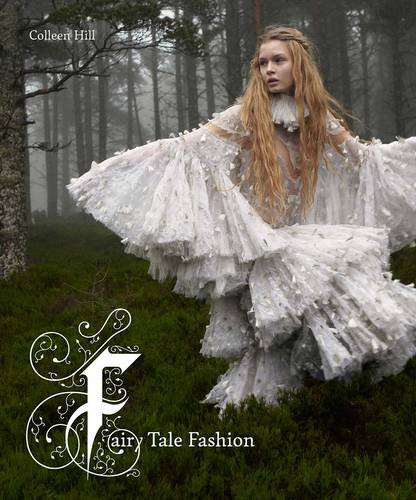
In the last section of Colleen Hill's fabulous Fairy Tale Fashion, she included some essays by other writers. I was really excited to read Ellen Sampson's "Dancing, Desire, and Death: The Role of Footwear in Fairy Tales." Twelve Dancing Princesses is one of my all time favorite tales and it's one I wish would be discussed more often; plus, the role of dancing in fairy tales can be so ambiguous and often contradictory.

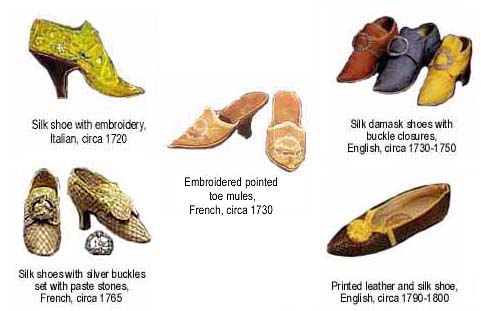
There is a section specifically on footwear, although that topic has been discussed before here, so if you're interested in further reading on shoes, you can read about the significance of shoes in Perrault's time, Red shoes in fairy tales and history,  or Kathrine Langrish's excellent essay Slippers of Glass, Slippers of Fur on Seven Miles of Steel Thistles.

The subject of dancing in fairy tales, though, is a pretty bleak one at the outset for feminists. Sampson reminds us that many fairy tales were aimed to promote obedience in women-the Victorian versions we're most familiar with reflected the values of the day. "In fairy tales, women's bodies are strictly regimented and disciplined. They are controlled physically (putting Sleeping Beauty or Snow White to sleep), spatially (locking Rapunzel in a tower), maritally (gifted to Rumpelstiltskin as a reward), or sexually. Their bodies may be transformed (into geese or trees), altered (made handless or footless, smaller or larger) or even consumed, but they are rarely inhabited or possessed by their owners for long." I'm not sure which version of Rumpelstiltskin she's been reading...the protagonist is never given to him in marriage, but the King, but there are plenty of other tales where a princess is also given away in marriage, even against her will, so the point stands.

Sampson also points out that women who stray from the culturally accepted humility and dare to long for beautiful shoes, or to dance the night away, are severely punished. Karen in "The Red Shoes" eventually gets her feet amputated, similar to the stepsisters in Cinderella whose feet are mutilated in an attempt to fit into the slipper. Then, of course, there's the stepmother in Snow White whose punishment is to be danced to death in red hot iron slippers, fresh from the fire. "The animation of the body that shoes induce is punished in the most violent and spectacular manner...The production of stillness and silence is the aim of fairy tale violence-it renders the (female) body docile." Even for Cinderella and the Twelve Dancing Princesses, who may not be directly punished, through marriage they are given to the authority of another man and their dancing is stopped. The essay ends with the uncomfortable description of Karen's confession followed by her amputation.

Yet can that really be the whole symbolism of dancing in folklore? That is just represents women who are rebellious and must be tamed? I had wondered about the different uses of dancing-sometimes it leads to death, but in Cinderella's case it is both her reward and it's the catalyst that leads to another reward, the Prince/escaping a life of servitude. Sampson explains this by saying it's all about the context-women may dance at the proper time, the proper steps, in a formal setting-but must not dance out of passion and desire, like the twelve Princesses who dance the night away in an underground kingdom. Many scholars see the twelve Princesses as symbolic of women who are mobile and capable of rebellion-they spend the night exploring, dancing in a forbidden context, and the fact that their shoes are completely worn through by morning indicates the passion and extent to which they are dancing. They weren't performing a few courtly dances, but having a wild night of excessive dancing. In many fairy tales that feature shoes, it's even ambiguous as to who's controlling shoes-the Red Shoes force Karen to dance, and maybe it's the dancing shoes that brought the twelve sisters to the underground Kingdom and forced them to dance as well.

Scholars also interpret the Princess' underground nightly romps as being sexual in nature. It makes sense, but when I was younger it never occurred to me that you would need any other excuse to sneak out at night than to have access to an enchanted Kingdom in your own bedroom to explore, and fancy balls to attend. And here it  is that we see the often confusing logic of fairy tales-characters (and vicariously through them, the readers) are rewarded with the same things they are punished for desiring. We see many tales in which the main character is rewarded for being unmaterialistic-by being given great material wealth (such as in "Beauty and the Beast"). In Cinderella, the stepsisters must have chunks of their feet cut off for daring to desire the wonderful slipper and the royal life it represents-yet Cinderella is rewarded with both. Karen longs for the red shoes when she sees a count's daughter wearing them. Karen is punished, in a way, not for wanting beautiful things, but for wanting things that don't belong to her station in life-the red shoes are appropriate for the count's daughter, not for Karen; just as the slippers are meant for Cinderella and not her stepsisters. In a way it seems unfair, especially to our modern minds where we view class distinctions as less important than most other cultures.

And, although Sampson briefly mentions "Juniper Tree" as an example of how acquiring new shoes can be satisfactory, I think it's very important to contrast to the other tales, especially "Red Shoes." In that tale, Marlene is rewarded with a pair of red shoes. It's clear that she desires and enjoys them, and they are not seen as inappropriate for her, though she is poor, because she has a good heart. It's also important to remember that "Red Shoes," the most extreme example of a preachy tale concerning shoes and dancing, is not true folklore in the sense that the story has circulated around many cultures for generations with a similar structure, but was a literary invention of one man, Hans Christian Andersen.

Even in the tales in which dancing must be quelled, there is still a level of irony. Even if the Underground Kingdom is destroyed, the reader delights in the women's adventures there each time the tale is read or heard. Even if Cinderella doesn't dance any more after marriage, the descriptions of her dress and her own nightly adventures are the most thrilling part of her story (and frankly, her forbidden journeys to the ball are not that unlike the Twelve Dancing Princesses, and the twelve are hardly ever punished either for their so-called "indiscretions"). The very stories themselves betray their morals, as listeners delight in what is officially termed bad by the "lesson" we supposedly learn afterwards.

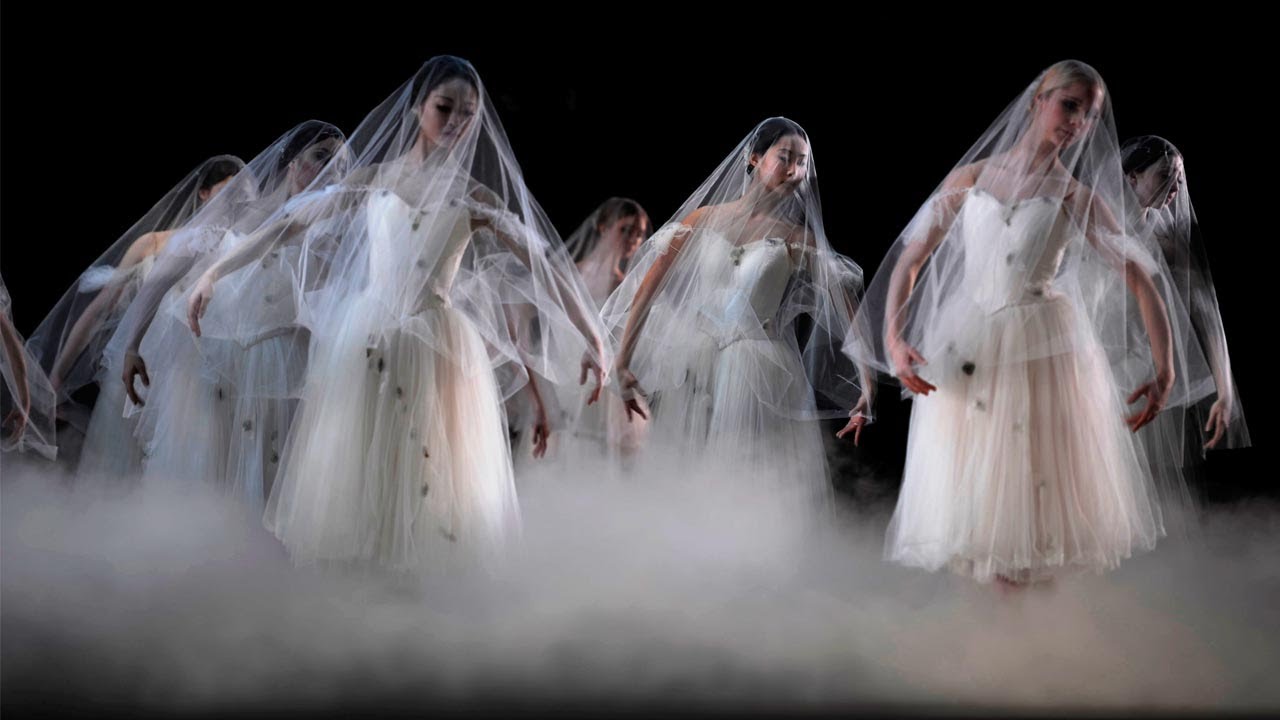
And, one story I wish Sampson had touched on is the ballet "Giselle." It's technically not a fairy tale, but neither is "Wizard of Oz" which she referred to many times. The haunting plot involves a group of Wilis, or supernatural women who force men to dance to their deaths. The idea of Wilis came from a passage by Heinrich Heine, but they are related to the Vila, a Slavic version of nymphs. In the context of the ballet, the women are said to be jilted lovers, and that is why they prey on men. So in a way, although they are the villains, the actions they perform reflect the original wrong, done to them by men-sort of like a gender-swapped version of King Shahryar in 1001 Nights, killing women because his first wife cheated on him. The very image of men being danced to death is a contrast to the popular tales referenced earlier, in which women's dancing is primarily described and their partners merely an afterthought.

How do you see the role of dancing in fairy tales?

Illustrations-"Twelve Dancing Princesses" by Kay Nielsen, "Red Shoes" by Anne Andersen, "Cinderella"-A.H. Watson, "Juniper Tree," by LBarrett, Wilis from "Giselle"-the SF Ballet

Friday, November 4, 2016

Unusual Births in Fairy Tales

It's fairly common in fairy tales for women to give birth to unusual babies. Sometimes their child is only the size of a thumb, as in Thumbling tales and variants; it might be a Snow child, or sometimes a mother might even give birth to a child that is a food, like the Pumpkin Girl, or the women born of mangoes or cucumbers in Papua New Guinea. Sometimes the mother gives birth to a healthy, human child-only to have it stolen as she is accused of giving birth to a wolf/bear hybrid, such as in Armless Maiden, or some other sort of animal. In the world of fairy tales, such accusations were believable enough to the other characters.

I used to think of tales like this as being a commentary on how we treat people who are different, and an encouragement for the underdog, which is certainly still true in many cases. But I've been reflecting on tales like these, especially where a child is born under some kind of unusual circumstances, and not just enchanted or cursed later in life (some Beauty and the Beast tales fit under each category-for example, Prince Lindworm was a lindworm from birth, unlike the cursed Beast of the French tradition).

Since being pregnant myself, I have a new level of respect for the mothers in these tales, and a sympathy for the anxiety that prospective mothers face. Even in our modern age where we can hear the baby's heartbeat and see ultrasounds, it can be pretty easy to feel anxious about your baby in between doctor's visits. For all we know now, there's still so much that's unknown-even for those who choose to find out the gender, it's still a mystery for months; as future parents, we wonder which traits our child will inherit from each of us, and what their personalities will be like-which can be exciting as well as frightening. On top of that, there's always the risk of health problems.

So I can only imagine how my current fears and anxieties would be amplified in an age where medical knowledge was limited and often wrong-many of these older superstitions, such as how to tell which gender your baby is by a variety of ways, still exist today. I can only assume that one of the purposes of such tales was a way for prospective mothers to express their fears.

I've also noticed that food and babies seem to be unusually connected in folklore. Even if a mother is more likely to give birth to a thumb-sized child than a piece of food, often these births are a miraculous result after a mother ate something (although, in Snow Child tales, it's possibly a hint that the mother was unfaithful but claims it was a supernatural birth). Pregnancy is a very odd time-for a while it's not obvious you're pregnant, it just looks like you maybe ate too much. I'm not sure how much was known in other cultures about pregnancy, they might have assumed the baby grew in a separate organ from the stomach, but it feels and looks like your baby is growing in your stomach. Not to mention the havoc your baby can wreak on your digestive system, first making it hard to keep things down, and then giving you a ravenous appetite-lately I've been feeling a lot like an ogress or a witch from fairy tales who will eat anything in sight! Then there's also the fact that we still measure a growing baby's size by, usually, corresponding fruits and vegetables (my baby has gone from being the size of a blueberry to a bell pepper to a spaghetti squash, and many other fruits and vegetables in between!).

And of course, pregnancy cravings can be the catalyst for the action in fairy tales, most notably Rapunzel. Whereas now, we're told to indulge our cravings with moderation, in other cultures, it was believed that not meeting a pregnant mother's cravings would result in bad luck. Of course, it's doubtful that that bad luck would have been worse than having to give away said child in order to meet those cravings...

Kristiana Willsy has a great article on The Toast, Hunger is the Beginning of Every Folktale. Fairy tales usually center around the greatest of human desires-whether it's literal hunger, or the desire for love, sex, or children. And often those desires become combined to the point where they are one and the same-"If the story begins with the lack of a child, then hunger becomes central. Food often replaces sex in folktales, and witches with some rule-bound delicacy are the fertility specialists of choice, second only to daring the fairies
to give you a baby hedgehog, a snow-child, or an infant the size of your thumb." (emphasis mine)

Sarah Allison also has a great post on unusual births in fairy tales. These stories often start with a woman desiring a child, and she is given something to eat that will impregnate her...only usually, she is given some kind of warning and disobeys it.  So these children are initially some sort of punishment, although it's ironic that they often turn out to be the hero in the end, like Tatterhood. So while on the surface these tales may seem like more misogynist white noise, warning women against curiosity and disobedience, it seems that the real message of these tales is not to underestimate those who are different-sometimes those very differences end up being an advantage-or even that the so-called "mistakes" we make might not really have been mistakes at all in the grand scheme of things.

In "Juniper Tree," the mother wishes for a child while peeling an apple by the Juniper Tree. From there, the gestation period of her child is linked to the growth of nature. It's her gorging on berries from the Juniper Tree that would appear to lead to her death (even though she supposedly "dies of joy", but it seems unnecessary to mention eating the berries and falling sick and predicting her own death if it's all a coincidence, and this bears similarities to the other food warnings in pregnancy tales). Later, it's the children's request for an apple that leads to the murder of this son, reminiscent of the wish that brought him about in the first place (as well as the famous poisoned apple in Snow White).

There are also tales in which an older woman desires to eat children-from the witch in Hansel and Gretel, Baba Yaga, the ogress mother in law in Perrault's Sleepinng Beauty, to the evil stepmothers in Snow White and Juniper Tree. To eat a child is the reverse of giving birth to them-Snow White's mother may have hoped to reabsorb her beauty through eating her organs, or it could be representative of trying to hinder a child's growth rather than letting them turn into adults. The fear of being eaten is always present in fairy tales, sometimes representing a literal fear of wild animals, but sometimes more symbolic. Fortunately, even if the worst fear is realized and a character is eaten, in fairy tales this is not necessarily the end-like Little Red Riding Hood, the hero may emerge triumphant and wiser for the next round against the wolf.

Illustrations-"tom Thumb," Jemima Blackburn; "The Snow Child" by Eowyn Ivy; Rapunzel images from Pinterest (anyone know the artist??), "Juniper Tree" by laurasmythart

EDIT: For more examples of strange ways of conceiving and/or giving birth, check out the linked post on Multicolored Diary!

Monday, April 6, 2015

Mothers Who Kill Their Children


I've mentioned before the surprise and wonderment that occurred when I discovered, several years ago, the existence in my library of an entire section devoted to books of and about fairy tales (which really initially spurred this blog into existence, as after I read so much I wanted to be able to remember and store the information).

On a recent trip to my local library I stumbled across another section that shouldn't surprise me-the murder section.  In the midst of various books on serial killers and famous murders, I found a title that piqued my curiosity; Mothers Who Kill Their Children by Cheryl L Meyer and Michelle Oberman, with Kelly White, Michelle Rone, Priya Batra, and Tara C. Proano. Although morbid and disturbing, I found the subject of infanticide by mothers to be fascinating, and incredibly applicable to fairy tales. The rate of mothers who abuse their children and either attempt to or succeed in killing them in fairy tales is frighteningly high. In the past, psychologists have explained this by saying it's young girls' playing out their Oedipal fantasies in which their fathers desire them and mothers are their rivals.

And while this is true on some levels-especially for those of us who were never abused, it's somewhat flattering to imagine yourself as someone else's rival, and the simplistic cast of fairy tales don't usually allow for complications like love triangles so family members tend to get in on the action-but the fact is, child abuse has been around for centuries and is not going away any time soon. Not that every fairy tale is based off of fact, but when those stories of mothers harming their children reach the public, they are sensational and tend to spread quickly. So it's not unheard of to think that the famous fairy tales such as Snow White, Cinderella, Hansel and Gretel, or Juniper Tree could have been inspired by people trying to understand how such acts of violence could have been committed by the one who is supposed to nurture and protect.

In fact, with all this discussion about the new Cinderella movie and whether or not it's feminist enough, it disturbs me a little that all of the heated debates about this tale of child abuse center around the faults of the young girl who did or didn't act too passively. (To clarify, I'm not referencing any of the reviews by my fellow fairy tale bloggers, but other ones around the internet like this one, or the whole discussion that generally circles around Cinderella). This is blaming the victim, which you should never, ever do in cases of actual abuse (read more on how to respond to someone who has been abused here). The book specifically negates any ideas that women allow abuse, or that they must all be weak and passive to have been abused.

Now don't get me wrong: I'm all for versions in which the heroine is not passive, and uses her wits and courage to creatively get out of horrible situations; I realize we apply fairy tales to situations in our own lives and patterns of passive females can be dangerous precedents. In the world of Faerie, taking risks that might be dangerous or foolish in real life are often rewarded. Plus, certain versions can make Cinderella appear extra dumb and helpless, which doesn't help matters. I still have yet to see the new movie so can't speak to how well it handles Cinderella's character and situation. Still-with all this talk over whether or not Cinderella should have rescued herself, why aren't we talking about how the stepmother could have gotten to the point where she would inflict such pain on her husband's daughter?

The truth is, abuse is something it's hard to escape. People who have been abused tend to gravitate towards abusive situations-it's all their used to, and they may believe it's all that there is or all they deserve. There is also the tendency for abuse victims to become the abusers later in life. While it's possible to escape from the cycle, the majority of abusive parents were once abused themselves. We should be asking where the stepmother came from and what her childhood was like and what factors lead to such extreme treatment of Cinderella. Research indicates that those who have been harshly punished are more likely to act violently. It's fairly common to see Snow White as a generational warning, that if Snow White is given worth for being young and beautiful, she is almost destined to become the stepmother as she grows older. The same could be said of other tales-Hansel and Gretel are more likely to be neglectful parents because of their trauma, and Cinderella is more likely to abuse her own children some day and/or end up with an abusive partner.

Not only that, but we should be looking at the whole culture. Laura J. Miller's comment on the back of the book states, "This carefully researched account shows how social forces can contribute to both the causes and cures for infanticide. Readers will find themselves shifting from asking, 'How could she do that?' to 'How could we have let that happen to her?'"

Take Cinderella. A stepmother comes in and starts dressing and treating her stepdaughter like a slave. This would have been obvious to other people in the community-they would have seen her clothes and her actions, knowing she was the true heiress to the estate, yet nobody did anything to help that we are aware of. Friends, family members, neighbors-in some versions the father is still alive, and simply passively allows his wife to treat his own beloved daughter like this. The person who is supposed to be providing Cinderella the most support and love is the one inflicting all the pain, and no one else in her community has attempted, or been successful in, stopping her. Why should Cinderella assume anyone else would be supportive?

So how do society and culture feed our understanding of why infanticide happens? From the book's introduction, "Infanticide is not a random, unpredictable crime. Instead, it is deeply imbedded in and is a reflection of the societies in which it occurs. The crime of infanticide is committed by mothers who cannot parent their child under the circumstances dictated by their unique position in place and time. These circumstances vary, but the extent to which infanticide is a reflection of the norms governing motherhood is a constant that links seemingly disparate crimes."

In short-in order for mothers to get to the point of killing their children, they have already been feeling various pressures, and get to the point of feeling completely overwhelmed. Some people dismiss all crimes of this nature as being committed by moms who just "went crazy," but this is actually very rare. When you start to look at the individual situations each of these women came from, you feel strongly sympathetic (although it doesn't, of course, justify what they did-the book is careful to never excuse their crime, but to explain why it happened and how we can prevent it).

Cultures have gotten, overall, much better in understanding the pressures of motherhood and giving women more rights. The book begins by a quick overview of the history of infanticide and the different cultures that gave women little to no value, and it seems like a miracle some societies survived at all under those conditions. Yet still, females bear the brunt of childrearing and face unique pressures. It is so strongly assumed that women want to get married and raise children, and that females are naturally nurturing and loving, that when women do struggle they're afraid to admit it, feeling guilt and shame. Obviously, the pregnancy and birth are responsibilities of women, but in cases of single parenthood, only 4% of children were raised by fathers at the time of the writing of the book (2001)-meaning 96% of single parents were mothers. Society tends to blame women for domestic violence, even when the father was the one doing the abuse.

A typical person convicted of infanticide will have several disadvantages in life. They might have gotten pregnant as a teenager and have been threatened by families or religions who don't support premarital sex. They are more likely to have been abused in the past, more likely to struggle with depression or suicide, and more likely to struggle with poverty. They were more likely to be minorities and/or lack privilege, and feel powerless in their own situations and to help their children's futures. The vast majority of women in the book were single, or if they were in relationships, were likely unsupported, abused, or going through a difficult separation. These women may not have had the education to know good parenting techniques or how to find support. Those who gave birth at younger ages were not mature enough to bear the responsibilities of parenting along with the pressures of adolescence and early adulthood, especially since nearly all of them felt unsupported by any member of their communities.
John B. Gruelle

The book divides infanticide into categories, depending on the circumstances and motivation behind the killings. One category is that of neglect-not necessarily intending to kill the child, but failing to meet their needs. This would be the case of the mother in "Hansel and Gretel". She didn't actually attempt to kill them herself, but to get them out of the picture because there was not enough food for all of them. Many have pointed out before that this fairy tale reflects earlier times when, if crops were not good, the people did go hungry and struggled with starvation, in Germany and around the world. The mother's acts were selfish, but not unheard of. Mothers who feel that they and their children have no hope and that they might save their children from suffering might attempt to kill them simply to spare them from suffering, or sometimes combined murder/suicide.

Snow White's mother/stepmother makes multiple attempts to kill out of jealousy of Snow White's beauty, and therefore assumed increased attention from the husband and father. This category is one that virtually never happens among mothers, although the authors note that sometimes males kill out of jealousy-it is men who are actually more motivated to kill a stepchild (one killed his wife's baby because he wanted to avoid the shame of raising a child that was not biologically his own).

The mother in "The Juniper Tree" appears the most evil of all. She has no apparent motive for killing, and she is the only one who actually succeeds (although the boy is transformed into a bird, and in some versions becomes a boy again). Her method of death is violent and cruel and she even goes farther than any of the disturbing cases in the book by having the boy's father eat his son's flesh.

The book may not shed light on all fairy tale characters' motivations, but will shed light on tragic circumstances that often hit too close to home. The authors surveyed 219 cases of infanticide that occured in the United States between 1990 and 1999 (and many cases undoubtably went undetected). This does not include child abuse that does not lead to death-according to safehorizon.org, more than 3 million cases of child abuse are reported each year, and childhelp.org clarifies that even though there are more than 3 million reports of child abuse, they affect the lives of more than 6 million individual children. (The book contains statistics, but being published in 2001, are not as up to date). These numbers are sobering. I can't help but wonder how our discussion of blaming Cinderella for "allowing" her abuse affects these people who have suffered and already experience feelings of guilt and shame.

The book was fascinating, although it was very difficult to read simply because of the material. The worst was reading the descriptions of how certain mothers killed their children. But the book suggests ways that culture and the government can provide more support to mothers and prevent these things from happening. Parenting is difficult even in the best of circumstances; and the more certain families suffer, the more difficult raising children becomes. Even in our own communities we can do our best to encourage and care for mothers who face troubling circumstances and their children. It may be true that many of the murders in the book could have been avoided if there had been a friend willing to lend a hand and show these mothers that there was hope for themselves and their children.

Cinderella illustrations-Frederic Theadore Lix, Valentine Cameron Princep
Snow White illustration-Charles Robinson
Juniper Tree-Warwick Goble

*Note-all the information about cases of infanticide and abuse were taken from the book; but the book had no application to fairy tales, so those are my additions

Sunday, September 28, 2014

Fairy Tale Endings: Happy, Bittersweet, Tragic

Roland Risse

Fairy Tales are often criticized for being simplistic, and for providing unrealistic happy endings. Of course, when you begin to familiarize yourself with more fairy tales, you realize this simply isn't true in all cases; however, many of the most well-known fairy tales do end happily, and happy endings remain true to the "fairy tale formula."
John Batten, "Tattercoats"
Beloved stories like "Cinderella," "Jack and the "Beanstalk," "Sleeping Beauty," "Frog Prince," and so many more end in the most traditional way: usually a wedding, while the villain gets punished. Yet even among the favorites, there are exceptions. There are unhappy versions of Cinderella (see here and here), Andersen originally wanted his Little Mermaid to end with her death and had to adjust the story to please his editors, Perrault's "Little Red Riding Hood" is eaten at the end.

Yet still, fairy tales that have become popularized are predominantly happy.

Kay Nielsen

But the "happily ever after" stories aren't the only form of fairy tales. There's another category I would call "bittersweet." Although there is a form of resolution at the end, it isn't perfect; there is still some physical evidence of trauma left after the story is done. For example, in the tale Juniper Tree; while in the Grimms' version the bird is transformed back into a boy, in other versions, such as the English The Rose Tree or the Scottish "Pippety Pew", the child remains a bird. But they aren't completely tragic stories; the bird is a beautiful creature, who sings a song which reveals the truth, rewards the kind father and daughter, and kills the evil mother. There is still life after tragedy, but the life is different than it was before. There's a sort of comfort and realism in this fact-it's not an empty assurance that things will be fine, but hope that a horrible situation can be redeemed.
Eleanore Vere Boyle

Another fairy tale with a bittersweet ending is "The Wild Swans." The princess is united with the good King and her brothers transformed back into humans-all except the last one, who will forever remain with a wing for an arm; a reminder of their enchanted state, and the fact that curses will often have consequences. Andersen's "Little Match Girl" is another very sad tale in which the Match Girl dies, although the story makes it clear that her life is very unhappy, and in her visions she sees her Grandmother welcome her into Heaven, so even in that unfortunate tale, there is hope.
Anne Anderson

Then, there are the fairy tales that are completely tragic. You won't find these in collections of children's tales, but they abound in the collections of Schonwerth, the Grimms, and Andersen. Hans Christian Andersen just loves to feature helpless creatures with no control over their destiny; besides "Little Mermaid," which I mentioned before, "The Steadfast Tin Soldier" ends with him being burned in the furnace. Throughout the whole tale, he never makes a move or utters a word to help himself; I like to think Andersen was playing on the fact that, while he might have had feelings, at least in the eyes of the child who played with him, he was, ultimately, a toy; incapable of actually doing anything to defend himself.
Kay Nielsen

Along the same vein, a random little story of Andersen's called "The Money Pig" is about a toy piggy bank. After describing some of the games the toys played in the nursery, the money pig falls off the shelf, shatters, and his pieces are swept into the dustbin. The tale leaves you with no sense of purpose or hope.

Of all the tales I've ever read, I still think the creepiest is the Grimms' "How children played Butcher with each other." It's not just that there's a tragic death, which happens in other tales-but there's no villain or motive; it's just children being shockingly ignorant and cruel.

Many of the stories in Schonwerth's collection weren't meant as much to entertain, but to warn people about local superstitions. You might find stories about certain events which were interpreted as foretelling doom or death; warnings about how to recognize Drudes or witches, or stories such as "Death of a Woman in Childbed" in which a woman dared to comb her hair after giving birth, on a Sunday while everyone else was in church, and died because of her unbelief. Or this other, very short and sad tale, "Till Death..."

"A girl had committed herself to being eternally faithful to her beloved; he died serving in the war, and she began a new relationship. One night, her former beloved appeared on a white horse and took her away to his grave where she was found dead in the morning."


Edmund Dulac

I think there's a place and purpose for each kind of tale. Sometime we just need an escape: a happy, predictable tale to comfort or give us hope. Other times we want a little more realism, and sometimes we want send warnings, or just to be a little scared, which is a form of challenging ourselves/having fun with friends and giggling at ghost stories. It's unfortunate, though, that few people realize the spectrum of fairy tales that are out there; some people think fairy tales are too violent and old-fashioned and unsuitable entertainment for children; others think they're too simplistic and perfect, and not realistic enough. But whatever your preferences and purposes, there's always some fairy tale, in some version, that could be helpful.

Tuesday, July 29, 2014

Evil Stepmothers: Another thought

I just recently listed a few reasons that mothers in fairy tales are villainized, historically, but I had another thought.
Louis Rhead

I don't know much about postpartum depression, but 10-20% of women are estimated to have clinical depression after giving birth. These women will have negative feelings towards their baby, sometimes wanting to hurt them: "when a woman with severe postpartum depression becomes suicidal, she may consider killing her infant and young children, not from anger, but from a desire not to abandon them." Most women never act on these thoughts, but some women, like Andrea Yates and Susan Smith, killed their children because of this condition. In fact, according to this article, over 200 women a year kill their own children in America (!!!).
Willy Planck
"Hansel and Gretel"

Even after the average birth, it's common to experience some form of "baby blues," emotions or sadness that go away after time. But 10-20% is pretty high-anyone who knows 10 mothers most likely knows at least one person who experienced postpartum.

It's a pretty strange thing to try to wrap your mind around, especially for those of us who have never given birth. Even today, when we are aware it's a serious medical condition, it's hard to understand what these new mothers are going through. How much more so hundreds of years ago? The mothers going through this would have really seemed like monsters if they tried to explain their feelings.
Jennie Harbour
"Snowdrop" (A Snow White variant)

So many fairy tales are about mothers acting violently towards their children-remember that in older versions, Snow White and Hansel and Gretel were abandoned by their birth mothers, not stepmothers; but many other fairy tales, like Cinderella, Juniper Tree, Wild Swans, etc., feature abusive and/or murderous mothers. Maybe some of these stories came out of/were considered helpful for the fathers and family members who witnessed a mother experiencing inexplicably violent wishes towards her baby? Or maybe the stories were ways that the mothers themselves could vicariously fulfill their own desires without actually acting on them?

I don't think I've ever read anything connecting postpartum to violent fairy tale mothers, although if it really occurs so often, people throughout history would have witnessed mothers they know going through this, and it makes sense that the stories would help the different people involved start to process through the experience.

Any thoughts?

Saturday, July 12, 2014

Red Shoes in Fairy Tales and History

"The Red Shoes" is a tale by Hans Christian Andersen, one that really reveals his tendency to condemn a young girl, in this case for her vanity, and make her suffer incredible punishments that seem to far outweigh the crime.

Karen, the protagonist, struggles with vanity long before she even comes into contact with the fateful shoes. "People said that she was pretty. But the mirror told her, 'you are more than pretty-you are beautiful.' " A throwback to Snow White's evil Queen, perhaps, another vain character known to listen to her mirror?
"Mirror Mirror on the Wall"-P J Lynch
Karen chooses red shoes for her confirmation, causing everyone to stare at her shoes the whole time. She continues to wear them, despite how "improper" they are to wear to church. She is no longer able to focus, but thinks of her shoes the whole time-"she forgot to say the Psalm, forgot to say the Lord's Prayer."


The first time Karen danced a few steps in the shoes, she found she couldn't stop, until the shoes were removed. She still thinks about the shoes even when she isn't wearing them, and finally wears them to a ball. This time she starts dancing and can't stop. After dancing for days, past meadows and fields, she is condemned by an angel: “Dance you shall,” said he, “dance in your red shoes till you are pale and cold, till your skin shrivels up and you are a skeleton! Dance you shall, from door to door, and where proud and wicked children live you shall knock, so that they may hear you and fear you! Dance you shall, dance—!”
Thomas Vilhelm Pedersen

She even passes a funeral for herself, and knows "she was forsaken by everyone and damned by the angel of God." Nothing can help her until she goes to the executioner and asks him to chop off her feet. Even the first time she tried to go to church again, the red shoes were still there, dancing on their own, and she had to repent of her sin.

After that she became the image of piety, "industrious and thoughtful," and when children "asked her about dress and grandeur and beauty she would shake her head." After living in humble piety for a while with her crutches, one day she is taken up to Heaven, "and no one was there who asked after the Red Shoes." (Italics part of the story, not my emphasis).
Anne Anderson

All that for a pair of shoes seems rather extreme, but wikipedia includes this pertinent background information: "Andersen explained the origins of the story in an incident he witnessed as a small child. By his report, his father was sent a piece of red silk by a rich lady customer, to make a pair of dancing slippers for her daughter. Using red leather along with the silk, he worked very carefully on the shoes, only to have the rich lady tell him they were trash. She said he had done nothing but spoil her silk. "In that case," he said, "I may as well spoil my leather too," and he cut up the shoes in front of her."

So Andersen may have had bitterness towards the rich more than towards women and girls especially. She originally wants red shoes because she sees a princess wearing them.
Katherine Cameron

This paper by Anastasia Yuanita sees the story as cautioning children more about obedience than vanity. Karen tricked her adopted mother into buying her red shoes, and wore them over and over again after being told not to. As far as we know, the princess in the beginning was never condemned for wearing her red shoes, so her sin could be idolizing the shoes more so than just wanting and wearing the shoes in and of themselves, good news for any of us who happen to own red shoes. Plus, extremely didactic tales enforcing children's obedience were pretty much the norm at the time.

However, when you look at this story in combination with Andersen's others, you really do start to notice a pattern. Inger of "The Girl Who Trod on a Loaf" is given even more dire punishment. This girl is bad, cruel, and proud-even despite her poverty. In her vanity and foolishness, she uses a loaf of bread given to her to place in the mud to keep her shoes from getting dirty. For this she becomes a statue in the underworld, forced to hear the voices of people up above telling her tale as a warning against wickedness, and she wishes she had never been born, and that people had punished her more for her waywardness.
Arthur Rackham-shoeless Gerda

In contrast, the good heroine of "Snow Queen," Gerda,shows her devotion by throwing her red shoes, her "treasure," into the river. (Interestingly, although you can find illustrations of Gerda with and without shoes, I haven't found any pictures of her wearing those red shoes, has anyone else?)

I couldn't help but wonder how much of Andersen's attitude towards red shoes were universal, and how much was his own, so I did a little digging.

From BBC News: "In the 1670s, Louis XIV issued an edict that only members of his court were allowed to wear red heels. In theory, all anyone in French society had to do to check whether someone was in favour with the king was to glance downwards. In practice, unauthorised, imitation heels were available."

Louis XIV's shoes in a portrait by Hyacinth Rigoud
  • Footwear facts
  • In Europe in the sixteenth and seventeenth centuries heels on shoes were always colored red. 
  • Six-inch-high heels were worn by the upper classes in seventeenth-century Europe. Two servants, one on either side, were needed to hold up the person wearing the high heels.
This lecture tells us that "woman in red" was basically a code name for "prostitute" in England and France in the nineteenth century. Prostitutes could also be identified simply from their dress-being overdressed according to cultural wardrobe norms. 

Yet, red shoes couldn't have been a universal symbol for wanton sexuality, especially (one would assume) if there were pairs available for little girls. Plus, in the Grimm's The Juniper Tree, when the brother is resurrected as a bird, he rewards his sister Marlene by bringing her a pair of red shoes from the shoemaker. Marlene is only represented as good and kind, and was thankful for the present.

In fact, I'm finding it difficult to research the importance of red shoes in nineteenth century Europe. It seems shoes of many different colors were fairly common, especially by the mid-1800s.
A pair of red shoes pictured among other colored shoes

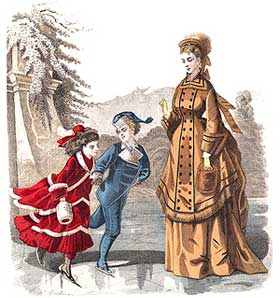
People also associate Red Riding Hood's red cap with daring and/or sexual overtones, but she clearly wasn't the only little girl wearing the bold color, as this mid-nineteenth century fashion plate reveals

Dorothy's shoes were only changed from silver to red to show off MGM's brand new color filming
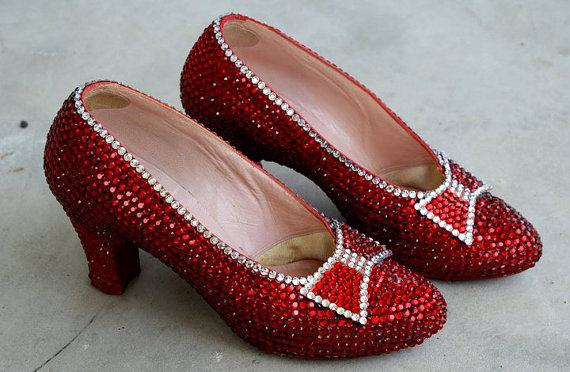
House of Harry Winston's Ruby Slippers-created from diamonds and rubies for the 50th anniversary of "The Wizard of Oz," these are supposedly the most expensive shoes in the world ($3 million)

And to bring it back to the Snow White reference at the beginning- if you missed it the first time, you should definitely check out Gypsy's post on the red-hot iron shoes Snow White's evil stepmother was forced to dance in. Here's the warning:
Warning:
This post is NOT for everyone.
It discusses historical torture methods.
Skip this if you have a sensitive stomach.

There are so many other fairy tales that deal with shoes in general, so I tried to keep this post limited to discussion of red shoes specifically (although you could also throw in the stepsisters from Cinderella-after putting their mutilated feet into Cinderella's slipper the trickling red blood is what tipped the Prince off to their deception). Any thoughts on the symbolism of red shoes in fairy tales, and/or historical facts about red shoes?

Thursday, October 4, 2012

Juniper Tree Variants

The Juniper Tree seems to have a deep appeal to many fairy tale lovers, despite its darker elements. The traditional version is found in the brothers Grimm.

Kay Nielsen
 
The Rose Tree is an English variant, by Joseph Jacobs, in which the children are gender-reversed -which struck me as odd when the bird gives the brother a present of red shoes. Having the mother hate her daughter seems so predictable in fairy tales, but in Rose Tree some of the elements are especially reminiscent of Snow White.

In Juniper Tree, the mother has no reason to hate her son other than the fact that he came from her husband's first wife. In Rose Tree, the hatred comes from jealousy. As the wife combs out the hair of the daughter, she "hated her more for the beauty of her hair." She sends the girl to fetch a comb, then a billet of wood, then " 'I cannot part our hair with a comb, fetch me an axe...now, lay your head down on the billet whilst I part your hair.' Well! She laid down her golden head without fear; and whist! Down came the axe, and it was off. So the mother wiped the axe and laughed."

Later, the mother cooks the heart and liver of the girl, which is reminiscent of Snow White's stepmother's attempted cannibalism-only this evil mother is successful.

As monstrous as this mother is, the mother in the Scottish tale Pippety Pew has no reason at all to murder her son-who is her full blooded son, not a stepson-other than to hide the fact that she tasted the stew she made for dinner "till she had tasted it all away, and she didn't know what to do for her husband's dinner. So she called Johnnie, her son, to come and have his hair combed. When she was combing his head, she slew him, and put him into the pot."

Warwick Goble
 
Then as the father unknowingly eats his son, the scene is more disgusting than the other variants. The father comes across the different body parts, saying, "surely that's Johnnie's foot" and "That's surely my Johnnie's hand" and yet still eats, implying this father is either incredibly stupid to confuse a human foot with a hare's, the explanation given by his wife, or knowingly feasts on his son.

In the Grimms' version, the bird is transformed back into a boy at the end. In neither the Scottish nor English counterparts does the bird ever regain human form. But I personally like the idea that there can be redemption and hope, despite the fact that things will never be the same again-it's more comforting in its realism. We all suffer loss and disappointment, and in life not everything is restored just the way it was, but it can be transformed into something new and beautiful.

Tuesday, November 1, 2011

Trees and folklore?


Reader Radha Pandey is doing a project on trees in folklore, myths, and legend, and we've started a discussion in the comments to my post on Juniper Tree, but I wanted to make you all aware of it so we could have more input. So far we've thought of, obviously, the Juniper Tree, as well as Cinderella variants where the tree is a way for Cinderella to communicate with her dead mother and receive gifts from her.


Also, I'm very glad that reader Dawn alerted me to the Grimm tale One-Eye, Two-Eyes, and Three-Eyes because of my interest in beauty standards and society's treatment of people who don't measure up to them. In this tale, which is similar to Cinderella, the stepsisters have one and three eyes, respectively, and mistreat their sister who has two eyes "like regular people." Though it's unusual that Two-eyes is mistreated because she is normal, those who are different are still represented as evil, for ugliness and evil go hand in hand in so many tales. (Two-Eyes, of course, just happens to have great beauty.) But the tree is very significant in this tale as well, for after Two-Eyes' animal helper, a goat, has been killed by her mother, from the entrails springs a magical tree with golden apples. The tree is also the means by which Two-Eyes is made known to a knight that passes by, for the tree will only allow her to pluck fruit from its branches.


In both of these tales the tree is a means of preserving someone's spirit after they've died, and a way of giving help and gifts to the living.


In the Firebird, there is another tree with golden apples, which the Firebird steals. Ivan's catching of the Firebird in the garden kickstarts his adventures.


What else is out there? I may know a little about folklore but virtually nothing about myth and legend.

Thursday, October 6, 2011

The Juniper Tree

Below is a summary of The Juniper Tree, a tale from the collection of the Brothers Grimm, full text can be read here. Look for the significance of food/eating, and the similarities between this tale and Snow White.

A long time ago, a man and his wife loved each other greatly but were sorrowful that they had no children and prayed fervently for one. One day when the woman was peeling an apple under the juniper tree in the garden, she cut her finger and blood dripped on the snow. She wished for a child as red as blood and as white as snow, and felt happy.

Spring came, and as the berries grew on the Juniper Tree, a child grew in her womb. The woman gorged herself on the berries from the Juniper Tree until she felt sick, and asked that if she die, she be buried under the Tree. The woman finally bore a son, as white as snow and as red as blood, and died of joy. The man was heartbroken and wept for days. After a time he felt better and was eventually ready to take a second wife.

The second wife gave birth to a daughter, and was concerned that her daughter receive the entire inheritance, and was harsh and cruel to the son.
One day her daughter asked her for an apple, and she gave her an apple from a chest with a big heavy lid. The girl asked if her brother could have an apple as well, and the woman, annoyed, said that the boy could have one when he got home from school. When he did, the wife acted as if possessed by the devil-she gave him a look of hate but asked sweetly if he would like an apple. He did, and as the little boy bent down into the chest, she slammed the lid down and his head flew off into the apples.

The wife realized with fear what she had done, and quickly fetched a scarf, propped the boy's body up, and tied the head on with the scarf. When his sister Marlene asked him a question and he did not answer, she became frightened of his stillness and pale face, and asked her mother about it. Her mother suggested that, if her brother did not answer her again, she slap his face. Marlene did this, and his head flew right off. Marlene ran crying to her mother, who said, "What a dreadful thing you've done! But don't breathe a word to a soul, for there's nothing we can do. We'll cook him up into a stew."

The mother chopped the little boy into pieces and cooked them into a stew which needed no salt because Marlene sat there and wept into it. When her father returned home, he asked where his son was, and his wife told him he had gone to stay with his uncle. The father was upset that his son had left so suddenly without saying goodbye, but he began eating the stew and thought it was delicious. He kept eating more and more, saying, "No one else can have any of it. Somehow I feel as if it's all for me."

Marlene sat crying through the meal. As her father threw the bones under the table, she collected them, tied them up in a silk handkerchief, and buried them under the Juniper Tree-only then did she feel better and stop crying. Just then a mist arose fom the tree, in which a flame was burning, and from the flame emerged a beautiful bird that began to sing. Marlene felt happy and returned home.

Kay Neilsen

The bird began to sing:
"My mother, she slew me,
My father, he ate me,
My sister, Marlene,
Gathered my bones,
Tied them in silk,
For the juniper tree.
Tweet, tweet, what a fine bird am I!"

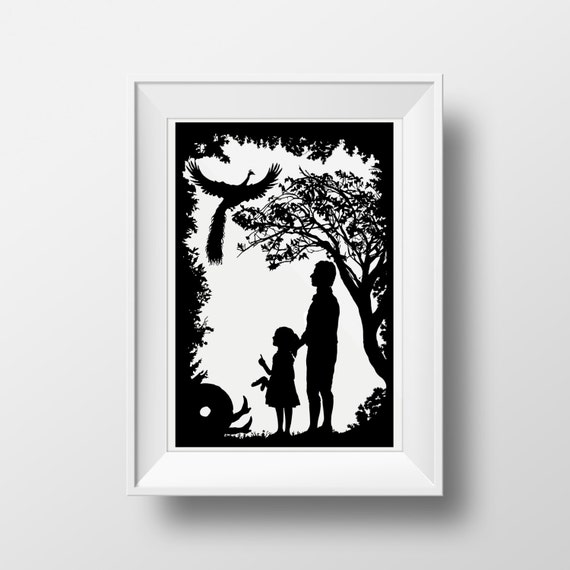
The neighbors who heard the bird all came out and begged him to repeat his song for them, but the bird said he would not repeat his song for nothing. He received a gold chain from the goldsmith, red shoes from the shoemaker, and a millstone from the mill workers, in payment for singing his song to them. Then the bird returned to the house with the Juniper Tree and began to sing his song again. His father felt happier the more the bird sang, the mother more frightened, and Marlene continued to weep. But the bird dropped the gold chain around the father's neck, and the red shoes at Marlene's feet, and she was happy again. The mother went outside to see if she would feel better too, but the bird dropped the millstone on her head and she died. The bird vanished in a cloud of flames, and when they left, their brother and son was standing there, and they all went in to a meal together.


Warwick Goble

This macabre tale adds cannibalism to the list of unsavory events that happen in the fairy tale world. In this tale, I don't find the murder scene nearly as chilling as the dinner scene, with the father obsessed with the stew made of his son's meat-though he is portrayed as a good character, his emotions in this tale are dramatically different than Marlene, the real compassionate hero, who was told that her brother's death was her fault.

This tale is not a true folk tale, but from a text given to the Grimms by Philipp Otto Runge, which is why it is a bit more realistic than some fairy tales. The mother has many emotions, from annoyance with her stepson, and when she kills her stepson it isn't necessarily the natural result of her hate but the result of a moment of temporary insanity; afterwards she is plagued by fear and guilt and tries to cover up what she's done, unusual for evil stepmother characters.

Maria Tatar says that both P.L. Travers and J.R.R. Tolkein thought this was a beautiful tale, despite its gruesome aspects, and I agree. Though the Grimms' version ends with the boy returning, some versions keep him as a bird. Though I'm happy for the family reunion ending (which represents the ideal family as motherless, which is a whole other issue...) I might like the other ending better. Again, it's more realistic. The son has been deeply traumatized and will never be the same, but there is still hope when he is transformed into a different, beautiful creature who recounts his story through song.