
Showing posts with label East of the Sun West of the Moon. Show all posts
Showing posts with label East of the Sun West of the Moon. Show all posts
Thursday, July 27, 2017
Jazzmeia Horn: East of the Sun (and West of the Moon)-Fairy Tale Titles
I was excited to see a fairy tale title-and a refreshingly not overused one at that-as the title of a new jazz song by Jazzmeia Horn. The lyrics don't really have much to do with the plot, other than being a love story-other words repeated throughout the song are "closer to the sun in the day and nearer to the moon at night." Still, it's a great song if you're a fan of classic jazz, and there's some level of fairy tale inspiration.
Although it is interesting to use the title but seemingly nothing else of the story...sort of like David Bowie's "Beauty and the Beast," although that title has more mass appeal than "East..." does. There's probably many more songs, and other forms of media, with this phenomenon that I'm not even aware of (share in the comments?). The vague idea of being "fairy tale inspired" is also popular in fashion but rarely has specific references. Why does the title itself appeal to people? You would think those who were drawn to a fairy tale name would also want other connections? Or do we just like the vague connection to folklore? (Or are the artists themselves aware of the fairy tale, or do they just use the name for the sound of it? "East of the Sun and West of the Moon" is a very poetic phrase, but Jazzmeia Horn seems a little more likely to research titles than other pop artists.)

Friday, April 21, 2017
Sleep in Fairy Tales
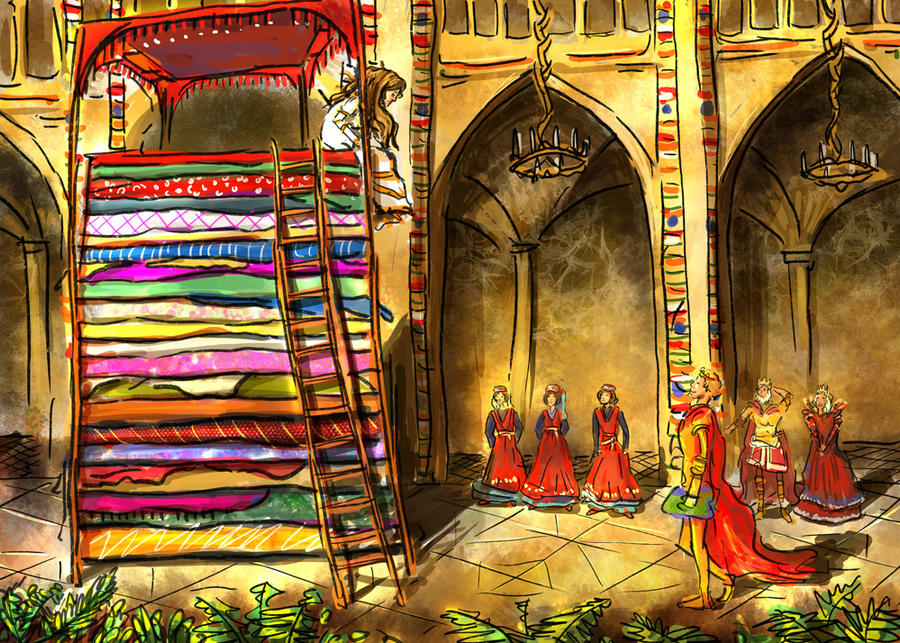
With my son Pearson almost 2 months old now, I have never been more sleep deprived in my life. Sleeping during the day when the baby sleeps, the advice you're usually given, is not as easy as it sounds-especially when you've always had a mild case of insomnia. I always used to think the main character in "Princess and the Pea" was too unrelatable-who wants to be a Princess who's too pampered and sensitive? But when I started to think of the pea as being the thoughts that keep me up at night, or a brain that takes a long time to relax, I now think of it in a whole new light.

Viktor Mikhaylovich Vasnetsov
I also find it very ironic that "Sleeping Beauty" begins with the desire for a child and then involves a supernaturally long sleep. By now, the mere thought of getting a full 8 hours of uninterrupted sleep is a longed-for fantasy, so rather than seeming like a curse, the idea of a 100 year's nap sounds wonderful. Maybe the sleeping princess isn't a way to condition little girls to be passive, but sometimes simply the parents telling a story expressing their own desire for sleep after that beloved baby finally arrives.
Yet, sleep functions very differently in other tales. In Animal Bridegroom stories, such as "East of the Sun and West of the Moon," the heroine disobeys the warning not to look at husband while asleep, and must go on a journey to find him. In many versions, she often then finds him engaged to another woman, where she finds a way to come to him at night but he is in a drugged sleep. Sleep is a source of temptation and an obstacle to be overcome in these instances.
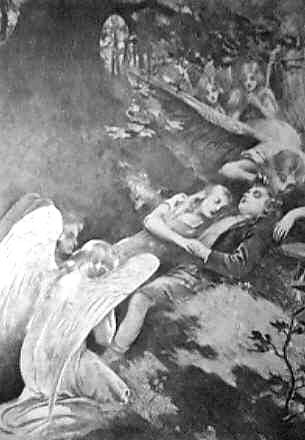 Sleep can also be a dangerous, unguarded time, for heroes and villains. In "Hop o' My Thumb," the titular main character tricks the ogre into killing his sleeping daughters instead of himself and his brothers, and they use the rest of the night to escape. Many protagonists must escape a villain's house during the night, under the cover of darkness-so what is risky for one character is protection for another.
In the "Twelve Dancing Princesses," their lack of sleep part of an ambiguous curse; it's the Prince's avoiding sleep that allows him to find the truth. Same with Hansel and Gretel-they overhear what their parents intend to do to them overnight, and Hansel gathers the pebbles while their parents are sleeping. Later, it's while they sleep in the forest that their parents abandon them, sleep once again functioning as danger.
What other fairy tales are there that feature sleep/lack of sleep?
Illustration-William de Leftwich Dodge, 1899
Tuesday, February 14, 2017
The Sleeping Prince
In my post on the different ways of Awakening the Sleeping Beauty, reader Nectar Vam shared this fantastic gender swapped version of the tale, The Sleeping Prince. It combines elements of Sleeping Beauty, Snow White, East of the Sun and West of the Moon, and even reminded me a little of Beauty and the Beast with the enchanted castle at the end. A bird tells a Princess of a sleeping Prince, who is white and gold and red, and goes on a dangerous journey even though she knew her parents wouldn't approve. She has to go to the lands of the West Wind, East Wind, and North Wind, where mortals should not go, and follow instructions to get past two lions that guard the gates of the castle, and awaits the time when the Prince's spell will be over.
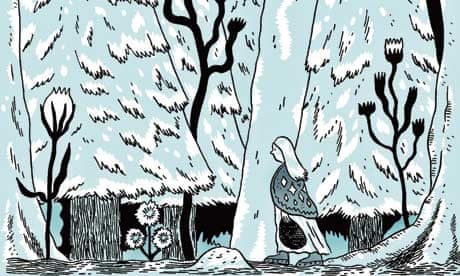
It very much has the feel of a traditional folk tale to me, and although the sleeping prince trope may be much less common, if you look hard enough you can generally find gender swapped versions of any classic fairy tale-especially since this one bears resemblance to the journey of the heroine in "East of the Sun, West of the Moon." But the only sites I could find the tale at had no source cited-Wikipedia has a tale of the same title but it's clearly different (although also fascinating-in this one the heroine must stay awake watching the sleeping Prince for 3 months, 3 weeks, 3 days, 3 hours, and 3 half hours. She is persuaded to sleep towards the end and then follows a Goose Girl-type episode of mistaken identity). This site says it's Spanish (thanks, Amy Elize!) but has no further information on collection, editor, date, etc. So I can't promise it's authentic folklore but an interesting tale worth reading and sharing! Any further information on it would be welcome! UPDATE: Sarah Allison has more information on the source in the comments. Thanks, Sarah!
 Also-in the past I've done features on roses in fairy tales on Valentine's Day. Interestingly, the key to getting past the lions in this tale is to pick two white roses from outside the North Wind's door, and throw them down before the lions when she gets close enough-something that would require lots bravery, since the lions act threatening until she gets close enough to throw down the roses! And the episode also reveals the great amount of power sometimes associated with roses in fairy tales.
Image sources-1 and 2
It very much has the feel of a traditional folk tale to me, and although the sleeping prince trope may be much less common, if you look hard enough you can generally find gender swapped versions of any classic fairy tale-especially since this one bears resemblance to the journey of the heroine in "East of the Sun, West of the Moon." But the only sites I could find the tale at had no source cited-Wikipedia has a tale of the same title but it's clearly different (although also fascinating-in this one the heroine must stay awake watching the sleeping Prince for 3 months, 3 weeks, 3 days, 3 hours, and 3 half hours. She is persuaded to sleep towards the end and then follows a Goose Girl-type episode of mistaken identity). This site says it's Spanish (thanks, Amy Elize!) but has no further information on collection, editor, date, etc. So I can't promise it's authentic folklore but an interesting tale worth reading and sharing! Any further information on it would be welcome! UPDATE: Sarah Allison has more information on the source in the comments. Thanks, Sarah!
Image sources-1 and 2
Friday, January 29, 2016
What Fairy Tales REALLY Say About Curiosity

Yet, when you ignore the moral tacked on at the end or inserted by an editor trying to make their tales more marketable for children's instruction, what do the tales themselves actually say about curiosity?
Sleeping Beauty-the Princess is exploring the castle one day and finds a spindle, and touches it, having never seen one before. She falls into deathlike sleep, as was predicted by the fairy (and really caused by her father's attempts to prevent the spell from happening). But after her sleep is over, she ends up with a royal husband and is none the worse for her long nap (also an extra episode with an evil mother in law in some versions, but that also gets resolved and the villain punished)


-And, in the "Twelve Dancing Princesses" category, we have to remember Kate Crackernuts, a version in which it's a female who does the exporing into the hidden Kingdom, saving her sister and a prince in the process! Thanks Sue Bursztynski :)
Bluebeard's Wife-opens the door to the forbidden chamber. Because of this she is threatened with death by her husband, but he is killed, and his killing seen as just. His widow ends up with his estate, and her freedom.

Jack and the Beanstalk-climbs up the beanstalk and discovers the world of giants. This gets him into a dangerous situation from which he ultimately escapes and triumphs, ending up with the money he lacked at the beginning
East of the Sun, West of the Moon/Cupid and Psyche-the heroine disobeys an order not to look upon her husband, seeing how hot he secretly is. She has to go on a long, hard journey to win him back, but they do ultimately end up together and happy

First of all, curiosity does often bring challenges and obstacles. (Even to males, like Jack!) And that, honestly, can be true. There's the old saying, "ignorance is bliss"-it's not always easy discovering new knowledge that might challenge your worldview, or the truth about a person you thought you could trust. Curiosity leads to discovering something you didn't know before, and that often sends you on a different life path than you were previously on. It's the same in detective stories-digging through clues and getting closer to the truth can put you in dangerous situations with the criminals, but is necessary for obtaining justice.
But if fairy tales truly wanted to condemn the curious, the characters who went where they weren't supposed to and opened locked doors would ultimately end up dying and/or unhappy-many fairy tales really do end tragically! The Grimms weren't afraid to punish disobedient children in their stories, or to make their villains suffer horribly. Yet the endings reveal that those who pursue knowledge really are the heroes and heroines, not the villains. Sometimes that forbidden discovery really enables the happy ending to happen. We, the readers, always want to know what lies on the other side of the door just as much as the characters-by listening we are complicit in the discovering alongside the protagonists! It would be too ironic if stories themselves (which impart ideas and knowledge) were to truly condemn discovery of other ideas and knowledge!
Of course, there are boundaries to curiosity. The Victorian idea of not indulging curiosity isn't entirely bad, because you should also respect other people's privacy, etc. The level to which the characters actually crossed that boundary could be debated for each tale and variant (such as Goldilocks). But for most of these stories, the plots of fairy tales ultimately speak louder than the official morals, and the characters who display curiosity are clearly the sympathetic protagonists.
Illustrations-Kay Nielsen
Friday, February 6, 2015
Fairy Tale Romance
Probably the biggest problem people find with fairy tales is that promise of a "fairy tale romance"-the love at first sight and implied message that if you find romance, your life will be complete and all your problems over. I myself don't like the idea of love at first sight (one of the reasons I love "Beauty and the Beast" so much). And while fairy tales involve incredibly dark, scary, traumatic experiences for the main characters, it's true that they never include breakups. Conflicts often start at home with parents and siblings and end by entering into a new family situation-as husband and wife.

But a huge reason for this is simply: fairy tales come out of a time in history where there was no dating. Marriages were largely arranged for much of human history, sometimes as business transactions, often just out of necessity so that the people could help each other out in all the work it took to feed and clothe themselves. People got married much younger, meaning there wasn't this time of limbo in which people could dream and wonder about what their spouse might be like; their options were much more limited in small rural communities. In the 1700s the idea of individuals choosing their own marriage partner began to take hold, but even then dating looked a lot different-gentlemen callers would woo a lady in her own home, under the supervision of a chaperone. Dating as we know it today-two young people going out on their own, potentially to see if they are compatible for marriage but sometimes just for fun and to enjoy each other's company, has really only been around for about 100 years.
So fairy tales don't reflect our current issues involved with dating; breakups and heartbreak, the stresses of figuring out what to look for and expect out of a partner, because they couldn't. However, although many fairy tales end with a marriage that leads to the cliche "happily ever after," many fairy tales also reveal some of the problems that can happen within a marriage.

In "The Fisherman and His Wife," an unhappy wife is never content with their current situations. Her demands on her husband and the magical fish he found become too much.

In the line of Selkie tales, magical sea creatures who turn into women are tricked into becoming wives of the men who hide their selkie skin. While they may appear to live happily for a time, the Selkies long for their true home (sometimes their original husbands,) and as soon as they find their skins, they leave their mortal husbands and go back to the sea.

In Rumpelstiltskin, we see a marriage that was based off of a father's deception. As a result, the nameless bride must labor under the threat of death from her husband. She was naturally distraught and only escaped that harsh punishment by a strange little man who manipulated her into promising to give him her first child.

How about the parents from Rapunzel? The mother was overdramatic and demanding about her pregnancy cravings-"if I don't get some rampion to eat...I know I shall die." Her husband then agreed to give the witch the child he and his wife longed for so much, so you know there was lots of marital strife in their house when the mother found out.

That couple as well as many others-such as the parents in Sleeping Beauty-begin their tale unhappy because they are childless ("so sorry that it cannot be expressed"). Then they have to deal with the stress of having a death curse put on their only child. Although their marriage itself may have been healthy, their married life was far from perfect.

How about the wife from Hansel and Gretel who convinces her husband to abandon their children in the woods? And the host of fairy tales featuring domineering wives who abuse the children in their care, Cinderella, Snow White, Wild Swans, and Juniper Tree-the husbands, when present, are weak enough to be overpowered while his wife takes over and tries everything in her power to get rid of his children.

What about East of the Sun, West of the Moon? The wife soon became sorrowful because she was left completely alone all day and ended up looking at her husband at night when she wasn't supposed to. He was taken from her, and she had to go on a long, arduous journey and win him back from another woman.

Then of course, Bluebeard is the ultimate example of a warning about the potential dangers found within a marriage. It can be read on a more symbolic level as well as literal-sometimes the person you are dating has figurative skeletons in his (or her) closet. As much as you can, make sure that your partner is totally trustworthy before you marry.
So although many tales end with a marriage and a "happily ever after" (although there are many different ways to end a fairy tale), that turns out to be simply a convenient way to wrap up a story. If we look at fairy tale as a generational pattern-that the children, who usually enter adulthood by the end of their story, will end up being the parents who later traumatize their own children in some way-we see that fairy tales actually paint a fairly bleak picture of marriage. Can you think of any fairy tale characters who have been married for any length of time and live an idyllic life?
We seem to have the idea that "happily ever after" means "perfect in any way with no struggles at all." How did we get to that conclusion? A perfect life is not attainable for anyone, no matter if you're single or in a relationship. But finding happiness and joy, despite your struggles, is possible and it's worth hoping for and working towards.

Eleanor Vere Boyle, "Beauty and the Beast"
But a huge reason for this is simply: fairy tales come out of a time in history where there was no dating. Marriages were largely arranged for much of human history, sometimes as business transactions, often just out of necessity so that the people could help each other out in all the work it took to feed and clothe themselves. People got married much younger, meaning there wasn't this time of limbo in which people could dream and wonder about what their spouse might be like; their options were much more limited in small rural communities. In the 1700s the idea of individuals choosing their own marriage partner began to take hold, but even then dating looked a lot different-gentlemen callers would woo a lady in her own home, under the supervision of a chaperone. Dating as we know it today-two young people going out on their own, potentially to see if they are compatible for marriage but sometimes just for fun and to enjoy each other's company, has really only been around for about 100 years.
So fairy tales don't reflect our current issues involved with dating; breakups and heartbreak, the stresses of figuring out what to look for and expect out of a partner, because they couldn't. However, although many fairy tales end with a marriage that leads to the cliche "happily ever after," many fairy tales also reveal some of the problems that can happen within a marriage.

Arthur Rackham
In "The Fisherman and His Wife," an unhappy wife is never content with their current situations. Her demands on her husband and the magical fish he found become too much.
Carolyn Emerick
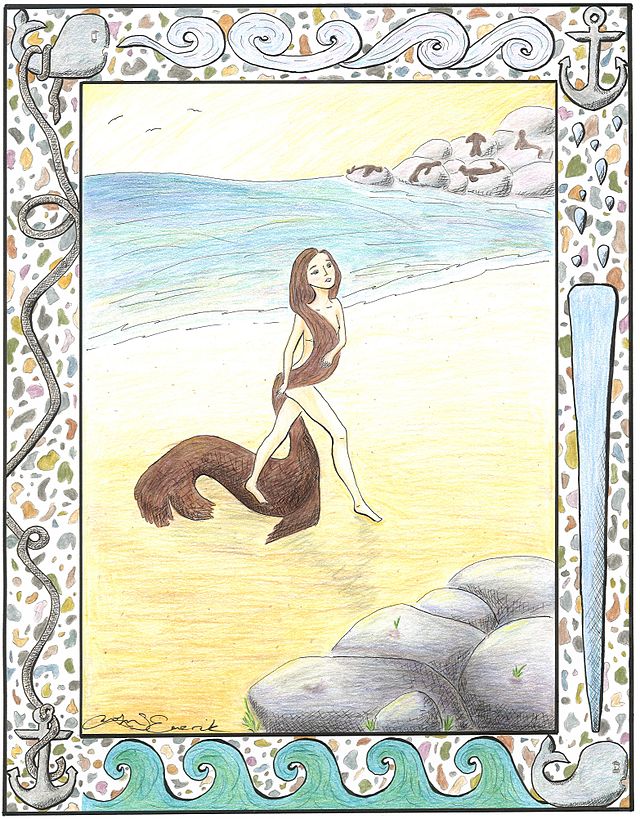
In the line of Selkie tales, magical sea creatures who turn into women are tricked into becoming wives of the men who hide their selkie skin. While they may appear to live happily for a time, the Selkies long for their true home (sometimes their original husbands,) and as soon as they find their skins, they leave their mortal husbands and go back to the sea.

A. H. Watson
In Rumpelstiltskin, we see a marriage that was based off of a father's deception. As a result, the nameless bride must labor under the threat of death from her husband. She was naturally distraught and only escaped that harsh punishment by a strange little man who manipulated her into promising to give him her first child.

Walter Crane
How about the parents from Rapunzel? The mother was overdramatic and demanding about her pregnancy cravings-"if I don't get some rampion to eat...I know I shall die." Her husband then agreed to give the witch the child he and his wife longed for so much, so you know there was lots of marital strife in their house when the mother found out.

Edmund Dulac
That couple as well as many others-such as the parents in Sleeping Beauty-begin their tale unhappy because they are childless ("so sorry that it cannot be expressed"). Then they have to deal with the stress of having a death curse put on their only child. Although their marriage itself may have been healthy, their married life was far from perfect.

Jessie Wilcox Smith
How about the wife from Hansel and Gretel who convinces her husband to abandon their children in the woods? And the host of fairy tales featuring domineering wives who abuse the children in their care, Cinderella, Snow White, Wild Swans, and Juniper Tree-the husbands, when present, are weak enough to be overpowered while his wife takes over and tries everything in her power to get rid of his children.

Kay Nielsen
What about East of the Sun, West of the Moon? The wife soon became sorrowful because she was left completely alone all day and ended up looking at her husband at night when she wasn't supposed to. He was taken from her, and she had to go on a long, arduous journey and win him back from another woman.

Hermann Vogel
Then of course, Bluebeard is the ultimate example of a warning about the potential dangers found within a marriage. It can be read on a more symbolic level as well as literal-sometimes the person you are dating has figurative skeletons in his (or her) closet. As much as you can, make sure that your partner is totally trustworthy before you marry.
So although many tales end with a marriage and a "happily ever after" (although there are many different ways to end a fairy tale), that turns out to be simply a convenient way to wrap up a story. If we look at fairy tale as a generational pattern-that the children, who usually enter adulthood by the end of their story, will end up being the parents who later traumatize their own children in some way-we see that fairy tales actually paint a fairly bleak picture of marriage. Can you think of any fairy tale characters who have been married for any length of time and live an idyllic life?
We seem to have the idea that "happily ever after" means "perfect in any way with no struggles at all." How did we get to that conclusion? A perfect life is not attainable for anyone, no matter if you're single or in a relationship. But finding happiness and joy, despite your struggles, is possible and it's worth hoping for and working towards.
Tuesday, October 26, 2010
Swan Lake Origins-or lack thereof
Swan Lake is a hard story to track down the origins of. Most internet searches lead to Wikipedia, which gives the two most likely origins-the most likely source appears to be "The Stolen Veil," collected German stories by Johann Karl August Musaus, although I can't find text for it online. The other story alluded to is the Russian "The White Duck," (also in Andrew Lang's Yellow Fairy Book) although it has very little in common with Swan Lake. I think far more likely are the many tales from around the world of Selkies (or swans or seals) who shed their skins to become women, or perhaps other European tales where a band of brothers is turned into ravens or swans and their sister has to save them.


One more issue that comes up when telling this tale to children is the issue of the happy vs. sad ending. It's a controversial topic that comes up often in fairy tale conversations-which versions should we tell children? The most authentic, most "adult" versions? The Victorian, somewhat authentic, sometimes very morbid versions? Or the modern children's versions that fit our ideals of "child appropriate," which are not authentic at all?

For anyone interested in reading on the possible origins of the ballet story, this has some good reading. No matter what the speculated origins, it points out that Tchaikovsky himself had a bit of influence on the ballet story, making it truly unique and not primarily a folk tale.
Surlalune has a Swan Maiden tale. The site is not yet annotated and doesn't include history currently, but this particular tale has a very interesting twist on the story-it has a more typical Swan Maiden beginning, where the man steals the dress of the maiden while she is bathing and won't give it back, insisting she become his wife. She goes with him unwillingly, although these tales always have them happily married after this rather unlikely beginning, which irritates me. As always, the maiden escapes when she has a chance-but then the fairy tale turns into East of Sun, West of the Moon, only with the male doing the searching instead of the woman. Once again, the running away part would imply that she doesn't WANT to be his wife, but once he finds her at the end she goes back with him and they live happily ever after (they must have a REALLY good marriage counselor.)

Surlalune has a Swan Maiden tale. The site is not yet annotated and doesn't include history currently, but this particular tale has a very interesting twist on the story-it has a more typical Swan Maiden beginning, where the man steals the dress of the maiden while she is bathing and won't give it back, insisting she become his wife. She goes with him unwillingly, although these tales always have them happily married after this rather unlikely beginning, which irritates me. As always, the maiden escapes when she has a chance-but then the fairy tale turns into East of Sun, West of the Moon, only with the male doing the searching instead of the woman. Once again, the running away part would imply that she doesn't WANT to be his wife, but once he finds her at the end she goes back with him and they live happily ever after (they must have a REALLY good marriage counselor.)

Speaking of gender role reversals-off of Surlalune you can read more versions on the web. One of Ashliman's collected tales is a German tale, "The Three Swans" (you have to scroll down past a couple other versions to get to it). In the tales about brothers turned into birds I mentioned before, the heroine saves them through a mix of silence and making shirts for them out of painful nettles. Naturally women get all up in arms because this could imply that the ideal female is silent, but in this version the male has to get the female back with suffering and silence! Although, the females who suffer from silence do so for a lot longer...

One more issue that comes up when telling this tale to children is the issue of the happy vs. sad ending. It's a controversial topic that comes up often in fairy tale conversations-which versions should we tell children? The most authentic, most "adult" versions? The Victorian, somewhat authentic, sometimes very morbid versions? Or the modern children's versions that fit our ideals of "child appropriate," which are not authentic at all?
There are those who adamantly claim that children should not be spoon-fed idealized and unrealistically happy stories, yet I wonder if they have ever actually looked a child in the face and told them all the gory details of an old fairy tale, or that the Prince and Odette die at the end of Swan Lake. It's simply different when you have an actual child in front of you. Keeping in mind, of course, that each child is different and has different tolerance levels. But speaking on the teacher side of things-parents get reeeally uptight about what you teach their children. Some of it is understandable and some of it is not (a fellow teacher once got a passive agressive letter starting, "Dear lady, I hear you have been telling kids I don't exist..." and signed "Santa Claus" because she taught a lesson to fourth graders about the history of Santa Claus. My mom has had to stop showing certain movie versions of stories because parents report that it gave their children nightmares.) Basically, when other people's children are in your care, it pays to be extra careful.
I solve the problem of the Swan Lake ending by asking, "Do you want the happy ending or the sad ending?" when telling it to students/children. No one has ever asked for just the sad ending-they either ask for both, or the happy one. Some storybooks, or maybe even ballet productions, have a true love conquers all ending, so it's not entirely made up by me.
Images-Finnish National Ballet, picture by Neil McCartney; Kiev Classical Ballet; Mariinsky Ballet
Images-Finnish National Ballet, picture by Neil McCartney; Kiev Classical Ballet; Mariinsky Ballet
Wednesday, March 31, 2010
East of the Sun, West of the Moon: Gender roles
The Surlalune fairy tales blog has a poll at the bottom where people can vote on their favorite fairy tale. I was happily surprised that Beauty and the Beast came out with an impressive lead, but even more surprising to me was that "East of the Sun, West of the Moon," came in second at 15%. Not only is is lesser known than many other tales on the list, but I think of it as part of the Beauty and the Beast/Animal Bridegroom cycle of tales. Most surprising to me was that Cinderella was pretty far down the list, at 9%. I'm pretty sure if you polled people off the street, and not fairy tale enthusiasts, Cinderella would be first or second place.
The mother gives advice too-but this advice the bear warns the daughter ahead of time not to listen to the mother's advice. Immediately the reader perceives negative things about the mother, when really her advice is much more sound--to know who you're sleeping with at night. Yet the mother is also never punished, like many fairy tale women whose punishments seem too extreme compared to how the men get off. And technically, if the daughter had followed her mother's advice all the way and been careful not to let the tallow get on the Prince's shirt, she may have been able to avoid all the trouble.
As I reread "East of the Sun, West of the Moon," the subject of gender kept popping out at me.
The father in this tale is definitely one who has his own best interests in mind rather than those of his daughter, as he pressures her to become the wife of a white bear so that the family can have money. No judgement is ever made on the father for doing this, but as his advice turns out to be true, one tends to forget how selfish this really was. Yet that was the reality for a lot of girls who were given away in marriage for no purpose other than help their family's financial situation.


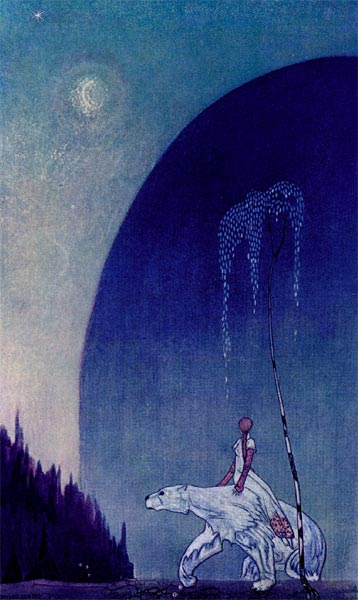
Illustrations by Kay Nielsen
The mother gives advice too-but this advice the bear warns the daughter ahead of time not to listen to the mother's advice. Immediately the reader perceives negative things about the mother, when really her advice is much more sound--to know who you're sleeping with at night. Yet the mother is also never punished, like many fairy tale women whose punishments seem too extreme compared to how the men get off. And technically, if the daughter had followed her mother's advice all the way and been careful not to let the tallow get on the Prince's shirt, she may have been able to avoid all the trouble.

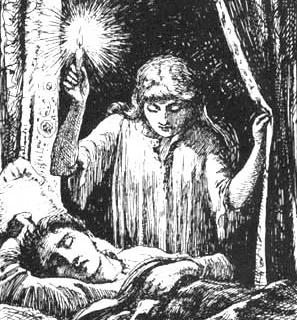
Image by Elizabeth Hoyle
Well, the Prince disappears and the heroine is left to search for him. Yet, just as both parents gave advice, which may or may not be considered helpful advice by the reader, the heroine is aided in her task by males and females alike-the four winds, which are represented as males, and three old kind hags. The hags are the ones that give her the amazing trinkets she needs to eventually win back her Prince from his new betrothed.
Well, the Prince disappears and the heroine is left to search for him. Yet, just as both parents gave advice, which may or may not be considered helpful advice by the reader, the heroine is aided in her task by males and females alike-the four winds, which are represented as males, and three old kind hags. The hags are the ones that give her the amazing trinkets she needs to eventually win back her Prince from his new betrothed.
The Prince's new fiancee has a nose three ells long. The word has the same root as "elbow" and is meant to be the length of a man's arm. The measurements differ from country to country but could have been between 25 to 45 inches long.
As is so often the case, the villains are females. Though the whole country is supposedly inhabited by trolls, the only trolls we meet are the long-nosed fiancee and her mother.

Then, the task that wins back the Prince is washing the tallow from his shirt. People say this is an example of women only gaining salvation by housework. Yet there is also the implication that the secret to success is the difference between human and Troll, and that the heroine's success may be because it was she herself who dropped the tallow. Either way, I don't see a problem with women adding a little imagination to a chore which they were destined to do over and over again.
Although, speaking of gender roles in Norwegain tales, "The Husband who was to Mind the House" makes fun of a man who attempts to switch roles with his wife for a day and majorly messes everything up. This may make you more angry for further cementing the "men work in the fields, women work in the home" stereotype, or may make you glad that it acknowledges that keeping a house is not a walk in the park. Especially back before running water, refridgerators, etc. Although, the woman seems to do just fine doing her husband's work in the fields. Either way, I like to think of it as a good reminder to everyone not to criticize something about which you have no experience.
Subscribe to:
Posts (Atom)