Showing posts with label horror. Show all posts

Tuesday, December 1, 2015

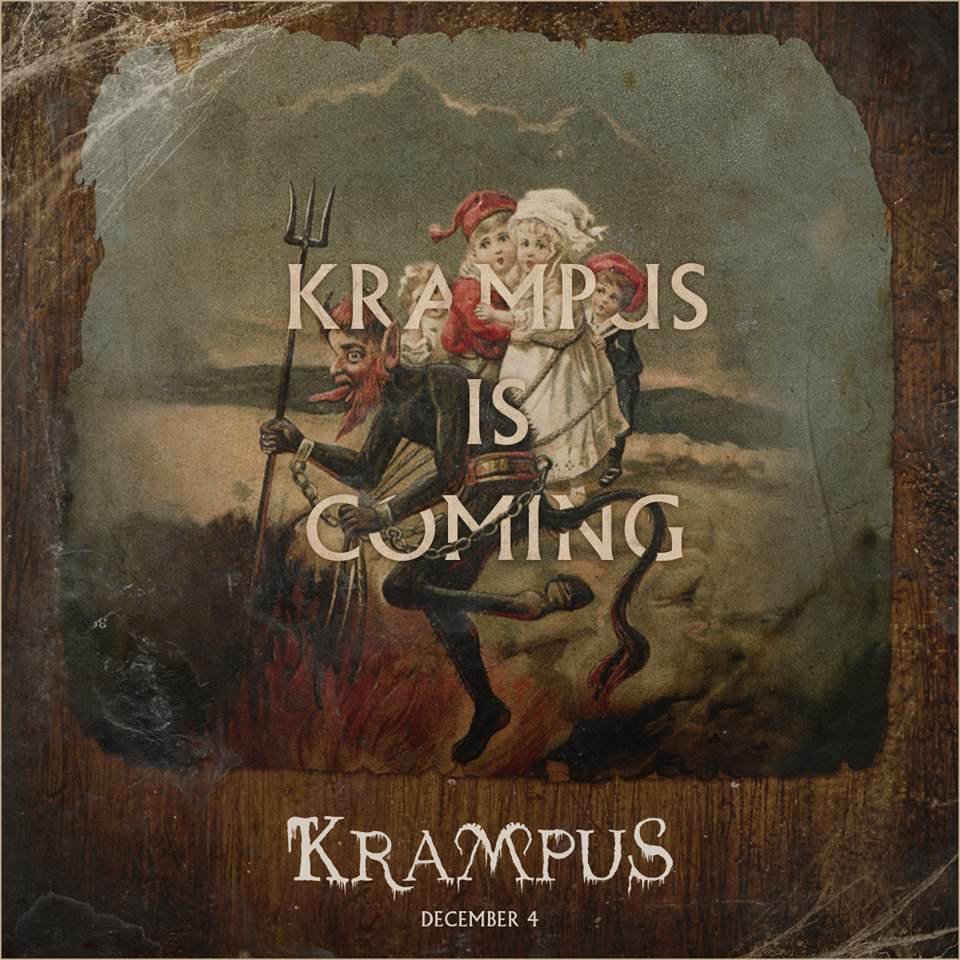
Krampus movie

Is anyone going to see the new Krampus movie? My friend recently told me about it and I thought a Christmas horror movie based on folklore had potential. 

The plot from IMDBWhen his dysfunctional family clashes over the holidays, young Max (Emjay Anthony) is disillusioned and turns his back on Christmas. Little does he know, this lack of festive spirit has unleashed the wrath of Krampus: a demonic force of ancient evil intent on punishing non-believers. All hell breaks loose as beloved holiday icons take on a monstrous life of their own, laying siege to the fractured family's home and forcing them to fight for each other if they hope to survive.

 I know some people get tired of the same holiday fluff over and over, and it seems like the message of every Christmas movie is "having Christmas spirit=you are a good person." Which is why it seems kind of redundant, even if they go from a horror angle, to say that Krampus comes because a little boy "lacks holiday spirit," which isn't even true of the Krampus folklore, who punishes kids who are naughty, not disillusioned. Doug Norrie predicts on CinemaBlend that the tone seems like it won't find the right audience-too scary for kids, too corny for adults. I like reading about the creepy and folkloric aspects of Christmas as much as/probably more than the next person, but I'm not sure if I want to see this. Thoughts?
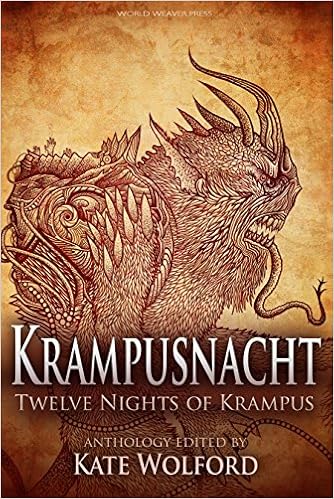
But it's timed fortuitously-the movie comes out December 4, and Krampusnacht is December 5, the night before St. Nicholas Day! And for those wanting more of Krampus, Kate Wolford has a Krampus themed anthology:


Friday, November 13, 2015

The Science of Things that Go Bump in the Night

This post would have been perfect right around Halloween. But here in the Northern Hemisphere, our days are still getting gradually darker and darker so the spooky aspect of stories is still applicable!

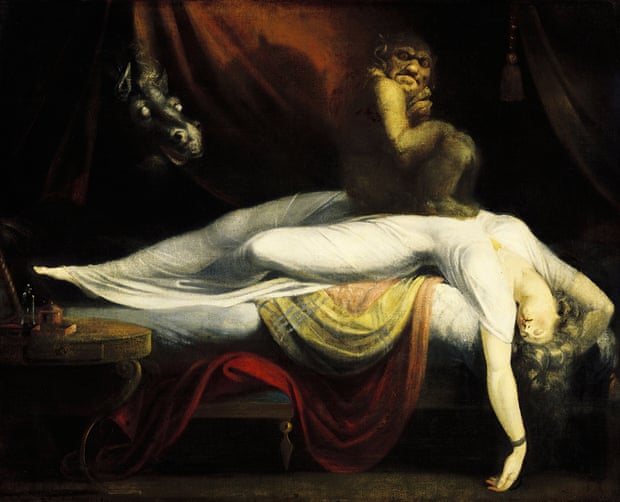
This article in the Guardian is about sleep paralysis, a condition in which you are somewhat awake during the night, but your body is still paralyzed in a dream state. What results is a terrifying feeling-people with this condition may notice noises or shadows on the wall but be unable to do anything. The brain, being so close to sleep, may continue to invent images, causing people to hallucinate figures they are already afraid of, often folkloric monsters, vampires, or ghosts. People will also experience heaviness on their chests, leading them to think there is something sitting on their chest, such as in this painting "The Nightmare."
John Henry Fuseli

Studies suggest that 8% of the general population has experienced sleep paralysis at one time, but the likelihood is higher among students or psychiatric patients. Having such a realistic vision of a supernatural monster can definitely increase belief in such creatures, and can potentially help to explain certain folkloric beliefs. The article states,

"In many cultures, humanity’s attempts over the centuries to seek explanations, have led to deep- held superstitions about witches and dark magic. Such fairytales act as a primer for the hallucinations.
“It creates a positive feedback loop,” Jalal explains. “So you’ve grown up being told by your grandmother that spirits and demons inhabit your village after dark. You wake up during REM sleep, you see some kind of a shadow, and you starting panicking, creating more body image hallucinations which your mind interprets in this cultural narrative and so you perceive a demon coming towards you. And then you go to bed the next night even more afraid, so it happens again, and you perhaps start to believe you’re possessed.”"


It reminds me that, even in this technological and scientific age, there is so much that is still a mystery. Sleep and dreaming itself is pretty crazy: your body shuts down and hallucinates for a few hours. While we sometimes tend to look back on older generations who believed in fairies, witches, vampires, etc., we may see them as simple and unintelligent, but really, in many cases they were just trying to make sense of this crazy world we live in. Watching nature shows you often see animals that are just as amazing as fictional ones. There are will-o'-the-wisps, or mysterious lights sometimes seen above swamps, and gravity hills-places where you can seemingly watch objects roll up a hill. Even we who might know the current scientific explanations for things like this can find them hard to believe, how much more for earlier generations who didn't have that knowledge!

Friday, October 16, 2015

At Willow Web-Scary Folklore: Motivating Children's Behaviors


"Baba Yaga and Vasilisa"- Milo Neuman

Today I'm posting over at The Willow Web as part of Amy's Halloween series! Hop on over and join the discussion about the ways that modern parents still use folklore to motivate their children to behave-whether threatening monsters who will punish or benevolent characters who reward. We'd love to hear from you-what supernatural creatures did your parents threaten you with? What do you think of using folklore in parenting? 


Friday, September 11, 2015

Shyamalan's The Visit-Fairy Tale Horror?


Like many other M. Night Shyamalan fans, I haven't gotten too excited for any of his latest projects. But something in the trailer for The Visit did make me a little hopeful-check out the part at 2:18

(Blogger is being weird and not embedding the trailer right so here's the link)

From CinemaBlend, where Brent McKnight calls it possibly Shyamalan's "weirdest movie yet":

"This does, however, have elements reminiscent of a modern day fairy tale—that scene of the grandmother asking the young girl to get in the oven is straight out of Hansel and Gretel, all she needs is a house made of sweet treats. That part is definitely right up Shyamalan’s alley, and gives this the potential to be a kind of synthesis of the no-frills horror of Blumhouse and Shyamalan’s sense of magical realism."

You can read the basic plot on wikipedia if you don't mind spoilers. Sadly, it doesn't seem to have too many fairy tale connections other than the mention of the oven, and the fact that it's a brother and sister in a creepy house. But Rule #2 below seems suspiciously witchy...maybe there are other little details hidden throughout the film?


Saturday, August 8, 2015

Sarah Moon's Little Red Riding Hood

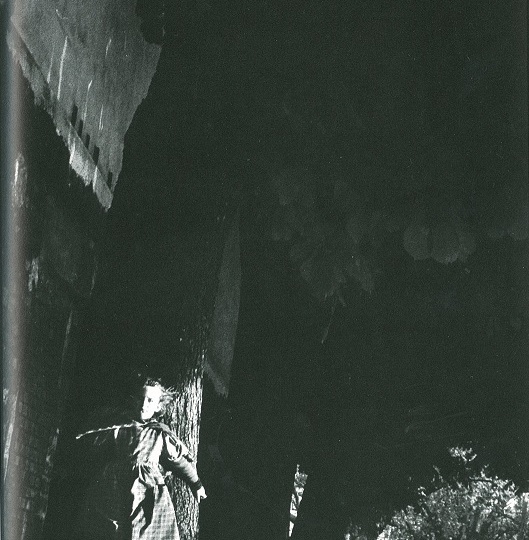
These Red Riding Hood photographs by Sarah Moon are so haunting. Many people tend to have a more romanticized notion of a little girl in red skipping through the forest, but these black and white images set in an urban and more modern setting evoke more dread and horror. Apparently Moon modeled her daughter as Little Red for this 1983 book.


Wednesday, May 20, 2015

Victorian Attitudes, Murder, and Bluebeard

Beneath its prim and proper exterior, the Victorian period was a fascinating, dark time. As far as fairy tale history goes, any version of a tale that people mistakenly call the "original" or "classic" was probably created and enforced during this time period. Not only did the morality of the Grimms shape how they edited their volumes of tales, but countless other translators, editors, and illustrators in this period contributed to what we now think of as the definitive fairy tale genre.

It's getting pretty trendy today to point back to the grim and gruesome details of the fairy tales that came from this time, partly for shock value and partly to legitimize the idea that fairy tales are not just simplistic stories for children. The amount of violence found in the tales can be disturbing for modern audiences.

Illustration-H.J. Ford, "The Girl Without Hands"

Our modern consumption of murder mysteries and violent media as arguably a much better alternative to what this replaced-through the Victorian period, criminals were often publicly executed for sometimes minor infractions of the law. Going to see a hanging was entertainment for the poor people-executions drew crowds who watched the events unfold like they would watch a play on the stage.

Image of the last public hanging in England
May 26, 1868

Yet in life, as in fairy tales, this exposure to death and violence was seen as excusable because it also provided an opportunity for moralizing. It was very common during the Victorian period to add a "moral" at the end of fairy tales aimed at teaching children how to behave properly, and the same went for the way the newspapers covered famous criminal cases. Broadsides, or a cheap, one-sided newspaper, would come out with a "confession" from the criminal (printed before the death actually happened,) including a remorseful insight into the now-realized futility of a life of crime. In murder cases, people were arrested and charged, often on very little evidence. This was partly due to a police system in its infancy and in a time before science and technology provided the ways we now catch criminals, but also to pacify the crowds into thinking they were safe and to give the impression that there was a happy ending, because the criminal was done away with.

Therein lies the paradox of consuming murder as entertainment-we are pleased as we are horrified, and comforted as we are disgusted. When I want a light, easy read I turn to Agatha Christie (even though I also get really depressed watching the news). The world of mystery, despite the necessary violence, is actually one of the most predictable and satisfying. There is a clear villain and a clear happy ending in which the criminal is caught and brought to justice.
George Melies' "Bluebeard", 1901

This goes a long way to explain the fact that Bluebeard was wildly popular in the Victorian period and even considered a suitable source for children's entertainment. The awful image of the bloody chamber was exciting as it was dreadful, and it was all okay as long as it taught children a very important lesson (in fact, the bloody chamber in Bluebeard is very similar to the Chamber of Horrors in Madame Tussaud's waxworks museum, very popular in the Victorian era, where bodies and scenes of famous murderers and their victims are on display. A google search will get you even more disturbing images than this one of the heads of French royalty as they were, just after the guillotine).
And of course, one of the greatest mysteries of fairy tale history is how so many people in the Victorian period could have actually interpreted the Bluebeard tale as a cautionary story against women's curiosity and not the obviously more evil serial killing husband. Yet these quotes really shed light on the issue: at the trial of Maria Manning, a famous 1849 murder case, her husband's barrister said "History teaches us that the female is capable of reaching higher in point of virtue than the male, but that when once she gives way to vice, she sinks far lower than our sex." Somehow their unfair expectations of females having the ability to achieve near "perfection" (more like, submission) was also used to unfairly condemn. Even though Maria and her husband were both found guilty of murdering Maria's lover, a popular ballad sung and sold at the execution (it really was an entertainment source!) goes "Old and young, pray take a warning/Females, lead a virtuous life/Think upon the fateful morning/Frederick Manning and his wife." Note that females are singled out for the warning despite their joint guilt.
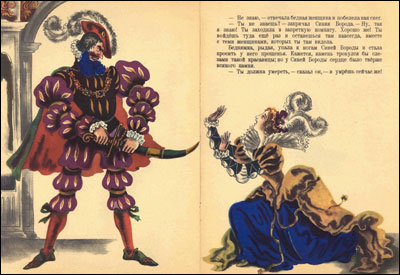
Russian Illustrated Children's Book (anybody know the artist?)

Yet the gender bias was so strong that some women were able to use this idea to their advantage-female murderers who are most likely guilty were able to escape sentencing simply because the public could not believe that they were actually guilty, such as Florence Bravo and Madeleine Smith. Though the evidence all pointed to them having murdered their husbands, the public couldn't accept that a young, beautiful, proper woman could have done such an "unfeminine" thing. Many people thought it was unseemly for a woman to even take interest in their cases, yet the world of murder was actually somewhat empowering. Women caught in oppressive marriages could actually speak out for themselves-at her trial Florence told reporters that her abusive husband "had no right to treat me in such a way" and was unpunished for poisoning him. Detective fiction as a genre was pretty proto feminist at its beginning, featuring strong and clever females.

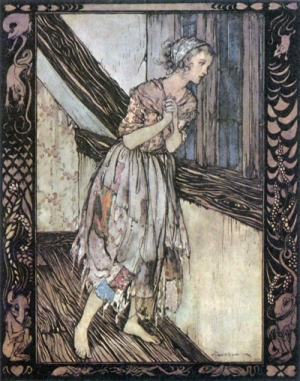
One more fairy tale connection-in the famous Road Hill House case, older sister Constance eventually confessed to slashing her brother's throat in the middle of the night. The reason was most likely that the little boy was her stepbrother, and much like Cinderella, Constance and her full brother were mistreated, while her stepmother's children were given preferential treatment. She had previously run away from home and told her friends that she was treated cruelly. Once again she was not initially convicted, partially because of prejudice (servants were suspected first) and  delicate Victorian sensibilities (a key piece of evidence, her nightgown being missing and bloodied, was not spoken of because it was inappropriate to talk about what a woman wore to bed). Yet years later she confessed and gave some closure to an unsolved case.

Arthur Rackham-Cinderella

*Source: The Art of the English Murder, by Lucy Worsley. Not directly fairy tale related, but a fascinating read that I highly recommend! I couldn't put it down!

Tuesday, April 28, 2015

Grimm's Grimmest

I don't know about you, but when it comes to reading new fairy tales, sometimes it can be intimidating to pull out a large copy of an edition of Grimms' complete fairy tales. Where to even start? It's not the sort of book you usually read cover to cover.

In fact, my copy of complete Grimm tales I use mainly for reference. I find it helpful to discover books in which tales are separated by categories such as themes or country of origin, which is why I was pleased to discover Grimm's Grimmest, edited by Marisa Bulzone, in my library. Not only did it introduce me to several tales I wasn't as familiar with alongside some of the classics, but the best part was the introduction by Maria Tatar.

She provides a little history of the Grimms and their process of collecting but also editing the tales to suit, what was then, modern tastes. Although the Grimms (and the general culture of the time) abhorred any mention of sexuality or pregnancy, altering the tales to remove such references, they actually tended to increase the violence when it was part of a character's punishment. Seemingly shocking and harsh punishments for what we might consider to be small misdemeanors were characteristic of not only the Grimms' collection but other children's literature of the time, such as Strewwelpeter.
Page from the book-Illustrations by Tracy Arah Dockray

For example, the short and haunting story "The Willful Child" would have been more or less typical fare for the time:

Once upon a time there was a child who was willful and would not do what her* mother wished. For this reason, God had no pleasure in her, and let her become ill. No doctor could do her any good, and in a short time the child lay on her deathbed.

When she had been lowered into her grave, and the earth was spread over her, all at once her little arm came out again and reached upward. And when they had pushed it back in the ground and spread fresh earth over it, it was all to no purpose, for the arm always came out again.

Then the mother herself was obliged to go to the grave and strike the arm with a rod. When she had done that, the arm was drawn in, and at last the child had rest beneath the ground.


*In the introduction, Tatar clarifies that in the German, the child is given no specific gender


Tatar also cited psychology and the fact that "children are rarely squeamish when they hear about decapitation or other forms of mutilation. Typical Saturday morning cartoon fare shows that grisly episodes often strike them as hilarious rather than horrifying." It's true that some of the stories, even with their gruesome aspects, I found mostly entertaining, such as "The Three Army Surgeons." Yet others were truly hard to read-I don't think anyone can read "The Willful Child" above and not find it disturbing on some level (and this collection didn't even include "How Children Played Butcher with Each Other," which I find the most horrifying).

For while we tend to think of fairy tales as simple, sweet children's stories, Tatar reminds us that they are also the precursors to other genres, such as urban legends and horror.

Yet, there are different categories when we look at violence in tales. There is violence that is punishment for a truly horrible villain-which we tend to be more comfortable with; children in America are familiar with the scene in which Gretel pushes the witch into the oven, whereas we have largely forgotten some tales that are still part of general knowledge in Germany today, such as "Juniper Tree" which involves a mother decapitating her son and feeding his flesh to her unknowing husband (and, another perfect example of cultural differences in approaching fairy tales!).
Tracy Arah Dockray-illustration for "Juniper Tree"

Then, sometimes, the protagonist is treated cruelly by the villain. This elicits sympathy from the reader and further establishes which characters we're rooting for and which ones we're against, and many of our most loved heroines in American culture fit into this category-Snow White and Cinderella, for example.

Then there's a different sort of story in which the violence doesn't seem to serve a purpose at all. In tales like "The Death of the Little Hen," the stories lead from one tragedy to another, with no happy ending. They seem pointless and depressing, but Tatar reminds us that if nothing else, these tales point to the harsh cruelties of peasant existence, where diseases spread rampant, mothers often died in childbirth, and poor harvest meant going truly hungry. Fairy tales blend truth with hope. Although the common perception is that fairy tales are all hope and no truth, that's a misconception; but it would also be misleading to present all Grimm tales as the creepy, depressing ones found in this volume either. We can point to the darker aspects of fairy tales but they are not the complete picture.
Albert Weisgerber-"The Death of the Little Red Hen"

I have to point out though-I was very disappointed that the book jacket description claims that the Grimms' "Aschenputtel" was "the original Cinderella story." It's a common thing to mistake Grimm tales for "original," but for someone responsible for creating a book description to make such a gross error, especially when Perrault's version is not only older, but arguably more famous? Whoever wrote it clearly didn't read Tatar's introduction, which not only referenced Perrault's "Cinderella" (with the year, 1697), but compared and contrasted the Grimms' version with Cinderella tales from around the world-some of which show forgiveness for the stepsisters and some of which are incredibly violent in their punishments. On the one hand this shows that violence is not limited to German or Grimm tales, but on the other it shows that violent aspects are not necessary for the tale type.

Saturday, October 11, 2014

Fairy Tales and Fear

An anonymous commenter recently wrote in response to my post on Fairy Tale Endings that people tend to forget, when criticizing fairy tales for being dark and violent, how dark much of classic children's literature is. And it's true-maybe not picture books on the whole, but I remember having a conversation with a friend years ago about how many children fantasize about being orphans. We see this trend in children's literature, as many childhood heroes are indeed orphans-from Hansel and Gretel in their parents' attempts to abandon them in the woods, to well-loved characters such as the Boxcar children, Mary of "The Secret Garden", or the children who enter Narnia (again not technically orphaned, but separated from their parents and I don't think any reference is ever made to their parents except to explain them away at the beginning of the books).
"Hansel and Gretel", John B. Gruelle

Partly, getting rid of parents is the only way to create a child-centered world; a realistic book about children would be pretty limited if they had to ask their parents for permission before going on spectacular adventures. Through orphaned characters, or characters whose parental figures are the enemy, the children can achieve independence and become the central figures of the story, moving the action along instead of responding to a world where all of their actions are dictated by parents and school teachers.
Dark Chamber of [Snow White's] Evil Queen, Tours Departing Daily

Fairy tales deal with our primal fears, such as abandonment, or being prey to wild creatures. G. K. Chesterton defended the scarier elements of fairy tales by saying, "All this kind of talk [of keeping fairy tales away from children] is based on that complete forgetting of what a child is like...if you kept bogies and goblins away from children they would make them up for themselves...One small child can imagine monsters too big and black to get into any picture, and give them names too unearthly and cacophonous to have occurred in the cries of any lunatic...fairy tales do not tell children the dragons exist. Children already know that dragons exist. Fairy tales tell children the dragons can be killed."

Well known authors have reflected on their remembrances of fairy tales in childhood-Samuel Taylor Coleridge remembered reading is father's copy of Arabian Nights over and over again, and how he looked at the book "with a strange mixture of obscure dread and intense desire." Charles Dickens recalled being terrified by his nurse's tales, yet returned to those same tales by alluding to them repeatedly in his works.

Michael Kotzin discusses Dicken's use of fairy tales in his essay, "Charles Dickens and the Fairy Tale as Social Commentary." He says that, in childhood, Dickens recognized the dual aspect of fairy tales-fun and terrifying-and reused those same ideas in his adult writings as he discovered that the real world was the same way. He saw horrors that were the natural, unavoidable way of things-disease and natural disaster-but also horrors that were inflicted by people, or society in general, and used fairy tales satirically to criticize political beliefs or groups of people.

Dickens used fairy tale images to make the ordinary extraordinary-in writing a personal letter about the beauty of the buildings in Paris, he tells a friend that "the Genius of the Lamp is always building Palaces in the night." Using fairy tales as a common frame of reference, his works can have a childlike wonder to them. But though he used fairy tales in fun, he also used them in serious ways at times, in making social commentary. He saw in fairy tales the potential to connect with real world scenarios. He "drew upon fairy tale motifs, narrative patterns, and fairy tale-type characters and settings to help people sense romance in the everyday world and grasp the need for moral improvement. His popularity then and now owes some legacy to the magic and mystery of the traditional fairy tale." (Remember, Dickens is the one who is often quoted as having wanted to marry Little Red Riding Hood as a child.)
William Christian Symons

But of course, you can go too far; you shouldn't push violent and gory stories at very young children. It's one thing for an academic to argue about the value of preserving folklore the way it originally was, and another thing for a parent to be awakened by a child who had a nightmare because of a story they read before bedtime.

But at the same time, fairy tales are wonderful because they provide us with different ends of the spectrum-the terror of tapping into our fears, but the wonder and enchantment of the supernatural, and the possibility of happy endings.

What are your recollections of reading/watching fairy tales as a child, in terms of how scared you were?

Friday, October 21, 2011

How children played butcher with each other

The Annotated Brothers Grimm by Maria Tatar has an Adult Tales section in the back, which is intruiguing, especially considering that morbid tales such as The Robber Bridegroom, Fitcher's Bird, and the Juniper Tree are in the regular section. The tales in the adult section aren't necessarily more violent than the above tales, but either racist ("The Jew in the Brambles") or violent in such a way that is condoned because it's a cautionary tale, but such that goes to extremes.

This was actually quite typical for Victorian children's stories, as can be evidenced by Struwwelpeter-a collection of German tales featuring children who suffer drastically for their mistakes, including: a girl who plays with matches and is burned to death, a boy whose thumb sucking results in his thumbs being cut off by giant scissors, a boy who goes outside during the storm and is carried off by the wind, "presumably to his doom"...you get the idea. Struwwelpeter himself is the cautionary tale about the importance of good grooming, the consequences of which are pretty severe, according to this picture on the left.


So maybe it's not just the violence that makes this tale disturbing, but the matter of fact way it's told:

"A man once slaughtered a pig while his children were looking on. When they started playing in the afternoon, one child said to the other: "You be the little pig, and I'll be the butcher," whereupon he took an open blade and thrust it into his brother's neck. Their mother, who was upstairs in a room bathing the youngest child in a tub, heard the cries of her other child, quickly ran downstairs, and when she saw what had happened, drew the knife out of the child's neck, and in a rage, thrust it into the heart of the child who had been the butcher. She then rushed back to the house to see what her other child was doing in the tub, but in the meantime it had drowned in the bath. The woman was so horrified that she fell into a state of utter despair, refused to be consoled by the servants, and hanged herself. When her husband returned home from the fields and saw this, he was so distraught that he died shortly thereafter."


According to Tatar's notes, the Grimms got complaints that this tale was violent and defended it because of its valuable lesson, Wilhelm saying, "My mother used to tell the story about the butchering when I was young, and it made me careful and apprehensive about child's play." Despite this reasoning, the tale didn't make it to later editions of Children and Household Tales.

I have lots of experience watching children play, and I think they have a pretty good sense that their play is not real, and they use imagination and not literal imitations even when copying adult behavior. Yet the concept of the potential for children to be cruel to each other mixed with their ignorance does make this a chilling tale that could possibly be made into a horror film...I'd watch that, if it was made well.


There is another version of this tale also found in Grimms that reads more like a news story-more specific, including the town name and ages of the children, and at the end the child in question is asked to choose between an apple and a coin, and as he chooses an apple, he is deemed innocent. It seems almost more upsetting to let the child get off scot free for murder simply because he didn't know any better. This article by Donald Haase has an interesting interpretation I hadn't considered-some fairy tales were not meant for children but may express adults' fears about parenting and raising children. The choice of apple verses coin represents the division between concrete and abstract thinking-something I understand as a teacher of students with developtmental disabilities who, in general, never go on to abstract thinking. The article discusses other aspects of this tale and is very interesting reading, so I recommend clicking through.

Sunday, July 24, 2011

Spike: A gothic failure?


Saw this at Blockbuster and wondered why I hadn't heard of it before. I was planning on getting it through Netflix and writing a review of it here, but the reviews on Netflix were possibly the worst movie reviews I've ever read. So, I'd probably advise you not to waste money on it, although I'm still slightly curious as to how they actually treat the plot. Has anyone seen this?

Netflix's description: "Beauty and the Beast gets a grisly retelling in this phantasmagoric horror fable that begins when four young people crash their car deep in the forest and soon find themselves at the mercy of a human-beast hybrid with a gory agenda. The creature's motivations turn out to be more complex than simple bloodlust, but the terrified kids being stalked in the darkness only know that any one of them could be the next to die."


However, for a possibly awesome Beauty and the Beast movie in the works, I heard through Surlalune about a movie directed by Guillermo del Toro starring Emma Watson as Beauty. I literally let out a very loud gasp when I saw that post. Guillermo del Toro?? Writer and director of Pan's Labyrinth, and producer of one of my all-time favorite ghost stories, The Orphanage? And Emma Watson will be so much better than Vanessa Hudgens in Hollywood's last Beauty character, from Beastly...