Showing posts with label Franz Schonwerth. Show all posts

Thursday, July 21, 2016

Little Rose and the Dwarves

Dwarves can be helpful or dangerous, and different folktales will show their various natures. This tale from Schonwerth's collection, "Little Rose and the Dwarves," shows the helpful sort.

Once there were two lovers, only the boy's father urged him repeatedly to marry a rich girl, and his sweetheart Little Rose was a poor maiden. One day Little Rose was working and heard a sigh. She saw a Dwarf who was trying to lift his pitcher out of a fountain and couldn't; she laughed at him although she felt pity for him. Rose lifted out the dwarf's pitcher and handed it to him.

The Dwarf asked her what she wanted in return for her service, and she replied, "Nobody can help me but God alone." The Dwarf promised he would meet her later, for he had to bring the water to his thirsty wife, and agreed to meet her at 11:00 in her kitchen.

Little Rose didn't show up until almost midnight, and the Dwarf scolded her for being late. But he had her remove the lid on top of the stove, and there was a tunnel that led to a chamber. The Dwarf told Rose that her father actually had been rich, but selfishly buried all his money and took his secret with him to the grave. The Dwarf pulled out the key to the chamber, and now Rose was more wealthy than the woman her beloved's father intended him to marry.


The Dwarf stayed with the young wife, and he and his companions did chores for her, and her work prospered. They attended to Rose in her childbirth and helped watch her children, and asked in return for warm milk three times a day. She even taught the Dwarves and their families to read, and also visited the Dwarf families when they had children. If she wanted the Dwarves to come visit, she just had to call out, "Little men, come to me, the men are gone!" and they would come out from between the floorboards.

*************************************

I like how the heroine in this story isn't perfect-she initially laughs at the sight of the Dwarf struggling with his water pitcher, and was late for their meeting. But these things are forgiven and we see an unusual but appealing picture of two species working and living together. It's interesting that the Dwarves will appear to women and children but seem to avoid men.

Illustrations by John Bauer

Tuesday, April 12, 2016

Guest Post: Lissa Sloan on God, the Devil, and Death Walk Into a Forest: Heavenly Godparents and Other Immortals

I am very pleased to bring Tales of Faerie readers a post by writer Lissa Sloan! She is one of the authors featured in Frozen Fairy Tales, with her story "Death in Winter."

(Also, it may seem like it's a little out of season by this point to still be featuring Frozen Fairy Tales but this guest post somehow got lost in the vast internet, and just recently made a harrowing journey back to my inbox. But as I initially drafted this, it was literally snowing here in Chicago, so depending where you live winter may still be lingering-or on its way, those of you in the Southern Hemisphere!)

Lissa's story involves a young mother's journey following Death in a desperate attempt to save the life of her daughter. It's well written and the protagonist is a strong, admirable character. Some of the stories in the collection have a modern feel to them; "Death in Winter" has a timeless quality to it.  In ways it feels like listening to an old folktale told by a fire, but it has some unique elements to it as well, and keeps you wondering what's going to happen next! So without further ado: Please enjoy Lissa's insights, delving further into the concept of Death and other Immortals as characters in folklore!

*********************************************************************************


God, the Devil, and Death Walk into a Forest: Heavenly Godparents and Other Immortals

 When I first began delving into fairy tales and reading more than the most familiar stories, I expected to find fantastical characters like witches, giants, trolls, and fairies. I did not, however, expect to find immortals like God, St. Peter, and the Virgin Mary. And yet, it's not at all uncommon for our hero or heroine to encounter them, like a poor man does in "Godfather Death". Desperately looking for a godfather for his child, he meets God, the Devil, and Death, who each offer to do him this service. The man rejects God, saying that he allows the poor to suffer. He likewise rejects the Devil, because, well, he's the Devil. And he accepts Death because all are equal in his eyes. The child does well with Death as a godfather. At least until, in true fairy tale fashion, he tries to push things a bit too far.
"Godfather Death," Heinrich Lefler

 Sometimes these Christian figures are in Heaven, doing heavenly sorts of things. For instance, St. Peter is often found guarding the gates, like in "The Tailor in Heaven", in which he erroneously lets an overly curious and judgmental tailor into heaven when God is out for the afternoon. But it is just as likely you will find him or the Lord down on earth, looking for directions, a place to stay, or something to eat. In fact there are many stories featuring Jesus and St. Peter just traveling around, rubbing shoulders with poor folk, rich folk, gamblers, and soldiers. Some of these stories are a bit like parables,with Jesus teaching a moral lesson. But many are silly, featuring Peter as a buffoon, trying to get away with doing less work or getting more than his share. In "How Saint Peter Lost his Hair", Peter hides a pancake under his hat so he doesn't have to share it with Jesus, but the hot pancake burns the hair off his head. Often, Jesus's response is reproving but forgiving, but other times he is as good-humored as a typical fairy tale trickster. In "Stones to Bread", Peter lugs a giant rock along the road, greedily hoping the Lord will turn it into a giant loaf of bread if there is no bread available at their destination. But there is plenty of bread, Peter has toiled all day for nothing, and Jesus has a good laugh at his expense.

 When the Virgin Mary appears in fairy tales, sometimes taking a poor girl into her care, she is more dignified. In fact, in "Our Lady's Child", she is quite austere. Her protege is caught in a lie she will not confess to, so Mary punishes her, kicking her out of her heavenly home and taking her voice. When the girl marries a king and has children, Mary appears after each birth, giving the queen a chance to confess, then taking the baby and framing her for its death when she refuses, much like the villainous mother-in-law in "The Six Swans". Only when the queen is about to be put to death and at last confesses does Mary relent.

 In "Pearl Tears" from von Schonwerth's The Turnip Princess, however, Mary is much more like a fairy godmother, helping to deliver her goddaughter Maria, and, when things turn ugly with the girl's stepmother, giving her a home in her palace. When Maria transgresses in the same way as "Our Lady's Child" (looking into a forbidden chamber), Mary does banish her, but she continues to keep an eye on her. Maria now cries pearl tears, so is able to make the best of any misfortune, and eventually Mary allows her to return to her palace and take her place caring for the poor and the sick.

May 12 - The Devil with the Three Golden Hairs by fresh4u
 The Ferryman from "The Devil and the Three Golden Hairs," by fresh4u

My favorite immortals are the Devil and Death, perhaps because they're both so unpredictable. Like the other immortals, Death and the Devil are powerful beings, but in many ways, fairly ordinary folks. In "The Devil with the Three Golden Hairs" and "The Devil and His Grandmother", the Devil has a grandmother, who cooks, keeps house for him, scolds him for being bad-tempered, and even removes his lice when he asks her. She also takes pity on our heroes when they ask for her help, even if it means her grandson loses out on his bargain. The devil is fond of bargaining, of course, but many heroes are able to outwit him. In some stories, however, he's just looking for some help around the house, as in "The Devil's Sooty Brother", and he pays up willingly at the end of his servant's tenure, and even cuts his hair before he goes. In "Bearskin" he loses out on the soldier's soul, but is just as happy to gain the man's two jealous sisters-in-law instead. Like the Devil, Death is often a fearsome adversary, and many tricksters are forced to submit to him in the end, as the godson must in "Godfather Death". But Death can also be merciful, as in "Death and the Gooseboy". The world-weary child asks Death to take him along, and, after making sure a rich, greedy man gets his just deserts, Death agrees and takes the boy to his heavenly rest. In "Death's Messengers", he promises a man who has helped him that he will warn the man his death is imminent by sending his messengers on ahead. (Unfortunately, the man does not recognize illness or increasing weakness when they arrive, but Death has kept his promise.)
"The Soldier and Death," Darcy May

 Like the Devil, Death also finds him or herself tricked by mortals, winding up caught in magic trees, bottles, or in the case of the Russian tale "The Soldier and Death", trapped in a soldier's magic sack for years while no one on earth can die. In this tale, Death, who appears as a little old woman, is quite a pathetic figure by the end of the story.

 Immortals in fairy tales may be a little less omnipotent and omnipresent than their counterparts in other genres. They're much more fallible and down to earth, despite their power to grant wishes and mete out supernatural justice. But as the soldier from "The Solider and Death" finds out, just because he can triumph over these powerful figures doesn't mean he should. Eventually the soldier sees the flaw in his plan and must let Death out to do her job. By this time, even he is ready to die, but Death is so frightened by him after her time in the sack that she will go nowhere near him. Some of Hell's devils, too, have been in the sack and refuse to let the soldier into Hell. Denied entrance to Heaven and Hell alike and unable to die, the soldier must wander the world forever. When dealing with immortals, as in so many fairy tales, “be careful what you wish for” is always good advice.
*********************************************************************************

Thanks, Lissa! For more of her writing, be sure to visit her website! (For more on the devil in fairy tales, check out Adam's recent post at Fairy Tale Fandom on the Grimms' tale "Bearskin," which happens to complement this post perfectly!)


Sunday, November 29, 2015

Turnip Princess

I found a copy of "The Turnip Princess" in a local library! This is the collection of Schonwerth tales translated by Maria Tatar. I have the Schonwerth collection edited and translated by M. Charlotte Wolf, and have posted on it before, but wondered how these collections compare.

I've just been browsing through "Turnip Princess", but there are some really interesting gems in there, including a version of Cinderella ("Ashfeathers"; it is a friendly dwarf who helps Cinderella get her dress and not a godmother or the spirit of her mother). There are, of course, many stories that aren't directly connected to our most popular fairy tales. Some of them are very dark and violent, as many unedited folktales are, and unlike the Grimms there are more references to sexuality, although none of them too explicit, as compared to some of our modern entertainment.
Arthur Rackham

The version of "Tom Thumb" is a good example of the physical and scatological humor found in the volume. Thumbnickel crawls through the keyhole into the treasure chest of the merchant who bought him, and tossed out the coins to his father. To avoid being whipped by the merchant he hid in a barrel of salt-but then the salt was fed to the cows, and Thumbnickel is passed through a cow (fully intact of course) and stuck in a pile of dung, about to be eaten by a mouse who is about to be eaten by a fox, until his father comes plowing nearby and manages to save him.

It seems gross but at the same time, when people lived in an age before indoor plumbing and many of our modern conveniences that allow us to be more discreet about our bodily functions, I guess it was better to embrace those aspects of life with humor than to stress out about them too much! And as we know, that type of humor is still enjoyed by children especially.

Both volumes have the tales separated into categories, which is really helpful. And it doesn't appear that there's much duplication of tales in each volume (Schonwerth had collected around 30,000 pages of text!!), so if you have one book and are considering getting the other, I consider it worth it to have both! You can compare versions of some tales side by side (such as "The Valiant Little Tailor," which I posted about here but mentioned Tatar talks of details that weren't in my version-they can be found in "Turnip Princess"). Wolf's collection has more tales (150 as opposed to Tatar's 72) but the stories found in Tatar's collection seem a little more easily digestible-shorter, faster paced, and more like the typical fairy tale formula we are used to. Although one major perk in the Wolf volume, for those of you who speak German, is the dual translation feature-you can read the original German on one page and the English on the other.

Thursday, September 24, 2015

The Valiant Little Tailor: Grimms vs. Schonwerth


When the Schonwerth tales were released in English, one of the selling points of the collection was that you could compare a version of "The Valiant Little Tailor" with the Grimm story about a man who kills seven flies and tricks his enemies into fearing him using clever wordplay (or lying, depending on how you look at it).

The marketers of the Schonwerth collection were very quick to jump on how dark and violent his unedited tales were compared to the Grimms'. Of course it's not like the Grimm tales are all rainbows and pink flowers either, however, I do think the Schonwerth version of this story is darker overall. Although I'm confused...there may have been multiple versions of this tale in his collection. In this interview with Maria Tatar, (titled Down and Dirty Fairy Tales: How this rediscovered stash of darker-than-Grimm stories destroys our Prince Charming myths), she says,

 "One example in this book is a version of the well-known story of “The Valiant Little Tailor,” the guy who kills seven flies with one blow. The Grimms’ version has the flies hovering over a sandwich that the fellow has made. In Schönwerth, the flies are hovering over a dung heap. So that gives you a sense of the raw energy of the stories and the way that Schönwerth decided he was going to tell it straight up, tell it like it was."

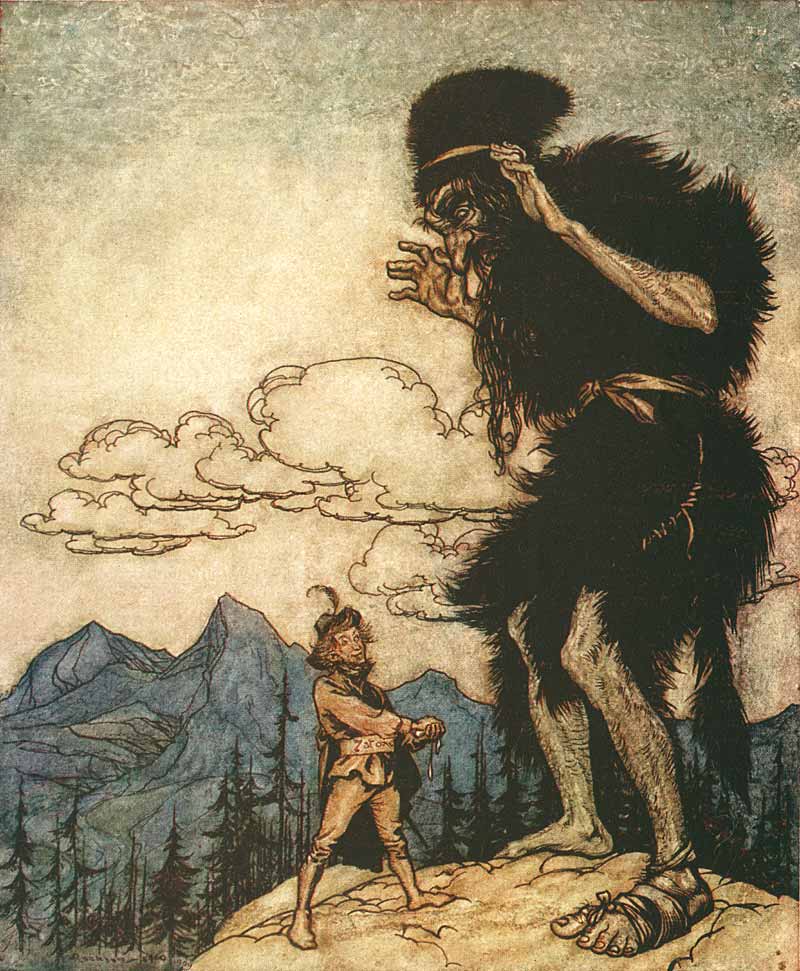
But in my copy, the story that is clearly the "Valiant Little Tailor" version, "The Tailor and the Giants," there are no flies at all, and no dung heap. The tailor just happens to come across a sash (by a well in a forest) that says "Seven with one stroke; who can match that?" and takes it; rather than the Grimms' tailor who sews the sash himself, making him seem a little more full of himself.

The episode where the tailor fools the Giant is similar in both versions-they both squeeze a piece of cheese to appear strong enough to squeeze water out of rock, and they both release a bird pretending they can throw a rock even farther than the Giant. Yet the Grimms' tailor had happened to find those objects before he met the Giant, whereas the Schonwerth tailor picks up the objects as he goes. The Grimms' hero appears to be just lucky, whereas the Schonwerth tailor is thinking on his feet and appears more clever. There is an episode in the Grimm story not found in Schonwerth, in which the tailor also pretends to help the Giant carry a tree.

There are other minor differences I won't go into, but just highlight the ones I find the most significant. In both stories, the tailor is eventually charged with killing troublesome giants. In Grimms, they appear to be two completely unrelated giants-the King has to show the tailor where they live, and he tricks the giants into getting into an argument and killing each other. Yet Schonwerth makes it clear that the tailor kills the very Giants that he had just stayed with, and he was able to do it because he already knew where they lived and their schedule. After cutting off their heads, he also cuts out their eyes and tongues as proof for the King.

Then, Grimms' tailor only has to secure a unicorn and a boar before being able to wed the princess. Schonwerth's hero is charged with killing seven Dragons that demanded daily human sacrifices, and a Serpent who would eat any humans that came near. Certainly more intimidating foes.

Then, in the middle of the tailor's slaying, he notices that the words on his sash have changed-now they tell him the secret to killing the rest of the Dragons. I like that element that the sash is a magical helper.

In both stories, the tailor wins the Princess that was his prize for his feats. She overhears him talking in his sleep about sewing, revealing that he was a tailor (a very lowly position at the time). The Princess tells the King she doesn't want a husband who was once a tailor. The Grimms' King promises to capture the tailor and ship him off across the world. The Schonwerth King was more violent-he arranged to place his new son in law at the front of an army in a doomed battle. But once again, the tailor looks down to see that the words on the sash have changed a third time, to say "You shall be the victor!" The tailor happened to come across a crucifix, and the sight of the "God of the Christians" fighting with the tailor's army caused the other army to flee in terror.

The Grimms' tailor just pretends to talk in his sleep again and threatens the King's servants who run away before shipping him off, so he stays King and nothing is said about the Princess' feelings changing towards him. The Schonwerth tailor returns to his wife who now respects him and they both lived long and happy lives.

Illustrations, in order: Arthur Rackham, H. J. Ford, Alexander Zick, Kay Nielsen

Friday, December 19, 2014

Schonwerth Christmas Tales Part II

#99: The Dwarf's Treasure

"On Christmas Day, a woman went home through the forest from the town of Eslarn bearing a back carrier. She noticed a pile of moss on the snow, stirred around in it and found a big bumblebee nest. She placed it into her back carrier to take it home to her children; then a tiny little man clothed in green approached, and asked her what she was doing here and asked to be shown the nest in her basket. Immediately, he began to take everything out; on the stroke of twelve he disappeared. Thereupon the woman became scared and hastened home. 

In the basket she found a brand new silver coin. The Dwarf had left behind one bumblebee when he was surprised by the striking of the clock."

According to the notes provided by M. Charlotte Wolf, the Bavarians believed that long forgotten precious metals would end up in the ground over time. "Such a treasure sinks down nine fathoms deep and then rises every seven years one foot toward the surface. Arrived at the surface, it gives testimony of its whereabouts with a blue little flame that hovers above the place where it is to be found."

Also note the importance of the clock striking twelve, which is significant not only in Cinderella but in Christmas lore, as Santa is often thought to visit homes right at midnight (although in this story it appears to be twelve noon).

Monday, December 15, 2014

Schonwerth Christmas Tales: Part I

Many cultures believed that the changing of the seasons-Easter/spring, Halloween/fall, Christmas/New Year's/Winter Solstice, or Midsummer, were times when the veil between the spiritual world and our world was especially thin. There are many superstitions involving these holidays, some of which translated into our modern holiday traditions.
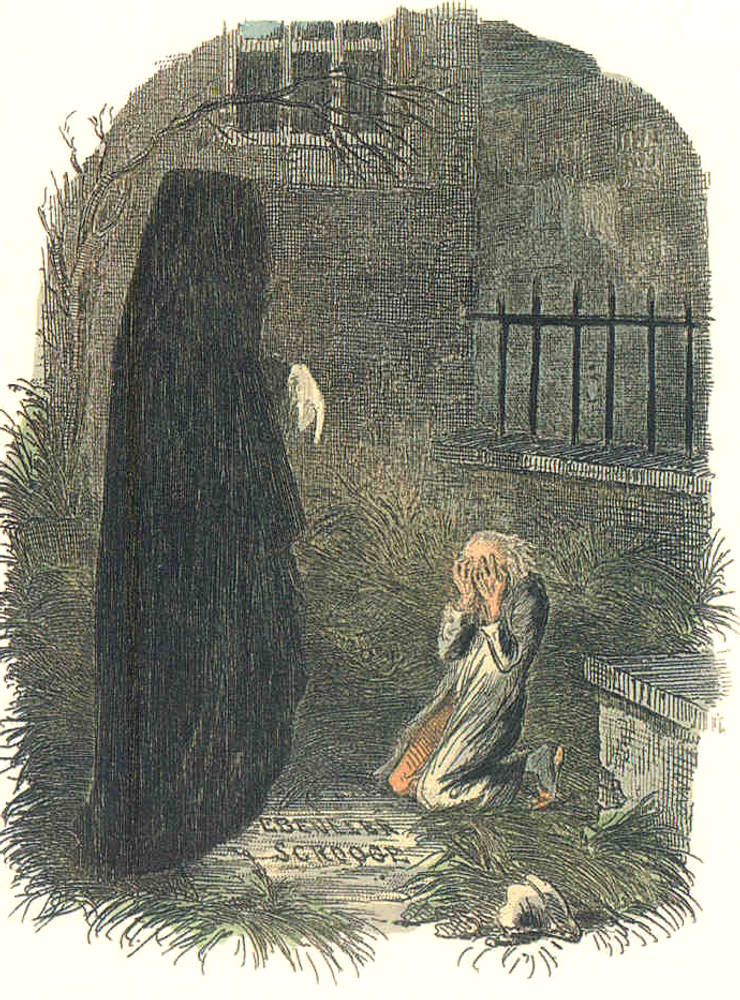
John Leech, for Dickens' "A Christmas Carol"

The below tale from the collection by Franz Schonwerth is along the lines of a very creepy ghost story, which used to be more associated with Christmas (from the song "The Most Wonderful Time of the Year"-"There'll be scary ghost stories/and tales of the glories/of Christmases long, long ago). There is another Schonwerth tale set at Christmas that is less morbid, on the way :)

#31: Premonitions and Predictions of Death II

"On Thunder Mountain near the town Oberviechtach there lived a tailor. He once visited the Stehr farm and worked until late on Holy Christmas Eve, while everyone else was attending Midnight Mass.
Image from here

When he was finished, he set off for home just as Midnight Mass was underway, and after he had walked for some time, a glass barrel, polished like the finest crystal glass, rolled up to his feet. He became frightened and wanted to turn around; but again the barrel rolled up to his feet.

So he decided he better continue on his way home, and the barrel always rolled along before his feet, and he saw inside of it several coffins and men beside them, all of whom he knew very well, since presently they were still alive; also, he saw himself standing beside the last coffin.

At this he was seized by such terror that he fell to the ground senseless, and people returning from Midnight Mass had to help him home. He lay down in bed feeling sick, and all of those whom he had seen through the barrel died in the same year-the last to die was the tailor."

Thursday, October 30, 2014

Schonwerth: Jack-o'-Lanterns

"Jack o' Lanterns are commonly thought of as ghostlike creatures, mostly Poor Souls, who are awaiting redemption. They are like Fiery Men in miniature...When you see them, you are not allowed to talk loudly to them, much less ridicule them, otherwise you will be led astray."

-So say the notes provided by M. Charlotte Wolf in the collection of Schonwerth tales, describing the folklore surrounding Jackolanterns in Bavaria. The collection includes this story:

75. Jack- o'-Lanterns

"A man from the village of Breitenwun near Velburg went home one night from the country fair, rather drunk. On the way, little lights were bobbing along before him, whereupon he called out to them, "If you give me light so that I may find my way home, I will give each of you a Taler [coin]."

Even more merrily the little lights bobbed along before him until the man reached his village. Then he said, "Now you can go home again; I don't need you anymore."-However, the little lights did not go home, but went in front of him, to his house, and from there into his sitting room, and they lighted the farmer's way to bed, and they kept glowing until he fell asleep. And so it happened every night; as soon as daylight faded, they were around him. Then he built a chapel in the village and paid for an eternal flame. As soon as it burned for the first time, the little lights were no longer seen. -The little chapel still stands today, but the eternal flame has gone out."
Arnold Bocklin, painting of will-o'-the-wisp

Versions of Jack-o'-Lantern tales are found all over Europe, but they are thought to originate with "the phenomenon of strange lights flickering over beat bogs", also known as will-o'-the-wisp, according to Wikipedia. You can read a different version from Ireland over at Fairy Tale Fandom.

Again from Wikipedia: "Jack-o-lanterns were also a way of protecting your home against the Undead. Superstitious people used them specifically to ward away vampires. They thought this because it was said that the Jack-o-lantern's light was a way of identifying vampires and, once their identity was known, they would give up their hunt for you."
Happy Halloween!

Sunday, September 28, 2014

Fairy Tale Endings: Happy, Bittersweet, Tragic

Roland Risse

Fairy Tales are often criticized for being simplistic, and for providing unrealistic happy endings. Of course, when you begin to familiarize yourself with more fairy tales, you realize this simply isn't true in all cases; however, many of the most well-known fairy tales do end happily, and happy endings remain true to the "fairy tale formula."
John Batten, "Tattercoats"
Beloved stories like "Cinderella," "Jack and the "Beanstalk," "Sleeping Beauty," "Frog Prince," and so many more end in the most traditional way: usually a wedding, while the villain gets punished. Yet even among the favorites, there are exceptions. There are unhappy versions of Cinderella (see here and here), Andersen originally wanted his Little Mermaid to end with her death and had to adjust the story to please his editors, Perrault's "Little Red Riding Hood" is eaten at the end.

Yet still, fairy tales that have become popularized are predominantly happy.

Kay Nielsen

But the "happily ever after" stories aren't the only form of fairy tales. There's another category I would call "bittersweet." Although there is a form of resolution at the end, it isn't perfect; there is still some physical evidence of trauma left after the story is done. For example, in the tale Juniper Tree; while in the Grimms' version the bird is transformed back into a boy, in other versions, such as the English The Rose Tree or the Scottish "Pippety Pew", the child remains a bird. But they aren't completely tragic stories; the bird is a beautiful creature, who sings a song which reveals the truth, rewards the kind father and daughter, and kills the evil mother. There is still life after tragedy, but the life is different than it was before. There's a sort of comfort and realism in this fact-it's not an empty assurance that things will be fine, but hope that a horrible situation can be redeemed.
Eleanore Vere Boyle

Another fairy tale with a bittersweet ending is "The Wild Swans." The princess is united with the good King and her brothers transformed back into humans-all except the last one, who will forever remain with a wing for an arm; a reminder of their enchanted state, and the fact that curses will often have consequences. Andersen's "Little Match Girl" is another very sad tale in which the Match Girl dies, although the story makes it clear that her life is very unhappy, and in her visions she sees her Grandmother welcome her into Heaven, so even in that unfortunate tale, there is hope.
Anne Anderson

Then, there are the fairy tales that are completely tragic. You won't find these in collections of children's tales, but they abound in the collections of Schonwerth, the Grimms, and Andersen. Hans Christian Andersen just loves to feature helpless creatures with no control over their destiny; besides "Little Mermaid," which I mentioned before, "The Steadfast Tin Soldier" ends with him being burned in the furnace. Throughout the whole tale, he never makes a move or utters a word to help himself; I like to think Andersen was playing on the fact that, while he might have had feelings, at least in the eyes of the child who played with him, he was, ultimately, a toy; incapable of actually doing anything to defend himself.
Kay Nielsen

Along the same vein, a random little story of Andersen's called "The Money Pig" is about a toy piggy bank. After describing some of the games the toys played in the nursery, the money pig falls off the shelf, shatters, and his pieces are swept into the dustbin. The tale leaves you with no sense of purpose or hope.

Of all the tales I've ever read, I still think the creepiest is the Grimms' "How children played Butcher with each other." It's not just that there's a tragic death, which happens in other tales-but there's no villain or motive; it's just children being shockingly ignorant and cruel.

Many of the stories in Schonwerth's collection weren't meant as much to entertain, but to warn people about local superstitions. You might find stories about certain events which were interpreted as foretelling doom or death; warnings about how to recognize Drudes or witches, or stories such as "Death of a Woman in Childbed" in which a woman dared to comb her hair after giving birth, on a Sunday while everyone else was in church, and died because of her unbelief. Or this other, very short and sad tale, "Till Death..."

"A girl had committed herself to being eternally faithful to her beloved; he died serving in the war, and she began a new relationship. One night, her former beloved appeared on a white horse and took her away to his grave where she was found dead in the morning."


Edmund Dulac

I think there's a place and purpose for each kind of tale. Sometime we just need an escape: a happy, predictable tale to comfort or give us hope. Other times we want a little more realism, and sometimes we want send warnings, or just to be a little scared, which is a form of challenging ourselves/having fun with friends and giggling at ghost stories. It's unfortunate, though, that few people realize the spectrum of fairy tales that are out there; some people think fairy tales are too violent and old-fashioned and unsuitable entertainment for children; others think they're too simplistic and perfect, and not realistic enough. But whatever your preferences and purposes, there's always some fairy tale, in some version, that could be helpful.

Thursday, September 18, 2014

Schonwerth tales: Dwarves

I had mentioned that the first half of Franz Schonwerth's Folktales didn't really fit into the category of "fairy tales": they were more like legends and ghost stories. But towards the back there are definitely fairy tales; stories that echo the structure of fairy tales we know, and many that could be considered versions of well-known fairy tales.
For those who need a refresher, Schonwerth collected tales from Bavaria around the same time as the brothers Grimm, but the stories in this book are actually from people native to the region, and remained unaltered throughout the years, unlike the popular Grimm's tales. From my archives, you can read about the mermaid tales and witch tales in the collection.
Arthur Rackham

When we think of fairy tale dwarves, we are sure to remember "Snow White and the Seven Dwarfs", and some people may be familiar with "Snow White and Rose Red". From these two tales we see the dual nature of dwarfs in folklore; they can be helpful and kind, as they were to Snow White, yet rude and ungrateful in the latter story.

Rie Cramer

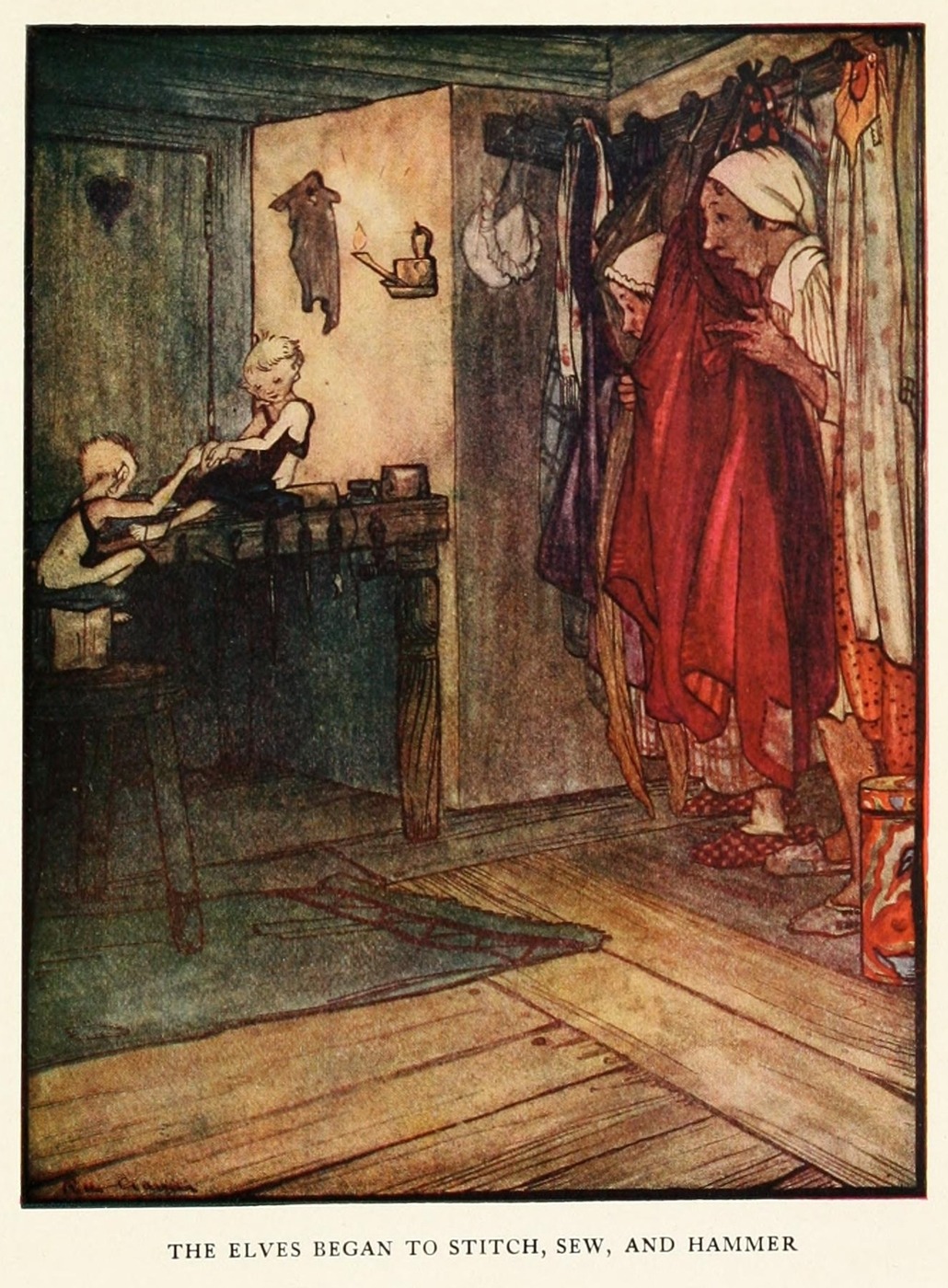
Dwarves in Bavaria could be secretive and helpful; much like the elves in The Elves and the Shoemaker. Many dwarves would inhabit farms and living spaces of humans, and come out at night to do hard work; yet they were so quick and nimble they would accomplish much more than humans could, and produce superior work. Yet the dwarves were incredibly sensitive-if their privacy was broken or any oaths humans made to them broken, they would leave and never come back. They also wouldn't accept gifts of money or clothing-they would interpret anything more than food as a final payment.

Like the dwarves in "Lord of the Rings", dwarves often lived in mountains, creating a system of tunnels, and were known for their work with precious metals. In one story they made a necklace that would make anyone who saw it love the wearer-this was for a wife who was afraid she would lose her husband's love. Yet in payment for this treasure, she had to give herself to the Dwarves. When the woman's husband found out what she had done, he left her-ironically bringing about the fate the wife had tried to avoid. The husband did eventually reconcile himself to his wife, but it's a reminder that powerful magic often comes at a price...
Brian Froud

Some dwarves could be very helpful to kind humans-they helped Little Rose gain money to marry her true love in one tale, and assisted a maid named Eve with her chores, and even helped disguise her pregnancy from those around her with magic to avoid her being shamed. They took care of her baby when it was born, gave them gifts, and in both cases the dwarves remained lifelong friends with the women they helped in their time of need.

Yet not all dwarves were as friendly-one castle was known as haunted; the dwarves there would scatter the sheep at night, causing them to fall off the mountain, so the castle was avoided.

John Batten

Two stories in particular reminded me of traditional fairy tales. "Beautiful Bertha, the Red Shoe, and the Golden Needle" is essentially a Cinderella tale. A beautiful nobleman's daughter, Bertha, and a shepherd's daughter, Hylde, were switched at birth. Bertha became a maid for Hylde, and being jealous of Bertha's beauty, Hylde gave her the hardest chores, and humiliated her as often as possible. A prince came through looking for a bride, but passed by their castle. But Dwarves came, bringing with them a red shoe and golden needle, saying that the one who owned both things would be the prince's bride. When the shepherdess, Hylde's true mother, revealed the truth, Hylde threw herself from the tower, and Bertha became the prince's wife. So in this story we have the elements of persecuted heroine, aid from magical helpers, and recognition by a shoe. (I had recently done a post on red shoes in fairy tales, so we can add this to the list of significant red shoes!)
Anne Anderson

"Tale of the Forest Dwarf" is very similar to Rumpelstiltskin, yet the dwarf in this version seems kinder overall. A very poor man with many children to feed came across a dwarf clad in green, who led him to a cave of treasures. The treasure could all belong to the poor man, if he could guess the dwarf's name in three days. The dwarf was under a spell and had to guard the treasures until someone could guess his name and say it out loud. The man went home and told his wife.

She prayed and went to find the dwarf herself. She overheard him lamenting about how easy it would be for them to guess his name because of his little pointed beard. So she came in her husband's place and guessed, "Little Pointed Beard!", and the dwarf turned into a dove and flew away; the poor family was able to enjoy all the treasures.

Monday, June 2, 2014

Schonwerth's Fairy Tales: Witches


The region from which Schonwerth collected his fairy tales was one where many witch trials were held and women were found guilty and burned. Although most of these trials were held during the 1500s and 1600s, they continued into the 18th century. The last woman to be sentenced to death as a witch in Bavaria was Anna Schwegelin in 1775. Really not that far back in history, relatively, especially when you consider that Schonwerth was born only 35 years later in 1810, and the first edition of the Grimms collection was published only 2 years later, in 1812.
"Snow White and the Seven Dwarfs," A.H. Watson

So that really affects how we read many fairy tales that feature witches, especially from Schonwerth's collections. Many of them were passed down from generations ago when belief in/fear of witches was widespread, and these fairy tales were often told as histories or warnings. They seem to me like letting people know what attributes to be on the lookout for to identify people as witches.

Another interesting thing about the stories in this collection is that they are challenging my perception of concluding that the outcome of a fairy tale is either a reward or a punishment for the actions that preceded it. Scholars and bloggers alike use thinking along these lines all the time-we bemoan the fact that females like Little Red Riding Hood and Bluebeard's wife are punished for being curious while male protagonists are rewarded, etc. (and in many versions, that moral is clearly spelled out, even if it wasn't necessarily intended in folklore). But this collection presents groups of stories with similar plots but opposite outcomes.
John Batten, "Johnnie and Grizzle" (a Hansel and Gretel tale)

For example, there are two stories that begin almost identically. An innocent woman comes to the house of a person who, unbeknownst to her, is really a witch. She is disturbed to see objects and tools moving around on their own, under enchantments, hardly believing her eyes at first. Finally she reaches the witch, spotting her holding her head in her hands (in the other version the witch is wearing a skull instead of a head). The woman asks the witch about all the strange things she saw-pitchforks fighting, doorbell pulls that are snakes, etc. The witch claims that those were natural things, as if the woman was just imagining things. But when the woman reveals that she also saw the witch herself either holding her head or with a skull for a head, the witch becomes angry, and threatens to rip her apart.

The first version ends suddenly-the witch does exactly as she says and rips her apart. My initial thought was that the story was a warning against either approaching a witch's house if you see enchanted objects, or to not be foolish enough to reveal to the witch that you know what she is. But in the second version, the woman is rescued at the last minute (alas, by three male hunstmen), who shoot the witch, and the servants who had been turned into pitchforks were released. So in that version, if the woman hadn't come and revealed the witch's true nature the servants would still be under a spell.
Anne Andersen, "Rapunzel"

So maybe folktales and fairy tales aren't meant to be a guide for life as many people have thought-they simply represent the fact that you never know what's going to happen, just as in life you can never be sure of the outcome of your actions. Over time we as a culture have pretty much weeded out any folklore that doesn't end happily and we have a skewed version of what fairy tales promise (only happily ever afters) or how to go about thinking about what they mean (that the one version we know as "standard" is the true meaning and that we are meant to learn the same lessons as the main character).

Arthur Rackham, "The Thirteenth Fairy" from "Briar Rose"

By the way, AdamYJ of Fairy Tale Fandom sent me a couple of links in the comments to two of the Schonwerth stories translated into English by storyteller Margaret French, and I wanted to make sure you all got a chance to check them out too. Even if you own/plan on owning this book I've been referencing, I don't believe these are in it (the book contains only a fraction of the total tales Schonwerth collected). You can read Belt and Necklace, another mermaid tale, and The Flying Little Box-a princess in a tower tale somewhat similar to Rapunzel, but also has the Cinderella element of identification by a shoe-only this time to identify the prince.

Also, The Turnip Princess was floating around the internet back when the Schonwerth collection was initially rediscovered, but as long as I'm compiling a link list I thought I'd throw it in.

Saturday, May 24, 2014

Schonwerth's Bavarian Folktales: Mermaids


I'm about halfway through this book and have yet to find more than a handful of stories that I would call "fairy tales" rather than legends, or parallels to familiar fairy tales. There was one story that started like Rumpelstiltskin, with a lazy daughter who didn't want to spin, but instead of being told to spin gold and helped by a funny looking little man, she was cursed to go spin in the Moon.

But I'm always fascinated by mermaid tales. And if there's anything we know about mermaid folklore, it's that these mermaids are entirely different than Hans Christian Andersen's suffering, lovesick young girl. Mermaids are dangerous and creepy, known to entice men to their lair below the surface, where the men often forget their families for a time. If they do return to land, they are often cursed, as are the offspring of men and mermaids.
Edmund Dulac

As far as origins, according to the beliefs of the people of Germany's Upper Palatinate, "The Mermaid was once a fair and beautiful princess, but also very cross and fitful, whereupon her own father cursed her and banished her to the sea where she would be able to do whatever she wanted. Thus she became half woman and half fish, living in the sea, where she announces through a very distinct song that a storm will occur in 24 hours."

Here's a shorter mermaid tale from the collection that gives you a good idea of what they are like. Apparently, the Mermaid in this tale demanded some sort of regular human sacrifice from sailors. Although this Mermaid shows mercy there is still a very dark side to interacting with sea maids:
Edmund Dulac

"A ship on the ocean had run out of corpses for the Mermaid, and it had to be decided by lot who among the crew should be sunk into the waters. A handsome young man drew the lot. But the Mermaid had mercy on him because his bride was already waiting for him with longing on the shore of the country nearby, and she carried him to the shore, and gave him as a present three little bags full of gold, silver, and pearls. In return, the bridal couple had to promise her the seventh child born to them.

When that child came into the world, the Mermaid appeared and took delivery of it; for she is allowed to assumed human form on every seventh day of the week; she comforted the grieving parents by assuring them that the little one would be treated well.

A long time had passed, when the oldest son, against his parents' will, chose a poor girl for his wife, and they cast him out. Thereupon the Mermaid reappeared, brought back the seventh child, who had grown up to become a handsome young man, and brought rich presents for the unhappy bridal couple, but once again, in return for their promise that the seventh child of the marriage would belong to her.
Gennady Spirin

To this day, the Mermaid is the kind and protective spirit for this family; when misfortune strikes, she comes to help; but always she has a child from the family circle with her in her palace of glass under the sea, and once this child has grown into a young man, she puts him back and takes another."

Sunday, May 18, 2014

Schonwerth's Fairy Tales

You may remember the buzz a couple years ago when 500 German fairy tales were discovered-Heidi covered it at Surlalune and Gypsy covered it on Once Upon a Blog in 2012 when it was in the news (among other bloggers).

Then when Heidi alerted us that the book is now available, I immediately put it on my Amazon wish list! The birthday fairies were very kind and struck again and I now have my very own copy:
To summarize, Schonwerth, inspired by the Grimms, collected many tales from his native region of  the Upper Palatinate. Only, he actually did what the Grimms only claimed to do: went among the common folk and preserved the tales just as he was told. And though we may frown upon the Grimms for taking the easy way out-having their educated, of-French-ancestry, middle class friends tell them the majority of their tales, it wasn't an easy task for Schonwerth. He sent out many surveys, many of which were never returned. He made multiple trips to that area of the country, having to first earn the trust of the working class there, who were afraid that they were being made fun of.
The Upper Palatinate, in red, a region of Bavaria-native home to Schonwerth and his wife, from where all of his tales were collected

Also interesting to note, Schonwerth worked for King Maximilian II of Bavaria, becoming one of his most trusted confidants. His son became King Ludwig II, who created the famed Neuschwanstein Castle, often called the Fairy Tale King. M. Charlotte Wolf, translator/editor of this book, points out that Ludwig may have been inspired in his love of folklore by his father's friend.


Schonwerth's collection includes varations of some of our familiar fairy tales, but I haven't come across those yet. In fact, overall the stories I've been reading (they are divided into sections according to themes) sound much less like stereotypical fairy tales and more like tales of fairies and spirits, or ghost stories. Much more similar in tone to Thomas Keightly's Fairy Mythology than to most of the Grimm tales (although several of the stories in their collection wouldn't fit into a Proppian analysis either, their collection contains religious tales and other genres as well). The book includes all aspects of folklore, myths and legends as well as fairy tales. Many of the stories were ways of passing down knowledge of superstitions held by the people (such as, clothing made by a pregnant woman are more likely to be struck by lightning, how to handle changelings, etc.). So in a way they are more warnings than stories for entertainment-and the book contains many helpful footnotes to explain certain customs and beliefs that the stories illustrate. And contrary to the stereotype that all fairy tales end happily, so far the vast majority do NOT end happily. Many characters suffer consequences of failing to heed advice, or simply suffer from some of life's unfortunate circumstances.

I'll be sharing more as I read in the upcoming weeks!