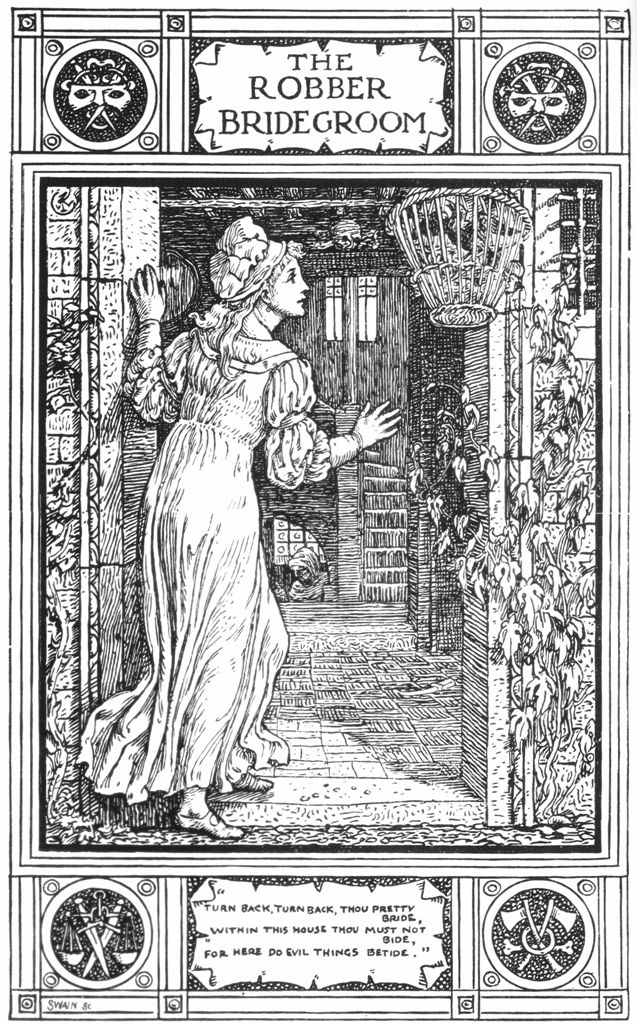
The Grimms' "Robber Bridegroom" isn't nearly as famous as Perrault's "Bluebeard," which is a shame because I think most people like it better. It's still every bit as creepy, as it features a woman who witnesses her betrothed and his friends killing and eating an innocent woman, but the heroine is clever and resourceful-she is able to find her way home because she throught to scatter lentils on the path to the house. Then she exposes the murderer safely by telling the story in public as if it were a dream, but then producing as proof a finger of the dead woman that had flown into her lap.
The great Russian writer Alexander Pushkin wrote several poems based on fairy tales, including "Robber Bridegroom." This poem isn't nearly as exciting, in my opinion, as the Grimm tale. It tells the perspective of the bride's family and friends who don't know why she is so upset until the very end, when she reveals that she witnessed her new husband killing a girl cutting off her hand, and produces the hand with a ring on it as proof. Pushkin's tale also doesn't have the gory details of the Grimms, including the cannibalism of the victims. The poem can be read here.
Mr. Fox is a very similar English tale. The heroine visits the house of the murderer, and first discovers buckets of blood and skeletons, then the men come home and she witnesses a killing. She exposes them in the same way as the bride in "Robber Bridegroom."
D. L. Ashliman has collected several fascinating variants of this morbid tale as well. In a different German version (not the Grimms'), the bride is given the choice of being either boiled in water or oil, and on the witch housekeeper's advice, says she prefers water. This means she draws the water herself, giving her an opportunity to hide. Although the cannibal slices off her toes in his attempt to find her, the blood magically disappears so as not to lead him to her hiding place in a tree, and a prince conveniently stops by the woods and saves her in the nick of time.
In some English versions, the girl comes across her sweetheart digging a grave and later hints at what she saw; sometimes the murderer is frightened off by her knowledge, but in a legend that supposedly took place at Oxford, he stabs her. The "Robber Bridegroom" story is also told in the form of another English legend, Bloody Baker.
In the Welsh Laula, the murderer succeeds in killing the first sister, but her elder sister had followed them and exposed the crime.
The Cannibal Innkeeper is a very dark Romanian tale. After a young servant girl refused to marry a man, he sold her to a cannibalistic innkeeper who locked her in a room and forced her to cook human flesh, which he then served to his guests. One day his mother, who was a witch and wanted to punish him, turned the girl into a duck, so she was able to fly out of the room and escape-but the girl remained a duck for the rest of her life.
In the Lithuanian story Greenbeard, a woman will only marry a husband who has a green beard. The murderer dyes his beard green for her. The moral of this story seems to be for women not to be so picky about the men they marry, for after the crimes are witnessed and exposed in a similar manner, it's added that the girl no longer has such in interest in green beards (and of course the image also links the tale to "Bluebeard"). It strikes me that in this tale, as well as others, the cannibals are not referred to as "murderers" or "cannibals," but simply "robbers." Why is their evil downplayed by that choice of words? The same question applies to the Grimm tale-why is it "Robber Bridegroom" and not "Murderous Bridegroom" or "Cannibalistic Bridegroom"?
Illustrations-Walter Crane, Arthur Rackham, John Batten
Showing posts with label the Robber Bridegroom. Show all posts
Monday, July 18, 2016
Tuesday, July 28, 2015
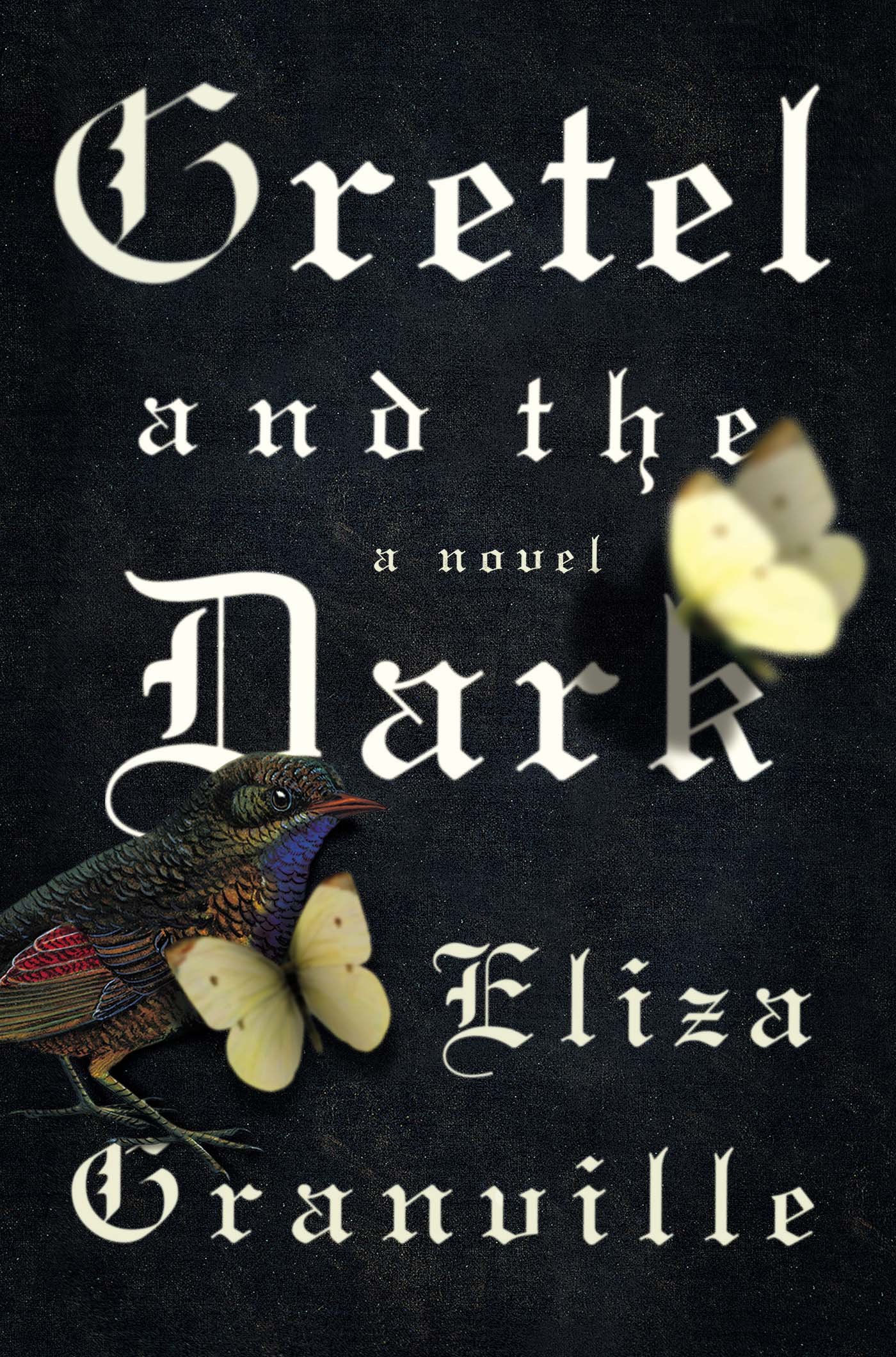
Gretel and the Dark
"It is many years before the Pied Piper comes back for the other children. Though his music has been silenced, still thousands are forced to follow him, young, old, large, small, everyone...even the ogres wearing ten-league boots and cracking whips, even their nine-headed dogs. We are the rats in exodus now and the Earth shrinks from the touch of our feet. Spring leaves a bitter taste. All day, rain and people fall; all night, nixies wail from the lakes. The blood-colored bear sniffs at our heels. I keep my eyes on the road, counting white pebbles, fearful of where this last gingerbread trail is leading us."
So begins Gretel and the Dark, a novel by Eliza Granville. I spotted it in my library's "New Books" section, and remembered reading about it on Surlalune.
The book description reads:
Gretel and the Dark explores good and evil, hope and despair, showing how the primal thrills and horrors of the stories we learn as children can illuminate the darkest moments in history, in two rich, intertwining narratives that come together to form one exhilarating, page-turning read. In 1899 Vienna, celebrated psychoanalyst Josef Breuer is about to encounter his strangest case yet: a mysterious, beautiful woman who claims to have no name, no feelings—to be, in fact, a machine. Intrigued, he tries to fathom the roots of her disturbance.
Years later, in Nazi-controlled Germany, Krysta plays alone while her papa works in the menacingly strange infirmary next door. Young, innocent, and fiercely stubborn, she retreats into a world of fairy tales, unable to see the danger closing in around her. When everything changes and the real world becomes as frightening as any of her stories, Krysta finds that her imagination holds powers beyond what she could ever have guessed.
Rich, compelling, and propulsively building to a dizzying final twist, Gretel and the Dark is a testament to the lifesaving power of the imagination and a mesmerizingly original story of redemption.
It's kind of hard to explain the book other than this, without giving too much away. But fairy tales are a very strong theme throughout the book, as well as many other themes that would make for great group discussions-this would be a great book to read with a mature literature class. We see how the characters use fairy tales to help them cope with the tragedy in their lives, and how the tales evolve and morph to suit the needs of the teller and listener. The story also causes you to think about how fairy tales are perceived by children; how adults use them to manipulate behavior, to reward or punish, or how they can be used to find hope, strength, and inspiration. Obviously "Hansel and Gretel" is a prominent tale featured; the "Pied Piper" and "Robber Bridegroom" are also referenced often (although "Pied Piper" is technically not a fairy tale, but a legend-read more on Adam's excellent post over on Fairy Tale Fandom).
I would highly recommend it. I was hooked; I couldn't put it down. Although, fair warning: this book is not your typical "light summer read": it is very dark and tragic. It can also get quite confusing at times (as the introduction above might indicate-you're often thrown into narration without being aware of what is actually happening). Throughout, there were times I wasn't sure if the storylines would come together to make a satisfactory ending, but I ended up being very pleased with the ending.
This book is for more mature readers-there is violence, death, and sexual content. Not explicit sexual scenes, but there's sexual abuse and very twisted ways of misusing power. But it all makes sense in the end; it was very well written. Read it if you get the chance! I hope to reread this book in the future because it's the kind that, knowing the end, will cause you to read things differently and catch on to lots of hints and foreshadowing I didn't catch the first time around.
So begins Gretel and the Dark, a novel by Eliza Granville. I spotted it in my library's "New Books" section, and remembered reading about it on Surlalune.
The book description reads:
Gretel and the Dark explores good and evil, hope and despair, showing how the primal thrills and horrors of the stories we learn as children can illuminate the darkest moments in history, in two rich, intertwining narratives that come together to form one exhilarating, page-turning read. In 1899 Vienna, celebrated psychoanalyst Josef Breuer is about to encounter his strangest case yet: a mysterious, beautiful woman who claims to have no name, no feelings—to be, in fact, a machine. Intrigued, he tries to fathom the roots of her disturbance.
Years later, in Nazi-controlled Germany, Krysta plays alone while her papa works in the menacingly strange infirmary next door. Young, innocent, and fiercely stubborn, she retreats into a world of fairy tales, unable to see the danger closing in around her. When everything changes and the real world becomes as frightening as any of her stories, Krysta finds that her imagination holds powers beyond what she could ever have guessed.
Rich, compelling, and propulsively building to a dizzying final twist, Gretel and the Dark is a testament to the lifesaving power of the imagination and a mesmerizingly original story of redemption.
It's kind of hard to explain the book other than this, without giving too much away. But fairy tales are a very strong theme throughout the book, as well as many other themes that would make for great group discussions-this would be a great book to read with a mature literature class. We see how the characters use fairy tales to help them cope with the tragedy in their lives, and how the tales evolve and morph to suit the needs of the teller and listener. The story also causes you to think about how fairy tales are perceived by children; how adults use them to manipulate behavior, to reward or punish, or how they can be used to find hope, strength, and inspiration. Obviously "Hansel and Gretel" is a prominent tale featured; the "Pied Piper" and "Robber Bridegroom" are also referenced often (although "Pied Piper" is technically not a fairy tale, but a legend-read more on Adam's excellent post over on Fairy Tale Fandom).
I would highly recommend it. I was hooked; I couldn't put it down. Although, fair warning: this book is not your typical "light summer read": it is very dark and tragic. It can also get quite confusing at times (as the introduction above might indicate-you're often thrown into narration without being aware of what is actually happening). Throughout, there were times I wasn't sure if the storylines would come together to make a satisfactory ending, but I ended up being very pleased with the ending.
This book is for more mature readers-there is violence, death, and sexual content. Not explicit sexual scenes, but there's sexual abuse and very twisted ways of misusing power. But it all makes sense in the end; it was very well written. Read it if you get the chance! I hope to reread this book in the future because it's the kind that, knowing the end, will cause you to read things differently and catch on to lots of hints and foreshadowing I didn't catch the first time around.
Labels:
books,
Hansel and Gretel,
Pied Piper,
the Robber Bridegroom
Saturday, March 13, 2010
The Robber Bridegroom
This lesser known Grimm fairy tale is very dark. I love hunting through my Grimm books to find treasures like this--Cinderella and Red Riding Hood and all the classics are wonderful but there are so many other fascinating tales.

Here is Wikipedia's summary, although read the full text if you can, it's so much better--
"A miller wished to marry his daughter off, and so when a rich suitor appeared, he betrothed her to him. One day the suitor complained that the daughter never visited him, told her that he lived in the forest, and overrode her reluctance by telling her he would leave a trail of ashes so she could find his home. She filled her pockets with peas and lentils and marked the trail with them as she followed the ashes.
They led her to a dark and silent house. A bird in a cage called out to warn her that she entered a murderer's house. An old woman in a cellar kitchen told her that the people there would kill and eat her unless the old woman protected her and hid her behind a barrel. A band of robbers arrived with a young woman, and they killed her and prepared to eat her. When one chopped off a finger to get at the golden ring on it, the finger and ring flew through the air and landed in the bodice of the hiding woman. The old woman discouraged them from searching, because the finger nor the ring were likely to run away: they'd find it in the morning.
The old woman drugged the robbers' wine. As soon as they fell asleep, the two living women fled. Wind had blown the ashes away, but the peas and lentils had sprung up into seedlings: the two followed the path of plants and reached the young woman's home.
When the wedding day arrived and the guests were telling stories, the young woman said that she would tell a dream she had had, and told of her visit to the robbers' den, her bridegroom punctuating it with "My darling, you only dreamed this." -- or the robber punctuating with exclamations that it was not so in the Mr. Fox variant -- until she produced the finger of the dead girl and showed it to the company.
The robber bridegroom and all his band were put to death."
When the wedding day arrived and the guests were telling stories, the young woman said that she would tell a dream she had had, and told of her visit to the robbers' den, her bridegroom punctuating it with "My darling, you only dreamed this." -- or the robber punctuating with exclamations that it was not so in the Mr. Fox variant -- until she produced the finger of the dead girl and showed it to the company.
The robber bridegroom and all his band were put to death."
Second image from Surlalune Fairy tales. First from here.
Subscribe to:
Posts (Atom)