Showing posts with label Godfather Death. Show all posts

Tuesday, April 12, 2016

Guest Post: Lissa Sloan on God, the Devil, and Death Walk Into a Forest: Heavenly Godparents and Other Immortals

I am very pleased to bring Tales of Faerie readers a post by writer Lissa Sloan! She is one of the authors featured in Frozen Fairy Tales, with her story "Death in Winter."

(Also, it may seem like it's a little out of season by this point to still be featuring Frozen Fairy Tales but this guest post somehow got lost in the vast internet, and just recently made a harrowing journey back to my inbox. But as I initially drafted this, it was literally snowing here in Chicago, so depending where you live winter may still be lingering-or on its way, those of you in the Southern Hemisphere!)

Lissa's story involves a young mother's journey following Death in a desperate attempt to save the life of her daughter. It's well written and the protagonist is a strong, admirable character. Some of the stories in the collection have a modern feel to them; "Death in Winter" has a timeless quality to it.  In ways it feels like listening to an old folktale told by a fire, but it has some unique elements to it as well, and keeps you wondering what's going to happen next! So without further ado: Please enjoy Lissa's insights, delving further into the concept of Death and other Immortals as characters in folklore!

*********************************************************************************


God, the Devil, and Death Walk into a Forest: Heavenly Godparents and Other Immortals

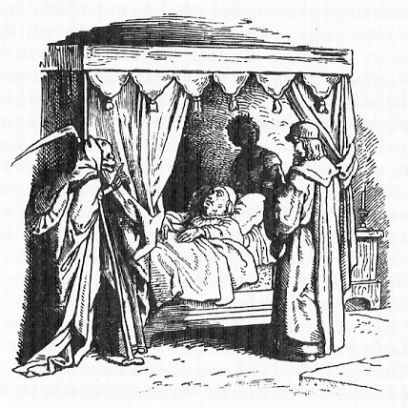
 When I first began delving into fairy tales and reading more than the most familiar stories, I expected to find fantastical characters like witches, giants, trolls, and fairies. I did not, however, expect to find immortals like God, St. Peter, and the Virgin Mary. And yet, it's not at all uncommon for our hero or heroine to encounter them, like a poor man does in "Godfather Death". Desperately looking for a godfather for his child, he meets God, the Devil, and Death, who each offer to do him this service. The man rejects God, saying that he allows the poor to suffer. He likewise rejects the Devil, because, well, he's the Devil. And he accepts Death because all are equal in his eyes. The child does well with Death as a godfather. At least until, in true fairy tale fashion, he tries to push things a bit too far.
"Godfather Death," Heinrich Lefler

 Sometimes these Christian figures are in Heaven, doing heavenly sorts of things. For instance, St. Peter is often found guarding the gates, like in "The Tailor in Heaven", in which he erroneously lets an overly curious and judgmental tailor into heaven when God is out for the afternoon. But it is just as likely you will find him or the Lord down on earth, looking for directions, a place to stay, or something to eat. In fact there are many stories featuring Jesus and St. Peter just traveling around, rubbing shoulders with poor folk, rich folk, gamblers, and soldiers. Some of these stories are a bit like parables,with Jesus teaching a moral lesson. But many are silly, featuring Peter as a buffoon, trying to get away with doing less work or getting more than his share. In "How Saint Peter Lost his Hair", Peter hides a pancake under his hat so he doesn't have to share it with Jesus, but the hot pancake burns the hair off his head. Often, Jesus's response is reproving but forgiving, but other times he is as good-humored as a typical fairy tale trickster. In "Stones to Bread", Peter lugs a giant rock along the road, greedily hoping the Lord will turn it into a giant loaf of bread if there is no bread available at their destination. But there is plenty of bread, Peter has toiled all day for nothing, and Jesus has a good laugh at his expense.

 When the Virgin Mary appears in fairy tales, sometimes taking a poor girl into her care, she is more dignified. In fact, in "Our Lady's Child", she is quite austere. Her protege is caught in a lie she will not confess to, so Mary punishes her, kicking her out of her heavenly home and taking her voice. When the girl marries a king and has children, Mary appears after each birth, giving the queen a chance to confess, then taking the baby and framing her for its death when she refuses, much like the villainous mother-in-law in "The Six Swans". Only when the queen is about to be put to death and at last confesses does Mary relent.

 In "Pearl Tears" from von Schonwerth's The Turnip Princess, however, Mary is much more like a fairy godmother, helping to deliver her goddaughter Maria, and, when things turn ugly with the girl's stepmother, giving her a home in her palace. When Maria transgresses in the same way as "Our Lady's Child" (looking into a forbidden chamber), Mary does banish her, but she continues to keep an eye on her. Maria now cries pearl tears, so is able to make the best of any misfortune, and eventually Mary allows her to return to her palace and take her place caring for the poor and the sick.

May 12 - The Devil with the Three Golden Hairs by fresh4u
 The Ferryman from "The Devil and the Three Golden Hairs," by fresh4u

My favorite immortals are the Devil and Death, perhaps because they're both so unpredictable. Like the other immortals, Death and the Devil are powerful beings, but in many ways, fairly ordinary folks. In "The Devil with the Three Golden Hairs" and "The Devil and His Grandmother", the Devil has a grandmother, who cooks, keeps house for him, scolds him for being bad-tempered, and even removes his lice when he asks her. She also takes pity on our heroes when they ask for her help, even if it means her grandson loses out on his bargain. The devil is fond of bargaining, of course, but many heroes are able to outwit him. In some stories, however, he's just looking for some help around the house, as in "The Devil's Sooty Brother", and he pays up willingly at the end of his servant's tenure, and even cuts his hair before he goes. In "Bearskin" he loses out on the soldier's soul, but is just as happy to gain the man's two jealous sisters-in-law instead. Like the Devil, Death is often a fearsome adversary, and many tricksters are forced to submit to him in the end, as the godson must in "Godfather Death". But Death can also be merciful, as in "Death and the Gooseboy". The world-weary child asks Death to take him along, and, after making sure a rich, greedy man gets his just deserts, Death agrees and takes the boy to his heavenly rest. In "Death's Messengers", he promises a man who has helped him that he will warn the man his death is imminent by sending his messengers on ahead. (Unfortunately, the man does not recognize illness or increasing weakness when they arrive, but Death has kept his promise.)
"The Soldier and Death," Darcy May

 Like the Devil, Death also finds him or herself tricked by mortals, winding up caught in magic trees, bottles, or in the case of the Russian tale "The Soldier and Death", trapped in a soldier's magic sack for years while no one on earth can die. In this tale, Death, who appears as a little old woman, is quite a pathetic figure by the end of the story.

 Immortals in fairy tales may be a little less omnipotent and omnipresent than their counterparts in other genres. They're much more fallible and down to earth, despite their power to grant wishes and mete out supernatural justice. But as the soldier from "The Solider and Death" finds out, just because he can triumph over these powerful figures doesn't mean he should. Eventually the soldier sees the flaw in his plan and must let Death out to do her job. By this time, even he is ready to die, but Death is so frightened by him after her time in the sack that she will go nowhere near him. Some of Hell's devils, too, have been in the sack and refuse to let the soldier into Hell. Denied entrance to Heaven and Hell alike and unable to die, the soldier must wander the world forever. When dealing with immortals, as in so many fairy tales, “be careful what you wish for” is always good advice.
*********************************************************************************

Thanks, Lissa! For more of her writing, be sure to visit her website! (For more on the devil in fairy tales, check out Adam's recent post at Fairy Tale Fandom on the Grimms' tale "Bearskin," which happens to complement this post perfectly!)

Monday, October 27, 2014

Godfather Death by Evangeline Allum


Here's a silhouette retelling of the tale about attempting to cheat Death, by Evangeline Allum.

View on Youtube

Thursday, October 11, 2012

Fairy tale retellings and subgenres

I shared once a story in which a friend of mine was baffled at the existence of multiple versions of the same fairy tale, saying, "how can they tell the same story over and over?"

I was reminded of this as I've been perusing The Fairies Return, because the book has so many examples of the different ways the same story can be told "over and over", yet with completely new life each time. If fairy tale retellings is itself a subgenre of fantasy, even within this category are many other sub-subgenres. All examples are found in The Fairies Return unless otherwise noted. These are just classifications I made up:

Expanded fairy tale: True folk tales have a very distinct style, they include the bare essentials of plot, and characters are never developed. Some authors will take those same essential plot points but build a fuller context. A good example of this would be Robin McKinley's Beauty, a novel version of Beaumont's classic "Beauty and the Beast" (and for new readers, my absolute favorite version of my favorite fairy tale). Though the short story limits the development we can get in a novel, I really enjoyed Clemence Dane's "Godfather Death." It's not a fairy tale we often see authors playing around with, but it becomes more real when characters have names and motivations, and we see extra details in setting and passage of time that make it more believable, yet still the same essential story found in the Brothers Grimm.

John B. Gruelle

Alternate explanations: In fairy tales, a character will do something and rarely are we told why; often their actions seem strange, especially when we're separated by culture and time differences. For example, when we think of Snow White being put in a glass coffin this is generally interpreted as creepy and fetish-y, but in Lord Dunsay's "Little Snow White" we find that the miners simply happened to know someone in the glass business who was able to cut glass to the right lengths-they were avoiding going to the police. It is creative details like these that help us see familiar plot details in a new light, and realize that there could be dozens of other explanations for the same actions.
Kay Nielsen

Removal of magic: Lady Eleanor Smith is able to retell The Little Mermaid in such a way that the supernatural is not present, but the parallels are still clear. This heroine was dubbed "little mermaid" by the prince figure because of her excellence in swimming and diving, which years later lands her a role as a bathing beauty in one of his motion pictures, for this Prince is not royalty but a film star.

Expanding on a single element: Anna Gordon Keown's "Aladdin" has virtually nothing in common with its predecessor from Arabian Nights, but this Aladdin manages to accidentally summon a demon who must do his bidding. Only this wish fulfillment is very different-the awkward undertaker finds himself enjoying not the direct benefits of wishes, but increased social status due to his new friend, which he passes off as his brother visiting from an exotic island. This type of fairy tale retelling focuses not on aligning plot points, but on exploring the "what ifs" of a familiar motif

Errol Le Cain

Sequel: Sometimes writers wonder what really happened after the "happily ever after," a personal favorite of mine is the children's story The Frog Prince, Continued, by John Scieszka. Eric Linklater's "Sindbad the Sailor" describes Sindbad's untold, eighth and final voyage, which is quite different from his previous seven. If I understand it correctly, the story contrasts the differences in culture between the heroes of the Arabian Nights, and the then-modern culture, as Sindbad accompanies a modern cruise to some of his previously visited locations. He finds that the modern people are not as easily impressed, and that what was such danger to him before is mere entertainment to other people. He is a little insulted at his lack of respect and (SPOILER ALERT) ends up basically letting the other passengers die at one of the islands, telling the authorities they were devoured by snakes. This may have nothing to do with it, but when I'm not reading up on fairy tales I'm something of a Titaniac, and I was struck by the parallels of a cruise ship designed to entertain the wealthy, who are not scared of any dangers, even when those dangers are quite real-and the trip ends in disaster. I would pass this off as coincidence except for the fact that the book was originally published in 1934, 20 years after the disaster, so all of the authors would have been alive during the shocking sinking which disillusioned the world against overconfidence in technology.

I'm really enjoying the book as I manage to find time during a very busy month at work, I may have a Part II to this post once I've read them all. There are so many other ways to categorize fairy tale retellings, even among the stories I've described here, and again these are NOT official literary terms at all, just me trying to make sense of things.

Wednesday, October 26, 2011

Godfather Death

There once lived a very poor man with twelve children who had to work all day and night to feed them. When a thirteenth child was born, he desperately went out into the road to find a godfather. First he came across the Lord, who promised to take care of the child, but the man refused, because of the way the Lord gave to the rich and let the poor go hungry. The man came across the devil, but the man refused him as well because he deceives people and leads them astray. Lastly he came to Death, and the man accepted his offer because Death made no distinction between the rich and the poor.

Death followed through on his promise and gave his godson a gift-he would become a famous physician with the ability to tell if a patient would survive or not. If Death was standing by the head of the bed of the patient, the physician would be able to cure him with an herb that Death gave him-if Death stood by the foot of the bed, the patient would die. With this advantage, the physician became famous and rich.

But one day the physician was called to look in on the King, who was sick, and when he got there, he saw Death at the foot of the bed. Though he knew he would be risking Death's displeasure, the physician turned the bed so that Death was at the head and administered the healing herb. Death was upset and warned his godson he wouldn't be able to get away with any trickery again.


Ludwig Richter

Not long afterwards, the King's daughter fell ill, and the King proclaimed that if anyone could save her, he should marry her and inherit the crown. The physician was so dazzled by her beauty and the prospect of being a King that he ignored his godfather and turned the bed again, giving her the herb. But this time Death was so furious that he took the physician by the hand and down to a cavern filled with flickering candles of all sizes. Death explained that each human life had a candle, and as soon as the candle flickered out, their life was over. Death showed the physician his candle, which was just about to go out. The physician begged to be allowed to live and marry the princess, but Death could not light a new candle without snuffing out another one. Death pretended he was getting a new candle for his godson, but deliberately put the candle out because he wanted his revenge, and the physician fell down and his life was ended.

This morbid tale taps into two things that all people struggle with at some point, no matter what your faith-the unfairness and cruelty of the world, and the inevitability of death. Naturally it would have been completely controversial in Victorian times to accuse God of being unfair, so the Grimms threw in a little narration to save themselves: "The man said that because he did not know how wisely God distributes wealth and poverty." Even though I'm a Christian, I don't like this little addendum of theirs-it sounds like the rich deserve to be rich and the poor deserve to be poor. And poverty for this man wasn't just that he had to wait a while before getting the newest version of the Iphone-it meant real hunger and deprivation, and watching his children suffer as well.

But I don't see Death as being all that much fairer. Yes, death comes to all, but death comes to some who are young and some who are old, and some suffer in death and some go peacefully. In this tale, even though Death supposedly makes no distinction between wealth and poverty, he gives his godson a gift that allows him to be rich and successful, and has mercy on him after his first offense.

I find it interesting that so many cultures personified Death as a character. Sometimes this is done more humorously, as in Family Guy where Death is just a regular guy doing his job and trying to get a girl. But aside from parodies, stories that feature Death generally all point to the same conclusion-no one can escape or cheat death. The trickery that the physician tries probably would have been rewarded in some fairy tales, but here it proves to be his downfall. And the cavern full of flickering candles is so haunting-it reminds me of one of my favorite Ray Bradbury stories, "The Scythe," where a man is unwillingly made to be, essentially, Death, cutting down stalks of wheat which are each people's lives-and he, like the physician in this tale, discovers that he can't cheat the system or save the lives of people he loves.
Sorry to end on such a downer-hope you all have a magically wicked Halloween weekend!