I haven't really read many other versions/about other versions of Rumpelstiltskin, so when Ozfan95 brought up something in the comments of a recent post it was completely new to me! The only versions I've read of are those in which the dwarf demands the protagonist's baby if she cannot guess his name.
But actually, there are multiple versions in which the Rumpelstiltskin character wants to marry the girl himself, and naming him is the only way to escape it. The tale "Doubleturk" below is a short but sweet example of this:
Doubleturk
Germany
Once a prominent dwarf fell in love with a beautiful girl and wanted to force her to marry him. To be sure, the girl had a great aversion toward him because he was so small and not at all good looking, and she would not agree to marry him. However, he won over her father by offering him much money and land, so she finally had to accept his proposal. Nevertheless, he agreed to release her from her promise and to leave her alone if she could succeed in discovering his name. The girl searched a long time, but to no avail. However, in the end fate came to her aid.One night a fish dealer was traveling along the road to Greifswald. Coming to a place where he saw a large number of dwarfs joyfully dancing and jumping about in the moonlight, he stopped with amazement. Then he suddenly heard one of the dwarfs call out with joy, "If my bride knew that my name is Doubleturk, she wouldn't take me!"
The next day the fish dealer related this experience in a tavern in Greifswald. The bride heard about it from the tavern keeper's daughter. She immediately assumed that it had been her lover, and when he came to her, she called him Doubleturk. Then the dwarf disappeared in great anger, and that was the end of their courtship.

This same idea where the dwarf wants to marry the maiden/take her away also happens in "Dwarf Holzruerhlein Bonnfuerlein," "Hoppetinkin," "Purzinigele," "Krizimugeli," "Mistress Beautiful," "Tom Tit Tot," "Diffy and the Devil," "The Girl Who Could Spin Gold from Clay and Long Straw," and "Kugerl." The fact that the woman is married doesn't necessarily deter the dwarf from demanding to take her with him. "Tarandando" begins just like the traditional Rumpelstiltskin tale, but not only does the dwarf demand the wife instead of her baby, the tale ends just like "The Three Spinners," in which an old aunt helps her cleverly get her way out of spinning by showing her niece's husband how spinning deforms your beauty.
"In Peerifool," a giant not only threatens to take away girls who protest that he is stealing their kale (hipster giant really into superfoods?), but we get a violent description of what he does to many girls before our heroine, peeling off their skin. (The heroine then restores all the other girls and together with her mother they destroy the giant. Great strong female protagonist tale!). Also, in "Kinkach Martinko," the dwarf reveals that had she not guessed his name, he would have torn her to pieces.
In "Naegenduemer," the main character is a lazy spinner, and by guessing the dwarf's name he is forced to spin for her.
 "Zirkzirk" is a blend of this and the traditional story-the dwarf promises to spin for a lazy married woman, if she will give him "what she was carrying under her apron." She agreed, not realizing she was pregnant. "Whuppity Stoorie" is another tale in which the dwarf demands a baby.
In "Winterkolbl," the dwarf raises the young maiden as a father, and the guessing of the name is a test in order for the King of the land to be able to marry his daughter-a tale where there is no threat at all (other than the King not being able to marry the maiden). Also, in "Gwarwyn-a-throt" the dwarf befriends young maidens and works only for food, but disappears when he is named (and also gets very savage if a something else is given to him, even by accident).
In "Penelop," a fairy is kidnapped by a mortal, and it's by his naming her that she becomes his wife. She bears him two children and according to the tale they "lived happily" together, although that's hard to imagine...
"The Rival Kempers" has a touch of "Diamonds and Toads" in it. Two girls are in a spinning contest to win the same man for a husband. A mysterious old woman comes to town and visits each of the girls. One is kind to her, and the woman promises that if the girl guesses her name, she will help her win the contest. The other girl is not as kind, so she does not get the same promise, and the kinder one wins the man.
 These tales are all available to read in full on D.L. Ashliman's Name of the Helper Fairy Tale Page. It's ironic that folklorists will try and read into the fact that Rumpelstiltskin wants a baby when really, that's only a rare feature of the story (at least as far as this collection shows!). Most often the girl's life is at stake-in some, through marriage to a dwarf, and others are more vague about what the dwarf wants by taking her away with him, since we see some examples of violence and cruelty and not dreams of domestic wedded bliss from the mysterious man with a strange name.
One theme that carries through nearly all of these naming stories is spinning, and the heroine is often a lazy spinner who is able to get out of her chores by the end. I wonder why there is such a strong connection between spinning and naming though?
The other common element is that the name is always found out by accident-it is overheard, and then usually casually mentioned to the damsel in distress. This heightens the tension, because the solution is found at the last minute and only by chance, but I find myself wishing that sometimes the heroine would go seek out the solution by herself-maybe even put together clues to work out what his name is?
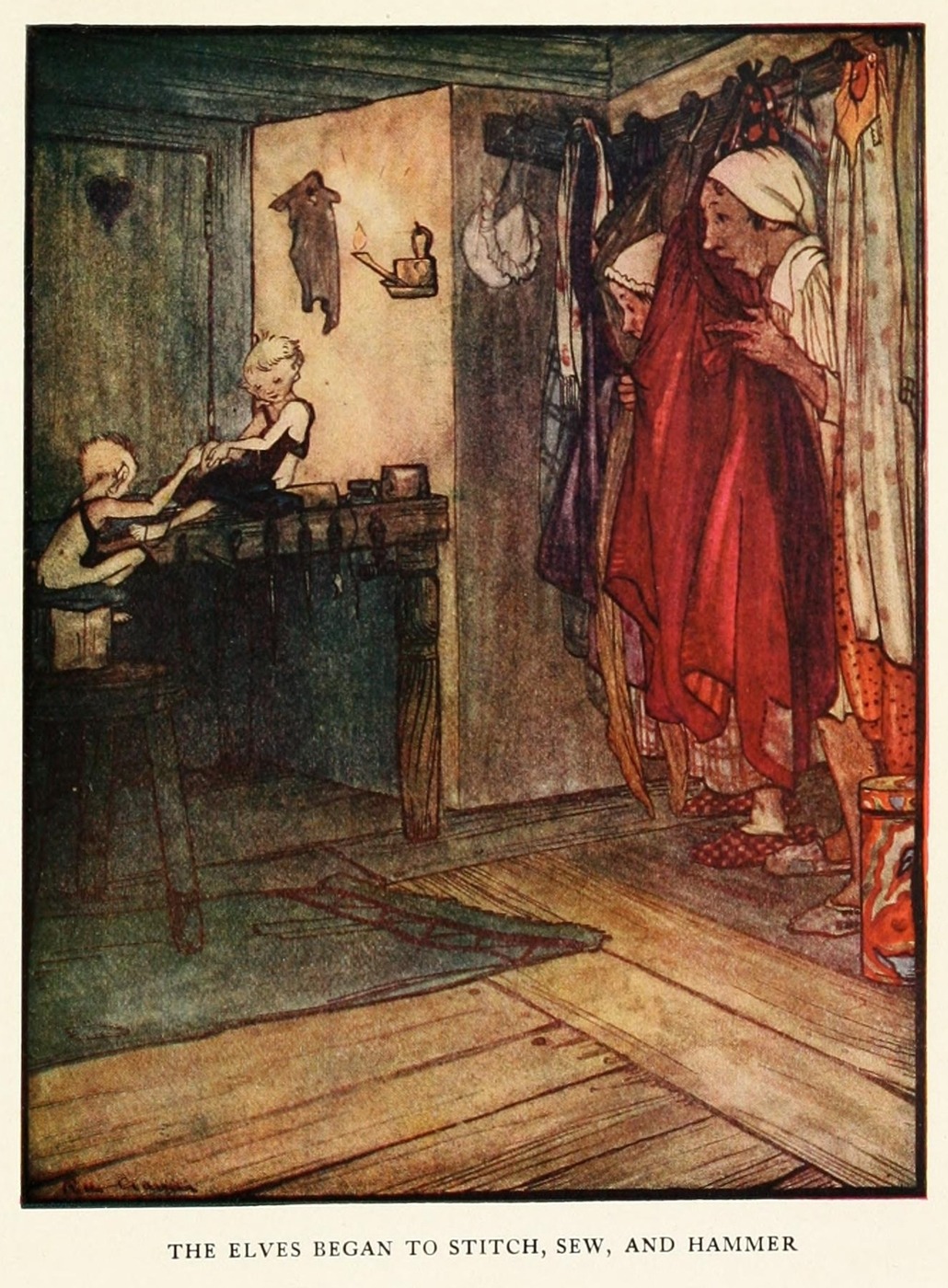
Illustrations by Arthur Rackham