Showing posts with label Cupid and Psyche. Show all posts

Friday, January 29, 2016

What Fairy Tales REALLY Say About Curiosity


Rosebud Nielsen Image
This post is kind of an extension of some of the discussion that went on in the comments from my post on an alternate beginning for Rapunzel a couple weeks ago. It's largely been accepted in fairy tale scholarship that traditional fairy tales tend to condemn female curiosity, some of them outright (like Perrault's moral for "Bluebeard") and some of them more subtly. Culturally, it was typical for curiosity in women to be seen as a horrible thing for a while there, so it's sad but not too surprising that that idea would have been applied to fairy tales.

Yet, when you ignore the moral tacked on at the end or inserted by an editor trying to make their tales more marketable for children's instruction, what do the tales themselves actually say about curiosity?


Sleeping Beauty-the Princess is exploring the castle one day and finds a spindle, and touches it, having never seen one before. She falls into deathlike sleep, as was predicted by the fairy (and really caused by her father's attempts to prevent the spell from happening). But after her sleep is over, she ends up with a royal husband and is none the worse for her long nap (also an extra episode with an evil mother in law in some versions, but that also gets resolved and the villain punished)

Snow White and the Seven Dwarfs Nielsen Image
Snow White-enters a strange house in the woods when she is running from her murderous mother/stepmother (this one is more desperation than curiosity, but she could have just sat outside and waited for the dwarves to come home, like a proper little girl should have). Yet she is never condemned-she strikes a deal with the dwarfs, who end up later helping the Prince find her (in a totally creepy way but that's a different topic)

Twelve Dancing Princesses-We are never told (in most versions) how the sisters discovered that there was an entrance to an underground kingdom in their bedroom, but it stands to reason they somehow discovered it, and made the choice to venture down. This tale is one of the most ambiguous, sometimes the Princesses are assumed to be under a spell, but in the Grimms their actions are never really explained-but they are also not specifically condemned (and interestingly, the princes in the underground kingdom are punished, but not the Princesses who traveled there to dance-the soldier, who was curious and adventurous enough to discover the truth, is the rewarded hero)

-And, in the "Twelve Dancing Princesses" category, we have to remember Kate Crackernuts, a version in which it's a female who does the exporing into the hidden Kingdom, saving her sister and a prince in the process! Thanks Sue Bursztynski :)

Bluebeard's Wife-opens the door to the forbidden chamber. Because of this she is threatened with death by her husband, but he is killed, and his killing seen as just. His widow ends up with his estate, and her freedom.
Bluebeard by Kay Nielsen


Jack and the Beanstalk-climbs up the beanstalk and discovers the world of giants. This gets him into a dangerous situation from which he ultimately escapes and triumphs, ending up with the money he lacked at the beginning

East of the Sun, West of the Moon/Cupid and Psyche-the heroine disobeys an order not to look upon her husband, seeing how hot he secretly is. She has to go on a long, hard journey to win him back, but they do ultimately end up together and happy

So, what do the tales themselves actually say about curiosity? (This is only a partial list of some big ones-feel free to add more in the comments! And there are always exeptions to rules but I'm going to go ahead and state:)
East of the Sun Image 5 by Nielsen
First of all, curiosity does often bring challenges and obstacles. (Even to males, like Jack!) And that, honestly, can be true. There's the old saying, "ignorance is bliss"-it's not always easy discovering new knowledge that might challenge your worldview, or the truth about a person you thought you could trust. Curiosity leads to discovering something you didn't know before, and that often sends you on a different life path than you were previously on. It's the same in detective stories-digging through clues and getting closer to the truth can put you in dangerous situations with the criminals, but is necessary for obtaining justice.

But if fairy tales truly wanted to condemn the curious, the characters who went where they weren't supposed to and opened locked doors would ultimately end up dying and/or unhappy-many fairy tales really do end tragically! The Grimms weren't afraid to punish disobedient children in their stories, or to make their villains suffer horribly. Yet the endings reveal that those who pursue knowledge really are the heroes and heroines, not the villains. Sometimes that forbidden discovery really enables the happy ending to happen. We, the readers, always want to know what lies on the other side of the door just as much as the characters-by listening we are complicit in the discovering alongside the protagonists! It would be too ironic if stories themselves (which impart ideas and knowledge) were to truly condemn discovery of other ideas and knowledge!

Of course, there are boundaries to curiosity. The Victorian idea of not indulging curiosity isn't entirely bad, because you should also respect other people's privacy, etc. The level to which the characters actually crossed that boundary could be debated for each tale and variant (such as Goldilocks). But for most of these stories, the plots of fairy tales ultimately speak louder than the official morals, and the characters who display curiosity are clearly the sympathetic protagonists.

Illustrations-Kay Nielsen

Thursday, February 13, 2014

Curiosity, Eve, and blaming women


"The ethical issues connected with Bluebeard's wife-disobedience, betrayal of trust, intrusiveness-have repeatedly preoccupied critics, who associate her disruptive behavior with the transgressive acts of Pandora, Eve, Psyche, and all those other mythical, biblical, and folkloric women who seem to be too curious for their own good or for the good of the human race." (Maria Tatar, "Secrets beyond the Door: The Story of Bluebeard and his Wives."

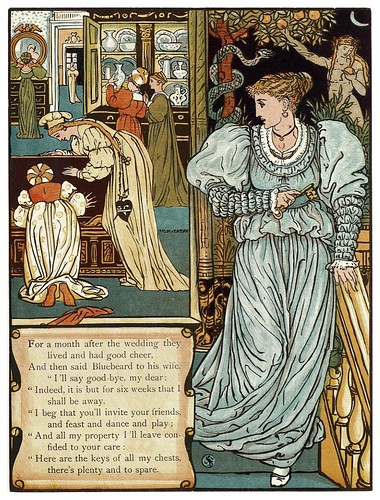
Fairy tale characters such as Psyche, many of the Animal Bridegroom heroines who followed her, and especially Bluebeard's wife, are condemned for their curiosity, which leads them to trouble. Folklorists and critics have noted this connection, as well as connecting them to the myth of Pandora and the biblical character Eve. Fairy tale illustrator Walter Crane has solidified this connection by inserting paintings of Eve and the serpent in the backgrounds of his illustrations of Bluebeard's wife (above) and Beauty from Beauty and the Beast (below).

Yet this connection bothers me because it's not actually theologically correct. Yes, Eve ate of the fruit of the tree of the knowledge of good and evil, but the main sin wasn't her curiosity-it was disobedience to the one command God gave and the pride of wanting to become like God. Yet more importantly than that for the sake of fairy tales and gender issues, Eve is never  held as exclusively responsible for the first sin in the Bible. When she took of the fruit and ate, "she also gave some to her husband who was with her, and he ate" (Genesis 3:6, ESV). This implies that Adam was there the whole time Eve was being tempted, and didn't say anything to contradict the serpent or attempt to dissuade her from eating the fruit. Therefore he was just as responsible as Eve.

God sees them as equally responsible when He punishes all three of them-the serpent, Eve, and Adam in Genesis 3:14-19. In fact, later in Scripture, Adam alone is representative of bringing sin into the world-"For as in Adam all die, so also in Christ shall all be made alive," I Corinthians 15:22.

However, for years and years the Church itself as well as those outside have seen the Fall as a picture of the sin of women who can't control themselves. The other myths and stories mentioned above have helped cement the idea of heaping the blame on women for global problems. How did this happen? Reminds me of Governor Huckabee's infamous statement that the problem with birth control is that women "cannot control their libido." Yes, it's all women's fault. Men have NOTHING to do with getting women pregnant.

Of course, we shouldn't forget that further back in fairy tale history, lesser known versions of the fairy tales feature women whose curiosity is rewarded-heroines such as in the Grimms' "Fitcher's Bird" find out the murderer's secret, and then heroically rescue and resurrect the other murdered women. Yet these tales are nowhere near as well known, sadly.

Tuesday, April 9, 2013

Artist Feature: Errol Le Cain

Twelve Dancing Princesses
 
 
Molly Whuppie
 
The Enchanter's Daughter
 
Snow Queen
 
Cupid and Psyche
 
Cinderella
 
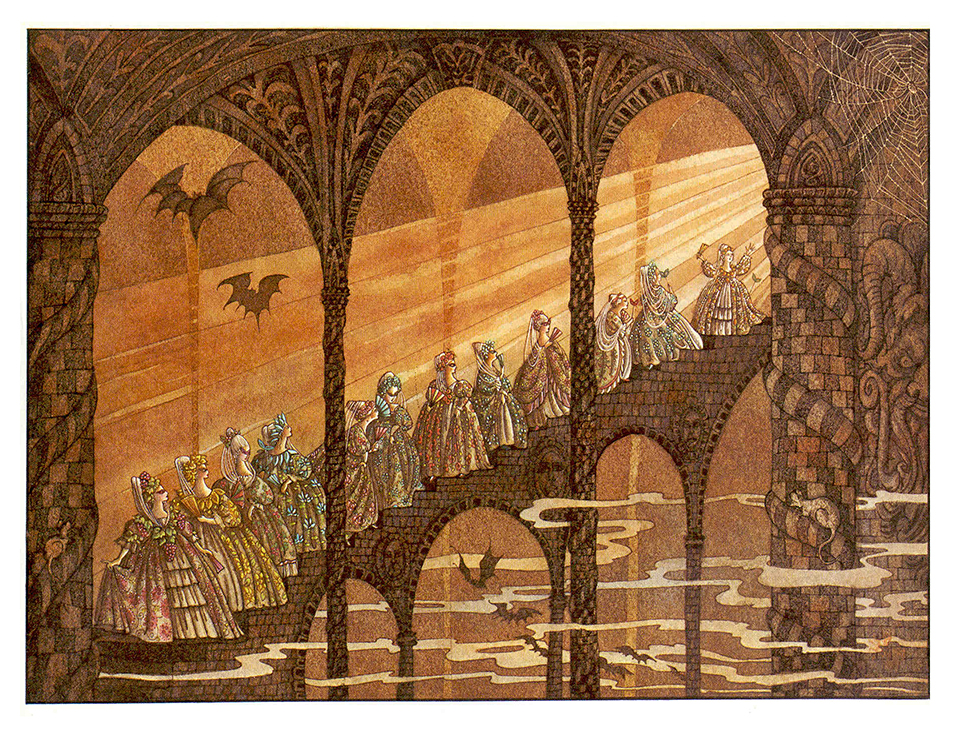
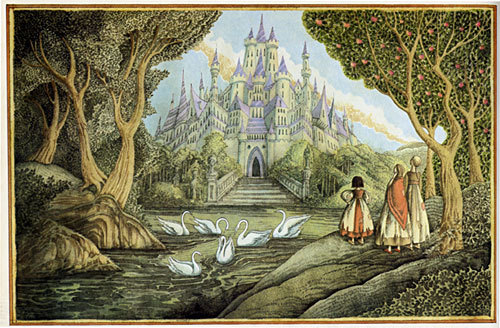
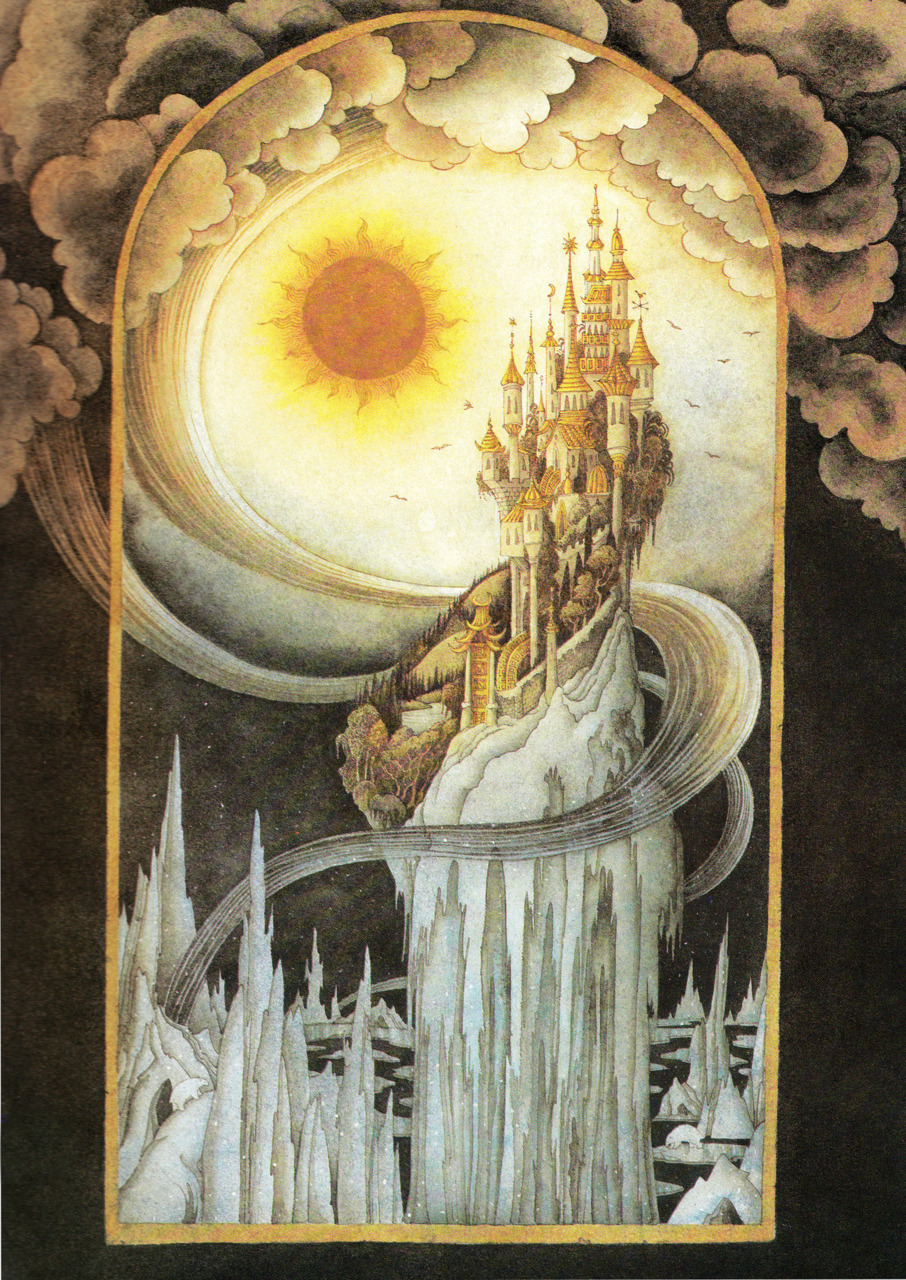
There are too many fantastic images to choose from by Errol le Cain (1941-1989), I could have kept going for a while!  Alas, I must get to work...
 

Saturday, September 1, 2012

Cupid and Psyche: Envy

Cupid and Psyche is known in the world of fairy tales as being the earliest known literary predecessor of Beauty and the Beast; however, it has one main theme in common with Snow White which is not often talked about: that of the older woman's envy of the younger woman's beauty.

That could be because tales related to Cupid and Psyche didn't evolve into tales involving sleeping women, as far as I know, but it is jealousy that starts all of the conflict in Cupid and Psyche.

Psyche is so beautiful that people refer to her as the second Venus, causing Venus to become jealous and order her son Cupid to cause her to fall in love with "the poorest, ugliest, and vilest creature alive." An oracle prophesies that she must be left on a mountain for "a winged snake, a monster so fierce that even the gods are afraid of him."

Domenico Corvi
 
Fortunately for our heroine, Cupid falls in love with her and takes her to be his bride, although as far as the reader knows, she may be married to the snake monster because her husband only comes to her at night, in the dark, and forbids her to ever try and look at him.

But just when things seem to be going well for Psyche-she loves her husband, has all her needs met during the day-her sisters come to visit, and out of their envy (although this time of her situation more than her beauty, but we can pretty much assume her beauty had to do with Cupid's falling in love with her) they decide to pressure her to look on her forbidden husband, inciting his anger. This she does, and because of that Cupid leaves and she is left to suffer and accomplish impossible tasks for Venus. She does this through the help of sympathetic creatures and eventually gets her happy ending.
John William Waterhouse
 
But the two main sources of conflict were started because of the envy of other women. At one point, as she goes to what she believes is her death by the monstrous husband, she laments, "Now you see the reward for my unusual beauty. Now you see the damage caused by envy. When people honored my beauty and called me the new Venus, you should have cried. Now I see that people have dishonored Venus and that the goddess is behind my suffering." This almost makes it seem like the envy of a beautiful woman is normal, to be expected, and those who are jealous aren't even blamed (the sisters later suffer death, but Venus suffers no more than having to watch Cupid and Psyche live happily ever after). Reminds me of Samantha Brick and her claim that "no one is more reviled than a pretty woman."

And while I don't agree with that statement, it is true that extremely beautiful women have a unique set of issues (not that I claim to know this from experience. I mean I have good self esteem overall but I'm under no delusions). Men might go after them, but only for their looks, and other women do tend to be jealous. Beautiful women also tend to get stereotyped as being less intelligent and more shallow.

Edward Burne-Jones
"Cupid Delivering Psyche"
 
But, although it was envy that brought on Psyche's suffering, in the end, if it weren't for Venus' jealousy, she never would have met Cupid. I feel like I've read versions where if she had just been patient she would have been allowed to see her husband anyway, but according to Jerry Griswold's translation, there was no such promise, so her giving in to the temptation of seeing Cupid actually brought them to a place where they did not have to hide from Venus, and Psyche was made immortal so the marriage could be legitimate. When we today tend to read this myth I think we get lost in the whole "woman chided for curiosity" issue that bothers us so much but maybe we miss the point: that our trials in life, though they suck at the time, may end up giving us hope for a better future.

Wednesday, April 11, 2012

Ruth Bottigheimer on Donkeyskin

Perrault's famous version of Donkeyskin was dedicated to a friend of his, the Marquise de
Lambert, who was in the process of gaining back rights and property that were hers by birth. It's fitting that the heroine of the tale should be first deprived of her royal status, but at the end rewarded with the royal rights and privileges she started with, in the classic restoration fairy tale plot.

At the time, the term "donkeyskin story" was used to refer to any amusing tale with magic in it, not necessarily because it contained a donkeyskin (maybe like how most fairy tales don't actually have fairies). In using a donkeyskin in his donkeyskin story, he was making a pun. Other stories did exist with actual donkeyskins in the plot, however-including the frame story to "Cupid and Psyche" in Lucius Apuleius' Golden Asse (the story that is thought to be the earliest literary precedent to Beauty and the Beast). It's probable that Perrault was familiar with this, but the combination of a donkeyskin and incest driving a royal girl to servanthood was taken from two earlier tale versions by Straparola and Basile. Though Perrault added his own take to the tale, the influence of the earlier writers' tales is fairly obvious. As is characteristic of the authors' tale collections as a whole, Straparola's and Basile's tales were full of bawdy and cruder humor, while Perrault made the story more acceptable to a dignified, refined French audience in the 1690s.

Donkeyskin is most noteable among current audiences for its shocking attempt at incest. Incest was not entirely uncommon in midieval literature, but in Donkeyskin it is noteable because it was not only ultimately unsuccessful, but in the end deeply repented (repentance itself is very rare in fairy tales-the villains usually meet grisly punishments with no thought given to a possible change of heart).

Illustration by Kay Neilsen. Information from Ruth Bottigheimer's "Fairy Tales: A New History"

Tuesday, September 13, 2011

The problems with trying to find morals in fairy tales

In Maria Tatar's Off With Their Heads!: Fairy Tales and the Culture of Childhood, she has a very interesting section on Beauties and Beasts, analyzing different types of Animal Bridegroom tales. Often, modern interpretations of tales such as Cupid and Psyche and Beauty and the Beast criticize the tales for what seem to be misogynist messages: "Never once do these stories show a heroine making a move in the direction of autonomy-the tales ceaselessly turn on the question of retargeting the object of the woman's devotion [from her father to her lover]." Tatar points out that women are expected to love because of duty and not passions, yet men rarely have the same standards applied to them.

Yet I have a very strong connection to the story of Beauty and the Beast and love the fact that Beauty learns to love someone despite how he looks-not because she's a woman, but because she's human. Many critics of the woman's expectation to accept whatever she's given are also under the impression that all Beasts are evil as well as ugly, a trend popularized by Disney, but this was never the case before (with the Marianna and Mercer Mayer picture book being the only exeption as far as I'm aware). As a single tale I think it's a beautiful, powerful, and challenging story, and yet if you look at the pattern of the tales told through history, you do notice disturbing trends. Cupid and Psyche especially is very condeming of feminine curiosity-Psyche is severely punished for looking upon Cupid, but who can blame a woman for wanting to look at her husband? Tatar points out that Psyche's act reveals she wants enlightenment-knowledge of her husband that goes beyond carnal (he's been visiting her every night and performing his husbandly duties under the mask of darkness). You would think this would be encouraged, but it proves to set off the chain of events that make Psyche miserable for years as she has to earn back her husband-another source of grief for modern people who loathe the implication that a woman's life should revolve around the man.


I'm still wrestling with the concept of how much you can condemn one tale for fitting into a pattern. Literary collections of tales, like Apuleius' "The Golden Asse", from which Cupid and Psyche comes, or the Grimms, have a direct source you can point to who had their own agenda. But folklore itself-those fairy tales that are supposedly handed down from generation to generation by word of mouth-have no one responsible for their messages and meanings other than collective humanity. It's just kind of sad that your appreciation of a tale can be diminished by knowing that it can be offensive, simply because it suggests things when studied alongside other similar tales.


But Tatar concludes with some very interesting observations that are important to keep in mind when studying fairy tales-you can't take fairy tales too seriously because even within one tale they will contradict themselves. Tatar says, "The many variants of 'The Search for the Lost Husband' remind us of the strength of children's fairy tales as moral magnets, picking up bits and pieces, if never entire blocks, of a value system. But since fairy tales seem to resist wholesale assimilation of a moral outlook or ethical orientation, they tend to offer mixed signals about the way to get ahead. One tale may impart a critique of dishonesty at the same time that it shows a boy defeating his enemies by cheating them. While it is tempting to look for a certain consistency in a tale's moral code (particularly since so many fairy tales have been pressed into service to provide behavioral models), it is rarely possible to find a story that does not encode competing moral claims."


Tatar uses the Grimms' The Frog King as an example. The heroine had to be forced to allow the frog to share her plate and bed even though she had given him her word, violently throws him against a wall, and ends up marrying the handsome Prince he becomes. Tatar's words: she is "selfish, greedy, ungrateful, and cruel, and in the end she does as well for herself as all the modest, obedient, magnanimous, and compassionate Beauties of 'The Search for the Lost Husband.'"' She contrasts this with a similar tale from England where the girl does obey each of the frog's requests, as her stepmother forces her to. The frog even asks that she chop off his head, and after hesitating she still obeys but still ends up with the same result. Tatar says that the tale could be meant to be humorous, as if obeying the commands of a villain would lead to a happy ending. In many fairy tales, whether you obey or violate a command, you get the same results.

Katharine Cameron

And remember that the fairy tales versions we are familiar with, especially from the Victorian period, were specifically written to be moral guidelines for children, therefore inserting messages in where they weren't before and sometimes contradict the actual facts of the story. But these messages we grew up with become embedded in the meaning of the tales in our minds and it's hard to see them as meaning anything different-but fairy tales can be read multiple ways. Though Tatar concludes that though Cupid and Psyche does have an unfortunate message of rewarding female self-sacrifice while condemning attempts at enlightenment, "it also celebrates the revelatory power of curiosity, the way in which the desire for knowledge of the beloved can deepen passion to turn it into love."

Thursday, August 11, 2011

Madame D'Aulnoy's Green Snake: Beauty, Ugliness, and Curiosity


Green Snake (or "Green Serpent") by Madame D'Aulnoy is a fascinating tale. It reminds me a lot of C.S. Lewis' "Till We Have Faces" (a lesser known but my favorite of all his books) because they are both retellings of the Cupid and Psyche myth, but starring a rarity: an ugly female. There are some versions of Animal Bridegroom tales which are little known today, but Green Serpent features a human female who is cursed with ugliness (note that this is not an authentic folktale, but a fairy tale from the French salon period-I can't think of any actual folktales that have an ugly human female as the protagonist).

This story has dual Beast characters-more like "Beast and the Beast" than "Beauty and the Beast," if you will, because the Prince is also in disguise as the title character. D'Aulnoy explores the themes of beauty vs. ugliness in her tale, just as Lewis did in "Till We Have Faces"-especially the cruel reaction of culture to a person's ugliness, especially a woman's. (This is kind of a soap box of mine-read more here.)


First of all, the heroine, Laidronette (it's been translated as Dorugly, which contrasts her sister Dorabelle) is cursed by an offended evil fairy, not unlike Sleeping Beauty. However, Laidronette's fairy claims that she was not invited to the party because "you only want beauties with fine figures and fine dresses like my sisters here. As for me, I'm too ugly and old. Yet despite it all, I have just as much power as they." Earlier this fairy is defined as malicious, but we already see the theme of someone being judged, possibly, by their appearance. So poor Laidronette is given "perfect ugliness," but the other fairies prophesy that she will one day be very happy. The Queen is still concerned that her daughter become beautiful again, which the fairies can't promise.

When the princess was twelve, she begged her parents to be allowed to be shut up in a castle so that she "will no longer torment them with her ugliness." This was difficult for the Royal couple, because "despite her hideous appearance, they could not help being fond of her," but they allowed her to leave. This language implies an assumption that people's worth is found mainly in their appearance. Later, Laidronette returns to see her sister marry, but was received coldly by the Court and her family. She was glad to return to her forest home "where the trees, flowers, and springs she wandered among did not reproach her for her ugliness."


One day while the Princess was out, she came across a green snake who spoke to her, saying, "Look at my horrible form. And yet at birth I was even handsomer than you." This terrified Laidronette, who ran away. Later she explored a boat which took her out to sea and threatened to capsize. In her hour of terror she mused, "Alas, have I ever enjoyed any of life's pleasures so much that I should now feel regret at dying? My ugliness disgusts even my family...wouldn't it be better for me to perish than to drag out such a miserable existence?"


Hopefully, this whole "ugly people have no point in being alive" message is making you angry. Yet at the same time, it's the other people in Laidronette's life that are making her life so miserable. I think it's safe to assume that any woman today who is considered extremely ugly would also find life to be very difficult because of how she is treated.

Laidronette is offered help from the green snake, but she is still so horrified she would rather die than owe her life to him. Here, sadly, the one person who should have learned not to judge by appearances seems to be just as shallow as anyone else. The boat wrecks on a rock, but Laidronette wakes up to find herself in an enchanted land where she is waited on hand and foot by a hundred strange little creatures called pagods.


Laidronette enjoys the luxuries provided for her, and is shocked to find herself treated honorably with "no longer talk of her ugliness." (In the picture above, she wears a veil, just like Orual in Till We Have Faces...) This is the part that begins to parallel Cupid and Psyche-very intentionally, too, for as her invisible lover begins to win her over, she realizes she's following in Psyche's footsteps. Laidronette can't believe anyone could love someone so ugly, and here we have a refreshing change in attitude, for the invidible prince says that she "has sufficient qualities to merit my affection," for the first time alluding to the fact that people can have positive qualities other than their appearance. Yet Laidronette hasn't quite learned her lesson-she still wants to know from the pagods if their prince is handsome, and can't return the love of someone she cannot see.


Eventually, though, she is won over and agrees to be the bride of the invisible voice. She is told that he has been cursed by the same evil fairy that cursed her, and that two years of his curse remain, and should she succomb to curiosity like Psyche, his sentence will begin all over again.


Yet, even having read the story of Psyche over and over again to avoid making her mistakes, Laidronette once again listens to her mother and sister and decides to look on her husband, only to find he is the Green Snake and she must complete impossible tasks (with the help of a beneficient fairy) before she can earn her happy ending. D'Aulnoy repeats over and over again that Laidronette deserved what she got for her curiosity, it's all her fault, etc., etc., even with a poetic moral at the end about the evils of the womanly sin of curiosity. Keep in mind that D'Aulnoy was a feminist in her day, who, according to Jack Zipes, "did not like the manner in which women were treated and compelled to follow patriarchal codes, and...did not even stop short of aabetting execution or murder of men she considered unworthy or tyrannical." So I don't know if D'Aulnoy was just trying to parallel Cupid and Psyche, or if she really thought curiosity a terrible sin limited to the female race, but Laidronette is continually reprimanded for her act of curiosity.


owever, she apparantly eventually learns her lesson. Sent on an errand by the evil fairy to fetch water from the bottomless spring using a pitcher with a hole in the bottom and with a millstone tied around her neck, Laidronette decides to drink the water to make her wise before washing her face in it to make her beautiful. The good fairy likes this. Later we are introduced to a character who fell in love with a cruel woman only because she was beautiful who suffered for it. So, despite the appearance of the beginning of the tale, women are found to have worth aside from their looks. Of course, Laidronette still becomes beautiful in the end, and the Serpent becomes a handsome prince. Then there's the moral, which informs us that "too oft is curiosity the cause of fatal woe...it is a weakness of womankind."


I don't get it, myself. Feminism has come a long way since the late 1600s.

Tuesday, March 15, 2011

Sleeping Beauty through the eyes of Bruno Bettelheim


One more to round out my little mini-series...

In "The Uses of Enchantment: the Meaning and Importance of Fairy Tales," Bruno Bettelheim explains his psychoanalytical understanding of fairy tales. I remember disagreeing with a lot that he said the first time I read through this book, but looking back at the Sleeping Beauty chapter, I was surprised by how encouraging I found some parts to be.

Bettelheim sees the sleep of both Sleeping Beauty and Snow White as the physical lethargy that literally occurs at puberty, and also the "long, quiet concentration on oneself that is also needed" which symbolically happens at puberty. Both activity and inactivity are necessary at times of major life change, and the tales assure listeners that their listless stages will not last forever. Modern interpretations of fairy tales treat the idea of passivity with contempt (especially female passivity), but I totally agree that there are times for either extreme in everyone's life, as well as taking into account different personalities prone to either one; all action or all passivity is bad, but it's not bad to lean naturally towards one or the other.

Bettelheim also claims that the passivity is not limited to girls, though the obvious examples of Snow White and Sleeping Beauty would appear to indicate so; "even when a girl is depicted as turning inward in her struggle to become herself, and a boy as aggressively dealing with the external world, these two together symbolize the two ways in which one has to gain selfhood...the male and female heroes are again projections onto two different figures of two separated aspects of one and the same process which everybody has to undergo in growing up...children know that, whatever the sex of the hero, the story pertains to their own problems." I really like the idea of this, but don't know how true this actually is...(he does reference Cupid and Psyche, though, and how in that the female falls in love when viewing the male in repose, switching the stereotype). Is it possible that our very gender-focused interpretations of fairy tales hinder readers from applying both genders to themselves?
Then Bettelheim discusses the major versions of Sleeping Beauty-Basile, Perrault, and the Brothers Grimm, with very interesting discussion and commentary on each (you can see basic facts about each one at my most popular post to date, Sleeping Beauty-A Very Brief History). In Basile's tale, the father king is replaced with a lover king, which Bettelheim sees as being the natural way that a girl replaces attraction to her father with attraction to a lover. Other people might see that as being the historical fact that females were subservient to their fathers, then handed off to husbands, to which they were subservient as well. Bettelheim goes into more detail about the oedipal influences he sees in the tale, which I won't list here.

He goes on to Perrault. The Prince in Perrault's tale is more separated from the father King, but is not faultless. He knowingly leaves his wife and children in the protection of his ogress mother. Bettelheim explains this: "he [Perrault] did not take his fairy stories seriously and was most intent on the cute of moralistic verse ending he appended to each."

Also in Perrault, the mother figure becomes the fairies, who are separated into good and evil aspects. Bettelheim sees the fact that the evil fairy is not punished as a weakness in the plot.
"The central theme of all versions of 'The Sleeping Beauty' is that, despite all attempts on the part of parents to prevent their child's sexual awakening, it will take place nonetheless." Again, it's a nice thing to take away from the tale, but who actually comes up with this on their own? I wouldn't call it "the central theme of all versions" of the tale. Bettelheim lists several reasons that the pricking of the finger (shedding of blood, the age of 15) is really menstruation. He also lists several things about the scene that symbolize sex (circular staircase, small door, lock and key, door springs open, small room, "what kind of thing is this that jumps about so funnily?") but still claims that the main associations aroused are menstration itself. In fact, he indicates the real theme is waiting-the fact that the parents have to wait so long for a child, and the wall of thorns that arises as protection until the time is right-suitors who come to early perish in the thorns. "This is a warning to child and parents that sexual arousal before midn and body are ready for it is very destructive." ...so what about all those symbols of sex that happened before the enchanted sleep?

Bettelheim makes another interesting point about the menstration theory-it's only the king who tries to prevent this curse from happening, while the queen seems untroubled in each version about the fairy's curse. I had never noticed this before-I guess I assumed the king's actions represented the concern of both parents. Bettelheim sees the queen as "knowing better than trying to prevent it." Interesting thought...

But no worries about younger children-though they won't understand the full meaning of the tale as in the onset of puberty, they will still understand it as "awakening to his selfhood."
Bettelheim also sees the sleep of the adolescent as narcissim-shutting oneself off from the world, teenagers dream of everlasting youth and perfection. The kiss that awakens the princess is connecting to other people-"only relating positively to the other 'awakens' us from the danger of sleeping away our life." Again...I agree with the general concept, but don't necessarily see it as the obvious meaning of the tale.

The tramatic events of the heroine's life have happy consequences-therefore "the story implants the idea that such events must be taken very seriously, but that one need not be afraid of them. The 'curse' is a blessing in disguise."

Bettelheim makes another interesting comment before he closes the chapter-in the earliest known versions of the tale, Perceforest and Basile, the awakening happens not from a kiss, but from a baby sucking the flax out of her finger. Females, he claims, don't acheive complete self-sulfillment until they have given birth and nurture their baby. A lot of women would be offended by this. Personally, I have no desire for my own children at this point in my life and I feel incredibly self-fulfilled, but I'm not offended; undeniably many women do feel the desire to have children, and that would be an experience unlike any other. It's just interesting that Bettelheim draws such grand conclusions from such drastically different variations of the tale. I don't think he would claim that this is representative of a cultural shift from valuing childbearing to valuing interconnectedness...

Images: 1. Honor C. Appleton 2. William A. Breakspeare 3. and 4. Harry Clarke

Tuesday, May 25, 2010

Possible link between Cupid and Psyche and Nightwish

Been a while since I posted a Nightwish song! High time again.

Their song "Planet Hell" repeats these lyrics: "Save yourself a penny for the ferryman/Save yourself and let them suffer." At first I assumed this was just describing a horrible place. But when I read the full version of "Cupid and Psyche" (the earliest known version in the history of "Beauty and the Beast"), I discovered that one of her tasks was to take the ferry to hell. She is given two halfpence to carry in her mouth (I don't know why) and specifically instructed, "and it shall come to passe as thou sittest in the boat thou shalt see an old man swimming on the top of the river, holding up his deadly hands, and desiring thee to receive him into the barke, but have no regard to his piteous cry..." and other sorry creatures Psyche is forbidden to share her pennies with, because otherwise she'll never leave hell. The people pleading for help, we are told, are traps set by Venus, so Psyche is not actually guilty of cruelty.

Was this an intentional allusion to Cupid and Psyche, as Beauty and the Beast is a favorite theme of songwriter Tuomas Holopainen? Who knows.

Sunday, May 2, 2010

Princess Zeineb and King Leopard: Before Beauty and the Beast

So we know that Beaument's Beauty and the Beast was basically a summary of Madame de Villeneuve's story of the same title from 1740. And though Villeneuve did give the story many of the unique twists that shifted it from the oral stories to the tale we know today, she didn't create it in a vacuum either. Jean-Paul Bignon's collection of tales, from 1712-1714, included Princess Zeineb and King Leopard, an Animal Bridegroom tale. In the words of Jack Zipes, the story "is extremely important because of the role it plays in the Beauty and the Beast tradition. It is more than likely that Madame de Villeneuve knew this version, and it may have served as the basis for her tale that later influenced Madame Leprince de Beaumont." And...I just realized that I've been spelling "Beaumont" incorrectly this entire blog. If I get really bored one day I'll go back and fix that.

ANYWAY...the story is of a King who stumbles innocently upon a palace and randomly threatened with death if he doesn't bring one of his daughters. He has no intention of letting them go, but the eldest insists. She goes, loses courage, and returns. The next four in the line go as one bunch and all lose courage. This helps to save time and fit into the fairy tale pattern of threes. Note: in this version the sisters are good and try to save their father. Usually the sisters are too selfish to consider the sacrifice, but here their only vice is lack of courage.


The youngest daughter, Princess Zeineb, is determined not to lose courage, so she goes and is waited upon by servants. She never actually meets or talks to the leopard, but every night he comes and lies in her bed-without touching her. This is more like Cupid and Psyche. Finally the Princess starts wondering if it's really a leopard. One night she finds the skin and rips it up, for which she is chastised by the Prince, who was nearly about to break the spell, but now her curiosity has ruined it. She doesn't cower before him, but gives him excuses, including that "girls are naturally curious." Note: this was written by a man (and at least Psyche had been specifically warned NOT to listen to her mother, Zeineb got nothing. Communication is key here, guys). Villeneuve replaced this violation with staying too long at home.


There are apparantly no pictures of this fairy tale online, but this sort of relates:

Image from here...even though I didn't see it on the site and can't credit it...

Princess Zieneb embarks on a long, difficult journey where she uses her embroidery skills (yes, a domestic skill...) to make a living for herself. However, some village pervs tried to take advantage of her, and later get revenge and have her burned alive when she spurned them. She survives her trials though her resourcefulness (including bribing the judges at her trial) and through a spell King Leopard had taught her. In the end, she's saved from Joan of Arc fame in the nick of time when the King comes back to town, and you'll never guess who he really is! Yup, he's King Leopard, who pardons and marries her. It ends with this odd little line: "Then I gave the judges who had let themselves be bribed by my money the punishment they deserved. On the other hand, those judges who had been moved by my beauty were punished in a more lenient way." Isn't the whole point of the story...not to judge by looks? But I guess these pre-Villeneuve/Beaumont stories are more about the dangers of curiosity.

Tuesday, April 27, 2010

Beastly females

In college I took a fantasy class, and I wrote a paper on C. S. Lewis' Till We Have Faces. The book retells the story of Cupid and Psyche from the perspective of Psyche's sister-named Orual-who is tremendously ugly yet not evil like the classic stepsister stereotype. In my paper I explored the concept of inner and outer beauty, and how beauty is perceived and treated.
This is a theme that fascinates me, but I was surprised to discover in my research that few other authors touched on the subject. In fact, given the importance of the theme in the book, it's pretty much ignored in most papers and books.

I learned some interesting things about C. S. Lewis as well-for example, his wife was not considered especially beautiful, and for a while he himself treated her like one of his male friends. This is also a theme of the book-how Orual is despised as a female and at best is treated like "one of the guys," all because of her ugly face. Only by veiling it can she ever hope to be treated like a woman.

Not only do critics of the book ignore the topic of female ugliness, but I think culture at large avoids it. Women love Beauty and the Beast-it is still far and away the favorite on Surlalune Blog's favorite fairy tale poll. Other popular stories involving beastly/deformed males include the Hunchback of Notre Dame, The Elephant Man, and especially Phantom of the Opera. You'd have to live in a cave not to know that (at least some) girls find the Phantom to be eternally more attractive than Raoul.
EDIT: Gerard Butler as the Phantom in a makeup test, without mask

Yet what about examples of Animal Brides or females with deformities? Though folklore has examples, virtually none remain in common knowledge. Even with historical Animal Bride tales, generally the animals take beautiful forms-swans or cats-and there is little struggle to win male affections. There are seal maidens, but they shed their seal skins and then the men fall in love with their naked human forms.

The Frog Bride (illustrated above by Kay Nielsen), is one of the exceptions. But very few people know that the Frog Prince is sometimes a Frog Princess. Why do we ignore this theme? Why do we only have animal grooms?

My theory is that we, as a culture, can't even stand the idea of an ugly female. Females themselves are willing to love the Beast-but don't want to be the ugly, vulnerable one themselves. I'd be interested to know how popular Beauty and the Beast is among males. Do they mind picturing themselves as the Beast? Or can they stand it as long as Beauty stays hot the whole time? From my limited experience, it APPEARS as though men tend to judge women by more shallow standards. Please contradict me if I'm wrong.However, there are some exceptions to the rule: Gail Carson Levine's Fairest. This book features a hideous girl with a beautiful voice in a land where singing is valued as highly as beauty. I would LOVE to live in a land like that (I am definitely one of those people who wishes every deep emotion would trigger backup music and a song with choreographed dancing). It's a very good story-I found it on the bookshelf of a girl I was babysitting one day and started it, and after I went home I had to go to the library and finish it. Then there's Penelope, in which Christina Ricci's character has a pig snout for a nose. Yet first of all, these examples are hardly classics like the male versions I mentioned before, and I also wonder about their implied messages. Fairest has good messages about how each girl is beautiful on their own, but seems to put a lot of pressure on the boys to fall in love (basically) at first sight-yet now they're not supposed to judge by beauty, but instantly know character. If boys do judge by appearances-and let's face it, we all do to some degree, should we ignore that fact? No one would claim that beauty/appearance doesn't matter at all. How do we deal with it in the world in which we live?
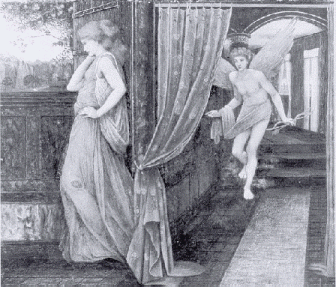
And one Netflix commenter pointed out that Penelope seems to indicate that any physical flaw will result in being treated like a complete monster, and that true happiness ends in looking like a beautiful celebrity. Of course, that's sort of the message implied by the old versions of Beauty and the Beast as well. Another commenter-I tried to find the exact quote but it was left a while ago-said something to the effect of, "This movie is stupid. I kept waiting to see Christina Ricci cuz she's hot but she had that stupid pig nose on the whole time."

What do you think?

Sunday, March 28, 2010

Cupid and Psyche

No study of Beauty and the Beast would be complete without a look into Cupid and Psyche.

Though the two stories at first glance may not seem to have all that much in common, Cupid and Psyche is the earliest known story that influenced the Animal Bridegroom tales which evolved over time and culture to become the story we know today as Beauty and the Beast. Learning the oral versions that came in between helps you see the progression.

The plot:

Psyche is so beautiful she becomes famous and makes the god Venus jealous. Venus gives Psyches' father a prophecy that Psyche must be set on a rock and wed a Serpent. Psyche goes bravely, only to find herself in an exquisite palace where she recieves all sorts of luxuries. A lover comes to her at night, whom she is forbidden to see.

Naturally, any prohibition in fairy tales is violated, so Psyche does look on her husband, after her sisters convinced her she must be married to a monster. Turns out her husband was Cupid, the son of Venus, who was sent to kill her but fell in love instead (woops). Because she looked, Cupid is sent away and Psyche is sent to fulfill many dangerous/impossible tasks by Venus before she can be reunited with Cupid.

Illustration by Errol Le Cain

The story of Cupid and Psyche is found within the larger work Metamorphosis, or The Golden Asse, by Lucius Apuleies, from the 2nd century A.D. Psyche's tale is told as a story within a story, which reflects the larger frame story. This is important, because Psyche's big sin in the tale is curiosity. The pattern in fairy tales is for women to be severely punished for their curiosity while men are often rewarded (think Bluebeard). Yet, this story is a parallel to the narrator of the larger story, Lucius (probably Apuleius himself), who was too curious about magic and ended up accidentally turning himself into a donkey. So this time, the curiosity is not reprimanded only in females. Yet, Benjamin Slade points out that even though the two characters suffer from their curiosity, they are both rewarded in the end. (You could argue the same about Bluebeard's wife, but not her predecessors).

So in this tale we have the precedent for the selfish sisters, and though the groom turns out not to be an actual animal, don't they all in the end turn out to be princes in disguise? Other elements of the story that were weeded out eventually include the violition of the prohibition to look on the husband, and that was often replaced by the prohibition of staying home too long, because of mean sisters/mothers as well. The series of tasks the heroine must go through disappeared by the Villeneuve/Beament version but are still there in some other versions.

Note that, although this is the first known version, it's not the authoritative. This was (likely)based off of earler work by Lucius of Patrae, which is based off of earlier oral stories... maybe this is what Disney meant by "Tale as old as time."

An EXCELLENT retelling of this story is C.S. Lewis' Till We Have Faces. My personal favorite of C.S. Lewis, he tells the tale from the perspective of the sister, but with some twists--the sister doesn't pressure Psyche to violate the prohibition out of jealousy, but out of genuine concern. The main character, Orual, is incredibly ugly, as opposed to Psyche's overwhelming beauty, but not evil. The book is a fascinating look into trust, beauty vs. ugliness, and different forms of love.