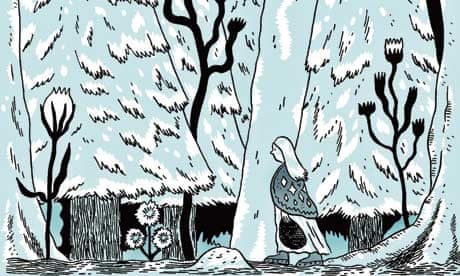
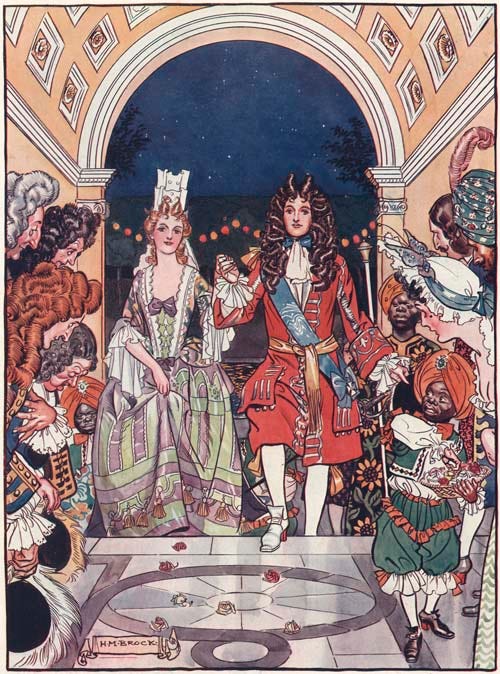
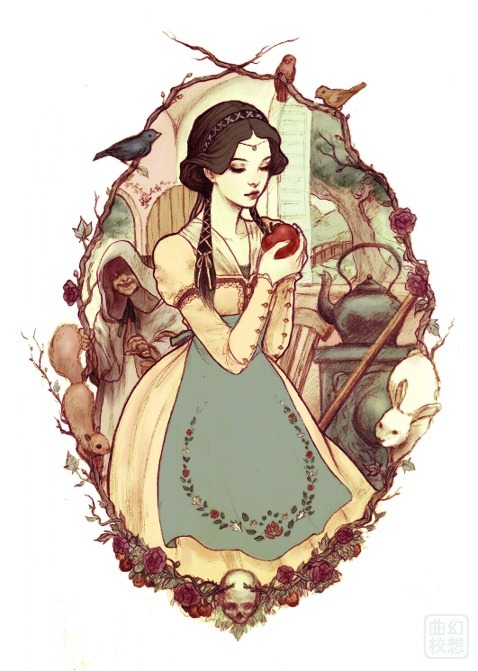
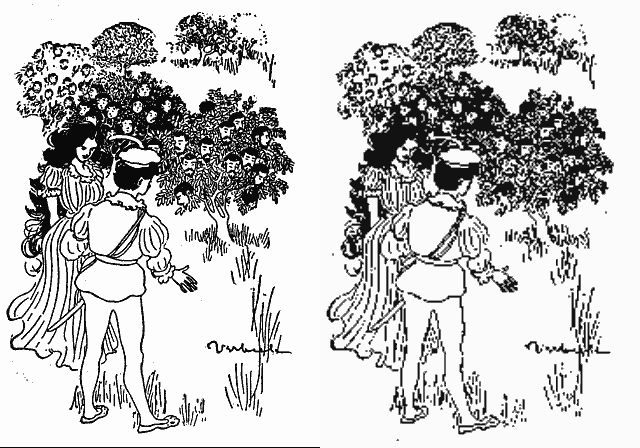
In my post on the different ways of Awakening the Sleeping Beauty, reader Nectar Vam shared this fantastic gender swapped version of the tale, The Sleeping Prince. It combines elements of Sleeping Beauty, Snow White, East of the Sun and West of the Moon, and even reminded me a little of Beauty and the Beast with the enchanted castle at the end. A bird tells a Princess of a sleeping Prince, who is white and gold and red, and goes on a dangerous journey even though she knew her parents wouldn't approve. She has to go to the lands of the West Wind, East Wind, and North Wind, where mortals should not go, and follow instructions to get past two lions that guard the gates of the castle, and awaits the time when the Prince's spell will be over.
It very much has the feel of a traditional folk tale to me, and although the sleeping prince trope may be much less common, if you look hard enough you can generally find gender swapped versions of any classic fairy tale-especially since this one bears resemblance to the journey of the heroine in "East of the Sun, West of the Moon." But the only sites I could find the tale at had no source cited-Wikipedia has a tale of the same title but it's clearly different (although also fascinating-in this one the heroine must stay awake watching the sleeping Prince for 3 months, 3 weeks, 3 days, 3 hours, and 3 half hours. She is persuaded to sleep towards the end and then follows a Goose Girl-type episode of mistaken identity). This site says it's Spanish (thanks, Amy Elize!) but has no further information on collection, editor, date, etc. So I can't promise it's authentic folklore but an interesting tale worth reading and sharing! Any further information on it would be welcome! UPDATE: Sarah Allison has more information on the source in the comments. Thanks, Sarah!
Also-in the past I've done features on roses in fairy tales on Valentine's Day. Interestingly, the key to getting past the lions in this tale is to pick two white roses from outside the North Wind's door, and throw them down before the lions when she gets close enough-something that would require lots bravery, since the lions act threatening until she gets close enough to throw down the roses! And the episode also reveals the great amount of power sometimes associated with roses in fairy tales.
Image sources-1 and 2
Showing posts with label roses. Show all posts
Tuesday, February 14, 2017
Tuesday, January 17, 2017
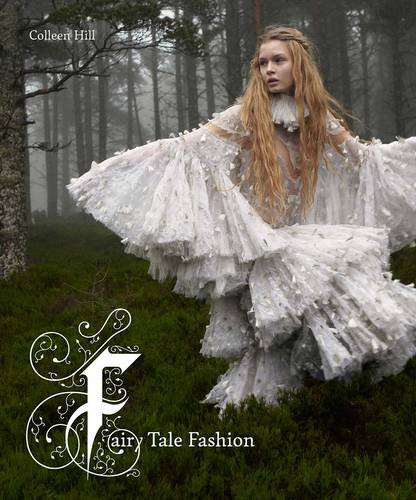
Fairy Tale Fashion: The Snow Queen
One more post from Colleen Hill's Fairy Tale Fashion!
In her essay on Andersen's "The Snow Queen," Hill informs us that the fairy tale was initially conceived as a short, ballad-style poem about a young woman and her lover, a poor boy who was abducted by the Snow Queen. The Snow Queen was then more of a sexual predator. The story evolved into the tale we know today, of two children separated when the boy, Kay, gets a piece of an evil mirror lodged in his eye that turns him into a cruel boy who mocks the things he used to love and follows the Snow Queen to her ice palace.
The tale uses opposing imagery-the natural, warm beauty of the rose verses the stark symmetry of mirrors and ice/snowflakes. The mirror in this tale is unusual in that, while mirrors usually tell the truth (such as the mirror in "Snow White" that is bold enough to bluntly tell the Queen when there is someone more beautiful than she), this mirror is deceptive-it distorts reality, causing beautiful things to seem ugly. (In fact, I sometimes thought of this mirror when I was in my first trimester-when foods I usually loved became disgusting to me and activities I enjoyed lost interest for me because of the constant nausea-I felt like I could relate to Kay).
Mirrors usually represent vanity in stories. The theme of vanity is also developed in "Snow Queen" by the reference to Gerda's red shoes. When she goes to search for Kay, she intentionally puts on her new red shoes that Kay has never seen before, but when she goes to the river she is willing to sacrifice her prized possessions to gain information about his whereabouts (but the shoes are returned to her because the river does not know where he is). Interestingly, this tale was written just four months before Anderson wrote the infamous tale "Red Shoes" in which the desire for the colored footwear is completely and repeatedly seen as selfish.
Hill interprets the red shoes as objects of pride, even for Gerda-saying that by wearing them she was initially hoping to impress Kay, but the difference between Gerda and Karen from "Red Shoes" was that Gerda was willing to give up her shoes. This may be, especially given Anderson's feelings about red sheos, but I didn't necessarily read it that way in "Snow Queen." It's natural for a child to be excited to show her friend a new toy or possession, without necessarily trying to impress or show off to your friend. If Gerda had taken a beautiful red rose and tucked it behind her ear with the intention of showing Kay, would that be interpreted as vanity? The rose would still be beautiful and displayed on Gerda, but fairy tale characters who request roses rather than clothes and jewelry are held up as the example of being non-materialistic, like Beauty in "Beauty and the Beast." Yet roses are a symbol of her friendship with Kay-when staying with the old woman, it was seeing an image of a rose that reminded Gerda of her quest to find Kay. Could the wearing of the red shoes even have been Gerda's attempt to remind Kay of their beloved roses, since a real rose wouldn't survive a long journey? The colorful roses of Kay and Gerda's childhood playdates are a stark contrast to the colorless white of the Snow Queen's palace.
Red Morocco leather shoes, from 1800-1810
Although, it was more of a natural assumption at the time to associate red shoes with luxury, since red dye was more difficult to produce, and therefore more expensive, so red was a color only the wealthier could afford. But it seems that illustrators to tend to intentionally bring out the contrast in warm colors associated with Gerda, her friendship with Kay, and her journey to find him, as opposed to the cold realm of the Snow Queen. See Arthur Rackham's illustration of Kay and Gerda in their garden, and Edmund Dulac's image of Gerda at the old woman's house:
Compared with the Snow Queen/her palace by the same illustrators:
Although, I may be too quick to defend the wearing of red, just based on our own modern culture, where bright colors are just as easily accessed as neutrals. If anything, we tend to associate good things with characters who wear bright colors, aligning them with bright, joyful personalities. What do you see as the significance of Gerda's red shoes?
In her essay on Andersen's "The Snow Queen," Hill informs us that the fairy tale was initially conceived as a short, ballad-style poem about a young woman and her lover, a poor boy who was abducted by the Snow Queen. The Snow Queen was then more of a sexual predator. The story evolved into the tale we know today, of two children separated when the boy, Kay, gets a piece of an evil mirror lodged in his eye that turns him into a cruel boy who mocks the things he used to love and follows the Snow Queen to her ice palace.
The tale uses opposing imagery-the natural, warm beauty of the rose verses the stark symmetry of mirrors and ice/snowflakes. The mirror in this tale is unusual in that, while mirrors usually tell the truth (such as the mirror in "Snow White" that is bold enough to bluntly tell the Queen when there is someone more beautiful than she), this mirror is deceptive-it distorts reality, causing beautiful things to seem ugly. (In fact, I sometimes thought of this mirror when I was in my first trimester-when foods I usually loved became disgusting to me and activities I enjoyed lost interest for me because of the constant nausea-I felt like I could relate to Kay).
Mirrors usually represent vanity in stories. The theme of vanity is also developed in "Snow Queen" by the reference to Gerda's red shoes. When she goes to search for Kay, she intentionally puts on her new red shoes that Kay has never seen before, but when she goes to the river she is willing to sacrifice her prized possessions to gain information about his whereabouts (but the shoes are returned to her because the river does not know where he is). Interestingly, this tale was written just four months before Anderson wrote the infamous tale "Red Shoes" in which the desire for the colored footwear is completely and repeatedly seen as selfish.
From the "Snow Queen" section of the Fairy Tale Fashion exhibit at the Fashion Institute of Technology. Far left; white fur cape by J. Mendel, second to the left; not in the book, second to the right; Alexander McQueen Fall 2008 dress inspired by snowflakes, far right; Tom Ford Spring 2014 dress that imitates shards of a broken mirror
Red Morocco leather shoes, from 1800-1810
Although, it was more of a natural assumption at the time to associate red shoes with luxury, since red dye was more difficult to produce, and therefore more expensive, so red was a color only the wealthier could afford. But it seems that illustrators to tend to intentionally bring out the contrast in warm colors associated with Gerda, her friendship with Kay, and her journey to find him, as opposed to the cold realm of the Snow Queen. See Arthur Rackham's illustration of Kay and Gerda in their garden, and Edmund Dulac's image of Gerda at the old woman's house:
Compared with the Snow Queen/her palace by the same illustrators:
Although, I may be too quick to defend the wearing of red, just based on our own modern culture, where bright colors are just as easily accessed as neutrals. If anything, we tend to associate good things with characters who wear bright colors, aligning them with bright, joyful personalities. What do you see as the significance of Gerda's red shoes?
Labels:
color symbolism,
fashion,
Hans Christian Andersen,
Red Shoes,
roses,
Snow Queen
Tuesday, January 3, 2017
H. M. Brock's Beauty and the Beast
Happy New Year! Hope you were all able to spend some time with friends and family over the winter holidays!
I got a few fairy tale treasures over the last month to share! First up, I received another book to add to my Beauty and the Beast collection, H. M. Brock's 1914 illustrated version. The copy I got has an introduction by Jerry Griswold, author of one of my favorite books on BATB.
The prose, adapted by an anonymous writer, follows the traditional French fairy tale pretty faithfully, but with a faster pace than either Beaumont or Villeneuve. One unique aspect I don't think I've read before was that when Beauty wishes herself back with her family, she uses the magic rose. Her sisters try to use the rose for themselves-only as soon as they wish on it, it withers. Beauty is dismayed to find the withered rose on the floor of her sister's room, but as soon as she picks it up, it blooms healthily again.
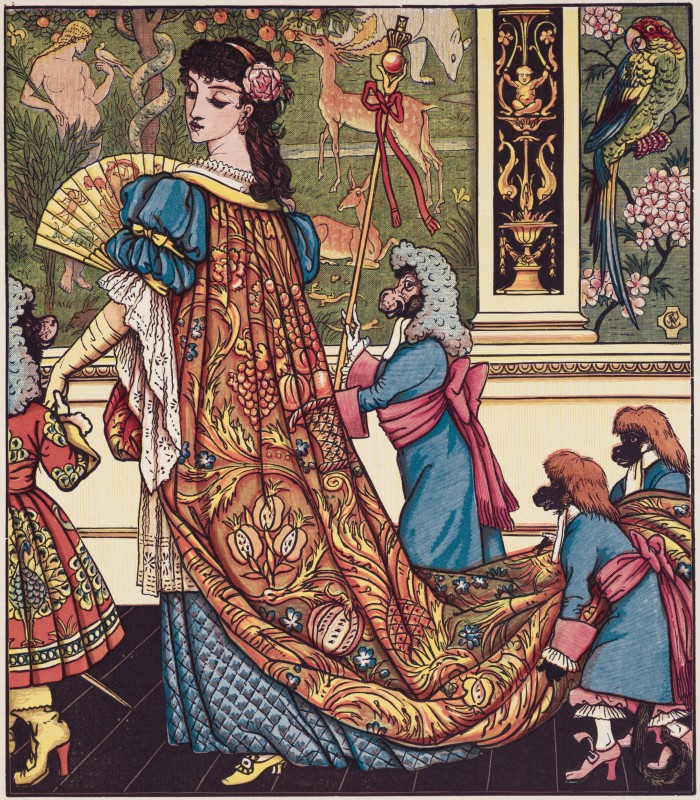
I wasn't familiar with H. M. Brock's illustrations before. They mimic Walter Crane's 1874 illustrations, but as Griswold discusses in the introduction, Brock has his own unique contributions.
I got a few fairy tale treasures over the last month to share! First up, I received another book to add to my Beauty and the Beast collection, H. M. Brock's 1914 illustrated version. The copy I got has an introduction by Jerry Griswold, author of one of my favorite books on BATB.The prose, adapted by an anonymous writer, follows the traditional French fairy tale pretty faithfully, but with a faster pace than either Beaumont or Villeneuve. One unique aspect I don't think I've read before was that when Beauty wishes herself back with her family, she uses the magic rose. Her sisters try to use the rose for themselves-only as soon as they wish on it, it withers. Beauty is dismayed to find the withered rose on the floor of her sister's room, but as soon as she picks it up, it blooms healthily again.
I wasn't familiar with H. M. Brock's illustrations before. They mimic Walter Crane's 1874 illustrations, but as Griswold discusses in the introduction, Brock has his own unique contributions.
Brock's emphasis, Griswold says (other than the luxurious, Cowardly-lion like locks of the Beast) is on the enchanted servants. Beauty's father is waited on by disembodied hands that seem to foreshadow Cocteau's row of candelabra sconces that appear to be disembodied human arms. Beauty's servants aren't as creepy; she gets monkey servants like in Crane (and in Villeneuve's "original" story).
Brock's Disembodied hands wait on Beauty's Father
Disembodied arms hold candelabras in Cocteau's 1946 film
Walter Crane's monkey servants in procession with Beauty
Brock's parallel monkey servant procession
Labels:
artists,
Beauty and the Beast,
children's books,
roses
Sunday, February 14, 2016
Roses in Fairy Tales: Beauty's Request
Roses are often associated with "Beauty and the Beast," whether people are familiar with the tales in which Beauty requests a rose from her father which he finds in the Beast's garden, or the Disney one that signals the end of the period in which the Beast's curse can be ended. People have found different meanings in the classic fairy tale's rose; it is generally thought to represent Beauty's character, since she appreciates nature and is not vain and materialistic like her sisters. Yet it's ironic, because the dresses and jewelry her sisters request are actually practical and will last a long time; flowers, especially roses, are beautiful for a few days and then fade.
It's also interesting to look at folktale versions of BATB from around the world in Surlalune's collection. Some stories don't even have the episode with the request.
In some, Beauty's request is there to emphasize her wisdom and restraint. Like Villeneuve, who tells us that Beauty realized her father may not be left with much money after paying off his debts, Beauty requests something she thinks will be cheap and easy to find; the heroine in an Italian version states, "this is not the time to spend money, and I love flowers." In most versions, Beauty initially requests nothing, saying she only wants her father to come back safely and/or in good health; but he presses her, for he wants to get her something. In the Italian "Bellindia," both the father and her sisters think her foolish for only requesting a rose tree. In this tale, it seems that money really is no longer a problem, and Bellindia could have had anything she wanted-her father later feels "no inclination to comply with Bellindia's wish."
Some Beauties don't ask for roses, although the majority of them do. In the Spanish "Lily and the Bear", the youngest daughter asks for a lily, saying, "We have many roses in our garden but I have never had a lily." (Interestingly, her eldest sister asks for a rose-colored dress).
In the Portuguese "Maiden and the Beast," this daughter is so emphatic that her father not buy her anything, she asks for that which does not exist-"a slice of roach off a green meadow" (?)-yet the supernatural beast is able to provide her father with...whatever that is...in order to demand that she be brought to him. In most versions, it's really the Beast who manipulates an innocent request into getting a potential date-although to be fair, he's pretty short on options. (The Villeneuve once again explains this away, and we are told that being threatened with her life before coming is the only way a woman can actually break the Beast's spell. It's a pretty complex curse.)
Whatever we may read into Beauty's request, it's usually essential to the story to simply bring her and the Beast together at some point. It shows that Beauty is different from her sisters and connects her to the Beast.
Illustrations by A. L. Bowley
Monday, February 8, 2016
Roses in Fairy Tales: Snow White

When I posted on roses last year, Gypsy of Once Upon a Blog reminded me that roses are also very significant in the history of "Snow White", and referred me to Kate Forsyth's fabulous post on Snow White.
There's a 9th century Norse saga that includes the tale of "Snow Beauty." A king's beautiful wife died, but her cheeks remained rosy. He became obsessed with the idea that she would come back to life, and neglected his kingly duties, sitting by her side. When his councillor finally suggested he allow them to change the bedclothes, they lifted the body up, "a rank smell of rotting rose with her, the body turned blue, and worms and adders and frogs and toads crawled out. So she was burned, and the King returned to his wits."
In Basile's "The Young Slave" (published 1634), arguably the oldest literary version of Snow White, the mother became pregnant with Snow White after swallowing a rose petal.
In the first version of "Snow White" that the Grimms collected (in 1808), there is no hunstman, but the Queen sends the girl into the forest to collect roses and abandons her there. (This is in the Grimms' earlier manuscripts, but by the first edition of tales in 1812 the story had become the version we have now with the huntsman).
I wonder why we've lost all associations with roses and Snow White in our current versions? I found it hard to find any images of Snow White with roses for this post, despite the general association of Princesses with pretty flowers. The stark color contrasts of red and white featured in "Snow White" do recall common rose shades to mind, such as in the fairy tale "Snow White and Rose Red." In that tale, the different shades represent the two sisters and their contrasting personalities.
It seems that roses, despite being the cliche and overly romantic flower we think of now, often had a history of being very morbid in fairy tales, especially those related to Snow White.
Labels:
color symbolism,
roses,
Snow White,
unhappy endings
Monday, February 1, 2016
Roses in Fairy Tales
Last year, leading up to Valentine's Day, I did a post on roses in fairy tales because it seemed rather fitting, but the subject could be explored so much more, that post was really only a scratching of the surface. So this year I'm following up on some more ways to look at roses.
You can even use the image to look at the complexity of tales themselves, such as Marcia Lane does in her book Picturing the Rose: A Way of Looking at Fairy Tales.
From the introduction:
"If I say to you, 'Think of a rose,' your mind conjures up a picture of a flower-but your picture is unique. You imagine a new, tight bud, or a full-blown flower. Everyone sees a different rose. Take it by the stem and rotate it slowly and, second by second, it transforms right before your eyes. Each time you look at it, it's different, but the rose is still there. In much the same way, fairy tales tend to change as we live with them, examine them, and tell them. Return to the rose. Close your eyes and the perfume will resurrect the image of the flower. Always the same, always changing. These stories will blossom as you examine them; you can look and look, and they will never lose their ability to delight and enchant. Such is their power!"
Image
Over the next couple weeks there will be some more posts on roses in fairy tales; hopefully even if Valentine's Day isn't really your thing, you can enjoy looking at all the decorations and ads popping up through a fairy tale lens!
You can even use the image to look at the complexity of tales themselves, such as Marcia Lane does in her book Picturing the Rose: A Way of Looking at Fairy Tales.
From the introduction:
"If I say to you, 'Think of a rose,' your mind conjures up a picture of a flower-but your picture is unique. You imagine a new, tight bud, or a full-blown flower. Everyone sees a different rose. Take it by the stem and rotate it slowly and, second by second, it transforms right before your eyes. Each time you look at it, it's different, but the rose is still there. In much the same way, fairy tales tend to change as we live with them, examine them, and tell them. Return to the rose. Close your eyes and the perfume will resurrect the image of the flower. Always the same, always changing. These stories will blossom as you examine them; you can look and look, and they will never lose their ability to delight and enchant. Such is their power!"
Image
Over the next couple weeks there will be some more posts on roses in fairy tales; hopefully even if Valentine's Day isn't really your thing, you can enjoy looking at all the decorations and ads popping up through a fairy tale lens!
Sunday, February 1, 2015
On Roses
In honor of Valentine's Day month, I thought I'd do a little reading on roses in fairy tales. The flower is featured in several tales, such as "Beauty and the Beast," "Snow White and Rose Red," and many more.
A little background on roses themselves, from Auracacia:
Perhaps no flower is more recognizable and no aroma more evocative than that of the rose. Its rich fragrance has perfumed human history for generations, from ancient Persian gardens, where the rose was probably first cultivated to extravagant Roman banquets whose revelers feasted amongst soft piles of rose petals. The rose is common and unassuming, blooming carefree in a grandmother's rambling, overgrown garden. But the rose can also personify black tie elegance, its velvety blossoms lavish enough to keep company with champagne and caviar. The rose symbolizes innocence, love, passion, sympathy, desire, luxury and the ideal aesthetic.
Elizabeth Park Rose Garden, Connecticut
Besides being used as a medicine in history, the rose has a long history as a costly perfume. Fresh roses were macerated in hot fat to produce fragrant pomades in ancient India, Greece and Egypt. In Egypt these pomades were shaped into cones and placed on the top of the head. As body heat melted the fat, fragrant, rose-scented oil would trickle down the face and neck.
The difficulty of extracting rose oil from the plant has always caused it to be a very expensive substance. A rose blossom contains only about 0.02% essential oil. It takes about 60,000 roses to produce just 1 ounce of oil, and ten thousand pounds of rose blossoms to produce 1 pound of oil. The extraction of rose absolute with chemical solvents is more efficient than the steam distillation of the essential oil. Ten pounds of a substance known as concrete can be extracted from 10,000 pounds of roses using this method. The concrete is further refined to produce rose absolute, the yield of which is about 67% from the concrete.
Regardless of its price, the potency and incredible fragrancing power of even tiny amounts of rose otto or absolute makes it a sound investment -- especially considering that a dozen fresh roses costs around $60.00 and it takes about 2 and 1/2 dozen roses to produce a single drop of oil.
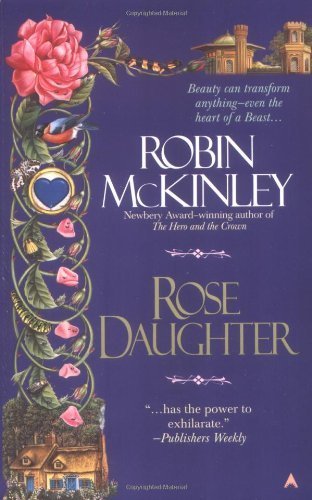
Already, we see that roses can present an interesting paradox. They can be commonplace and represent innocence, and at the same time bring to mind luxury and passion. Also, I was reminded of Robin McKinley's Rose Daughter as I read the bit about how difficult/costly it is to make rose perfume. I've read that part of the reason McKinley wrote a second Beauty and the Beast novel was to incorporate all that she had learned about roses since writing her first book, and the flower is featured more prominently in the second.
In the Grimms' version of Sleeping Beauty, the main character is named Briar Rose. After she pricks her finger and falls asleep, the castle is covered with a hedge of thorns that, one hundred years later, are only beautiful flowers that magically separate to let the Prince in. Although the flowers aren't named, it's not surprising that later storytellers and artists have assumed them to be roses, such as Edward Coley Burne-Jones:
The Briar Wood
The fateful slumber floats and flows
About the tangle of the rose.
But lo the fated hand and heart
To rend the slumberous curse apart.
The fateful slumber floats and flows
About the tangle of the rose.
But lo the fated hand and heart
To rend the slumberous curse apart.
"The Briar Wood "
(1890)
Edward Coley Burne-Jones
(1890)
Edward Coley Burne-Jones
Shmoop has a page about the symbolism of roses in Hans Christian Andersen's fairy tales. Roses are featured in the final redemption scenes of many of his tales, such as "The Wild Swans", in which the air is filled with the scent of roses as Elisa's brother finally explains how she sacrificed herself to rid them of their curse. Red roses start magically blooming, with a single white rose on the top of the stake that was to have burned Elisa to death.
W. Heath Robinson, "The Wild Swans"
In Andersen's tale "The World's Most Beautiful Rose," we are told outright that the rose "symbolizes the highest and purest love." Especially when we look at the colors most often featured, white and red, there is an association with Christian theology, which Andersen was referring to here: the red blood of Christ, which results in white purity.
Rose Garden Wallpaper
The Grimms have a short, tragic tale called "The Rose:"
Once there was a poor woman who had two children. The youngest one had to go into the forest every day to fetch wood. Once when he had gone a very long way to find wood, a child who was very little but very strong came to him and helped him gather the wood and carried it up to his house, but then in the wink of an eye he disappeared. The child told his mother about this, but she did not believe him. Finally the child brought a rose and said that the beautiful child had given it to him and that when the rose was in full blossom he would come again. The mother placed the rose into water. One morning the child did not get up; the mother went to his bed and found him lying there dead. On that same morning the rose came into full blossom.
Josee Masse, for Marilyn Singer's poem "Longing For Beauty," from the book Mirror Mirror which YOU NEED TO OWN
"The rose is a common element in the Beauty and the Beast tales. Beauty usually requests a rose from her father, hoping to ask for a gift he can afford whatever his success in reviving his business. Ironically, Beauty's request for the rose will be the most dangerous and costly gift the father tries to produce.
Thomas Mintz views the rose as "representing both the Beast's masculinity and Beauty's femininity, the thorns signifying the former, and the seeds and color of menses/defloration the latter" (Mintz 1969-70).
In later versions of the story, primarily Disney's film, another rose symbolizes the Beast's life. The Beast has been given a fixed amount of time to have the spell broken which is represented by the rose. The rose will die when the time is up."
Again, illustrators love to make use of the rose and you'll find the flower in many fairy tale illustrations, even when not specified in the text. For example, Marianna and Mercer Mayer's picture book "Beauty and the Beast" has a lot of symbolism connected to the roses and their colors throughout the story
There are so many more examples in fairy tale and folklore, maybe a part 2 for next year?? Anyway, something to think about as stores fill up with roses and red heart decorations!
Subscribe to:
Posts (Atom)