Showing posts with label Guest post. Show all posts

Tuesday, April 12, 2016

Guest Post: Lissa Sloan on God, the Devil, and Death Walk Into a Forest: Heavenly Godparents and Other Immortals

I am very pleased to bring Tales of Faerie readers a post by writer Lissa Sloan! She is one of the authors featured in Frozen Fairy Tales, with her story "Death in Winter."

(Also, it may seem like it's a little out of season by this point to still be featuring Frozen Fairy Tales but this guest post somehow got lost in the vast internet, and just recently made a harrowing journey back to my inbox. But as I initially drafted this, it was literally snowing here in Chicago, so depending where you live winter may still be lingering-or on its way, those of you in the Southern Hemisphere!)

Lissa's story involves a young mother's journey following Death in a desperate attempt to save the life of her daughter. It's well written and the protagonist is a strong, admirable character. Some of the stories in the collection have a modern feel to them; "Death in Winter" has a timeless quality to it.  In ways it feels like listening to an old folktale told by a fire, but it has some unique elements to it as well, and keeps you wondering what's going to happen next! So without further ado: Please enjoy Lissa's insights, delving further into the concept of Death and other Immortals as characters in folklore!

*********************************************************************************


God, the Devil, and Death Walk into a Forest: Heavenly Godparents and Other Immortals

 When I first began delving into fairy tales and reading more than the most familiar stories, I expected to find fantastical characters like witches, giants, trolls, and fairies. I did not, however, expect to find immortals like God, St. Peter, and the Virgin Mary. And yet, it's not at all uncommon for our hero or heroine to encounter them, like a poor man does in "Godfather Death". Desperately looking for a godfather for his child, he meets God, the Devil, and Death, who each offer to do him this service. The man rejects God, saying that he allows the poor to suffer. He likewise rejects the Devil, because, well, he's the Devil. And he accepts Death because all are equal in his eyes. The child does well with Death as a godfather. At least until, in true fairy tale fashion, he tries to push things a bit too far.
"Godfather Death," Heinrich Lefler

 Sometimes these Christian figures are in Heaven, doing heavenly sorts of things. For instance, St. Peter is often found guarding the gates, like in "The Tailor in Heaven", in which he erroneously lets an overly curious and judgmental tailor into heaven when God is out for the afternoon. But it is just as likely you will find him or the Lord down on earth, looking for directions, a place to stay, or something to eat. In fact there are many stories featuring Jesus and St. Peter just traveling around, rubbing shoulders with poor folk, rich folk, gamblers, and soldiers. Some of these stories are a bit like parables,with Jesus teaching a moral lesson. But many are silly, featuring Peter as a buffoon, trying to get away with doing less work or getting more than his share. In "How Saint Peter Lost his Hair", Peter hides a pancake under his hat so he doesn't have to share it with Jesus, but the hot pancake burns the hair off his head. Often, Jesus's response is reproving but forgiving, but other times he is as good-humored as a typical fairy tale trickster. In "Stones to Bread", Peter lugs a giant rock along the road, greedily hoping the Lord will turn it into a giant loaf of bread if there is no bread available at their destination. But there is plenty of bread, Peter has toiled all day for nothing, and Jesus has a good laugh at his expense.

 When the Virgin Mary appears in fairy tales, sometimes taking a poor girl into her care, she is more dignified. In fact, in "Our Lady's Child", she is quite austere. Her protege is caught in a lie she will not confess to, so Mary punishes her, kicking her out of her heavenly home and taking her voice. When the girl marries a king and has children, Mary appears after each birth, giving the queen a chance to confess, then taking the baby and framing her for its death when she refuses, much like the villainous mother-in-law in "The Six Swans". Only when the queen is about to be put to death and at last confesses does Mary relent.

 In "Pearl Tears" from von Schonwerth's The Turnip Princess, however, Mary is much more like a fairy godmother, helping to deliver her goddaughter Maria, and, when things turn ugly with the girl's stepmother, giving her a home in her palace. When Maria transgresses in the same way as "Our Lady's Child" (looking into a forbidden chamber), Mary does banish her, but she continues to keep an eye on her. Maria now cries pearl tears, so is able to make the best of any misfortune, and eventually Mary allows her to return to her palace and take her place caring for the poor and the sick.

May 12 - The Devil with the Three Golden Hairs by fresh4u
 The Ferryman from "The Devil and the Three Golden Hairs," by fresh4u

My favorite immortals are the Devil and Death, perhaps because they're both so unpredictable. Like the other immortals, Death and the Devil are powerful beings, but in many ways, fairly ordinary folks. In "The Devil with the Three Golden Hairs" and "The Devil and His Grandmother", the Devil has a grandmother, who cooks, keeps house for him, scolds him for being bad-tempered, and even removes his lice when he asks her. She also takes pity on our heroes when they ask for her help, even if it means her grandson loses out on his bargain. The devil is fond of bargaining, of course, but many heroes are able to outwit him. In some stories, however, he's just looking for some help around the house, as in "The Devil's Sooty Brother", and he pays up willingly at the end of his servant's tenure, and even cuts his hair before he goes. In "Bearskin" he loses out on the soldier's soul, but is just as happy to gain the man's two jealous sisters-in-law instead. Like the Devil, Death is often a fearsome adversary, and many tricksters are forced to submit to him in the end, as the godson must in "Godfather Death". But Death can also be merciful, as in "Death and the Gooseboy". The world-weary child asks Death to take him along, and, after making sure a rich, greedy man gets his just deserts, Death agrees and takes the boy to his heavenly rest. In "Death's Messengers", he promises a man who has helped him that he will warn the man his death is imminent by sending his messengers on ahead. (Unfortunately, the man does not recognize illness or increasing weakness when they arrive, but Death has kept his promise.)
"The Soldier and Death," Darcy May

 Like the Devil, Death also finds him or herself tricked by mortals, winding up caught in magic trees, bottles, or in the case of the Russian tale "The Soldier and Death", trapped in a soldier's magic sack for years while no one on earth can die. In this tale, Death, who appears as a little old woman, is quite a pathetic figure by the end of the story.

 Immortals in fairy tales may be a little less omnipotent and omnipresent than their counterparts in other genres. They're much more fallible and down to earth, despite their power to grant wishes and mete out supernatural justice. But as the soldier from "The Solider and Death" finds out, just because he can triumph over these powerful figures doesn't mean he should. Eventually the soldier sees the flaw in his plan and must let Death out to do her job. By this time, even he is ready to die, but Death is so frightened by him after her time in the sack that she will go nowhere near him. Some of Hell's devils, too, have been in the sack and refuse to let the soldier into Hell. Denied entrance to Heaven and Hell alike and unable to die, the soldier must wander the world forever. When dealing with immortals, as in so many fairy tales, “be careful what you wish for” is always good advice.
*********************************************************************************

Thanks, Lissa! For more of her writing, be sure to visit her website! (For more on the devil in fairy tales, check out Adam's recent post at Fairy Tale Fandom on the Grimms' tale "Bearskin," which happens to complement this post perfectly!)

Wednesday, August 19, 2015

Guest Post: 5 Strangest Things I Learned About Sleeping Beauty, by Amy Elize Brown of Willow Web

This summer has been full of travels, weddings, and other such things that, while wonderful, make it a little harder for me to do the research and blog work I'd like. But I'm thrilled to be able to bring you some guests posts as I transition back into a regular school year routine! First up is Amy Elize Brown of The Willow Web, although you may recognize her as the face behind the Blog Formerly Known As "Asleep in the Woods." I was so excited to find "Asleep in the Woods," which is where Amy shared some of the things she discovered as she was researching "Sleeping Beauty" for her dissertation! This Brit is very knowledgeable about fairy tales in general, and shares her insights with humor and personality, which makes her blog fun to read.
So as a special treat for Tales of Faerie readers, Amy has generously agreed to share with us 5 strange things she learned about Sleeping Beauty via her research!

******************************************************************

When studying fairy tales, there are always little things to notice. A golden goose in one tale may be a swan in another, or you might find lots of enchanted necklaces. The fact that the princess must visit the troll three times is significant, because it’s like the part in another tale where another princess has to go to a ball three times…

The human brain loves to make patterns. Once you notice these details, you notice them everywhere. When you choose a specific story to investigate, this only intensifies. For me, this story was Sleeping Beauty and it’s variations, most notably Sun, Moon and Talia (Basile), Little Briar-Rose (Grimm) and The Sleeping Beauty in the Wood (Perrault). For the year I spent working on my dissertation, my brain was a constant mush of spinning wheels, cannibal ogres, and evil fairies/witches/wise women. I grew up with the Disney version of Sleeping Beauty, which I still love, but I’ve always felt that it was somewhat… lacking. Maleficent’s backstory and motive are never explained (well, not until the film Maleficent was released in 2014, but even that doesn’t do a great job!), and poor Aurora doesn’t get much choice in anything. She gets her happily ever after, but it could so easily not have turned out like that. As a writing device, the premise of ‘girl cursed to fall asleep for a century’ has so much potential. I wanted to use it.
Edmund Dulac

For my dissertation, I wrote the opening to a novel based on certain elements from Sleeping Beauty. Specifically, I used "Sun, Moon and Talia" as my source. But before I got to that final piece of writing, I researched Sleeping Beauty stories until I fell asleep at my desk. Multiple times. I devoured and version of the story and every critical text about it that I had time to, making notes on each to compare and contrast. Some things I learned were exciting, and made me squeal about my own story and write faster. Some were obvious, so I just glossed over them. Some were fascinating, and gave me a sense of the wider context of the story. Others were just a bit strange. And come on, let’s be honest, it’s the strange ones we’re really interested in, isn’t it?

Let me take you on a little tour into the strange side of Sleeping Beauty…

Strange Thing #1: Not all spinning wheels have points… And ‘spindle’ is not another word for spinning wheel 

That iconic scene, where the princess touches the sharp point of the spinning wheel and falls asleep? Not quite so easy to replicate in real life!

The sharp point of the spinning wheel is called the spindle. This is where the fleece (or whatever you’re spinning) gets twisted to make it into yarn. The wheel is attached to the spindle via a belt, and so when the wheel turns, it turns the spindle as well and that’s how the fleece/whatever gets twisted into thread.

However, few spindles have the sharp metal point on them, and ever fewer have it standing upright as shown in Sleeping Beauty. Most spindles are horizontal, and if they are sharp they are protected by the other parts of the wheel to prevent spinners from injuring themselves. Some spinning wheels have a vertical pole-type attachment called a distaff, which is where the unspun fibres are stored to stop them from getting in the way. So it’s more likely that the princess could prick her finger on that - except it’s not sharp!


1880s Oak Spinning Wheel

Spindles can also exist independently from spinning wheels - these are called drop spindles. A drop spindle is a straight spike, usually made from wood, with a round weight on the bottom which is called a whorl. Drop spindles come in different sizes, depending on how thick the spinner wants the yarn to be.


I actually bought a cheap second-hand spinning wheel to have a go with. Unfortunately, the bolt through the centre of the wheel is lose so it doesn’t work properly. I’m still looking for someone to fix it a year later. Spinning wheel repair people are few and far between! However, I was recently given a drop spindle to play with, too. I’m still figuring that one out.

Strange Thing #2: How witches came to fly broomsticks 

Not exactly Sleeping Beauty related, but this is one of the most peculiar and fascinating things I came across on my dissertation journey.

Every Halloween, we are inundated with images of women wearing pointy hats and flying on broomsticks. Magic, right? Actually, the reality is quite different…

Flying ointment. Not something made up of sugar, spice, and all things nice, that’s for sure! Flying ointment was composed of herbs such as henbane, belladonna, hemlock, and wolfsbane. If ingested, these are poisonous. But if heated to extract the oil and then mixed with animal fat, they become hallucinogenic. This mixture was absorbed through the skin (and… other places. Just look at the shape of a broom, doesn’t take much imagination!), and used before mounting broomsticks to simulate flying through hallucination.

Due to the toxicity of the herbs, to prevent the flying ointment from causing harm opium was used as an antidote. Opium’s properties oppose belladonna’s, and so taking it counteracts the effects of the poison. A variation of flying ointment including morphine and opium was also given to women during childbirth, to ease pain and encourage temporary amnesia.

Another version of flying ointment is the mould ergot, which grows on rye bread. Again, if ingested in large quantities it is lethal, but smaller amounts absorbed through the skin and ‘other places’ produce hallucinogenic effects.

I’m going to link you to Kristin’s post about drug use in fairy tales for more information and links about this topic. When I was doing my research, that was what led me to this topic!

Strange Thing #3: It’s not just princesses who sleep… there’s also a fairy tale about a sleeping prince!

Funnily enough, it’s called ‘The Sleeping Prince.’ And it does exactly what it says on the tin! Although, as well a being a gender-bent version of Sleeping Beauty, it also contains elements of Snow White and East of the Sun, West of the Moon.

A princess is sewing, and she pricks her finger and spills droplets of blood onto the windowsill. This happens three times, and each time a bird appears. The bird tells the princess about a prince who is asleep, and will awaken on St. John’s night. So the princess sets out to find him, wearing a pair of iron shoes because the journey is long and tough.

She meets three old women, whose sons are the winds. They give her directions to the prince’s castle. When she arrives there, she waits until the prince awakens and then they get married.

You can read the full story here

Strange Thing #4: Fairies, witches, and wise women can be interchangeable.

Depending on the version of the story, the beings which bestow gifts on the princess vary. It can be fairies, goddesses, or wise women. But ultimately, these are all variations on a theme. They are ambiguous, and magical. Many folklorists draw parallels between witches, fairies and goddesses from ancient mythology. Over time, they have evolved to become interchangeable terms for one another. Interesting, because in some cases this undermines the true natures and histories of witches, fairies, and goddesses, but in others it reinforces the sense of shared roots between the three entities. In "Sun, Moon and Talia", goddesses are present at the christening. In "The Sleeping Beauty in the Wood", it's fairies. In "Little Briar-Rose", it’s wise women - which seems to be a more polite way of saying ‘witch.’ Being a wise woman would still have earned you a trip to the stake during the times of the witch trials.

For further reading, I recommend Jack Zipe’s book The Irresistible Fairy Tale: The Cultural and Social History of a Genre. There is a whole chapter in here about witches, fairies and interchangeability.

Strange Thing #5: The moral of the story

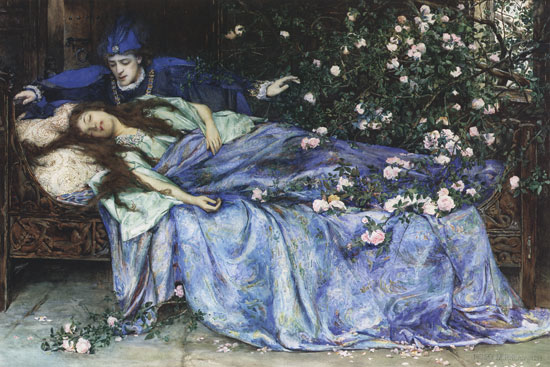
Like all fairy tales, Sleeping Beauty has been interpreted in lots of different ways by lots of different people. Most commonly, it is seen as a story of warning against parents who try to prevent their children (particularly daughters) from reaching sexual maturity. Regardless of the king’s efforts, the princess pricks her finger on the spinning wheel anyway. Growing up, menstruation, and sex are inevitable rites of passage, and if parents interfere then they may cause more harm than good. Like, a 100 years worth of sleep type of harm…
Henry Meynell Rheam

However, Charles Perrault offers another moral to the end of "The Sleeping Beauty in the Wood":

‘Many a girl has waited long
For a husband brave or strong;
But I'm sure I never met
 Any sort of woman yet
Who could wait a hundred years,
Free from fretting, free from fears.
Now, our story seems to show
That a century or so,
Late or early, matters not;
True love comes by fairy-lot.
 Some old folk will even say
It grows better by delay.
Yet this good advice, I fear,
Helps us neither there nor here.
Though philosophers may prate
How much wiser 'tis to wait,
Maids will be a-sighing still --
Young blood must when young blood will!’

This poem varies from translation to translation, but the meaning remains the same. Patience is a virtue. If you wait for love, it will be just as good or perhaps better than if you rush into things. When the princess pricks her finger, she is not ready for commitment. Her long sleep is symbolic of waiting until she is ready to receive the prince’s affection. But many young women are impatient, and although he advises them to wait Perrault cannot quite bring himself to condemn them with his moral- ‘young blood must when young blood will.’ Although, In The Uses of Enchantment, Bettelheim says that 'to have to wait even a long time for sexual fulfilment does not at all detract from its beauty' (p231).

You can read more about my research on The Willow Web, under the label ‘dissertation.’

*********************************************

Thanks for sharing, Amy! I've loved having this fun peek into your research! There's a lot more where this came from if you're interested in her posts on fairy tales or want to read more about her Sleeping Beauty research, just follow the tags!

Saturday, December 22, 2012

Guest post: Christie from Spinning Straw Into Gold on Little Match Girl

Tales of Faerie is proud to bring you its first ever guest post! I have been an admirer of Spinning Straw Into Gold for a while now; Christie's posts always give me lots of food for thought, and her blog is on my list of regular must-reads. I was absolutely thrilled when she agreed to write a guest post for us here! Please enjoy reading her thoughts on "The Little Match Girl".

********

The Little Match Girl was first told to me by my own grandmother during Christmastime.  An exquisitely tragic tale, even beyond what is customary for Hans Christian Anderson, it gripped me with its unusual straightforwardness—almost brutality—in describing suffering, as well as its bittersweet ending.

You’re probably familiar with it; if not, do a little detective work here on Tales of Faerie and you’ll find it. 

As the story goes, a poor little match girl, shoeless in the freezing cold on the eve of the new year, receives three visions when she strikes three matches, each one so real, she is utterly disappointed when the visions vanish into the icy night.  After experiencing, each in their turn, the fulfillment of her earthly needs—sustenance, shelter, and beauty—the little match girl dares to strike a fourth match.  In the blaze, her deceased grandmother, the only one who ever been kind to her, appears.  The little match girl begs her grandmother not to leave her as the other visions did and strikes all the remaining matches.  So the old woman lifts her granddaughter up with her into the light of eternity.
Rachel Isador

The Christian tradition of the beatific vision goes back as far as the Old Testament: the belief that should one witness God in true form, as one speaks face to face with a friend, he should die (think Zeus and Semele, the mother of Dionysus).

I don’t claim Anderson was thinking of this very theology when he wrote The Little Match Girl, but it does give one pause for thought.  The three visions lit from three matches are preludes to or glimpses of the fourth beatific vision, that of the grandmother who “had never looked so big or so beautiful.”  It is in the final vision that the little girl is taken up with her grandmother to be “where there was no more cold, no hunger, no pain, for they were with God.”

Janet and Anne Graham Johnstone

Another theme very strong in all of Anderson’s work is that of suffering.  The glorious visions of the little match girl do not come by nothing.  Rather, they are granted to one who has endured no small amount of mental and physical anguish.  But for the match girl, as for others in Anderson’s tales, suffering is redemptive—that is, it is not useless suffering.

The little match girl’s suffering has led her to light the matches and summon her grandmother, an obvious emissary of the divine.  And in addition to her own beatification, the child’s frozen body is witnessed the following morning on New Year’s Day, and onlookers and readers alike internalize the puzzle of why the dead little girl smiles so peacefully.

The theme has not escaped notice.  Composer David Lang won the 2008 Pulitzer Prize for music with The Little Match Girl Passion.

In another example, the namesake character of The Little Mermaid experiences the daily passion of the sensation of walking on knives.  When she finally sees her beloved find happiness with another, her acceptance of this suffering is transformative.  It gives her a lease-to-own soul of sorts, something she wouldn’t have had otherwise.

Lastly, the matches lit by the little girl are reminiscent of the four candles of the Advent wreath, each lit during one of the four weeks leading up to Christmas, in anticipation of the solstice holiday (holy day).  The candles are symbols to remind observers of the light of the Christ child and the guiding star, the halo of eternity at the end of the earthly journey, and the season of new life to come in spring.  The worst is almost over.

On the first day of the new year, when we find the tranquil but dead little match girl in the snow, we find also this important truth, which Anderson has presented to us without fancy wrapping paper or softened edges: that suffering is only to be endured for a time.  That “the light shines in the darkness, and the darkness has not overcome it” (John 1:5).

Or perhaps, a word from fairy tale grandfather J.R.R. Tolkien is more fitting: “in the end the Shadow was only a small and passing thing: there was light and high beauty for ever beyond its reach” (The Return of the King, “The Land of Shadow”).