
 Even if you're not headed to the beach this summer, all things nautical start popping up in advertisements at this time of year and we're told that the ideal summer includes time at the shore. For me, this means that I tend to consider mermaids as an especially "summery" interest, so recently I've turned to Surlalune's Mermaid and Water Spirit Tales from Around the World.
This book is one of the thickest volumes in the series, which means there's so much to explore. I've posted on Historical Mermaid Accounts, Mermaid Hoaxes, and Danish Mermaid Tales, all courtesy of this volume, and have only scratched the surface. This time around I was interested in some of the tales from areas around the world that were least influenced by Western culture, such as those from South America (although, once a tale has been told and translated into English, there's no guarantee it wasn't also influenced by Western tales).

Howard Pyle
In Charles Daniel Dance's essay on mermaid folklore in Guyana, he states that "the attachment of the Water Spirit to human beings is mostly sexual." And while you can find stories of mermaids who threaten the lives of children, it's true that the vast majority of mermaid tales across the globe seem to be explorations of tragic romances and fatal attractions. The well known beautiful and dangerous sirens of mythology have their counterparts around the world, but there are also mermen who prey on females. In Herbert H. Smith's words about the Brazilian mermaids, called Oiara, Uauyara, or Yara, he says "The Uauyara is a great lover of our Indian women; many of them attribute their first child to this deity, who sometimes surprises them when they are bathing, sometimes transforms himself into the figure of a mortal to seduce them, sometimes drags them under the water, where they are forced to submit to him. On moonlight nights the lakes are often illuminated, and one hears the songs and the measured tread of the dances with which the Uauyara amuses himself."

H. J. Ford
As I read the tales from Brazil, I was struck by how powerful the force of these siren/sea maids were, and how no man was able to resist them, even to the point of altering his personality. Elizabeth Brown Chase recounts that the Brazilian Yara, this time also called a water-witch, "lured young men by her marvelous singing. After seeing her the youth would become melancholy and would haunt the river day and night where he had first beheld her. His friends and people would remonstrate with and warn him of the enchantress "whose smile is death", but the youth, be he chief or simple Indian would not listen; he would go to the river. There the beautiful being would appear and as he rushed to embrace her the waters would divide, and the two would disappear."

These stories, and the power attributed to the sirens and mermen who destroy as they entice, could simply be literal warnings (belief in such creatures was pretty universal until relatively recently in human history), or warnings against sexual temptations. But the obsession and altered character of the victim of the Sea Maid sounds a lot to me like someone who has developed an addiction to drugs or alcohol.
I'm not sure if this interpretation even works historically-I know that in the past, alcohol was more diluted and drugs were not as strong, although drunkenness is certainly not a new problem. But considering that physical abuse is one of the primary themes of folklore, and the strong connection between substance abuse and domestic violence, it's a theme that seems like it's begging to be explored through stories.
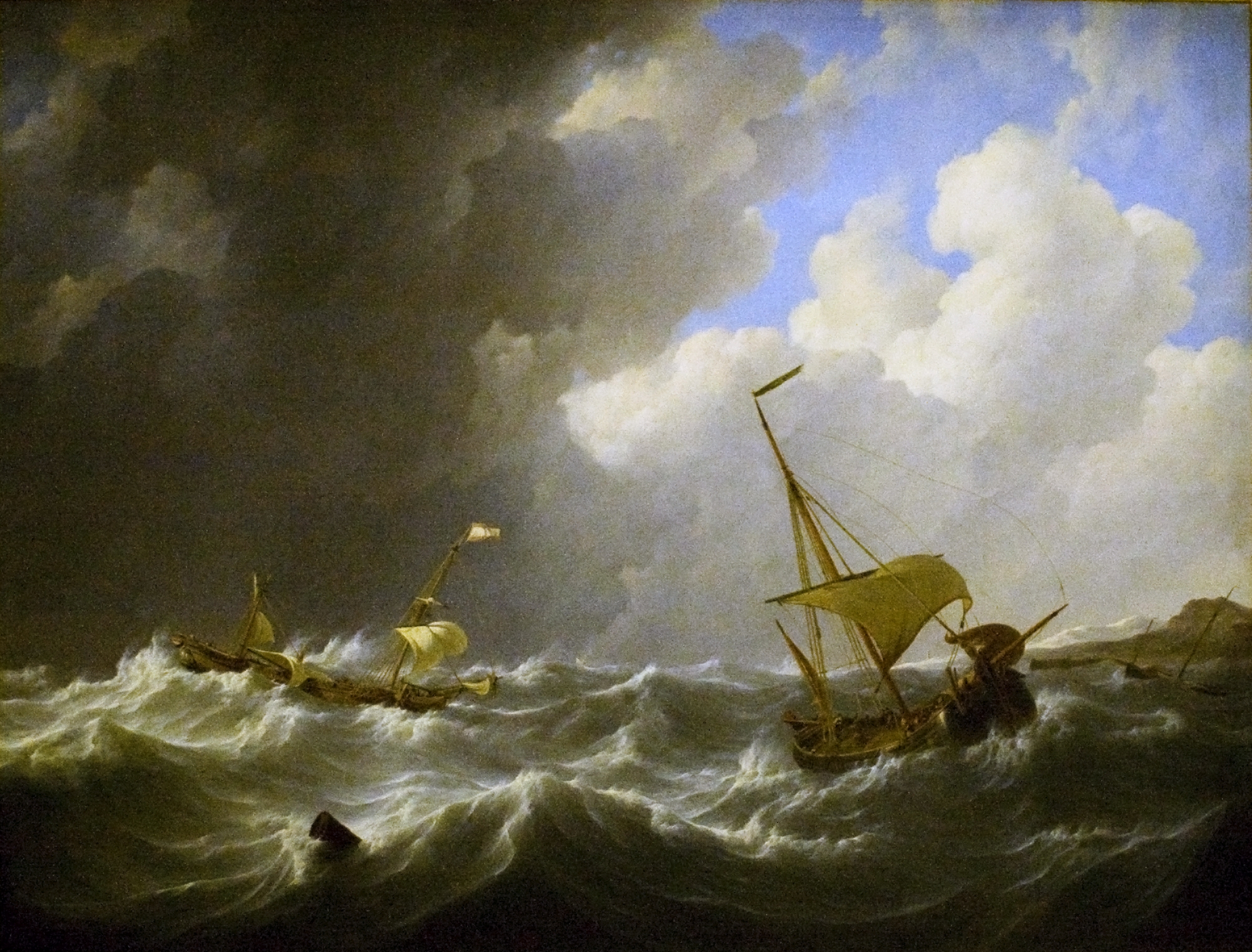
Johannes Christiaan Schotel, "Storm on the Sea"
But it's also interesting to note that mermaid beliefs and legends are really quite similar around the globe. We are fascinated by them, but have always attributed a sense of danger and the threat of death with them. This is likely a reflection of how dangerous water and sea travels could be, such as is revealed in a series of North American children's ballads, with a chorus like this one: "The raging sea goes roar, roar, roar, and the stormy winds they do blow, while we poor sailors are drowning in the deep, and the pretty girls are standing on the shore." Although most of the tales seem to warn of the dangers of seduction more so than sailing, every culture seems to agree that great caution should be heeded around water spirits.
