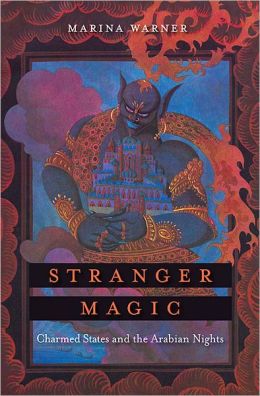
Around 1700, "Oriental Fever" began sweeping Western Europe. In France and England, anything from the East was vogue-from the decor to their drinks to fairy tales. In fact I really like this quote from Marina Warner*, partly because I love coffee: "The diaspora of the
Arabian Nights does in fact resemble the triumphant progress of coffee, as it multiplies and metamorphoses from brass thimbles of thick dark syrup, in Damascus and Istanbul and Cairo, to today's US and UK hybrids (skinny latte, macchiato, et al.). So it is rather neat that Galland [first translator of the Arabian Nights] also published, in 1699, a treatise in praise of coffee, one of the first if not the first of its kind."

So
while facets of culture were making their way West, they became changed and diluted. This was the complaint of Edward William Lane, who didn't approve of Antoine Galland's translation of the Nights-(it was Galland's French one that served as the basis for the first English translation). Lane was considered to be an expert on Egyptian culture, after he taught himself some about Egyptian culture and the Arabic language after a bout of typhoid, and then took a couple of trips to Egypt.
So this "expert" set out to correct Galland's mistake; that of not being familiar enough with the culture to make a good translation. Lane stated, "I am somewhat reluctant to make this remark, because several persons, and among them some of high and deserved reputation as Arabic scholars, have pronounced an opinion that his version is an improvement upon the original.
That "The Thousand and One Nights" may be greatly improved I most readily admit; but as confidently do I assert, that Galland has excessively perverted the work. His acquaintance with Arab manners and customs was insufficient to preserve him always from errors of the grossest description, and by the style of his version he has given the whole to a false character."
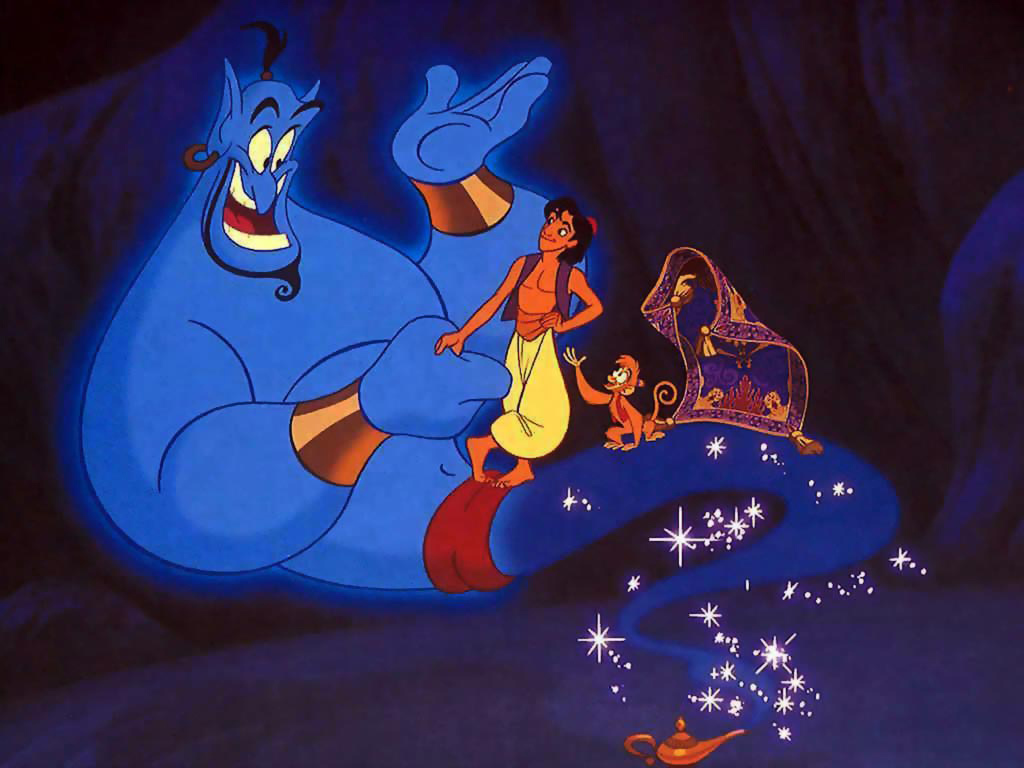
Galland had indeed altered the stories to fit his audience, the same thing that the brothers Grimm would do years later in Germany-take out any questionable parts, and Galland even added whole stories that became the most famous, such as Aladdin and Ali Baba. Yet
Lane considered his translation to be both an "improvement" and a "perversion".
So his solution was to make a new translation, filled with detailed footnotes that often had nothing to do with the stories themselves, but to go into depth about Egyptian culture-at least, his experiences there. But rather than sticking to the original text,
Lane continued to "improve" the stories and then write judgmental footnotes about the original. He left out passages and whole sections, yet all in the name of being true to the culture, such as leaving out a sexual passage "which is of a nature to disgust every person of good taste." He eliminated any scenes with drinking or sex, and states that many passages of the tales "seem as if they were introduced for the gratification of the lowest class."
The fascination that many Europeans had with Eastern culture did not, at this time, seem to lead to a greater understanding of the Eastern peoples, with increased respect and appreciation for them. In fact, rather than emphasizing the similarities between the people groups and their favorite folklore, the collections tended to emphasize the differences-which served to
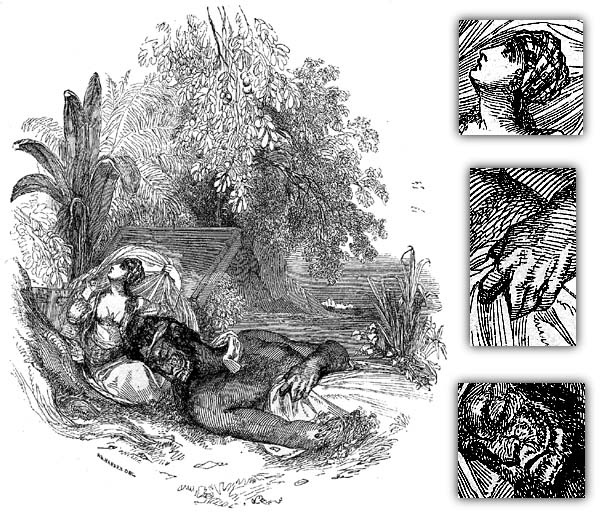
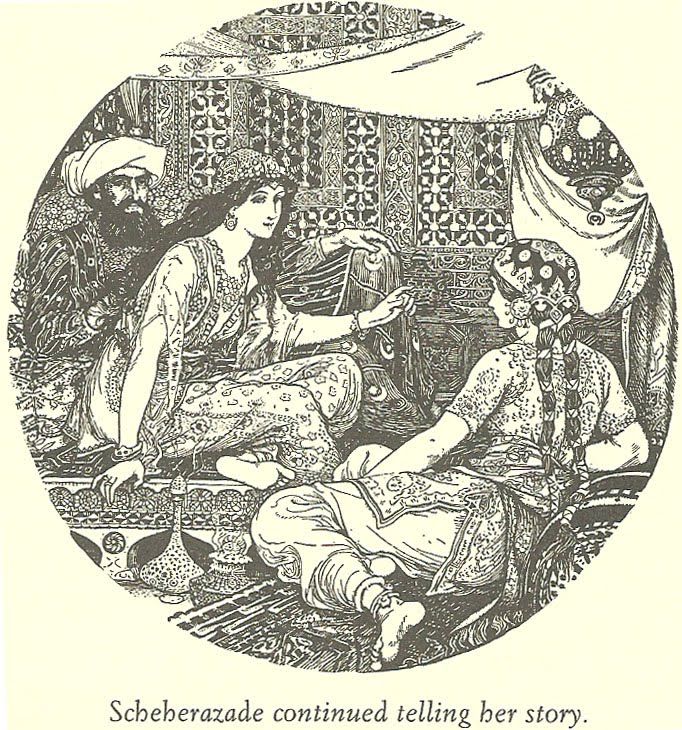
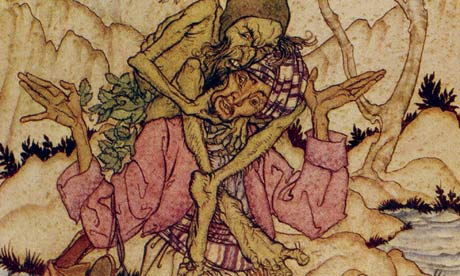
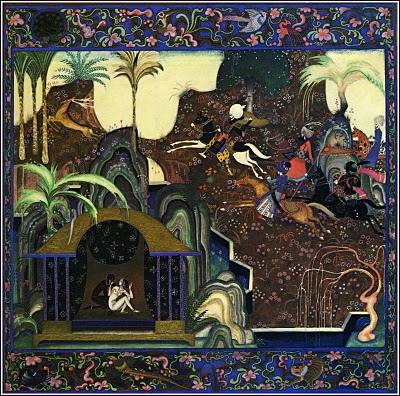
widen the gap between East and West. Even the illustrations by William Harvey that accompanied Lane's text (and this post) are examples of this. Jennifer Schacker points out that in the illustrations, the attention is often not on the people in the story or the unfolding drama, but the exotic locations, dress, and architecture.
In this case, "ethnicentrism often shapes the underlying conception of the Real." The attitude at the time was that the Nights was a "potentially valuable source of information regarding Arab lifeways and attitudes," but many used the stories "to support preconceived notions of Arab character." By emphasizing the contrast between the perceived violent and sexual nature of the Arabian Nights, "
The Orient was central to the discursive construction of the West as dominant, civilized, and rational" (the public was blissfully ignorant, apparently, to the fact that Western European tales were just as sexual and violent in their natural state).
*Marina Warner:
Stranger Magic: Charmed States and the Arabian Nights
All other information taken from Jennifer Schacker's
National Dreams: The Remaking of Fairy Tales in Nineteenth-Century England.