Showing posts with label fairies. Show all posts

Tuesday, December 8, 2015

Faerie Magazine

The Winter edition of Faerie Magazine is out, for those who subscribe or want to search for it in bookstores. And although it's off season, the summer issue is now available to download for free!
Available through 1 or 2 year subscriptions

Temporarily available for free download

Monday, May 4, 2015

Article: How Faerie Subculture has Gone Mainstream

Here's an interesting article from The Observer on How Faerie Subculture Has Exploded Into The Mainstream, by Ruby Warrington. I wasn't even aware of Faerie subculture when I started this blog, but obviously there's plenty of overlap between people who are interested in faeries and fairy tales. And just as fairy tales are very trendy right now, so are the supernatural creatures found in the genre's name (even though very few fairy tales actually feature faeries...more on the origin of the term "fairy tale" here).
An image from Fairy School in Brooklyn

The article mentions phenomenon such as Fairy School (yes, that exists, as an after school program), Faerie Magazine, Twig the Fairy, and how faerie subculture interacts with fashion, the organic movement, veganism, etc.
Twig the Fairy

And of course, faerie subculture can vary. Some people simply like fairy-inspired, natural things; to other people it is a religion, and they believe in fairies and their power to connect to and communicate with them (although if there's anything we learn from fairy tales, it's that fairies can be very dangerous and it would be more wise to avoid them). As the article's subtitle says, "Faeries are the new angels, emerging from the fantasy subculture into the sphere of spiritual faith and attracting believers in surprising places."

Tuesday, March 17, 2015

Fairy Gold: An Irish Tale

It happened one time that a poor man had a dream three nights in a row of a sack of fairy gold buried under a bush on his property. He didn't know if there was anything to the dream, but decided it would be well worth it to check.

He told no one of his intentions, but at the end of the day started digging in the place he had seen in his dream. Before too long he struck a sack full of gold and jewels. He carried the sack home, staggering under its weight. He hid the sack in the cow barn, for if anyone came to visit, he did not went his new wealth to be public knowledge.

He went in and told his wife about the treasure, who was entertaining strangers by the fire. She encouraged him to bring it in so she could see, but the man waited until the strangers were gone, so as not to tempt thieves.

He told his wife the story, and she asked him, "Did you spit on it?"
"I did not," he replied.

His wife warned him he had made a mistake. Her father had much knowledge of enchanted fairy gold, and the treasure is likely to melt away unless a man were to spit on it. Her husband doubted whether the treasure should melt, after staggering home under its weight.

When the strangers left, the man and his wife went to the cow barn, to see the cows straining to get away from the sack. The wife noticed the sack was moving, and thought it was no longer treasure; the husband claimed a rat must have gotten in.

But when the sack was opened, a great eel came out, twisting its head around; the two people were too afraid to move. The eel broke out through the roof and was never seen again in those parts, but that was all the man had left of his fairy gold.
*******************

From "Folk Tales of All Nations," edited by F. H. Lee, 1930, summarized by me

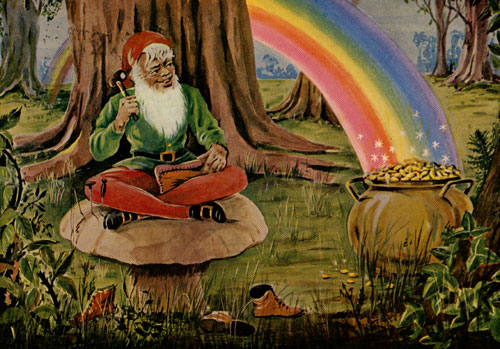
This tale may be one of the sources of the whole legend of leprechauns with their pot of gold at the end of the rainbow (tales of faerie gold are all over, although I don't know where the rainbow part came from?). Leprechauns, an Irish form of Faerie, were more often red in older tales, such as the "wee little man" in the Irish story "The Snow, The Crow and the Blood" I shared earlier this month. The site yourirish.com has some information about current leprechaun beliefs and how to catch a leprechaun if you find one, but warns that they are such tricksters, you may be better off avoiding them entirely...or from this RavensShire post on How to Survive an Encounter with Fairies:

"Some people stumble upon fairies, without the fairies or the person having really planned the encounter. This is when people capture leprechauns or other fairies to try to force them to give up their treasure. How well this works and whether the fairies seek revenge afterwords depends on the individual. One person who robbed the fairies was never able to leave his house afterwords. Others were able to live happily with their ill gotten gains. These stories don't say exactly what the difference is, but it is established that it's very, very difficult to steal a fairies treasure and attempting to do so can get you into a lot of trouble."

Gypsy at Once Upon a Blog also shared a lovely Irish tale in honor of St. Patricks Day-check it out here! And Heidi Anne Heiner has an Irish Cinderella tale at Surlalune!

Thursday, February 26, 2015

Madame D'Aulnoy: The Origin of the Term "Fairy Tale" and How It Spread like Wildfire

In one of his latest books, The Irresistable Fairy Tale (2012), Jack Zipes builds on what he discusses in his 2006 book, Why Fairy Tales Stick: The Evolution and Relevance of a Genre. I haven't read "Why Fairy Tales Stick" but the former is at my public library so I've gotten a chance to peruse it recently. In both books, Zipes seeks to look into and answer the question of the undeniable long-term popularity of fairy tales. Although they have changed over the years, evolving and adapting according to each culture, fairy tales have managed to remain in public general knowledge and popularity for an impressive longevity. In fact, really the only other thing I can think of that compares to fairy tales in its universal human appeal over completely varied human cultures is religion.

Zipes discusses the science of memetics, or to use a term most people are familiar with, "memes." Memes can be more than pictures of cats with funny captions-a meme is anything that captures the public imagination and spreads in popularity. Memes generally rise and fall over time, but fairy tales have stayed afloat for hundreds of years. What makes a meme stick with us is its relevancy. Therefore, general human consensus for most of known history would indicate that we find fairy tales relevant to our lives. Zipes points to the fact that fairy tales start in conflict, as do our real lives. Although I might point out that basically every story has some form of conflict, so there has to be some other common thread that indicates why fairy tales and not other literature remain so prevalent.

However, tracing the history of fairy tales themselves is incredibly difficult. Zipes says, "Almost all endeavors by scholars to define the fairy tale as a genre have failed. Their failure is predictable because the genre is so volatile and fluid." Not only that, but he goes on to mention that the term "fairy tale" never existed until Madame d'Aulnoy coined it as the title of a book in 1697. Her collection of stories about fairies prompted a trend with far-reaching impact she could not have imagined at the time. For now we use the term to cover a multitude of stories, but most of them don't actually involve actual fairies. How did that specific term explode to cover the undefinable genre we now call fairy tale?

(Fun fact: the original French, conte des fees, was originally translated into English as Tales of the Fairies in 1707. Sound like a certain blog name?!? I wish I could say my blog title was a direct reference to this original French term, but it was really a quick decision made when I impulsively decided to make a fairy tale blog, and I thought the title should simply convey what I would be talking about. I wasn't very creative.)
Adrienne Segur
Illustration for "The Royal Ram" by D'Aulnoy

Although the French fairy tales were very influenced by the Italian collections of Straparola and Basile, those works were only self titled as "tales" and not necessarily associated with, or strongly featuring, fairies (although a few do make an appearance). Yet D'Aulnoy made fairies central characters and put the word in the title of her book, creating an association between a term and a genre that are inseparable today. Why fairies, and why all of a sudden? And what was it about D'Aulnoy's newly coined "fairy tales" that made them so popular?

D'Aulnoy lived in a time when women's rights were severely limited. She created a world of fiction in which human lives and destinies are governed by powerful female fairies-the fairies influence everything from fertility and birth, to arranging destinies and love. Some fairies are more evil and witch-like, others good and just, but they are all powerful and fearsome, and in control of the fate of humans. In a time when women had little to no power either in society or in the home, she created a world where women could vicariously live through fairies to have responsibility, supernatural powers, and control. D'Aulnoy and the other female writers who followed in her footsteps self-identified with the fairies and used them to create alternate ideals for society.
Madame D'Aulnoy

The human characters in the first official fairy tales turned not to government, or the church, to solve their problems-but to the fairies that were a throwback to old mythological dieties and goddesses. For the first French fairy tale writers, "the fairies in their tales signal their actual differences with male writers and resistance to the conditions under which they lived...it was only in a fairy-tale realm, not supervised by the church or subject to the dictates of King Louis XIV, that they could project alternatives stemming from their desires and needs."

Monday, December 8, 2014

Santa and the 'Shrooms

Haddon Sundblom-Coca Cola ad

A friend of mine sent me this article, Santa and the 'Shrooms: The Real Story Behind the "Design" of Christmas, by Holly McWhorter. Basically, the premise is that Santa's traditional red and white coat actually stems from old traditions of the Kamchadales and Koryaks of Siberia involving hallucinogenic red and white mushrooms, called "fly agarics".
Vintage holiday cards, via the article

Before passing it off as ridiculous, it's a pretty interesting article and they make connections not just between the colors of the mushrooms and Santa's coat, which in itself would be quite a stretch, but to many other traditions about Santa, from his reindeer to why he comes down the chimney. 

The article describes a solstice ritual of the Siberian people in which the Shaman would go out and gather these mushrooms, which were enjoyed by reindeer and people alike, and would give them a high, which could explain some of the stories about flying reindeer and such. McWhorter goes on to describe the actions of the Shaman:
"But how would he get into a yurt whose door was blocked by several feet of snow? He’d climb up to the roof with his bag of goodies, go to the hole in the center of the roof that acted as a chimney, and slide down the central pole that held the yurt up over the fireplace. Then he’d pass out a few ‘shrooms to each guest, and some might even partake of some of the ones that had been hung over the fire. Clearly, this idea of using the chimney to get in and pass out the magic mushrooms (and other goodies) had sticking power. Interestingly, even as late as Victorian times in England, the traditional symbol of chimney sweeps was a fly agaric mushroom — and many early Christmas cards featured chimney sweeps with fly agarics, though no explanation of why was offered."

The article claims that this ritual is the origin of the Santa myth, which got later mixed in with other traditions such as the Dutch Sinterklaas. I think that's maybe stretching it a bit much-many European cultures had some form of gift giving spirit, or mischievous house elf, or a possible relation to Santa. The influence of St. Nicholas can't be ingnored, because where this article claims that hanging mushrooms in a sock over the fire was the origin of stockings, that has also been attributed to a legend of St. Nicholas. It seems a little odd to me that the traditions of such small, isolated tribes should have spread and grown throughout Europe over the years; the article claims the traditions were carried to Great Britain by ancient druids. I'm sure that some elements of this tradition did get incorporated into the modern Santa, but I find it extremely unlikely that these traditions would have been spread all around Europe in bits and pieces, then later all brought together again when those descendants immigrated to America, where they were all joined together again in a remarkably similar way.

Debating origins is pretty tricky and ultimately impossible to know for sure, but I found the article interesting. Red is such a significant color in Santa Claus history as well as fairy tales, especially "Snow White" and "Little Red Riding Hood". Could the use of this color in these stories could also be related to these mushrooms, which are also often pictured alongside fairies? I also posted earlier this year about the possibility that the traditions of witches flying on brooms were also caused by a hallucinogenic plant that would give the eater illusions of flying. It's not too much of a stretch to see that as a possibility, but at the same time, flying is a pretty universal human wish, and a common dream. I don't think we need to be high, necessarily, to create stories about flying.
Elsa Beskow
Selina Fenech


Also, I've done a fair bit of reading into the history of Santa and Christmas traditions, and this is the first I've heard of any of it being related to mushrooms and highs. 

Something else to keep in mind whenever looking at possible origins of either Santa Claus or various related fairy tales is that, statistically, some coincidences are bound to happen. If you compare our Christmas traditions with every ancient culture's Winter Solstice, you're more than likely to find some parallels, it doesn't necessarily mean they're related. Still, pretty interesting to consider!

Friday, July 18, 2014

Richard Dawkins on Fairy Tales

I had almost missed this post over on Surlalune, so make sure you read it if you haven't already: the fairy tale community responded to Richard Dawkins' statement that fairy tales could be detrimental to children. Hop on over to the post to read more about what he actually said (and his later amendment), and the fairy tale defenders discussing their worth-all very interesting stuff. I've partly addressed the possible benefit of fairy tales/fantasy before, even from an intellectual perspective, in my post on what Einstein may have meant when he (supposedly) said "If you want your children to be intelligent, read them fairy tales. If you want them to be more intelligent, read them more fairy tales."

I just find it interesting that Dawkins assumed that children who read fairy tales automatically believe in them. I never believed fairy tales were true, what's more is in all my interactions with children I feel like I've never had to have a discussion with them about what's possible and impossible-they get that a pumpkin turning into a coach and fairies granting wishes is magic. I do think that, possibly, the difference between most children and most adults interacting with fairy tales is that children tend to want the fairy tales/magic to be true, but they can also be pretty shrewd/skeptical. We shouldn't underestimate children and their potential.

Furthermore, to equate fairy tales with Santa and with God is just illogical. Santa is a cultural myth-many parents go to great lengths to convince their kids that Santa is real, and when we throw in movies and mall Santas it's a completely different story than we have with fairy tales-except in rare cases no one is actively trying to provide their kids "proof" that Cinderella was at the ball or Snow White bit the apple.

And God is a whole other matter. You can find very intelligent scientists who believe in God or the possibility of God, bu you won't find any who believe in Santa Claus.

Plus, Dawkins seems to assume that anyone unveiling the "truth" about childhood beliefs will be damaged by that. I personally think that, when I read tales of magic and wonder, it often helps me appreciate the beauty and wonder of creation. I also talked a little about this in my post on Mermaid hoaxes.

Anyway, I'm curious as to how you all reacted with fairy tales when you were little. Did you/anyone in your acquaintance believe in fairies? Was there a moment of discovering the "truth" that affected you in any way?

Sunday, April 6, 2014

Fairy Tale Rituals: Snow White

Another library book, which if nothing else shows how vastly differently two people can interpret the same fairy tale!

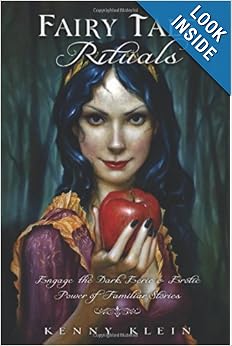
I was instantly intrigued by Fairy Tale Rituals: Engage the Dark, Eerie and Erotic Power of Familiar Stories by Kenny Klein. I knew if nothing else it would be an interesting read, and so far that is absolutely true! It's fascinating in one way just because it's a new way of looking at fairy tales for me. Again, I don't agree with everything, but very interesting concepts to ponder.

Klein takes a look at several fairy tales, analyzing the Grimm versions but also looking further back to older tales. He believes that the stories came from beliefs in Faerie creatures-the dark and powerful kind and not the tiny cute kind-which may very well be true in some cases. Many people did used to believe in Faeries, changelings, and all sorts of mischievous Beings that interacted with humans and explained away certain phenomenon.

Klein goes even further, though-providing with each tale a ritual based on Wiccan magic that the reader can practice and perform to enhance change in their own lives. I had to keep reminding myself that he was serious...in my experience, magic spells and wands are things you only find in fiction such as Harry Potter. But although it's something I've never come across in my own life, I know there are a lot of people out there practicing Wicca and other forms of magic. A commenter here once enlightened me that there is even a branch called Faery Wicca. Which I would guess is what this book is all about. Klein says, "As a distant memory of actual Faerie beings, these characters are real, and inhabit this world as we do...so we will evoke these ancient Faerie creatures...for aid in achieving our real-world goals."
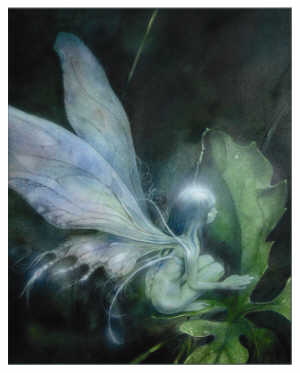
"Winged Fairy," Brian Froud

Klein's theory about Snow White is that she is actually a Nymph, or a nature being. First he uses Changeling as almost interchangeable with Nymph, and says "stories of beautiful changeling children are quite common throughout Europe." Really? I've only come across stories where changelings are ugly/disabled.

But to think of Snow White as a Faerie with otherwordly beauty actually makes a lot of sense when you think about it. First of all, Klein points out that the Grimms changed Snow White's natural mother to a stepmother, to make it less disturbing. So in the versions where her own mother is trying to kill her, she was also the one who made the wish for a child as red as blood, white as snow, and black as ebony. She therefore is trying to destroy the very child she wished for. So is it just a case of "be careful what you wish for?"
Trina Schart Hyman

Klein goes even further back in Snow White's history to versions where the mother did not wish for a child at all. In one he quotes (with no source,) it is the king who wishes for a child upon three ravens. Snow White is not born to the mother, but just then appears by the side of the road. This story makes a lot more sense as far as imagining why the mother might be so jealous of this strange child's beauty.

I was curious as to how prevalent versions like this were, because this really could change how we view Snow White and her mother/stepmother. I went to my copy of Surlalune's Sleeping Beauties: Sleeping Beauty and Snow White tales from around the world. I only found one story where the father wishes for a child-but actually in the vast majority of them, there is no wishing scene at all-the beautiful child simply exists as the story begins. However, pretty much all the tales were from sources after 1812, when the Grimms' famous version had already been published. I would be very curious to learn if there are more versions like the one Klein referred to, especially ones that predate Grimm.
Margaret Tarrant

Klein also points out how curious it is that absolutely everyone is overwhelmed by Snow White's beauty. She isn't merely beautiful-she motivates a mother to kill, a huntsman to disobey his Queen, dangerous animals to leave her alone, dwarves to protect her, and a prince who absolutely needs to possess her dead body. Not only that, but each of those categories of people would be looking for something different in a female-yet they all find what they most want (or fear) in Snow White. A sexual threat, a homemaker, a ravishing beauty, a lover. It really makes more sense if she is indeed a Faerie or Nymph of unearthly beauty-what else would cause everyone to lose their heads over one woman?

The temptation scene analysis is a striking contrast between Klein and the author I most recently read, Sheldon Cashdan. Cashdan believed that fairy tales help children overcome their sinful tendencies through 1. identifying their sins in the sins of the main character, and 2. also identifying with the villain. I simply don't think that happens in the vast majority of cases. Anyway, to Cashdan, when Snow White accepts gifts from her stepmother in disguise, it's proof that she suffers from the sin of vanity.
Trina Schart Hyman

Klein sees the scene as the stepmother/mother trying to undo Snow White's beauty. By putting the laces on Snow White, the witch is "tightly binding the Nymph's breasts." Only...don't stay laces tighten your waist but support the breasts in a way that makes them look larger, much like a corset? Like above?

But anyway other than that fact he does have a very interesting point. The three objects the mother uses-laces, a comb, and the apple-are attempts to destroy the three parts of the mother's wish: skin as white as snow (the laces which bind the skin), hair as black as ebony (the poisoned comb) and lips as red as blood (the apple).

Then the sleep episode. This is where feminists of today are outraged, because to have famous fairy tale princesses sleeping indicates that men want their women passive. It was kind of refreshing to hear a different take. Klein says, "While we appear to be dead in sleep, our minds are quite active, connecting us to the Underworld through dreams." He says Snow White goes through a near death experience which enables her to become fully human and later accept a lover. He cites many world religions which involve a ritual that is symbolic of death and rebirth-from pagan beliefs to Christian baptism (although, some of the things he says about biblical passages and/or the Christian faith are incorrect, which makes me wonder how accurate some of his other facts are).

Anyway, it's an interesting thought, and encouraging to think that maybe Snow White (and Sleeping Beauty) are being anything but passive in their sleep. In fact, Klein also points out that the Beast, a MALE fairy tale character, has a similar unconscious/sleep phase-can't believe I hadn't thought of that before. And though, in the Villeneuve version, the sleep is not directly connected to his transformation, in most other versions it's after Beauty revives the Beast from his near death that he has his rebirth into humanity. Hmm...

Then follows an actual Wiccan-inspired ritual detailed for the reader to follow. It involves calling the spirit of Snow White to make you feel beautiful and desirable, and the cutting of an apple, on the New Moon, and an alter and a wand and all that. I kept thinking of Willow from Buffy...
*Also-this post from Ravens Shire/Fairies and Fairy Tales is on the remnants fairy tales have from ancient religions, and is very applicable to the above

Sunday, December 22, 2013

Hildur the Fairy Queen

Here's an Icelandic version of the Twelve Dancing Princesses tale; this one is a slightly morbid tale set at Christmastime!

*******

Once there was a farmer who settled in the mountains. He had a housekeeper named Hildur who kept to herself but performed her duties well and was kind. Though the farmer was kind as well, he had trouble keeping shepherds, because one after another, they were all found dead in bed on Christmas morning. Hildur did not go to the Christmas mass like everyone else, but stayed at home to tend to her duties and prepare for the Christmas feast.

Finally the farmer decided not to employ any more shepherds, until a man came to him and offered his services for the winter. The farmer protested that those who had filled that same position met with a sad fate, but the man insisted he would still care for the sheep.

So he stayed with the farmer that winter, although on Christmas Eve thought it wise to stay awake. During the night, he saw Hildur approach him. He pretended to be asleep and felt her put a magic bridle in his mouth. She mounted his back and they rode to a chasm in the earth. There she dismounted; in order to follow her the shepherd rubbed his head against a stone until the magic bridle came off.

He followed Hildur, and noticed she did not act like the same housekeeper he knew. He took a magic stone out of his pocket that would make him invisible as long as he held it, and kept close behind her.

Finally they reached a great palace, where a great crowd of people came to meet her and a man dressed in purple in gold came to meet her, calling her his wife. The crowds called her their queen and treated her with respect. Two children ran into her arms and called her Mother. Hildur was given royal attire and together with her king sat down at a big feast, which was followed with dancing. But Hildur and the king did not dance, they sat and talked, and seemed to the shepherd to be very sad. At one point Hildur gave one of her children one of her rings to play with; after the child was done playing with it the shepherd snatched it up.
"Fairy Feast", Arthur Rackham

Finally Hildur made preparations to leave, which was met with protests by all except an old woman alone in the corner. The King begged her to stay, but Hildur said, "I cannot stay here, in consequence of the spell by which your mother has bound me, and who knows if I shall ever see you more." She told him that she had killed so many men that she would certainly be found out and punished, even though she had done it against her will.

The shepherd went back to the bridle and pretended to be asleep again as she rode him back to the farm. The farmer came in early in the morning, anxious to see whether or not this shepherd had survived through Christmas morning, and rejoiced to see him alive and well. He asked if anything strange had happened during the night.

"Nothing, except that I had a very wonderful dream." He then told the story of what had happened. Afterwards Hildur said, "If you tell the truth, show us some token to prove what you say."
The shepherd showed the ring. Hildur then said that he had delivered her from the spell that had been placed on her by her mother in law and told them the full story. She was a lowly fairy maid, but the fairy king fell in love with her. The marriage displeased his mother, who bound Hildur by a spell to become a servant in the world of woe, and every Christmas Eve, to kill a man, the only night she was allowed back to the fairy kingdom. She was to do this until she was convicted of murder and put to death, unless she should meet a man courageous enough to go with to the world of Fairies and bring back evidence. She thanked and blessed the shepherd for being the first man who dared venture into the dark roads that lead to Fairyland, but longed for her true home, and disappeared, never to be seen again in the world of mankind.

The shepherd later married and became a wise and successful farmer, but he always attributed his wealth  to Hildur the Fairy Queen.

*******

Found in Surlalune's Twelve Dancing Princesses: Tales From Around the World; summarized by me

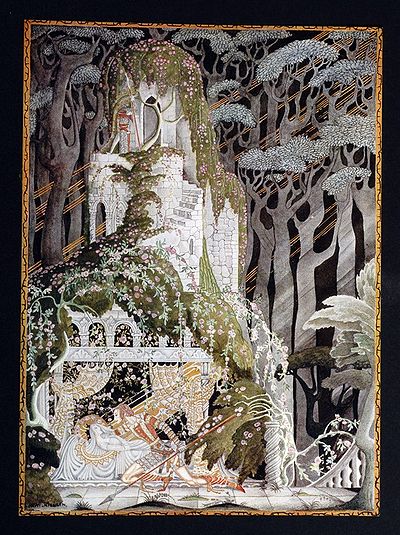
First image above, an illustration of Hildur, found on Wikipedia. No illustrator credited, but this excerpt from the same page is interesting:
"There are four Icelandic holidays considered to have a special connection with hidden people: New Year's Eve, Twelfth Night (January 6), Midsummer Night and Christmas night.[44] Elf bonfires (álfabrennur) are a common part of the holiday festivities on Twelfth Night (January 6).[45][46][47] There are many Icelandic folktales about elves and hidden people invading Icelandic farmhouses during Christmas and holding wild parties.[48] It is customary in Iceland to clean the house before Christmas, and to leave food fo the huldufólk on Christmas.[49] On New Year's Eve, it is believed that the elves move to new locations, and Icelanders leave candles to help them find their way.[50] OnMidsummer Night, folklore states that if you sit at a crossroads, elves will attempt to seduce you with food and gifts; there are grave consequences for being seduced by their offers, but great rewards for resisting."

Monday, March 25, 2013

In this fairy land of light

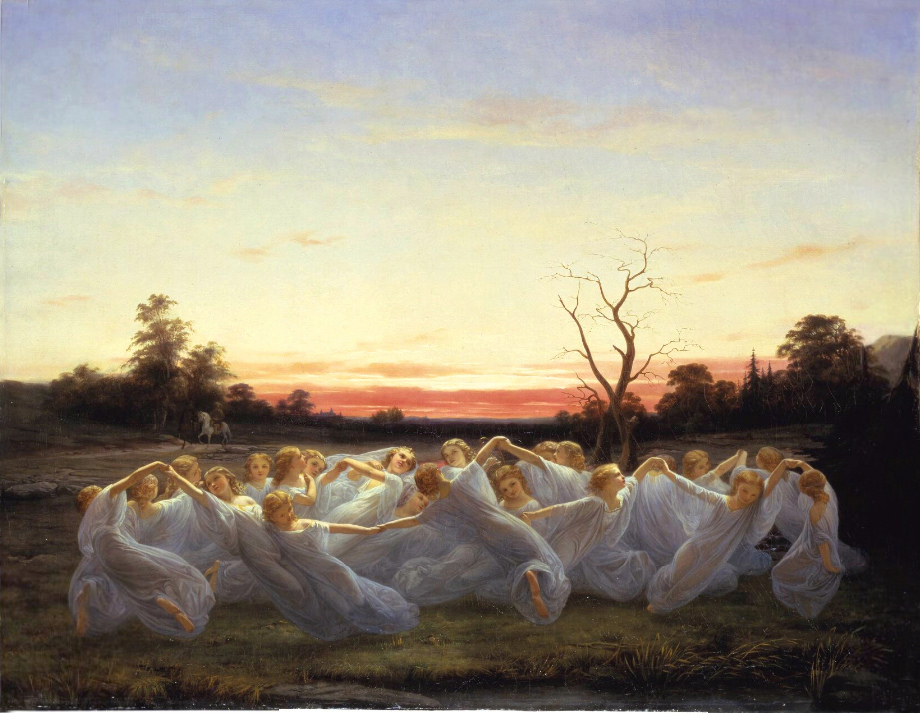
Nils Blommer
"In this fairy land of light
No mortal ere has been
And the dreadful grandeur of this sight
By them hath not been seen.

T'would strike them shuddering to the earth
Like th eflash from a thunder cloud
It would quench their light and joyous mirth
And fit them for the shroud.

The rising of our palaces
Like visions of the deep
And the glory of their structure
No mortal voice can speak.

The music of our songs
And our mighty trumpets' swell
And the sounding of our silver harps
No mortal tongue can tell."
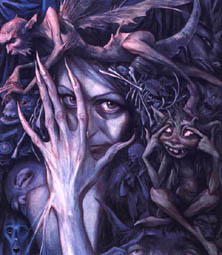
Brian Froud

These words were penned by a 13-year-old Charlotte Bronte in 1829. Makes me want to give up trying to write anything ever again...or at least, it appears in a story she wrote, "The Search After Happiness," she may have been quoting from a well-known poem. Anyway, I love that the fairy world is painted as awesome and even dangerous, rather than cute and saccharine.

Sunday, March 17, 2013

Ethna the Bride: and Irish faerie tale

This story is also found in Surlalune's Sleeping Beauties: Sleeping Beauty and Snow White Tales From Around the World. Although I'm not sure it technically qualifies as a Sleeping Beauty tale, I think it's a fascinating tale of faerie lore.

Kay Nielsen

"The fairies, as we know, are greatly attracted by the beauty of mortal women, and Finvarra the king employs his numerous sprites to find out and carry off when possible the prettiest girls and brides in the country. These are spirited away by enchantment to his fairy palace at Knockma in Tuam, where they remain under a fairy spell, forgetting all about the earthly life and soothed to passive enjoyment, as in a sweet dream, by the soft low melody of the fairy music, which has the power to lull the hearer into a trance of ecstasy."

There was a great lord who had a beautiful wife named Ethna, the loveliest bride in the land, who held all sorts of festivals in her honor. One evening while Ethna was dancing she suddenly let go of the hand of her partner and fell down in a faint.

She was carried to her room. In the morning she woke up and said she had had the most beautiful dream, where she was in a palace she longed to go to again. As evening came, Ethna fell into a deep trance. Though her nurse kept watch over her, in the morning she looked over and saw that the bride had disappeared. No one could find any trace of her.

The young lord went to question Finvarra about the whereabouts of his bride. He had no suspicions that Finvarra had taken her, but he was friends with the Fairy King. As he stopped to rest his horse, he heard voices in the air around him talking about how Finvarra was glad of his new beautiful bride, who could only see her husband again if he were to dig a hole through the hill to the center of the earth.

The lord was determined to dig a hole through the hill. He gathered a great crowd of workmen to dig through the hill all day. They made much progress, only to find the hole filled in the next day by Finvarra's power. The same thing happened for three days, and all their work was undone by the fairies.

The young lord heard a voice near him whisper, "sprinkle the earth you have dug up with salt, and your work will be safe." With this knowledge, the lord and his men were able to dig through the hole until they could hear the fairy music from below.
Sir Joseph Noel Paton
Voices in the air told the workers that the fairy kingdom would crumble if the men were to reach it with their spades, and the only way to save it was for Finvarra to give up his bride. Finvarra was willing to give up Ethna in order to save his kingdom. That night Ethna was delivered back to her husband. She was on her bed, lying in a trance as before, and no one could wake her for days on end. Everyone feared she had eaten of the fairy food and was under the fairies' enchantment.

The young lord was very sad, but once again overheard voices in the air by the fairy hill, saying Ethna's spirit was with the fairies though her body was with her husband. She would stay that way until he unloosed the girdle from her waist that was fastened with an enchanted pin, burn the girdle with fire, and throw the ashes before the door, and bury the pin in the earth.

The young lord hurried home to break the spell, and Ethna returned smiling to him, as if the year she had spent in Fairyland were nothing but a dream.

"After this Finvarra made no further efforts to carry her off; but the deep cut in the hill remains to this day, and is called 'The Fairy's Glen.' So no one can doubt the truth of the story here narrated."

Saturday, May 19, 2012

Marie-Louise von Franz on Baba Yaga

More on Baba Yaga-in Marie-Louise von Franz' Shadow and Evil in Fairy Tales she suggests that Baba Yaga is clearly Mother Nature. She talks about owning the day and the night in the story of Vasilisa the Beautiful, and as her hut is surrounded with skulls she must also be the Goddess of Death.

I've heard before that true fairies (not the cute, diminuitive fairies we find in current culture) can also be understood when thinking of them more as forces of nature as well. Fairies and other supernatural creatures have their own laws and codes of conduct, but they are not the same ones humans operate by, and a fairie's instinct is not necessarily to preserve human life. In my recent post on Baba Yaga, Helen Pilinovsky was pointing out the multiple and seemingly contradictory roles Baba Yaga plays-sometimes as a helper, yet sometimes as cruel. Nature itself also displays such opposite faces-a beautiful, breezy spring day can give way to terrible storms and result in great loss of life at times. We can love and enjoy nature, yet so often are at its mercy.

Saturday, March 17, 2012

The Young Piper

An Irish tale, in honor of St. Patrick's Day-


A good, honest couple named Mick and Judy lived with their four boys. The younger three were boys to make their parents proud, but the oldest was miserable and ugly, with dirty matted hair and a greenish yellow face, a mouth full of sharp teeth ever since he was a year old, and who was always screaming or yelping.


The neighbors all suspected that he was a changeling, for every time they would gather around the fire and talk about religion and good things, the child would holler "as if the divil was in him in right airnest." The neighbors advised her to burn him with hot tongs, or throw him out on the dunghill, but Judy was too loving to do any of those things to her child. They advised she get a priest to see him, but she never got around to having the priest come. The child continued to play pranks, until one day Tim Carrol, the blind piper, came.

During Tim's visit, he brought out his pipes and began to play, and the child leapt out of his bed and began to dance with glee. The boy wanted to play the pipes himself, and Tim consented to let him play-and the child who had never played pipes before in his life played a tune as well as anyone.
The family was shocked. Tim claimed that the boy was a leprechaun, and offered to teach him, which thrilled the boy's parents. His father Mick went out and bought him a set of pipes, which delighted the boy. He immediately started playing, and soon news of his talent spread, and people came from all around to hear him play. Everyone who heard him felt the urge to dance, some said the furniture was inclined to move when the boy played his pipes.

Besides the Irish tunes the boy played, he also had his own tune he made up, and when he played it, people felt compelled to dance, yet they weren't in control. The child played many pranks on people, causing his brothers to burn themselves or break themselves on furniture, making the animals wild, upsetting milk jugs and even killing neighbors' animals or causing barn roofs to fall in.

Since the boys' parents wouldn't hear of anyone hurting their child, their neighbors asked them to leave on account of their child. As the cart was moving their family over a bridge, the piper sat up and began to wail. His mother tried to comfort him, saying their was nothing to be afraid of, and eventually the frustrated father got out his whip and cracked it at the boy. The boy jumped, took his pipes, "an' lept clane ovir the battlemints o' the bridge down into the wather."

His family was horrified and went to look for him, and saw him sitting on a wave, playing the pipes as if nothing had happened. They ran after the boy but he disappeared.
"No one ivir led eyes an him sence; but the gineral belief is, that he wint home wid the pipes to his own relations-the good people-to make music fur thim."


-From Thomas Keightley's "Fairy Mythology"
Top Image from here

Wednesday, November 9, 2011

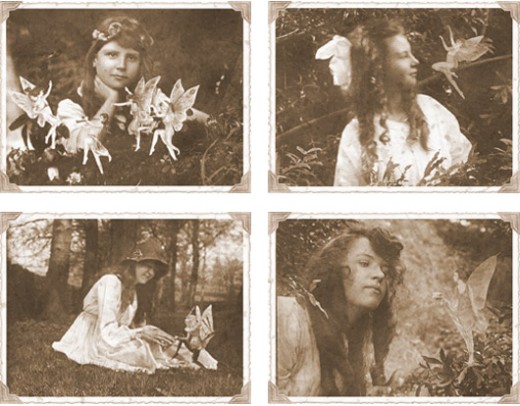
Photographing Fairies and the Cottingley Fairy Hoax


I found a couple of faerie-related books at a library book sale I had never heard of before.

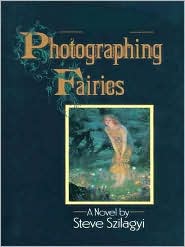
The first was Photographing Fairies by Steve Szilagyi...which I also just found out has been made into a movie, which seems to have pretty good reviews.

The novel's inside flap promises to take the reader back in time to the 1920s and see the story of the Cottingley Fairies through the eyes of a young photographer. Sir Aurthur Conan Doyle figures in as a character- he was a believer in the photographs himself, and I like historical fiction that blends as much fact as possible in.

I assumed the novel would prove to us that the Cottingly Fairy hoax was actually true, and it was proved by this photographer, which seemed interesting enough, but the book actually skims over the Cottingley Fairies and concentrates on a competitive (fictional) set of photographs, which also happened to involve two girls in a garden. But I'm glad that the premise of the book was not to make the hoax true-although the pictures are pretty impressive considering that the fairies were drawn by a 16-year old and 10-year old girl, I agree with Szilagyi's assessment of them: "Your pictures are crude concoctions pandering to the popular idea of what a fairy is supposed to look like. Look, this fairy here is wearing a gown. Where did she get that? Are there fairy dress shops? Are there fairy mills where they weave the fabric? And who works in the mills and dress shops?...what I do know is that if there are fairies, they don't look like popular illustrations. They'll look how they look. Not how we want them to look."

Cottingley Fairy Photographs

The novel was entertaining but I especially enjoyed Szilagyi's interesting ideas on what a separate race of people could be and the implications of discovering such a thing. The fairies as we see them in the book are still diminuitive and we don't ever discover if they are a complex, powerful group of beings such as in true fairie lore or a simple-minded, cute garden adornment hardly any different than butterflies (or the Tinker Bell fairy of the popular imagination). At least Szilagyi leaves you to ponder the possibilities yourself.

I also really enjoyed this passage, from when the main character, Castle, is still unsure as to if the fairies actually exist or not and another character gets stung by a bee: "Templeton's sting was a rebuke from nature. While we search the garden for tiny, imaginary versions of ourselves, we miss entirely the more fantastic creatures that crowd there, more mysterious and impenetrable than any parallel universe of floating fays."

Interestingly, the year the movie for this book came out was the same year Fairy Tale: A True Story came out, a movie about the Cottingley Fairies, represented as a true story. My mom rented that movie for me once when I was sick and even being younger, I resented them misusing the phrase "True story", for I knew it wasn't true although I knew none of the details at that point. The story was "true" in that there really was an incident, but not in the sense that the fairies were real as the movie portrayed. However, for those who still want to believe, this is the final photograph that Frances insisted was genuine, even though Elsie claimed it was also a fake.

This interesting quote came from Frances at the end of her life: "I never even thought of it as being a fraud – it was just Elsie and I having a bit of fun and I can't understand to this day why they were taken in – they wanted to be taken in."

Saturday, October 1, 2011

The Skeleton Fairies of Tessa Farmer

In theory, I plan on October being a sort of morbid/creepy fairy tale month, in honor of Halloween. I may run out of creepy things and find lots of cutesy things instead so we'll see, but to start off, these images of fairies by Tessa Farmer that are definitely not the fairies we're used to seeing.

From her website:
"Tessa's miniscule sculptures reinvigorate a belief in fairies: not the sweet Tinkerbell image in popular conscience, but a biological, entomological, macabre species translating pastoral fable into nightmarish lore. Constructed from bits of organic material, such as roots, leaves, and dead insects, each of Tessa's figures stand barely 1 cm tall, their painstakingly intricate detail visible only through a magnifying glass.

Hovering with rarefied, jewel-like beauty, Tessa's tiny spectacles resound with a theurgist exotica: their specimen forms borrow from Victorian occultism to evolve as something alien and futuristic. Playing out apocalyptic narratives of a microscopic underworld, Tessa's manikin wonders rule with baneful fervour: harnessing mayflies, battling honey bees, attacking spindly spiders. Presented as wee preternatural discoveries, Tessa's sculptures conjure a superstitious premise, dismantling the mythos of fantasia with evidence of something much more gothic, sinister, and bewitching."


More images can be viewed here.

Tuesday, September 6, 2011

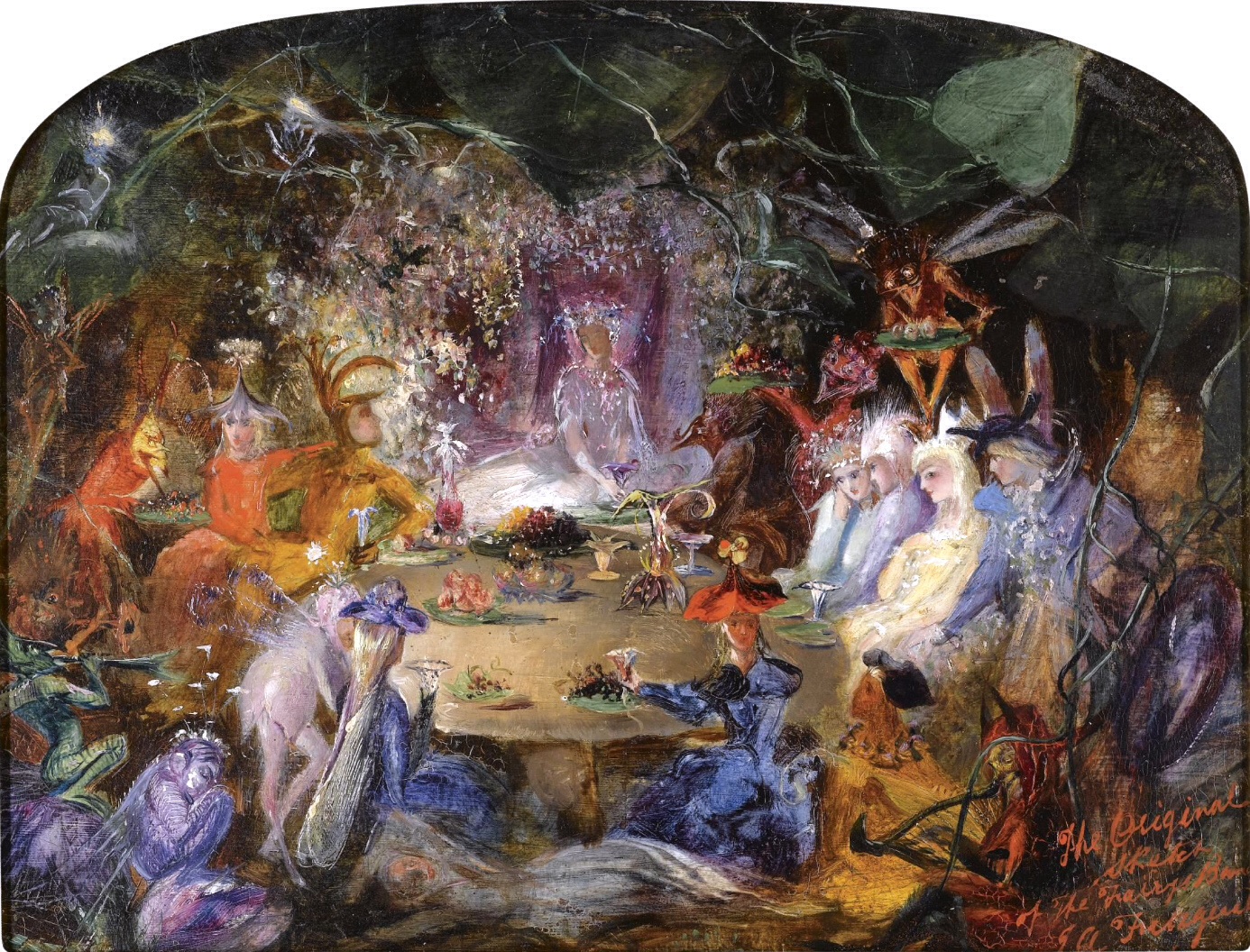
The Fairy Banquet


"A man one time was led by invisible musicians for several miles together, and not being able to resist the harmony, followed till it conducted him to a large common, where were a great number of little people sitting round a table, and eating and drinking in a very jovial manner. Among them were some faces whom he thought he had formerly seen, but forbore taking any notice, or they of him, till the little people offering him drink, one of them, whose features seemed not unknown to him, plucked him by the coat, and borbade him whatever he did to taste anything he saw before him, "For if you do," added he, "you will be as I am, and return no more to your family." The poor man was much affrighted, but resolved to obey the injunction. Accordingly, a large silver cup, filled with some sort of liquor, being put into his hand, he found an opportunity to throw what it contained on the ground. Soon after, the music ceasing, all the company disappeared, leaving the cup in his hand, and he returned home, though much wearied and fatigued. He went the next day, and communicated to the minister of the parish all that had happened, and asked his advice, how he should dispose of the cup, to which the parson replied, he could not do better than to devote it to the service of the church, and this very cup, they say, is that which is now used to the consecrated wine in Kirk Merlugh."


Story from the Scottish Highlands, as found in Thomas Keightley's Fairy Mythology.

Image by John Anster Fitzgerald.