Showing posts with label Irish folklore. Show all posts

Wednesday, August 3, 2016

The Fisherman Who Had Seven Sons: An Irish Mermaid Tale


Jean-Baptiste Monge | Siren: Once there was a poor fisherman with three sons. One night, he was trying unsuccessfully to fish, and a mermaid approached him. She told him that if he and his wife would give them their unborn son at the age of 21, she would make them rich. Neither he nor his wife has any problem agreeing to this, and the next night he finds more gold than he can carry, and becomes very prosperous.


He went on to have a total of seven sons, but was burdened by the knowledge that he must lose one of them. Finally he revealed to the son in question that he had sold him to a mermaid and the time was nearly up, so the son decided to leave. Although his father was troubled at his going, the son took expenses and food and left.

The son traveled until he was tired and sat down to rest, and saw a lion coming towards him. He thought he was dead for sure, but the lion offered to carry him. The lion carried him a long way and brought him to the house of a shoemaker.


The shoemaker told the traveler that the next day, the King's daughter was going to be devoured by a sea monster, unless someone could defeat it. With nothing but an old rusty sword used for cutting vegetables, the son took a boat to where the Princess was waiting. No one but the young man had the courage to fight the monster, and he killed it. The Princess would only marry him.

Shortly after, the mermaid approached, and revealed that her intention all along had not been to kill him, but to bring him to his present Kingdom to rescue the Princess. The mermaid left and was not seen again.


Illustrations-

Siren by Jean-Baptiste Monge
"Andromeda's Fate" by PaulHectorT

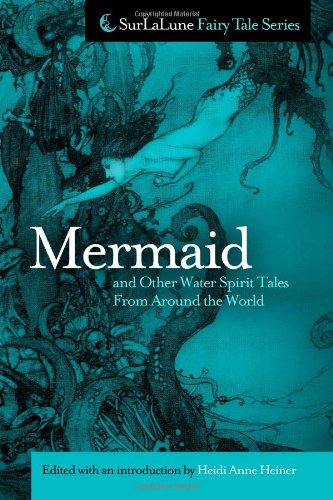
Source: Surlalune's Mermaid and Other Water Spirit Tales From Around the World, summarized by me

Thursday, March 17, 2016

The Three Daughters of King O'Hara: An Irish Animal Bridegroom Tale

Continuing in my tradition of sharing an Irish tale for St. Patrick's Day!

A King had three daughters. One day while he was away, the eldest put on a cloak of darkness and wished for the most beautiful man under the sun as a husband, and a beautiful man came and took her away.

The middle daughter saw this, and put on the cloak and wished for the best man in the world as her husband. The youngest put on the cloak and wished for a white dog, and they were each taken away.

When the king came home he was furious his youngest daughter had wished for a white dog and gone off with him.

The eldest daughter's husband asked her if she would like him to stay in his current form at night, or during the day. She asked for his human form in the daytime, and he was a seal at night. The same thing happened to the next sister.

The youngest wife asked for her husband to remain a white dog during the day, and at night he became a handsome man. After a time she bore a son, and her husband warned her, if anything happened to the child, she must not shed a tear. While her husband was gone, a great crow came and carried the week old baby away, and she did not shed a tear.

The same thing happened after she bore a second son. A little while later, she gave birth to a daughter. Despite the warning, when the crow carried her away, the wife shed one tear, and put it in her handkerchief. When her husband came home and realized she had shed a tear, he was very angry.

Some time later, the father invited his three daughters to stay with him. The white dog was in dread that he would not be allowed to stay in the palace, but his wife told him, "There is no danger to you, for wherever I am, you'll be, and wherever you go, I'll follow and take care of you."

Although the King did not want the dog in his castle, his youngest daughter did not listen to him, and insisted on staying with the white dog all evening. Later, when everyone was in their rooms, the Queen and the cook stole into her daughter's rooms, and was surprised to see her eldest daughters with seals, and her youngest with a handsome man. The Queen also found the white dog skin, and threw it in the fire.

The skin gave a crack that woke everyone in the castle, and everyone for miles around. The youngest daughter's husband was angry, and revealed that if he had spent three nights with his wife under her father's roof, he could have resumed his human form permanently; but if his skin was destroyed, he was forced to leave. But his wife followed him, even though he ran all night and the next day; she would not leave him.

On their journey, they encountered three houses. In the first lived a little boy who called her "mother", and the woman of the house gave her a pair of scissors that would cut rags and turn them into new gold clothes. In the second house the woman met another little boy who called her "mother," and was given a magical comb that would heal sores on people's heads and give them a head full of beautiful golden hair. In the third, she met a little girl with one eye. The mother had kept the handkerchief in which she had shed a tear, and the tear had turned into an eyeball; the mother took out the eye and fitted it into her daughter's head, and she could see out of it. At this home she was given a whistle which would bring birds to her aid.

Finally, the husband and wife came to a place where he had no power to stay on upper earth, but was forced to become the husband of the Queen of Tir na n-Og (the land of youth), and he disappeared. His wife followed down until she came to the lower land, where she befriended a poor washer woman, and helped her with her chores.

One of the local children came to the wife in rags, and she used the magic scissors to make her beautiful new clothes. News of this traveled to the Queen, who insisted on having the scissors for herself. The true wife traded the scissors for a night with the Queen's husband, where she tried to talk to him, but he slept all night.

Later, she used the comb to heal a little girl with sores all over her head, and when the Queen heard of the girl's beautiful golden hair, she traded the comb for a night with her husband, but the same thing happened.

The wife used the whistle to call the birds to her, and they told her how to kill the Queen: her husband must find her heart in an egg in a duck in a wether (a neutered male sheep-thanks, Sue Bursztynski!) in a holly tree in front of the castle, and destroy the egg, which contained her heart. The true wife wrote her husband a letter, telling him of their history and that the Queen was giving him sleeping potions, and how to kill the Queen. Once the Queen heard about the whistle, the true wife was able to strike the same bargain, but this time her husband was awake; he was able to obtain the egg and smash it, killing the evil Queen. He and his first wife are still living happily together in the Land of Youth.

*******************************
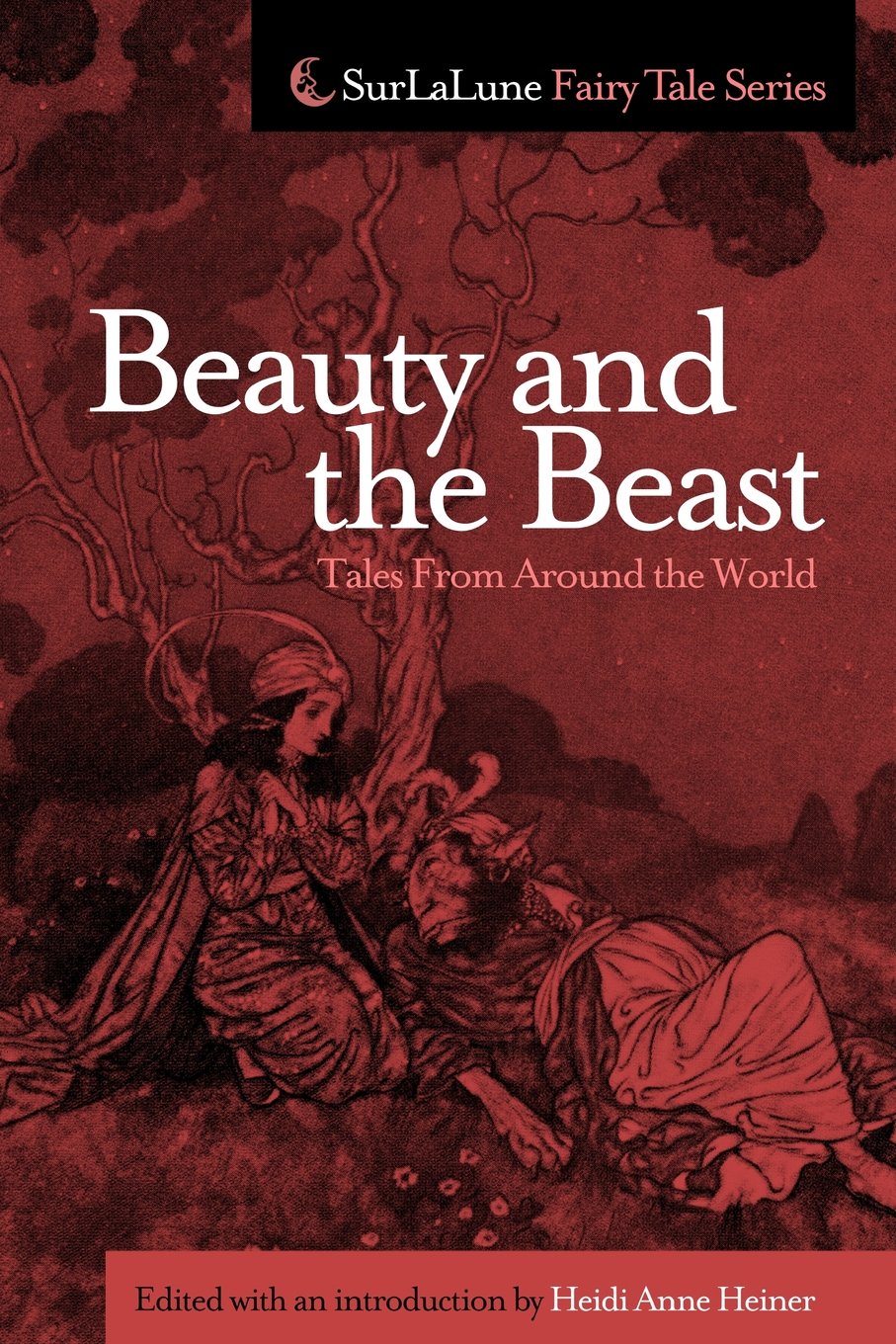
Found in Surlalune's Beauty and the Beast Tales From Around the World
This is such an interesting version of Animal Bridegroom tales! The journey of the wife and the trading trinkets for a night with her husband is similar to many other stories, but so many other features are unique.

I find the idea of the other sisters' husbands also being part time animal bridegrooms fascinating. It's as if the youngest daughter somehow realized that obtaining a husband through wishing on a dark cloak would have some kind of catch. She is also bold enough to defy her father's wishes that her white dog husband not stay in his house, and to follow her husband despite his protests that she return home.

I love how she keeps the eyeball and is able to heal her daughter (in a similar English tale, the daughter simply remains blind in one eye). The stipulation of not crying after her children are taking is very sad-but in tales like these, even though the curses are never explained, it seems that they were meant to be impossible to break (in another similar tale, the wife must remain silent while her husband, a bird, is being attacked and beaten). Yet none of the wives in these tales are condemned for showing motherly affection (or sticking up for their husbands).

 I also love how, whereas the husband usually just disappears, this wife chases after him and won't let him out of her sight during the journey! This story is definitely more feminist, even compared to other Animal Bridegroom tales in which the wife is already on a journey and seeking her husband, playing the part of the traditional male rescuer to her helpless cursed husband.

In some versions, the magical objects she is given is only used for bartering purposes; I really like how in this tale she befriends the poor people, works with them, and uses the magic to help others, and indirectly gets an audience with her husband. Also, in other versions, the husband is eventually clued in to the voice in his bedroom by a friend or servant, but in this one, his wife takes the initiative to write him a letter! Makes so much more sense. This heroine is active and clever. It's still a pretty bizarre little tale (what ends up happening to her children, for example?) but a fun one.

Tuesday, March 17, 2015

Fairy Gold: An Irish Tale

It happened one time that a poor man had a dream three nights in a row of a sack of fairy gold buried under a bush on his property. He didn't know if there was anything to the dream, but decided it would be well worth it to check.

He told no one of his intentions, but at the end of the day started digging in the place he had seen in his dream. Before too long he struck a sack full of gold and jewels. He carried the sack home, staggering under its weight. He hid the sack in the cow barn, for if anyone came to visit, he did not went his new wealth to be public knowledge.

He went in and told his wife about the treasure, who was entertaining strangers by the fire. She encouraged him to bring it in so she could see, but the man waited until the strangers were gone, so as not to tempt thieves.

He told his wife the story, and she asked him, "Did you spit on it?"
"I did not," he replied.

His wife warned him he had made a mistake. Her father had much knowledge of enchanted fairy gold, and the treasure is likely to melt away unless a man were to spit on it. Her husband doubted whether the treasure should melt, after staggering home under its weight.

When the strangers left, the man and his wife went to the cow barn, to see the cows straining to get away from the sack. The wife noticed the sack was moving, and thought it was no longer treasure; the husband claimed a rat must have gotten in.

But when the sack was opened, a great eel came out, twisting its head around; the two people were too afraid to move. The eel broke out through the roof and was never seen again in those parts, but that was all the man had left of his fairy gold.
*******************

From "Folk Tales of All Nations," edited by F. H. Lee, 1930, summarized by me

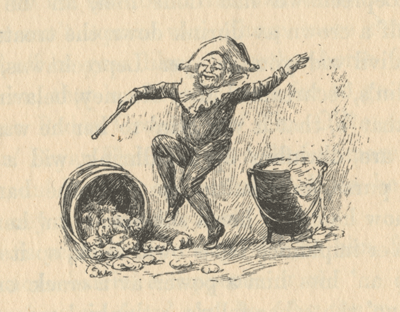
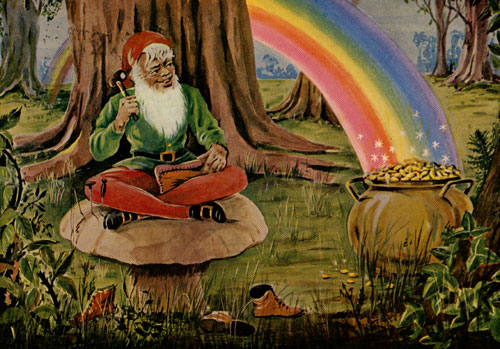
This tale may be one of the sources of the whole legend of leprechauns with their pot of gold at the end of the rainbow (tales of faerie gold are all over, although I don't know where the rainbow part came from?). Leprechauns, an Irish form of Faerie, were more often red in older tales, such as the "wee little man" in the Irish story "The Snow, The Crow and the Blood" I shared earlier this month. The site yourirish.com has some information about current leprechaun beliefs and how to catch a leprechaun if you find one, but warns that they are such tricksters, you may be better off avoiding them entirely...or from this RavensShire post on How to Survive an Encounter with Fairies:

"Some people stumble upon fairies, without the fairies or the person having really planned the encounter. This is when people capture leprechauns or other fairies to try to force them to give up their treasure. How well this works and whether the fairies seek revenge afterwords depends on the individual. One person who robbed the fairies was never able to leave his house afterwords. Others were able to live happily with their ill gotten gains. These stories don't say exactly what the difference is, but it is established that it's very, very difficult to steal a fairies treasure and attempting to do so can get you into a lot of trouble."

Gypsy at Once Upon a Blog also shared a lovely Irish tale in honor of St. Patricks Day-check it out here! And Heidi Anne Heiner has an Irish Cinderella tale at Surlalune!

Wednesday, March 4, 2015

The Snow, the Crow, and the Blood

During the month of March, I thought I'd share some Irish folklore! This tale, "The Snow, the Crow, and the Blood" is included in Surlalune's Twelve Dancing Princesses from Around the World collection in the Grateful Dead section. There are similarities to Twelve Dancing Princesses, such as following a Princess who goes to the netherworld by means of an invisibility cloak, and the title itself is also a reference to the tri-color theme most famously known in Snow White. (And some other interesting themes and similarities with other fairy tales, which we can discuss in the commments!) Enjoy-

*********
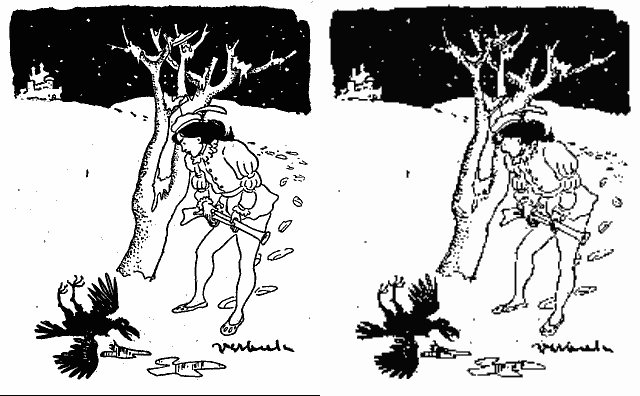
One winter's day, the son of the King of Ireland, Jack, went out to shoot. He shot down a crow, and when he saw the crow in the snow, he decided "he never saw anything blacker than the crow, or redder than the blood, not anything whiter than the snow round about." He decided he would not rest until he found himself a wife with hair as black as the crow, cheeks as red as the blood, and skin as white as the snow.

He told his parents the King and Queen of his quest, who tried to discourage him, because it might be impossible to find such a bride. But Jack insisted and set off with a hundred guineas.

Not too long into his journey, Jack came across a crowd fighting over a corpse. The dead man had owed a debt and the people to whom the money was owed didn't want him buried until they were paid. So Jack took the hundred guineas out of his pocket, paid the dead man's debt, and went on his way. Soon afterwards, Jack was approached by a little red man who offered him his services. Jack protested that he had nothing to pay him with, but the man insisted it would be free of charge. The little red man also knew of the one woman in the world with hair as black as crow, cheeks as red as blood, and skin as white as snow-the Princess of the East, and would lead Jack there.

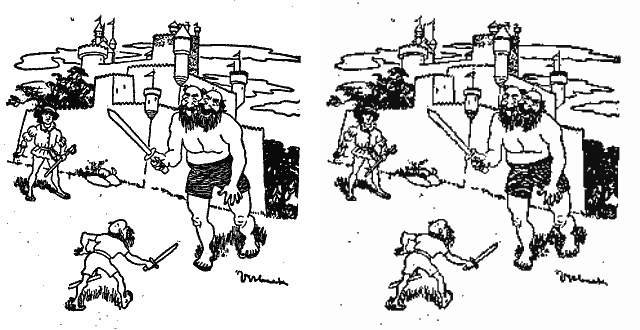
First they came upon the Castle of the Giant of the Cloak of Darkness. Jack knew of the giant's fearsome reputation and wanted to move on, but the little red man insisted they stay the night. They entered the castle and the red man demanded food and beds. The giant threatened to kill them and Jack was very afraid. But then "in a flash, the wee red fellow whips out his sword" and fought with the giant, and killed him. After a good night's sleep and eating their fill, they left the next day with the Cloak of Darkness.

The little red man did the same at the Castle of the Giant of the Purse of Plenty, as well as the Giant of the Sword of Light-he killed the Giants and took their treasures.

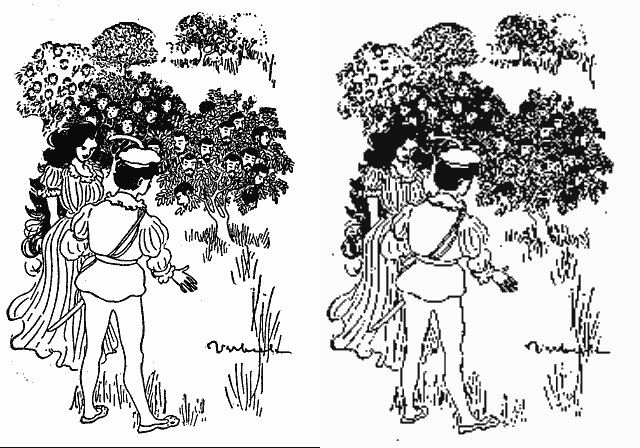
The two men traveled until they got to the East, and Jack went to court the Princess. She was just as beautiful as he had imagined, but she demanded three tasks of any who might court her. If the men failed the tasks, she would take off their heads. She showed Jack her rose garden-there were three hundred and sixty five rose bushes; all of them had a man's head on the flower except one, and the Princess told Jack she hoped to have his head on the last rosebush.

She then told Jack his first task. He must take the gold comb from her hair during the night, but she would spend the night "neither on the earth nor under the earth."

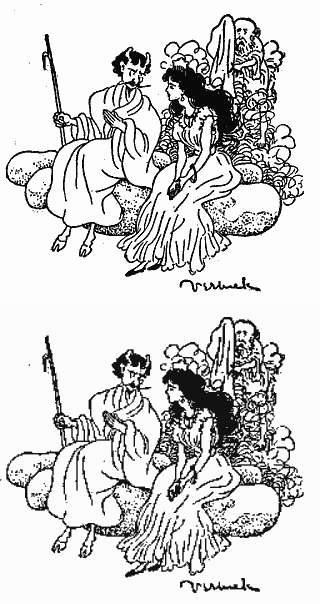
Jack was troubled and told the wee red man his task, and the red friend told him not to worry. With the Cloak of Darkness, he followed the Princess into Hell, where she kissed the Devil and talked with him. The red man snatched the comb from her hair and returned it to Jack, who showed it to the princess in the morning.

She was upset, but gave him his second task; to retreive the diamond ring from her finger. The red man accomplished this the same way, as well as the last task, to retrieve the lips the Princess had kissed, which the red man did with the Sword of Light.

The Princess had to consent to marry Jack once he completed the three tasks. Before the red man left he gave Jack instructions for making his wife good, for she was possessed with devils.

It was then that the red man reminded Jack of the debt he had paid for the corpse that was being buried at the start of his journey. The man told him, "it was I whom you buried, and I have tried to repay you a little. Now, good-bye, and may you and your wife prosper ever after."

************
Images and full tale text here

*I have also just added a tag for Irish folklore if you'd like to read more! A few others will, hopefully, come this month

UPDATE: Gypsy of Once Upon a Blog has shared some more insights and information into the tri-color aspect of fairy tales here, definitely worth checking out!

Sunday, March 17, 2013

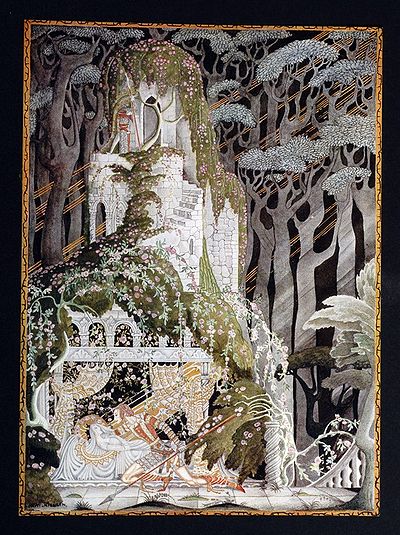
Ethna the Bride: and Irish faerie tale

This story is also found in Surlalune's Sleeping Beauties: Sleeping Beauty and Snow White Tales From Around the World. Although I'm not sure it technically qualifies as a Sleeping Beauty tale, I think it's a fascinating tale of faerie lore.

Kay Nielsen

"The fairies, as we know, are greatly attracted by the beauty of mortal women, and Finvarra the king employs his numerous sprites to find out and carry off when possible the prettiest girls and brides in the country. These are spirited away by enchantment to his fairy palace at Knockma in Tuam, where they remain under a fairy spell, forgetting all about the earthly life and soothed to passive enjoyment, as in a sweet dream, by the soft low melody of the fairy music, which has the power to lull the hearer into a trance of ecstasy."

There was a great lord who had a beautiful wife named Ethna, the loveliest bride in the land, who held all sorts of festivals in her honor. One evening while Ethna was dancing she suddenly let go of the hand of her partner and fell down in a faint.

She was carried to her room. In the morning she woke up and said she had had the most beautiful dream, where she was in a palace she longed to go to again. As evening came, Ethna fell into a deep trance. Though her nurse kept watch over her, in the morning she looked over and saw that the bride had disappeared. No one could find any trace of her.

The young lord went to question Finvarra about the whereabouts of his bride. He had no suspicions that Finvarra had taken her, but he was friends with the Fairy King. As he stopped to rest his horse, he heard voices in the air around him talking about how Finvarra was glad of his new beautiful bride, who could only see her husband again if he were to dig a hole through the hill to the center of the earth.

The lord was determined to dig a hole through the hill. He gathered a great crowd of workmen to dig through the hill all day. They made much progress, only to find the hole filled in the next day by Finvarra's power. The same thing happened for three days, and all their work was undone by the fairies.

The young lord heard a voice near him whisper, "sprinkle the earth you have dug up with salt, and your work will be safe." With this knowledge, the lord and his men were able to dig through the hole until they could hear the fairy music from below.
Sir Joseph Noel Paton
Voices in the air told the workers that the fairy kingdom would crumble if the men were to reach it with their spades, and the only way to save it was for Finvarra to give up his bride. Finvarra was willing to give up Ethna in order to save his kingdom. That night Ethna was delivered back to her husband. She was on her bed, lying in a trance as before, and no one could wake her for days on end. Everyone feared she had eaten of the fairy food and was under the fairies' enchantment.

The young lord was very sad, but once again overheard voices in the air by the fairy hill, saying Ethna's spirit was with the fairies though her body was with her husband. She would stay that way until he unloosed the girdle from her waist that was fastened with an enchanted pin, burn the girdle with fire, and throw the ashes before the door, and bury the pin in the earth.

The young lord hurried home to break the spell, and Ethna returned smiling to him, as if the year she had spent in Fairyland were nothing but a dream.

"After this Finvarra made no further efforts to carry her off; but the deep cut in the hill remains to this day, and is called 'The Fairy's Glen.' So no one can doubt the truth of the story here narrated."

Friday, March 15, 2013

Gold-tree and Silver-tree: and Irish Snow White

Some Irish fairy tales for this weekend, to coincide with St. Patrick's Day!

Once upon a time there was a king, who lived with his wife, Silver-tree, and daughter, Gold-tree. Silver-tree went to a glen where there was a trout in a well. She asked the trout, "an not I the most beautiful queen in the world?"

"Oh indeed you are not."
"Who then?"
"Why, Gold-tree, your daughter."

The Queen fell ill. The King asked what he could do to cure her, and the Queen said the only thing that could heal her was the heart and liver of her daughter, silver-tree. It happened that a prince of another kingdom had asked for Gold-tree's hand in marriage, so the King sent her off to be married, and had his lads cook the heart and liver of a goat for his wife, which she ate, believing them to be her daughter's.

A year later Silver-tree went back to the glen, and asked the trout the same question as before. He revealed to her that Gold-tree was still living in another kingdom.

The Queen demanded that she go and be allowed to see  her daughter. She herself steered the helm of the ship that took them to Gold-tree's kingdom. Gold-tree did not want to see her mother, for she knew she wanted to kill her. So she had herself locked into a room. When Silver-tree begged to see her, Gold-tree said that she was locked in and could not get out.

Silver-tree said, "Will you not put out your little finger through the keyhole, so that your own mother may give a kiss to it?"

Gold-tree did, and Silver-tree put a poisoned stab in it, and she fell down dead.

The prince was grieved when he found his wife dead, but unwilling to bury her because she was still so beautiful, he kept her in a room of his house, and he alone had the key to the room.

Over time he remarried, and one day he forgot to take with him the key to the room, and his second wife found Gold-tree, the most beautiful woman she ever saw. She tried to wake her, and then noticed the poisoned stab and pulled it out. Gold-tree rose alive, as beautiful as she was before.

That night the second wife was eager to tell her husband what she had discovered. The Prince was overjoyed. The second wife said, "Since she is the first one you had it is better for you to stick to her, and I will go away."

The prince insisted that she stay, and both be his wives.

The next year, Silver-tree again went to the trout in the glen and found out Gold-tree was still alive. She had the ship made ready to go to Gold-tree's kingdom. Gold-tree was afraid when she saw the ship, but the second wife told her not to be afraid, for they would meet her together.

Silver-tree offered Gold-tree a drink. The second wife told Silver-tree it was a custom in their country that whoever offered a drink must first take a sip of it themselves. As Silver-tree was taking a sip, the second wife pushed the rest of it into her mouth, and Silver-tree fell down dead. They buried her corpse, and the prince and his two wives lived happily ever after.

******************

I like this version of Snow White, especially the fact that the father and heroine are not as stupid as in the Grimm's. Although I hate the polygamy aspect and don't believe there's ever a situation where that would actually work out well, in a way it's refreshing to read about two women who should be rivals who forge a friendship. How ironic that in fairy tales, mothers and daugthers can never get along without trying to kill each other, but two wives of the same husband can.


The full tale is found in Surlalune's Sleeping Beauties book-I've summarized it here.

Saturday, March 17, 2012

The Young Piper

An Irish tale, in honor of St. Patrick's Day-


A good, honest couple named Mick and Judy lived with their four boys. The younger three were boys to make their parents proud, but the oldest was miserable and ugly, with dirty matted hair and a greenish yellow face, a mouth full of sharp teeth ever since he was a year old, and who was always screaming or yelping.


The neighbors all suspected that he was a changeling, for every time they would gather around the fire and talk about religion and good things, the child would holler "as if the divil was in him in right airnest." The neighbors advised her to burn him with hot tongs, or throw him out on the dunghill, but Judy was too loving to do any of those things to her child. They advised she get a priest to see him, but she never got around to having the priest come. The child continued to play pranks, until one day Tim Carrol, the blind piper, came.

During Tim's visit, he brought out his pipes and began to play, and the child leapt out of his bed and began to dance with glee. The boy wanted to play the pipes himself, and Tim consented to let him play-and the child who had never played pipes before in his life played a tune as well as anyone.
The family was shocked. Tim claimed that the boy was a leprechaun, and offered to teach him, which thrilled the boy's parents. His father Mick went out and bought him a set of pipes, which delighted the boy. He immediately started playing, and soon news of his talent spread, and people came from all around to hear him play. Everyone who heard him felt the urge to dance, some said the furniture was inclined to move when the boy played his pipes.

Besides the Irish tunes the boy played, he also had his own tune he made up, and when he played it, people felt compelled to dance, yet they weren't in control. The child played many pranks on people, causing his brothers to burn themselves or break themselves on furniture, making the animals wild, upsetting milk jugs and even killing neighbors' animals or causing barn roofs to fall in.

Since the boys' parents wouldn't hear of anyone hurting their child, their neighbors asked them to leave on account of their child. As the cart was moving their family over a bridge, the piper sat up and began to wail. His mother tried to comfort him, saying their was nothing to be afraid of, and eventually the frustrated father got out his whip and cracked it at the boy. The boy jumped, took his pipes, "an' lept clane ovir the battlemints o' the bridge down into the wather."

His family was horrified and went to look for him, and saw him sitting on a wave, playing the pipes as if nothing had happened. They ran after the boy but he disappeared.
"No one ivir led eyes an him sence; but the gineral belief is, that he wint home wid the pipes to his own relations-the good people-to make music fur thim."


-From Thomas Keightley's "Fairy Mythology"
Top Image from here

Friday, May 21, 2010

Lusmore

This is an Irish version of a story that also has Spanish, English, and German counterparts. I like it because though Lusmore isn't entirely a "Beast figure," since it's not a romance, he's still a deformed man who goes through transformation-and it's about the power of music.

Once there was a hunchback named Lusmore, who found it hard to walk. One dark night he was resting on his way home and heard sweet music coming from a ruined fort. The little voices inside kept singing over and over, "Da Luan, Da Mort!" (Monday, Tuesday!) He listened, but felt the need to add another phrase. Finally when he heard a pause in the music, he piped in, "Agus da Cadin!" (And Wednesday too!) There was a moment of silence, and then the voices started their refrain again, only with Lusmore's addition. The fairies burst out of their fort and pulled him in, waiting on him and thanking him for finishing their song. Knowing the danger humans can come to in fairy company, Lusmore was uneasy, but the fairies rewarded him by removing his hump.

Jo March

This joyous news spread, and woman who knew another hunchback named Jack Madden asked for the whole story. Lusmore gladly told it, and Jack's mother and her friend wheeled him to the place Lusmore had lost his hump. The fairies were singing the song Lusmore had helped them finish. Though there was no pause in the music, Jack yelled out with his own "Augus da Cadin, Augus da Hena." But this time the fairies were furious with Jack for spoiling their song, and as punishment they gave him an extra hump and kicked him out into the moat, after which he didn't live much longer.