Showing posts with label origins of fairy tales. Show all posts

Wednesday, January 20, 2016

Article, BBC News: Fairy Tale Origins Thousands of Years Old

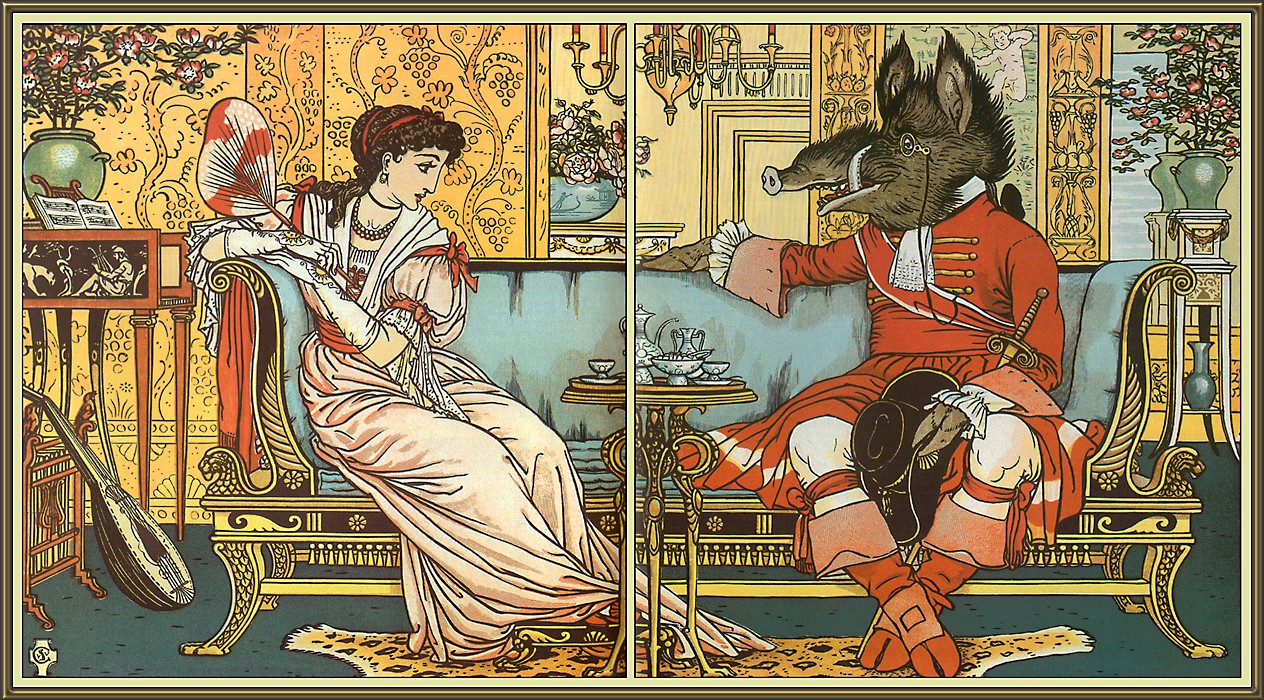
An illustration of Beauty and the Beast
My friend sent me a link to this article from BBC News, Fairy Tale Origins Thousands of Years Old, Researchers Say. An Excerpt:

"Dr Tehrani, who worked with folklorist Sara Graca Da Silva, from the New University of Lisbon, said: "We find it pretty remarkable these stories have survived without being written.
"They have been told since before even English, French and Italian existed. They were probably told in an extinct Indo-European language."
In the 19th Century, authors the Brothers Grimm believed many of the fairy tales they popularised, including Red Riding Hood, Cinderella, Hansel and Gretel and Snow White, were rooted in a shared cultural history dating back to the birth of the Indo-European language family.
Later thinkers challenged that view, saying some stories were much younger and had been passed into oral tradition, having first been written down by writers from the 16th and 17th Centuries.
Dr Jamie Tehrani said: "We can come firmly down on the side of Wilhelm Grimm.
"Some of these stories go back much further than the earliest literary record and indeed further back than Classical mythology - some versions of these stories appear in Latin and Greek texts - but our findings suggest they are much older than that."
This article doesn't provide too many details beyond this (they reference a different article from Science News which basically says the same). They've used language analysis to do their studies, as opposed to the usual method of finding a tale referenced in writing. In a way it's no surprise to us that fairy tales existed, in some form, thousands of years ago. For example, we already know that "Beauty and the Beast" can be linked to "Cupid and Psyche" from the second century, and that that was probably based on oral tales. But according to the article, BATB is probably 3,000-4,000 years old. Yet the stories change so much over time, even "Cupid and Psyche" is significantly different than BATB. I wish the articles had more examples showing how they can be confident that these stories are "far older than the first literary evidence for them." Still, very interesting, and contradicts the literary source theory that Ruth Bottigheimer has put forth.
Illustrations by Walter Crane

UPDATE: Surlalune has posted on the CNN article which provides the link for the full study. I'm definitely not an expert in phylogenetic analysis and I probably wouldn't understand any of it anyway but I'll pretend it's because I haven't had enough coffee yet. If anyone wants to look it over and attempt to explain pertinent findings in layman's terms, please do! (I also don't feel too badly because Don Melvin, in the CNN article, humorously points out how wordy the study is)

UPDATE:  Zalka Csenge Virag also discussed the article on Multicolored Diary (and has far more intelligent, in depth things to say about the study than I!)

*Also, I've added a tag for fairy tale origins. It contains posts about the debate over ancient oral sources for fairy tales verses relatively recent literary sources, but also those theories about historical precedents for fairy tales, if you're interested!

Tuesday, June 30, 2015

Jack Zipes on Ruth Bottigheimer

Back in 2012 I read Ruth Bottigheimer's book Fairy Tales: A New History and posted my thoughts on it.  Bottigheimer claims that fairy tales as we know them did not originate with the common folk as most people assume, and that they can all really be traced back to Straparola. It was a pretty daring claim to make and caused some controversy within the fairy tale world.

As I mentioned in my review, I had some issues with it, but I was really interested to see what Jack Zipes would think. We actually had a lot of the same points of concern (although his are worded much more strongly. According to Zipes, Bottigheimer's definition of fairy tales is "the most misleading, the most simplistic" he has ever read; her earlier book is "one of the most narrow, positivist studies of folklore and fairy tales ever produced").

1. Bottigheimer claims that there are literally no rise fairy tales (in which the protagonist goes from being poor to being wealthy) previous to Straparola. This is simply untrue, and Zipes points out, there's plenty of documentation of such stories previous to the Italian Renaissance. Plus, there are a million reasons that oral stories wouldn't be printed (many people were illiterate, and even those that weren't had no motivation to write them down). Many tales can trace their history back further to myths and motifs found in other literature, although I assume Bottigheimer would just say they were similar stories but don't fit in to the fairy tale genre (as she defines it).  Even then, there's the 8th century Chinese version of Cinderella, "Yeh Shien," and countless tales from the Arabian Nights that fit her definition of rise fairy tales. Which lead to the next major point-

2. Bottigheimer completely ignores non-Western countries. Not that she explains away the tales, she literally never mentions the highly influential Arabian Nights which predate Straparola, or acknowledges that similar folk and fairy tales occur in countries all over the world, even countries that would not have had the Italian literary fairy tales published in their language at the time when they were telling such stories.

3. This hadn't occured to me, but Zipes points out that Bottigheimer's view can really be seen as looking down on the peasants of Europe-she assumes that there's no way they could have had the creativity to create, tell, and spread fairy tales other than to simplify stories that they heard of through the literate upper class.

Still, I'm glad I read Bottigheimer's book. Although her claims are extreme, I think it's important to realize how influential Basile and Straparola were in the history of fairy tales. We might get frustrated when we hear yet another person mistakenly calling a Grimm tale the "original" or "authentic," but to have so completely forgotten these Italian men as a culture is like imagining that in the future, people will be calling the Disney cartoons the "original" versions (scary). A balanced view of fairy tale history will look at both the oral nature of fairy tales and the literary, and how the two interwove to influence each other over the generations. A balanced view should also take into account how little we can actually know about cultures hundreds of years ago when we don't have too many historical documents rather than making absolute claims.

From The Irrestistible Fairy Tale: The Cultural and Social History of a Genre by Jack Zipes

Friday, June 19, 2015

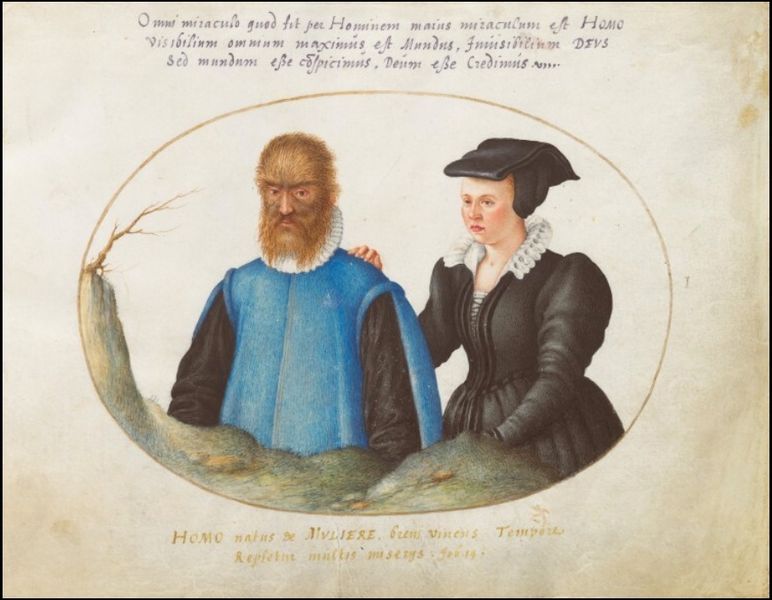
Petrus and Catherine Gonsalvus: Historical Beauty and the Beast?

I've heard of people trying to find true historical precedents for fairy tale characters such as Bluebeard and Snow White, but despite all my readings on Beauty and the Beast, I had never heard of a supposedly historical Beast, until recently an anonymous commenter led me to this video on the smithsonianchannel. It tells of the story of Petrus Gonsalvus, a man with hypertrichosis, or Ambras syndrome-a body completely covered in hair.

You can read the basics of his life on Wikipedia. The video on smithsonian is about 46 minutes long, and details the life of Gonsalves, as well as some of the modern people who have the same rare condition, and some of the science behind it. The description claims: "It's a condition known as "hypertrichosis" or "Ambras Syndrome," but in the 1500s it would transform one man into a national sensation and iconic fairy-tale character. His name: Petrus Gonsalvus, more commonly known today as the hairy hero of Beauty and the Beast. Discover the facts behind the fable as we follow Petrus's remarkable life with a very rare and hairy genetic condition. Then learn about this medical phenomenon, which continues to fascinate and perplex scientists to this day."

It's quite a sad tale of how humans treat those who are different, especially in the 16th century. But the claim that Petrus Gonsalvus is not just coincidentally similar to the Beast, but the inspiration for the classic fairy tale, had me suspicious. No history of BATB I've ever read has cited this man as being part of the tale's history. Was this just another sensationalized show, exaggerating to get more views? The story is always linked back to the myth of "Cupid and Psyche". There is a long string of folklore between that and the Animal Bridegroom tales written in the French Salon period. I'm not sure if you can prove either way if those tales most similar to BATB were around before Gonsalvus, it's so hard to date the oral tales, but I think given how widespread Animal Bridegroom tales are all over the world, folklorists would say they were being told before Gonsalvus. The documentary hardly mentions the fairy tale at all until this at the end-"And even if there had been tales of Beauty and her love for the Beast before them, their lives must have influenced one of the most famous love stories in world literature."

It's an interesting theory. Given that the couple was well known at European courts, it's not impossible to assume that they would have been known to Basile, who included several Animal Bridegroom tales in his collection in the late 1600s, or later Villeneuve and her French contemporaries (D'Aulnoy's "The Ram" and Bignon's "Princess Zieneb and the Leopard" are very similar tales that predated Villeneuve's).

Petrus Gonsalvus was given a wife-a wife selected for her beauty, not told what her husband looked like, and ordered to marry by the Queen. Yet, the couple got along, and may have grown to fall in love-in the illustration above, the resting of Catherine's hand on her husband's shoulder is a sign of affection. They had seven children together-some of them with hypertrichosis (the only ones the public cared about). The family attempted to live a normal life, but were exploited by a public that did not see those with differences as entirely human-tragically, the children who inherited their father's condition were all given away as gifts to other European royalty.
Who else thinks that the story of Catherine Gonsalvus is just begging to be made into a novel by Kate Forsyth?

Saturday, June 16, 2012

Finding the First Fairy Tales

Graham Anderson's essay "Finding the First Fairy Tales" is an interesting contrast to Ruth Bottigheimer's Fairy Tales: A New History.  Bottigheimer argues that the idea that fairy tales have existed since antiquity is simply false, and that fairy tales began in Italy with Straparola and Basile and were spread primarily through literature, not orally. And I agree that Straparola really probably created the genre of the fairy tale as we know it today, and that printed books played into the spread of tales much more than is usually acknowledged, but as I pointed out in my post on the book, the history of each tale goes back further than the genre itself, and related stories, as Anderson shows, do go back all the way into antiquity.

Anderson lists several examples of ancient plots that bear similarities to traditional fairy tales, but I have to admit some of them seemed like a stretch to me. And this brings up an issue of how we classify fairy tale variants, verses stories with similarities. Each story contains multiple functions, or plot elements, but also usually contains visual elements or classic lines we associate-"all the better to eat you with" immediately brings Little Red Riding Hood to anyone's mind, and a glass slipper is enough to remind anyone of Cinderella. Yet virtually none of these functions or symbols is necessary to classify a story as a tale type-there are versions of Cinderella where she is identified by another means, yet the plot is enough so keep it a Cinderella tale. Yet the more the plot and/or symbols become changed, the harder it is to actually classify it as a version of the tale. Some similarities may be intentional, and some may not.

I think if I wanted to classify an ancient story as a fairy tale variant (or really, the fairy tale would be a variant of the ancient story), I'd have to see a transitional tale. The process from Cupid and Psyche to Animal Bridegroom tales to Beauty and the Beast is a good example of this, but I'm not so sure as Anderson is that any ancient story  where a child is disgorged from the belly of a monster is clearly a Little Red Riding Hood story, and I don't think I'd have ever made the connection between the Exodus of Moses to the Pied Piper-the differences outweigh the similarities, in my opinion. It would be incredibly strange if no fairy tale shared a motif with any other story that previously existed, but that doesn't necessarily mean they're related stories.
However, he does provide insight into the history of many tales, including Sleeping Beauty. Traditinally, the oldest version of Sleeping Beauty is thought to be Basile, and sometimes Perceforest is credited as having a sleeping girl who gets raped. Anderson mentions the story of Chloris, in which a jealous goddess kills the daughters of a woman who boasts of their beauty, but one escapes and is renamed Nightingale, and later marries. This is slightly reminiscent of the jealous fairy's curse, but not enough on its own to classify it as a Sleeping Beauty tale. However, there is another tale where the heroine is called Nightingale, in which she is raped in a building in a wood, and out of revenge she cooks the son of the king who rapes her, and then serves him the meat of his own son. This wouldn't remind most people of Sleeping Beauty, unless you're familiar with the more grisly details of Basile's version, which appears to be a combination of these two Nightingale stories-although whether or not he was familiar with them, I don't know, so the similarities may just be coincidence.

If you want to read more from Graham Anderson on this topic and don't mind spending a lot for a book, you can read his Fairytale in the Ancient World

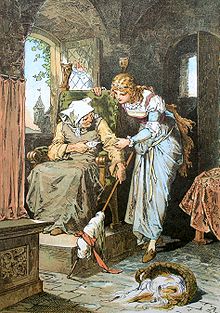
Above image-Alexander Zick

Monday, March 12, 2012

A historical Snow White?

Lancelot Speed

Once Upon a blog featured an interview with Ginnifer Goodwin, who plays Snow White in ABC's "Once Upon a Time," in which she talks about her researching for the part of Snow White. Goodman says, "I read all kinds of versions because this is not a story written by the Grimms.
This is a story older than anyone could possibly trace. It’s possible that it
was based on a real-life story of a princess named Maria Sophia Maragrita."

This was news to me, so first I went to wikipedia-no article on a Princess named Maria Sophia Margarita. Next step was Surlalune, who made no mention of a historical princess at all. The tale was a familiar one in many cultures previous to being published in the Grimm collection (the Goodwin quote above almost sounds like Snow White isn't in the Grimms' collection at all, but she just meant they didn't invent the story, merely collected it). The earliest literary version is from Basile's collection, so especially given what I just read in Ruth Bottigheimer's Fairy Tales: A New History, it's quite possible that this really was the genesis of the story, and not, as Goodwin claims, "older than anyone could possibly trace." But of course, you can't prove that the story wasn't in circulation before Basile-and wikipedia does reference an Albanian version that could be as old as the Middle Ages.

Found this post which I had to have translated into English, therefore making some of the wording very confusing... which talks about a Princess born in 1729 who lived in a castle with a toy mirror that was somehow rigged to repeat whatever you said to it, and probably interacted with dwarfish playmates: "The Seven Dwarfs (or elves) the story is perhaps not entirely bullshit: work in the narrow silver and copper mines
in the nearby town of Bieber demanded workers
who used short stature and endorse caps and brightly colored clothing to
facilitate identification in case of landslides and incidents, otherwise so
common in the mines. And according to historian Eckhard Sander suits we know of the
dwarves were wearing real clothes these children in their work. Maria Sofia played with them, hence its image has been associated with these child miners."
Charles Robinson

The blog post appears to have been well researched, but given the lack of reference to this Princess elsewhere I'm not sure I'd get my hopes up about finding out that Snow White actually having existed.
But while I'm referencing Once Upon a Blog, if you haven't already you should definitely check out what she has to say in this post on females rescuing themselves in modern interpretations of fairy tales...
EDIT: Megan has some information on The Dark Forest http://darkforestfairytales.blogspot.com/2012/03/analysis-historical-snow-white.html, including more details on two possible predecessors of Snow White

Friday, February 24, 2012

Ruth Bottigheimer's New History of Fairy Tales


If you want a book that's not too long or academic but still gives you plenty of food for thought, read Fairy Tales: A New History by Ruth B. Bottigheimer. This book challenges the commonly accepted notion that fairy tales have an oral history, but instead have a history that can be traced back through published books.

Bottigheimer goes in reverse chronological order, exploring the roots behind the major fairy tale publishers, proving that the roots of their fairy tales were really a previous collection of published tales, not actual peasants. First she started with the Grimms. I actually found this section to be a little frustrating. If you've read anything about the Grimms published recently, it's common knowledge that their informants were their middle class family friends and not actual German peasants. I've posted on John Ellis' One Fairy Story Too Many, which is the book that really first revealed to the English speaking world the truth about the Grimms' collection, but other books published since then seem to give the impression that they're the first to deliver the shocking news and it gets a little tiring when each author claims to be the one exposing the shocking truth. Bottigheimer spends too much time giving you the false scenario which is "commonly believed" about the Grimms traipsing through the German countryside and searching for tales, which gets old and comes across as a little condescending to the reader. It almost weakens her arguments, because few people, especially today, believe this given scenario exactly, so it sets you up on the defensive rather than being receptive to hearing what she has to say. Even before Ellis, not everyone was completely ignorant-in my last post, I shared what Sokolov published in 1950-that it would be foolish to assume that the tales originated from the people as a whole and obviously had an author at some point.

I enjoyed the other sections more. As I've lamented about before, if my library is any indication, books about the Grimms are plentiful, but reading about Perrault is limited to chapters in other books, and it's virtually impossible to read about Straparola and Basile without spending a fortune on more obscure books, so I was very interested to read about them. (But for the dedicated, the wonderful Heidi Anne Heiner of Surlalune has a Basile's Pentamerone page and a Straparola's Facetious Nights, where the tales are available to read in full text! I have determined to read more of them...) Basically, in the timeline of published fairy tale collections-Straparola in the 1550s, Basile in the 1620s, then Perrault (and Lheritier and others) in France in the late 1600s/early 1700s, and finally Grimms in 19th century Germany-for each major collection, the previous collections were in print, widely circulated, and translated into multiple languages, so that each author was aware of the tales of the other authors and intentionally (Basile, the French authors) or unintentionally (Grimms, who may have been somewhat deceptive but really did think they were preserving the German tradition in their tale collection) created their own versions of the previously existing stories in their own collections. Bottigheimer provides examples of the tales that evolved under each author's pen, from the well known (Sleeping Beauty) to the obscure. Even Straparola's were based off of previous story collections, but Bottigheimer also makes a very bold claim: "It was Giovan Francesco Straparola who created rise fairy tales."

Giovan Francesco Straparola


             Giambattista Basile

Bottigheimer defines rise and restoration fairy tales, which are very helpful terms when categorizing: a rise tale is one in which the protagonists begins in poverty and acquires a royal spouse and wealth through magical means. A restoration tale features a character that begins in an elevated state, is brought low through some humbling circumstance, and rises back to power and wealth at the end-for example, Donkeyskin, who begins as a Princess, is forced to make herself ugly and work as a servant because of her father's incestual passions, and ends up as a rightful princess. Some longer fairy tales may be a rise and a restoration within the same tale. These terms can help us understand the history of a tale and how it is created to meet the demands of the audience-Straparola's tales were written in Venice at a time when there was lots of poverty, and naturally the poor would be enticed by a rise tale, and his collection featured many rise tales. Yet Basile wrote his tales for the upper class, who dispised the poor, and in his collection, "the vulgar masses are rejected and depicted as repellent." There are a few rise tales in his collection, but Bottigheimer tells us they are rare exceptions. Yet restoration tales abound, which is something his audience can relate to.


According to Bottigheimer, "dig where we may, no rise fairy tales can be found in layers of literary remains before Straparola." Yet what about the ancient Chinese tale of Sheh Hsien, from the 8th century, which features a poor mistreated girl, forced to do all the work, who with the help of a magic fish acquires beautiful clothes and gold shoes, with which she was discovered by the King, who married her? How is this not a rise tale? Bottigheimer doesn't mention this version of Cinderella.

Here's where things get sticky-Bottigheimer states that, though many motifs common in fairy tales may have been around since antiquity, Straparola was the one who really created the genre. Yet you really have to look at the history of each tale itself. Beauty and the Beast is usually traced back to the myth Cupid and Psyche. Yes, Cupid and Psyche is a myth and not a fairy tale, but it is still part of the history of the story-drawing lines to define genres can be helpful but doesn't give us the full picture.

Bottigheimer's implication is that, in creating the rise fairy tale, Straparola created the genre we know of as fairy tales, but what about fairy tales that aren't rise tales or can't be necessarily traced back to Straparola? Surlalune traces the Frog King back to the 13th century, as well as a Scottish version from 1549, both before Straparola. What about those tales that don't even necessarily end happily, such as Swan Maiden tales? While we now create categories and criteria, the tellers of the tales most likely didn't distinguish between rise and restoration tales, fairy tales or tales about fairies, but simply told stories. While I think most people, even those writing on fairy tales, underestimate the significance of Straparola and Basile and published books in the history of the tales, you can't say everything started with Straparola. But certainly fairy tales as we know them would be significantly different without him.

Illustrations of Cinderella and Beauty and the Beast by Warwick Goble

Monday, April 19, 2010

Historical Bluebeard

Usually when we talk about the history of a fairy tale, we mean how the story evolved over time, but not a historical event on which the tale was based. With one of the creepiest fairy tales, Bluebeard, there are actually a couple possible historical precedents.

Kay Nielsen


Henry Bett claims that Gilles de Retz, Sieur de Laval, Marshal of France, was nicknamed "Barbe Bleue," "because of his blue-black beard," and that he believed he could restore his strength by bathing in the blood of young children (an awful resemblance to Countess Elisabeth Bathory bathing in the blood of young virgins to retain her beauty).


I haven't found any concurrence on the nickname or the bloodbaths, but he was a serial killer of young boys who gained pleasure from their pain and humiliation. More about him on wikipedia.

Matt Mahurin

Conomor the Cursed is the other possible candidate for the "real" Bluebeard. Once again, history becomes intertwined with legend. We do know he existed and killed his wives-I can't tell from my sources what are the exact known facts, but there's a whole legend about killing his wives once they got pregnant and how the last one was murdered but brought back to life and became a saint.

Edmund Dulac


If you want to know more about the tale, read the annotated version on Surlalune, or Terri Windling's article. Windling explores the various folkloric versions that predate Charles Perrault's tale, and how many of the heroines were able to outwit their murderous husband on their own, saving their sisters who had been victims-a stark contrast to Perrault's heroine who can do nothing but wait for her brothers to save her. And the moral (Perrault's) which condemns the woman for disobedience, and not the serial killer husband.


Art by Frederic Theodore Lix