Showing posts with label Myth. Show all posts

Monday, June 5, 2017

Myths and Legends Podcast

Normally, I prefer to read old fashioned, physical books over any other form of reading-including from a Kindle or listening to audiobooks. But now that a good chunk of each day (and night) is spent nursing my baby, hands-free listening is the way to go to pass the time! I had shared the Myths and Legends Podcast earlier and I've been listening to more episodes. Some ones that I particularly enjoyed:

Episode 56-Nepali Folklore: Hope You Guess My Name-From the title I thought this might be a sort of Rumpelstiltskin tale, but it's a sort of Cinderella story, only with a completely different ending. There's no Prince Charming, and after the main character thinks she has escaped her horrible life, she ends up returning home and confronting her problems rather than marrying and magically erasing past issues! A great alternative to the traditional Cinderella tales to tell to modern audiences

Episodes 5A and 5B: Two fascinating stories about Koschei from Russian folklore. He's a fascinating villain I was eager to learn more about. The first tale has a gender reversed Bluebeard element to it, but with a very different result! Also an opening scene in which bird magicians fly in through a window and ask for brides, which made me wonder if David Bowie's entrace as the Goblin King in Labyrinth was a nod to this story?

In the second tale, Jason, the narrator, expands a little on Koschei's character and motivations. In fact, the way he tells it, I not only felt sorry for him, but realized Koschei has an uncomfortable resemblance to Disney's Beast...in fact, he's less abusive than Disney's Beast...

Episode 32-Tricksters: Wager-I'm sadly ignorant of trickster tales; they tend not to be as common among people who rewrite or analyze fairy tales. The tales can have troubling moral implications but are highly entertaining if you don't take them too seriously. There are several shorter tales in this episode from around the world, including a version of a Tortoise and the Hare race, in which the Native American Coyote races a turtle; there is also a story about Anansi the Spider, and Loki and Thor.

Thursday, May 23, 2013

Historical Mermaids

In his essay "Melusina" from Curious Myths of the Middle Ages by Sabine Baring-Gould (which can be found in Surlalune's Mermaid Collection), Baring-Gould describes some of the history of mermaids before the more well-known Little Mermaid by Hans Christian Andersen.

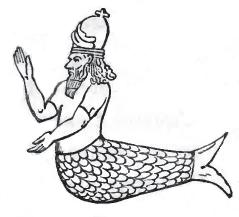
He links mermaids and mermen to solar gods. Sun and moon gods and goddesses were often depicted as having fish tails, because in the view of ancient people, the sun and moon appeared to arise from the sea each day, and then plunge back into the sea. A creature spending half of their time in water and half in the air would have to have a body to accomodate both.
Oannes

Early mermaid history also contains stories such as that of Melusina and Undine. Baring-Gould gives us the skeletal outline of such stories:

1. A man falls in love with a woman of a supernatural race
2. She consents to live with him, subject to one condition
3. He breaks the condition and loses her
4. He seeks her-and at this point the story can go one of two ways, he either finds her and secures a happy ending, or loses her.

This storyline strikes me especially because I'm also in the midst of reading Maria Tatar's Secrets Beyond the Door: The Story of Bluebeard and His Wives, in which Tatar points out that most versions of Bluebeard, as well as older myths and stories such as Cupid and Psyche, Pandora, and the biblical Eve, condemn women who are too curious, and associate knowledge with sin, but only when applied to women.

Yet here we have the opposite storyline-much like a role-reversed Cupid and Psyche or Animal Bridegroom tale, the man is usually forbidden to look at his beautiful wife under certain conditions. Just like Psyche, he is eventually persuaded to break his promise and satisfy his curiosity, and just like Psyche he suffers for it. Although I doubt anyone would conclude from the tale of Melusina that men are condemned who seek knowledge...(largely because tales such as these are the exception and not the rule, although I wonder how widespread this tale type was in earlier centuries compared to those that either imply or outright condemn female curiosity?)
Elenore Abbott

One of the things that always fascinates me about mermaids and faerie stories are how widespread belief in them was at one time. Baring-Gould says that belief in mermaids is universal. In my earlier posts Historical Evidence for Mermaids, I list several supposed "mermaid sightings" that have been recorded in history, with specific times, locations, and people. I won't do that again, but Baring-Gould lists several other similar "sightings", from as early as 1187 and through the eighteenth century. Interesting reading, even for the skeptical...


Sunday, June 13, 2010

Indian mythology-Ganges

Indian mythology is intertwined with Hindu beliefs. Indian epic poems "are some of the oldest epic poetry ever created and some works form the basis of Hindu scripture" (from wikipedia), unlike Western fairy tales, which existed before the spread of Christianity, and when Christianity came, some tellers of tales infused the newer Christian theology into the older fairy tales.

Although, apparantly the Hindu tales were also revised a bit for the sake of religion. In a 1928 book from my library, Washburn Hopkins retells some of these ancient stories. He says, "I have endeavored to tell the tale as I conceive it to have been before it was tampered with, to remove the priestly interpretation and re-interpret the story as it should have descended to us, with the emotional implications (suppressed by the priests) intact." I am not familiar with the other versions of these stories (or if modern scholars agree with Hopkins' claims), but the ones Hopkins tells are retold beautifully. Here I am going to relate excerpts of his tale "Ganges" (also known as Ganga).

"There lived of yore a maid divine, a daughter of the sky,
And all the gods rejoiced in her whenever she passed by.
Like shining water leamed her form, her laugh was like a rill,
She was so happy in her heart she never could be still.
Now sorrow she had never known, and ne'er had heard of woe;
So joyous in the clouds she lived she seldom glanced below;
She had no time for other things, but all her life was play.
She had the clouds to toss about, to sing and greet the day,
And chase the little wandering starts that always got away."

One day Ganges comes to the door of heaven, from where she can look down and see earth. But when she does she is stricken to see the sufferings of the people down below.
"As Ganges looked, the joyousness slow faded from her face,
The dancing light that loved her eyes fled to another place,
And for the first time in her life she felt no longer glad;
She became sorrowful; Ganges was sad."

The other gods find Ganges and attempt to distract her.

"Turn thy face from earth, dear, turn thy head and smile.
We from thee have hid the truth but ah, so short a while!
Life is linked with suffering. The truth at last we own,
Which all the gods concealed from thee. We would not make it known"

The gods go on to explain that the earth is in draught and they cannot do anything to help, because Fate has ruled that until a god leaves heaven and gives up their life for the sake of man, the ocean will continue to dry. None of them could imagine giving their lives for the humans, but after considering the matter, Ganges decided she would be the one to make the sacrifice.

The Ganges River in India

Ganges, fair Ganges, stood at heaven's high door.
She looked around on all the scenes she was to see no more;
But in her face no sadness showed, her sorrow was at rest,
She felt a wonder of great joy that flooded all her breast.
She gazed upon the earth below, into the distance deep,
There was no fear within her heart to take that deadly leap;
But she loosed her flowing garment and she clasped her hands on high,
And straight before the tearful gods sprang headlong from the sky.

"Thus she leaped, the immortal goddess, thus she left her home above;
Leaped to earth to show to mortals how a heart divine may love.
Touch we e'en her garment, lo! our souls are purified,
And all sins shall be forgiven him that bathes in Ganges' tide."

Saturday, April 17, 2010

Little Red Riding Hood as Sun Myth


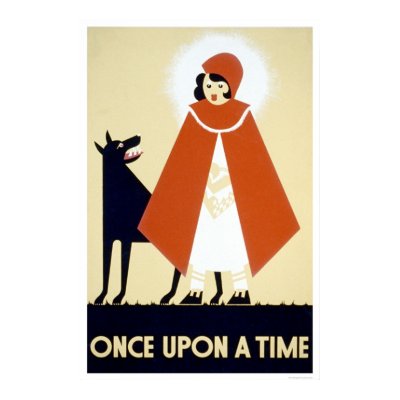
Kenneth Whitley poster

Little Red Riding Hood tends to be over-analyzed, in my opinion. Every branch of folkloric thought believes it has the correct symbolic meaning. Any psychoanalist will tell you the red cloak is OBVIOUSLY blood from menstration and the wolf is OBVIOUSLY a sexual predator. Henry Bett, on the other hand, claims with certainty that Little Red is a myth of sunset and sunrise. Generally sun myths can be applied to anything because anything good is the sun, anything bad is the night. The ultimate triumph of good over evil is the dawn triumphing over night. Congratulations, you have an interpretation for 99% of human stories.

Image by Paul Woodroffe

Yet, after a conclusion that might seem oversimplified, Bett goes on to cite many myths and legends from around the world that are directly related to the moon and sun and have parallels to Little Red-either connecting the color red/red coverings with the sun, or wolves with the night. Even one Melanesian myth where the hero takes a piece of red obsidian and cuts Dawn out of the belly of night. Personally, I can see a red hood as the rising sun more easily than menstration. This would all make a lot more sense if the red cap/hood wasn't added till Perrault's version. But anyone who claims any myth or tale has one specific origin or meaning is making one heck of a claim. Betts himself admits earlier, when critiquing those who interpreted everything as a sun myth, that "It seems to be the fate of every theory in folk-lore to be made ridiculous by being pressed too far." Modern interpretations don't really pay any attention to this sun myth idea and attribute everything to sexual meaning.

Image by Annie Rodriguez

Yet the complex influences of culture and history that created the fairy tales we know today are all fascinating to contemplate. It's true that Little Red has a hold on the imagination-it's one of the few tales that every child knows yet has not been marketed by Disney, with Hansel and Gretel also up there holding it on their own. Folklorists love to quote Dickens when he, reminiscing on his childhood, recalled how he believed that if he should have been married to Little Red Riding Hood, he should have known perfect bliss.

Saturday, April 10, 2010

Persephone

While reading Donna Jo Napoli's Beast, which I will have a full post on shortly, I came across a reference comparing Beauty and the Beast to the Greek myth of Persephone.
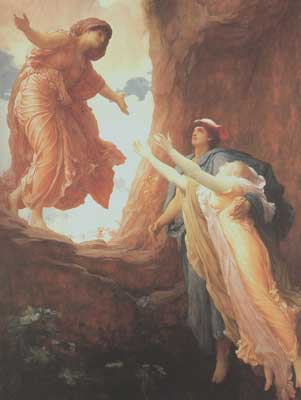
Leighton painting

Persephone was the goddess of the Underworld-but not by choice. While out picking flowers one day, she was abducted by Hades. Her father Zeus demanded her return, but before he returned her, Hades tricked Persephone into eating six pomegranate seeds. Food from the Underworld is powerful and will keep the eater there (much like fairy food). So Persephone spends six months of the year in the Underworld, as payment for the six seeds she ate.
The flowers Persephone was picking reminds us of Beauty's innocent request for a rose, which ultimately brought her to the Beast. Donna Jo Napoli's Beast makes the observation that Belle probably thought she was going to live with someone who was more or less the lord of the Underworld. And Beauty does go back and forth between her strange lover and her family- though not as much as Persephone.
Tile art by William Morris

Yet the Persephone myth is also similar to the tale of Little Red Riding Hood, who also got into trouble for straying off the path to pick flowers. She and Persephone are punished for this, while Beauty is usually commended for her appreciation of nature over materialistic goods. Yet, as critics have pointed out (Maria Tatar is freshest in my mind,) Little Red wasn't really a story about the importance of obeying parents or staying on the path until the Grimms got ahold of it. In fact, in older versions, Red would often perform a striptease for the wolf instead of the "My, what big (insert body part here) you have!" Not the Little Red we fell asleep listening to...