Showing posts with label Tom Thumb. Show all posts

Friday, November 4, 2016

Unusual Births in Fairy Tales

It's fairly common in fairy tales for women to give birth to unusual babies. Sometimes their child is only the size of a thumb, as in Thumbling tales and variants; it might be a Snow child, or sometimes a mother might even give birth to a child that is a food, like the Pumpkin Girl, or the women born of mangoes or cucumbers in Papua New Guinea. Sometimes the mother gives birth to a healthy, human child-only to have it stolen as she is accused of giving birth to a wolf/bear hybrid, such as in Armless Maiden, or some other sort of animal. In the world of fairy tales, such accusations were believable enough to the other characters.

I used to think of tales like this as being a commentary on how we treat people who are different, and an encouragement for the underdog, which is certainly still true in many cases. But I've been reflecting on tales like these, especially where a child is born under some kind of unusual circumstances, and not just enchanted or cursed later in life (some Beauty and the Beast tales fit under each category-for example, Prince Lindworm was a lindworm from birth, unlike the cursed Beast of the French tradition).

Since being pregnant myself, I have a new level of respect for the mothers in these tales, and a sympathy for the anxiety that prospective mothers face. Even in our modern age where we can hear the baby's heartbeat and see ultrasounds, it can be pretty easy to feel anxious about your baby in between doctor's visits. For all we know now, there's still so much that's unknown-even for those who choose to find out the gender, it's still a mystery for months; as future parents, we wonder which traits our child will inherit from each of us, and what their personalities will be like-which can be exciting as well as frightening. On top of that, there's always the risk of health problems.

So I can only imagine how my current fears and anxieties would be amplified in an age where medical knowledge was limited and often wrong-many of these older superstitions, such as how to tell which gender your baby is by a variety of ways, still exist today. I can only assume that one of the purposes of such tales was a way for prospective mothers to express their fears.

I've also noticed that food and babies seem to be unusually connected in folklore. Even if a mother is more likely to give birth to a thumb-sized child than a piece of food, often these births are a miraculous result after a mother ate something (although, in Snow Child tales, it's possibly a hint that the mother was unfaithful but claims it was a supernatural birth). Pregnancy is a very odd time-for a while it's not obvious you're pregnant, it just looks like you maybe ate too much. I'm not sure how much was known in other cultures about pregnancy, they might have assumed the baby grew in a separate organ from the stomach, but it feels and looks like your baby is growing in your stomach. Not to mention the havoc your baby can wreak on your digestive system, first making it hard to keep things down, and then giving you a ravenous appetite-lately I've been feeling a lot like an ogress or a witch from fairy tales who will eat anything in sight! Then there's also the fact that we still measure a growing baby's size by, usually, corresponding fruits and vegetables (my baby has gone from being the size of a blueberry to a bell pepper to a spaghetti squash, and many other fruits and vegetables in between!).

And of course, pregnancy cravings can be the catalyst for the action in fairy tales, most notably Rapunzel. Whereas now, we're told to indulge our cravings with moderation, in other cultures, it was believed that not meeting a pregnant mother's cravings would result in bad luck. Of course, it's doubtful that that bad luck would have been worse than having to give away said child in order to meet those cravings...

Kristiana Willsy has a great article on The Toast, Hunger is the Beginning of Every Folktale. Fairy tales usually center around the greatest of human desires-whether it's literal hunger, or the desire for love, sex, or children. And often those desires become combined to the point where they are one and the same-"If the story begins with the lack of a child, then hunger becomes central. Food often replaces sex in folktales, and witches with some rule-bound delicacy are the fertility specialists of choice, second only to daring the fairies
to give you a baby hedgehog, a snow-child, or an infant the size of your thumb." (emphasis mine)

Sarah Allison also has a great post on unusual births in fairy tales. These stories often start with a woman desiring a child, and she is given something to eat that will impregnate her...only usually, she is given some kind of warning and disobeys it.  So these children are initially some sort of punishment, although it's ironic that they often turn out to be the hero in the end, like Tatterhood. So while on the surface these tales may seem like more misogynist white noise, warning women against curiosity and disobedience, it seems that the real message of these tales is not to underestimate those who are different-sometimes those very differences end up being an advantage-or even that the so-called "mistakes" we make might not really have been mistakes at all in the grand scheme of things.

In "Juniper Tree," the mother wishes for a child while peeling an apple by the Juniper Tree. From there, the gestation period of her child is linked to the growth of nature. It's her gorging on berries from the Juniper Tree that would appear to lead to her death (even though she supposedly "dies of joy", but it seems unnecessary to mention eating the berries and falling sick and predicting her own death if it's all a coincidence, and this bears similarities to the other food warnings in pregnancy tales). Later, it's the children's request for an apple that leads to the murder of this son, reminiscent of the wish that brought him about in the first place (as well as the famous poisoned apple in Snow White).

There are also tales in which an older woman desires to eat children-from the witch in Hansel and Gretel, Baba Yaga, the ogress mother in law in Perrault's Sleepinng Beauty, to the evil stepmothers in Snow White and Juniper Tree. To eat a child is the reverse of giving birth to them-Snow White's mother may have hoped to reabsorb her beauty through eating her organs, or it could be representative of trying to hinder a child's growth rather than letting them turn into adults. The fear of being eaten is always present in fairy tales, sometimes representing a literal fear of wild animals, but sometimes more symbolic. Fortunately, even if the worst fear is realized and a character is eaten, in fairy tales this is not necessarily the end-like Little Red Riding Hood, the hero may emerge triumphant and wiser for the next round against the wolf.

Illustrations-"tom Thumb," Jemima Blackburn; "The Snow Child" by Eowyn Ivy; Rapunzel images from Pinterest (anyone know the artist??), "Juniper Tree" by laurasmythart

EDIT: For more examples of strange ways of conceiving and/or giving birth, check out the linked post on Multicolored Diary!

Sunday, September 25, 2016

Fun Facts about Thumbling Tales from Sarah Allison

I just discovered another terrific resource: the blog Writing in Margins by Sarah Allison. It's all focused on her research into Thumbling tales, or any protagonist that is about the size of a thumb. I haven't looked into Thumbling tales as much myself but there is so much fascinating, well-researched information on variants from around the world, as well as on the significance of certain images/motifs in different cultures. I asked Sarah to put together a guest post with some of the fun facts she's learned and she graciously obliged!

*******************************************************

"Thumbelina," Charles Robinson

I’ve been seriously researching fairytales about miniature characters, or thumblings, for maybe a year and a half now. These are characters like Tom Thumb and Thumbelina, the Japanese story of Issun-Boshi, and the Grimms’ Thumbling. I started this project mainly in search of other lady thumb persons besides Thumbelina. From there, it took on a life of its own. Here’s a list of some of the things I found most interesting: 

*The basic story: a childless couple wishes for a baby, even if it’s as small as a [thumb, chickpea, etc.]. By some twist of fate, this tiny child is born or created. Most versions feature him helping around the farm, going on wacky adventures, and getting swallowed by an animal before eventually returning to his parents. Some versions go in different directions. 

*This tale is incredibly widespread throughout Europe, North Africa, and Asia. As far as I can tell, it didn't really show up in the Americas until Europeans brought it there. There are American Indian tales with small heroes, but they are not typically thumb-sized. 
Children's book published by McLoughlin Bros, 1888

*The Brothers Grimm collected three Thumbling stories (well, two and a half) - Thumbling, Thumbling’s Travels, and The Young Giant. 

*Female thumblings are rare but not unheard of. A few examples: there are two versions of the basic story from Spain, three Frog Princess-type tales from Norway, France and Vietnam, and one from Corsica that is part Thumbelina and part Donkeyskin. 

* In a Jewish version from Turkey, the tiny girl is given to her mother by the prophet Elijah. 

*Tom Thumb is the first known fairytale printed in English. The earliest copy, from 1621, is satire with lots of scatological humor. Princess Kaguya, which begins like a thumbling story, is from the 10th century and is considered the oldest Japanese prose narrative existing. 


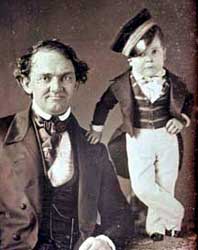
P. T. Barnum and Charles Sherwood Stratton, "General Tom Thumb"

*In real life, General Tom Thumb (Charles Sherwood Stratton) was a dwarf who performed under P. T. Barnum. He was a world-famous celebrity, and most of the random things named Tom Thumb, like geraniums and umbrellas and pastries, are actually named for Stratton. A few other performers with dwarfism also used the fairy tale name around the same time, presumably to cash in on Stratton’s fame. 

*Someone wrote a story where General Tom Thumb met his fairytale namesake (Tom Thumb’s Bridal Tour: A Fairy Story, 1863.) 


"Thumbelina" by Milo Winter

*Hans Christian Andersen’s Thumbelina has been translated multiple times into many languages, including Central Alaskan Yup’ik.

*****************************************************************

Thanks, Sarah!

If you hop on over to her blog, there's a lot more where this came from-I enjoyed reading about Death and Food in Thumbling Tales, Elves in Clothes, and the history of how Fairies got pointed ears. And if you, like me, were intrigued by her mention of a tale that combines Thumbelina with Donkeyskin, you can read about it here (along with a fascinating discussion of abuse in fairy tales, including those with an abusive husband as well as parent). And I've only scratched the surface of her archives so far!

*Also on the blog you can answer a survey about which Thumbling story you're most familiar with and how you heard of it. I'm sure Sarah would appreciate more input and I'm curious to find out the results!

Sunday, November 29, 2015

Turnip Princess

I found a copy of "The Turnip Princess" in a local library! This is the collection of Schonwerth tales translated by Maria Tatar. I have the Schonwerth collection edited and translated by M. Charlotte Wolf, and have posted on it before, but wondered how these collections compare.

I've just been browsing through "Turnip Princess", but there are some really interesting gems in there, including a version of Cinderella ("Ashfeathers"; it is a friendly dwarf who helps Cinderella get her dress and not a godmother or the spirit of her mother). There are, of course, many stories that aren't directly connected to our most popular fairy tales. Some of them are very dark and violent, as many unedited folktales are, and unlike the Grimms there are more references to sexuality, although none of them too explicit, as compared to some of our modern entertainment.
Arthur Rackham

The version of "Tom Thumb" is a good example of the physical and scatological humor found in the volume. Thumbnickel crawls through the keyhole into the treasure chest of the merchant who bought him, and tossed out the coins to his father. To avoid being whipped by the merchant he hid in a barrel of salt-but then the salt was fed to the cows, and Thumbnickel is passed through a cow (fully intact of course) and stuck in a pile of dung, about to be eaten by a mouse who is about to be eaten by a fox, until his father comes plowing nearby and manages to save him.

It seems gross but at the same time, when people lived in an age before indoor plumbing and many of our modern conveniences that allow us to be more discreet about our bodily functions, I guess it was better to embrace those aspects of life with humor than to stress out about them too much! And as we know, that type of humor is still enjoyed by children especially.

Both volumes have the tales separated into categories, which is really helpful. And it doesn't appear that there's much duplication of tales in each volume (Schonwerth had collected around 30,000 pages of text!!), so if you have one book and are considering getting the other, I consider it worth it to have both! You can compare versions of some tales side by side (such as "The Valiant Little Tailor," which I posted about here but mentioned Tatar talks of details that weren't in my version-they can be found in "Turnip Princess"). Wolf's collection has more tales (150 as opposed to Tatar's 72) but the stories found in Tatar's collection seem a little more easily digestible-shorter, faster paced, and more like the typical fairy tale formula we are used to. Although one major perk in the Wolf volume, for those of you who speak German, is the dual translation feature-you can read the original German on one page and the English on the other.