Showing posts with label Firebird. Show all posts

Monday, July 25, 2016

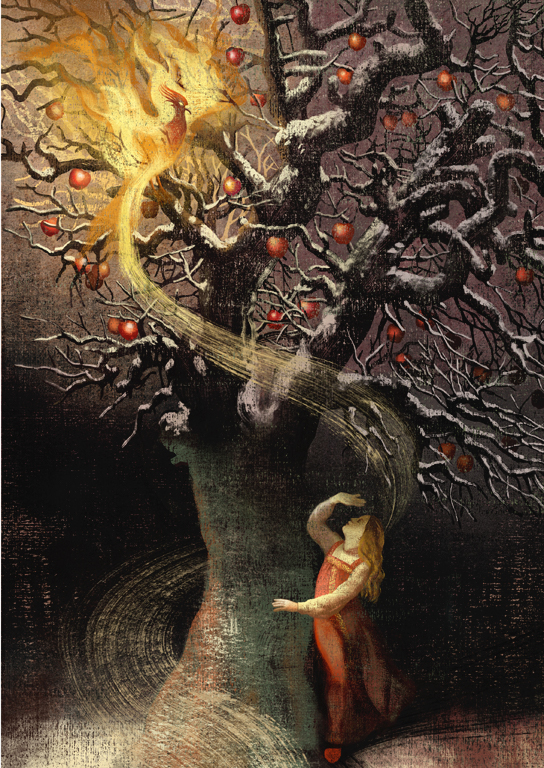
Artist Feature: Anna and Elena Balbusso

Enjoy some beautiful artwork by sisters Anna and Elena Balbusso:


"The Too-clever Fox"

Wild Swans

The Nutcracker

Men Who Wish to Drown


Monday, November 7, 2011

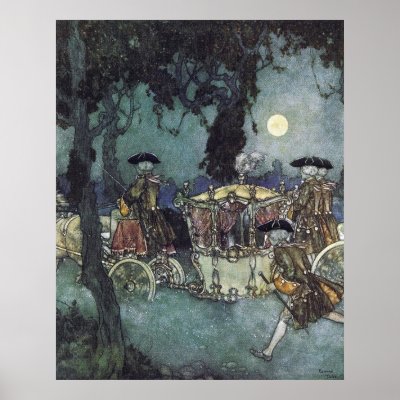
Edmund Dulac eye candy


It's more difficult to find online information on fairy tale illustrators than authors. Edmund Dulac (1882-1953) is one of the most well known fairy tale illustrators, for good reason. Was he personally drawn to the source material, or did his style just happen to suit it well and he complied with commissions? It's hard to believe from these gorgeous images that he wasn't at least a little inspired by the stories. He started his career illustrating some other favorite literature of mine, Jane Eyre and Edgar Allen Poe poems. Later in his life he even designed banknotes and stamps for France.

Tuesday, November 1, 2011

Trees and folklore?


Reader Radha Pandey is doing a project on trees in folklore, myths, and legend, and we've started a discussion in the comments to my post on Juniper Tree, but I wanted to make you all aware of it so we could have more input. So far we've thought of, obviously, the Juniper Tree, as well as Cinderella variants where the tree is a way for Cinderella to communicate with her dead mother and receive gifts from her.


Also, I'm very glad that reader Dawn alerted me to the Grimm tale One-Eye, Two-Eyes, and Three-Eyes because of my interest in beauty standards and society's treatment of people who don't measure up to them. In this tale, which is similar to Cinderella, the stepsisters have one and three eyes, respectively, and mistreat their sister who has two eyes "like regular people." Though it's unusual that Two-eyes is mistreated because she is normal, those who are different are still represented as evil, for ugliness and evil go hand in hand in so many tales. (Two-Eyes, of course, just happens to have great beauty.) But the tree is very significant in this tale as well, for after Two-Eyes' animal helper, a goat, has been killed by her mother, from the entrails springs a magical tree with golden apples. The tree is also the means by which Two-Eyes is made known to a knight that passes by, for the tree will only allow her to pluck fruit from its branches.


In both of these tales the tree is a means of preserving someone's spirit after they've died, and a way of giving help and gifts to the living.


In the Firebird, there is another tree with golden apples, which the Firebird steals. Ivan's catching of the Firebird in the garden kickstarts his adventures.


What else is out there? I may know a little about folklore but virtually nothing about myth and legend.

Thursday, May 5, 2011

Origins of Firebird Ballet

I had mentioned, a while ago, that the plot for the Firebird ballet was a combination of Russian fairy tales, but what are the fairy tales the ballet drew from?


The ballet basically took two common characters found in Russian folklore, Koshchey the Deathless and the Firebird.

The villain of the ballet is Koshchey, who holds ten young princesses captive. The Russian tale "Koshchey the Deathless" tells of the hero, Ivan, who goes in search of the Princess he knew of from the lullabies his nurses sang to him. The compassion he has on a man being flogged (Bulat the Brave) results in Bulat accompanying him on a series of quests, basically doing everything for him, including freeing the Princess Vasilisa from Koshchey and finding his death, to kill it. The death itself is in an egg in a duck in a hare in a coffer under an oak on an island in the sea. In the ballet they simplified it to just being an egg he has to smash.

Koshchey is also found in the tale "Maria Morevna." Feminists would love this tale-Ivan only allows suitors to marry his sisters if his sisters consent (the suitors are all birds...?...but it's okay because they can all turn into men...), and then marries Maria Morevna, who is beautiful and powerful, can slay whole armies by herself, and has imprisoned Koshchey. In fact, it's sort of a role-reversed Bluebeard, because Ivan is forbidden to look into a certain closet; he does and ends up freeing Koshchey and has to go search for Maria Morevna. After many trials (including dying...thank goodness for the water of life) Ivan defeats Koshchey by smashing his head. Ironic how Koshchey the Deathless always ends up dead...


The Firebird is in different Russian tales-"The Firebird and Princess Vasilisa" is less related to the ballet plot. In this one, a hunter finds a feather of the Firebird, and is warned by his horse not to take it. He, of course, does, which again results in many impossible quests, in which he is aided-this time by the horse, whose loyalty wins his master a Princess in the end.

"Prince Ivan, the Firebird, and the Gray Wolf" (which is available to read on Surlalune) has the beginning sequence of the ballet plot-the Firebird is stealing apples from the King's orchard. Ivan's brothers try to keep watch but fall asleep. Ivan stays awake when it is his turn, and manages to grab the Firebird's tail, and is left with a feather, which he presents to his father. Once again, series of impossible tasks which the hero wins with the aid of a helper-this time a gray wolf who felt badly after tearing Ivan's horse to pieces. One of the tasks is to bring back the whole Firebird, and the wolf warns him to bring the bird but not touch the cage. I bet you can guess what happened next...other than that the Firebird doesn't really factor in the plot.

In "The Maiden Tsar" (interesting tale-the villain is an incestuous stepmother) the Firebird has a little more power, like she does in the ballet-she rescues Ivan from a Baba Yaga. Later on, the egg in the duck in the hare in the coffer in the oak in the ocean is seen again-this time the egg contains the Maiden Tsar's love, not Koshchey's death.

I don't know of any tales in which 10 maidens are all kept prisoner-I'm pretty sure that was thrown in there to give the corps de ballet something to do.

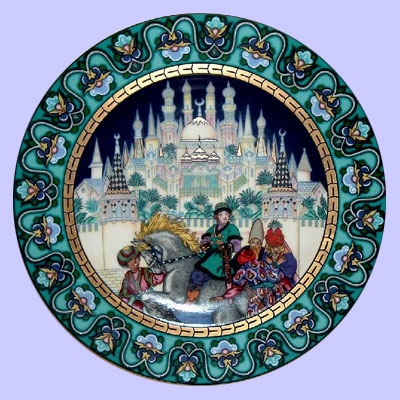
Images from here and by Ivan Bilibin
Tuesday, July 6, 2010

Mercedes Lackey's Firebird

Mercedes Lackey's Firebird is a good story, yet left me somehow unsettled. It retells the ballet story, which combines the Russian character with other folklore scenes and characters.

The first half I found almost boring. Ilya was not technically the youngest son, as in traditional fairy lore, but fulfilled the role of the underestimated "fool". The brothers were unrealistically stupid, and they spent so much time beating up Ilya and he spent so much time recovering from their beatings, it got tiring. Plus, pain is not something the reader can vicariously experience (not like they want to either). Situations, characters, can be very real to the reader, but descriptions of pain are hard to connect with, especially if there are too many of them.


Finally the Firebird came and things began to happen. I did also like Lackey's twist on the simpleton son-Ilya fakes idiocy in order to protect himself. By the way, is it too late to warn for spoilers? Several plot elements were altered but the scenes progress in the plotline of the ballet version. Lackey also includes the animal helper theme included in many fairy tales, and one of the animals is a fox, probably alluding to one of the better known oral versions of Firebird. In this story, the Firebird bestows on Ilya the gift of understanding animals. This is another common folklore motif-the protagonist assisting an animal, who later comes back to aid him.
Anastasiya Kazakova


The thing that most bugged me was Lackey's portrayal of women. Granted, it is told from a man's perspective, in a very chauvenistic culture. But Ilya is portrayed as the ultimate hero who can do no wrong, a direct contrast to his selfish brothers and father. Yet he only sees women as sex objects, yet supposedly he is the enlightened one for not abusing them like the other males. In this society, women who are beautiful have to sleep their way to higher positions, yet none of the women ever seem to have a problem with this. The end of the story provides an interesting twist-he had fallen in love with the most beautiful tsarina, and they were betrothed. This is where the ballet ends, with the assumption that they all live happily ever after, but the book goes on. Ilya discovers Tatianna's selfishness and realizes he does not love her, but the Firebird. After she's caught cheating on him with his brother, he leaves her, guilt-free, to go back to the Firebird.

Lev Lominago

In theory, I like this twist. But first of all, it seems to me to diminish the mystery and magic of the Firebird to have her fall in love with a mortal-I like that she wasn't part of any romance in the ballet version. That's a more minor point though. The whole thing reminded me of the Disney movie Enchanted-the moral is, you actually can't have love at first sight, but Giselle and the dude fall in love after two whole days of aquaintance (or, in the case of Idina Menzel's character and the Prince, we're back to love at first sight-technically, first dance.) The circumstances contradict the message. Although it's a family comedy, I give it the benefit of the doubt and don't think too hard about it.


This book, however, is not for children. Given the sexual content, it's for mature young adults and adults, so I expect more consistency in messages. Here, Ilya's had a couple conversations (including a dangerous mission, but still, very short on bonding time here) with the Firebird-so, exactly one more than he had with the Princess before betrothal, and we're supposed to imagine that this is true love? And somehow, although he was foolish enough to pledge himself to a stranger just because she's hot, she comes across as the villain and he just the innocent victim. Earlier in the book, there is a character that enforces the stereotype that fat girls are fat because they have no self-discipline and just eat everything in sight, and also they're all probably stupid too. Though Ilya at one point thinks that her heart is better than his beautiful betrothed princess, he as much as stated earlier that it would be impossible for a man to love a woman who was fat and ugly-and this from the most gentlemanly character of all.


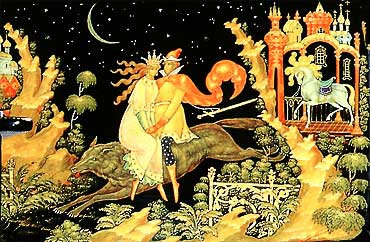
Boris Zvorykin

Overall, reading this book just made me feel like I, as a woman, had no worth unless I was beautiful and sexually appealing to men, which disappointed me, especially coming from a female author. Oh, she pays lip service to the character part, but the Firebird just happens to be inhumanly, stunningly beautiful at the same time. It was an interesting, quick read but I probably won't go back to it.

Friday, March 19, 2010

Firebird ballet

The story for the "Firebird" ballet comes from a different pieces of Russian folklore--as if someone made a Western tale in which a girl wears a red hood, loses her glass slipper and falls into a deep sleep because of an enchanted apple, to be awakened by the kiss of a Prince.

The story follows Prince Ivan as he tries to find the culprit who keeps stealing his father's golden apples. This turns out to be the Firebird, who gives him one of her feathers to use in time of need in reward for releasing her. The Prince then discovers a group of Princesses all kept captive by the evil Katschei, who can only be defeated when someone breaks the egg which holds his heart. With the help of the Firebird to tame Katschei's evil minions, and of course true love, Ivan succeeds in freeing the maidens and securing the most beautiful Princess for himself.


The music for the ballet was composed by Igor Stravinsky. One of his earlier works, there isn't the avant garde aspect of his later music, but this makes it more accessible to the average listener--which is not at all to say the music is boring. Stravinsky used diatonic music (music that uses the regular notes of a traditional major or minor scale) to represent normal, earthly things, and chromatic music (using all the notes available) to represent the world of magical creatures. Listen to Katschei's slithering, evil theme at the beginning. This version seems to have more emphasis on their beautiful set than on dance, but the Firebird comes in and dances around 6:30 (to a wicked hard flute part!). Listen to the violin harmonics (a very high and eerie sounding effect) around 2:00.

You can follow the links to watch the complete ballet. I'm including the last section as well. This starts with the Firebird's lullaby as she enchants the evil minions into a deep sleep and goes into the joyful finale, one of my favorite moments in classical music. Listeners might recognize the music as also being featured in Disney's Fantasia 2000, as the Spring Fairy overcomes the obstacles to spread spring throughout the land (how appropriate for this time of year).


Enjoy!