I have to admit, I have a rather defensive attitude about Disney. I have very happy memories of watching the classic films during my childhood as well as family trips to Disneyland, and Disney's "Beauty and the Beast" is what sparked my interest in researching the history of the fairy tale more fully, which ultimately led to this blog (I would also point to Robin McKinley's "Beauty" as my other major inspiration, but I'm honestly not sure if I would have ever read it had it not been for my love of the movie). Not only that, but I'm not sure that all the arguments I read against Disney are that good-it seems people love to attack him simply for the sake of attacking him.
So, I will attempt to be as unbiased as possible and I welcome your opinions and insights in the comments as well.
Bruno Heroux
I did appreciate very much that Zipes examined Disney's early career in context-first he described the history of fairy tales and the major changes the stories underwent as they went from being primarily orally told, to literary stories. These changes included: becoming more elite, in the sense that now the stories were only accessible to those who could read and afford books; making tales more definitive and enduring, as opposed to oral stories which change slightly with every teller, retelling, and audience; the tales were now geared towards children, whereas before they had been meant mainly for adults; the tales reinforced ideas of patriarchy; the tales were no longer a communal activity but became more private; now authors had power to adapt the tales to their particular preference and publish that version as the "definitive"; and now the stories had illustrations to go along with them and help define and shape the reader's ideas of the stories.
The next major development in the lives of fairy tales was film. Other filmmakers had used fairy tales as inspiration, such as George Melies (featured in the movie
Hugo) and Lotte Reiniger (I've featured her
The Adventures of Prince Achmed before, such beautiful artwork). But none of them focused on fairy tales as much as Walt Disney, and his movies (and following his death, his company's movies) have become the definitive fairy tales of our culture.
Just as literary, published tales gave the stories a more definitive form, film versions make a story even more definitive. Now
nothing is left up to the imagination, but each character and scene is illustrated for us. If you asked people across the world what color Cinderella's ball gown is, I bet the vast majority would tell you it was blue, which is a feature of Disney's film but never (or at least very rarely) in folklore. In the words of Walter Benjamin, the phenomenon of films that can be reproduced to mass audiences leads to a "shattering of tradition." Or perhaps more accurately, it supplants the former with a new, more widely known tradition.
As animation was in its infancy, filmmakers and directors wanted their films to reflect their own creativity and give their unique flavor to each story. Zipes said the images on the screen were meant to "celebrate the ingenuity, inventiveness, and genius of the animator." The credits of Disney's early movies show his name filling the screen, and for a long time he
didn't even credit the artists and technicians who worked on the film (I'd be curious to learn what other filmmakers of the time did? Was the industry so new there was no expectation of recognizing each of the many workers, or did Disney alone refuse to give credit where due?).
A complaint about early films is a complaint we often hear (and I've made myself) about current movies-the story suffers as the director goes more for shocking and aweing us with special effects. Early animators wanted to impress audiences with new levels of illusions. Zipes: "The animators sought to impress audiences with their abilities to use pictures in such a way that they would
forget the earlier fairy tales and remember the images that they, the new artists, were creating for them." What filmmaker wouldn't want to make the definitive version of Cinderella, Sleeping Beauty, and Snow White? Genious for marketing, but not for enhancing the long, rich tradition of fairy tales. I've had instances where I pointed out a version of a non-Disney fairy tale to a child and they got confused and said, "But that's not Sleeping Beauty/Cinderella/Beauty/etc!"
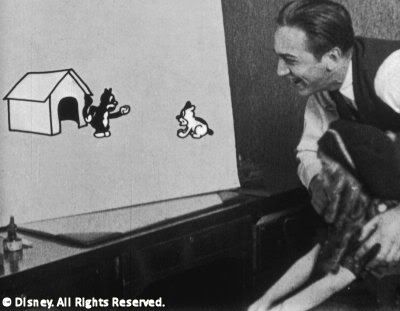
Zipes analyzes Disney's 1922 "Puss in Boots" (can be viewed in
this post). The plot is hardly even related to Perrault's story of a clever cat who uses his wits to trick a king and an ogre. A cat and a man together trick a king into getting the princess/lady cat they desire. Zipes reads the human protagonist as
representing Disney himself, the young clever hero who wants to break into the industry.
I personally don't see anything wrong with making a fairy tale current and infusing it with your personal story, although I do generally want the plots to be more related. Fairy tales are always evolving and can be interpreted many ways, and I think the spirit of the story is the same-the underdog defeating the Powers That Be-although I admit I have little interest in Puss in Boots and would be more picky about other tales. But Zipes says Disney "robs the literary tale of its voice and changes its form and meaning...Disney
returns the fairy tale to the majority of people."
Zipes himself says that Perrault's Puss represented his own class, so couldn't you say that by Disney using the tale to represent himself and the common people, he actually stayed true to its voice and meaning? Again, not an expert on Puss in Boots, so those more familiar with the tale's history and Perrault's intentions, please pipe in in the comments. But can we really accuse Disney of distorting tradition when
Perrault did the same thing with his own literary tales-taking oral tales and elements of oral tales and creating stories that suited himself and his culture?
Zipes gives these as the main characteristics of Disney's contribution to fairy tales as they became his films: 1. Democracy-American attitude towards debunking monarchy and giving power to the people 2. Technology-not only in the making of the films, but Puss uses a machine to defeat a bull and an automoblile to escape the king 3. Modernity-references to specific people and items of the twentieth century
Zipes condemns Disney not for the message of empowering the people, but because Disney's heroes only help themselves, not the community at large. He uses deception to defeat the King, just like films themselves are, in a way, deceptive-multiple images are made to look like movement.
My question is,
how is this different from any other fairy tale protagonist? Often characters in folklore use trickery and deceit (though those versions and tales are more suppressed as we've tried to make fairy tales morality stories for children). Though many characters are rewarded for being "good" I can't think of any that actively sought to make the world a better place. Fairy tales are almost always a personal journey-they are not epic battles between good and evil that currently attract audiences.