Showing posts with label The Nightingale. Show all posts

Monday, April 18, 2016

Heinrich Lefler

In the process of putting together a recent Guest Post in which Lissa Sloan explored religious/immortal characters in fairy tales, I discovered a new-to-me fairy tale illustrator with some gorgeous images, Heinrich Lefler (1863-1919). These images seem to have such a wide variety of styles that I was inclined to doubt they were all done by the same artist (such as the two illustrations of the final scene of "Six Swans"-very different, but both attributed to Lefler). Unfortunately I had a hard time tracking down more authoritative sources than Pinterest, so if anyone knows better, please let me know in the comments! He did often work with his brother in law, Joseph Urban, so maybe that explains some of the differences. In any case, enjoy some eye candy!

wild+swans+illustration - Google-søk:
The Six Swans By Heinrich Lefler and Joseph Urban:
Six Swans

Heinrich Lefler/Joseph Urban, Illustration for Snow White in Bilderbogen für Schule und Haus (1905):
'Schneewittchen / Snow White’ by the Brothers Grimm, illustrated by Heinrich Lefler. Part of a fairy tale calender published 1905 by Berger & Wirth, Leipzig.:
Snow White

hans christian andersen illustrations - Google-søk:
Andersen's "Princess and the Swineherd"


Godfather Death

little mermaid, heinrich lefler:
Little Mermaid

fuckyeahvintageillustration:  'Rapunzel’ by the Brothers Grimm, illustrated by Heinrich Lefler. Part of a fairy tale calender published 1905 by Berger & Wirth, Leipzig. Source:

Heinrich Lefler, "Dornroeschen" or "Sleeping Beauty":
fuckyeahvintageillustration: 'Dornröschen / Sleeping Beauty’ by...:
Sleeping Beauty

The Goose Girl -- Heinrich Lefler -- a really good story about a princess who avoids sexual harassment.:
Goose Girl

Hänsel and Gretl by Heinrich Lefler ~ 1905:
Hansel and Gretel

Original watercolor by Heinrich Lefler for Die Nachtigall [The Emperor’s Nightingale] -- offered by Battledore Ltd.:
The Nightingale

'Aschenbrödel / Cinderella’ by the Brothers Grimm, illustrated by Heinrich Lefler. Part of a fairy tale calender published 1905 by Berger & Wirth, Leipzig.:
Cinderella

Sunday, March 27, 2016

The Storybook Collection by JBW Studios

Artist J. Brooke Patterson creates intricate dioramas within real eggshells. The Storybook Collection contains several fairy tale scenes (as well as nursery rhymes, not included here).

The Real Princess
Princess and the Pea

The Nightingale
The Nightingale

Thumbelina
Thumbelina

Rumpelstiltskin
Rumpelstiltskin

Goldilocks and the Three Bears

Hansel & Gretel (lighted)
Hansel and Gretel (this one lights up!!)

The Ugly Duckling
The Ugly Duckling

"As a container of life, the egg inspires one to imagine the many things that can dwell inside.  It can frame and focus a passing observation, or a deep contemplation, and its intimate nature can draw people inwards. Inside this space is where I create little worlds that can enchant, delight, and amuse people.  While the themes are often narrative, I also embrace an appreciation for the decorative.  The shell itself is often a subject of my work and a point of departure.  I will explore its color and texture, and the juxtaposition between its strength and fragility.  I make a conscious effort to consider, choose, and combine different artistic methods.  It is in using the humblest of materials that I find the greatest reward."
-J. Brooke Patterson

Happy Easter!

Thursday, February 27, 2014

Hans Christian Andersen and Appreciating Nature


It's obvious from the tales of Hans Christian Andersen that he valued nature and was suspicious of too much dependency on technology. His story The Nightingale is a perfect example: it tells of a Chinese emperor and his subjects who got bored with a nightingale that sang beautiful melodies and instead became obsessed with a mechanical nightingale; the people loved the predictability and repetition of the mechanical bird, and the real bird flew off. However, the mechanical bird eventually broke down, and when the emperor was sick, only the real nightingale could restore his spirits.

As a writer in the Romantic era, this embodiment of ideals was typical. According to N. Ingwersen, in the Romantic era people looked down on the logical thinking of the Age of Reason which preceded it. "The Romanticist prefers nature to culture--the city is deemed a place of corruption, whereas nature is the place for those who are in touch with their natural instincts. Of course, folklore appeals to the Romantic mind, for through those age-old tales the voice of the people, unspoiled by civilization, expressed the wisdom of the past."

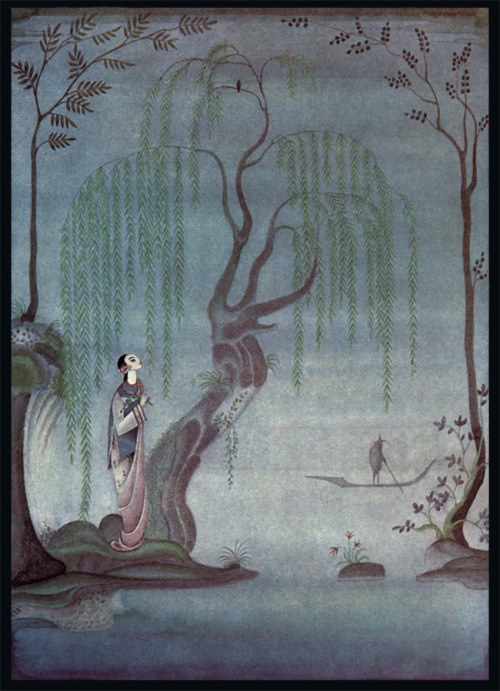
Kay Nielsen

Andersen's distrust of technology may have also had something to do with the fact that he had a very difficult childhood, which Wikipedia says is partly due to the Industrial Revolution. Wikipedia also quotes fairy tale friend Heidi Anne Heiner of Surlalune: "The tale's theme of "real" vs. "mechanical/artificial" has become even more pertinent since 1844 as the Industrial Revolution has led to more and more artificial intelligences, machines, and other technologies. The tale gains more poignance in the age of recorded music."
Vilhelm Pedersen

Also dealing with the issues of real/artificial is Andersen's fairy tale The Swineherd, in which a princess is condemned for preferring mechanical toys and a dirty swineherd to a beautiful nightingale and rose given to her by a prince (who is, incidentally, disguised as the swineherd). An older translation ends with the prince saying, "I am come to despise thee...thou could'st not prize the rose and the nightingale." The wording was so similar I almost wondered if Marilyn Singer's Beauty and the Beast poem, "Longing for Beauty," was referencing this tale: "A moist muzzle can welcome a rose/A hairy ear can prize a nightingale, singing." (It's been a while since I've mentioned this book, but even though I'm not super into poetry or have any reason to own children's books, Marilyn Singer's Mirror, Mirror book of reversible poems is SO GOOD!!!)

Although traditional Proud Princess tales like this usually end with the princess being humbled yet falling in love with the prince, Andersen gives the story a more tragic ending (not unusal for him though) in which the prince leaves and she is left alone, driving home the point even more that those who cannot appreciate nature=bad and unforgiveable.

In this case Andersen comes across as one of those authors who almost eerily predicted the future, since technology and machines have come to play even more prominent roles in our daily lives. I always think these tales are a good reminder to unplug more often, but obviously as one who is posting all of this on a blog and half of my sources were online, I believe technology is a very useful tool if we use it well.

Wednesday, November 13, 2013

Rosaspina Vintage

Rosaspina Vintage's 2013 Fall/Winter Collection is inspired by "the 60s and my favorite childhood fairy tales," says creator Ale.
 I wasn't too surprised to see a Little Red Riding hood cape; it's one of the most obvious ways to connect fairy tales to fashion. However, all the items are named for a fairy tale character. After the obvious ones came some that don't quite have the fame of LRRH or haven't been turned into Disney princesses. It was fun to see inspiration taken from Gerda, The Little Match Girl, and even the Nightingale.
Briar Rose pinafore
 Gretel dress
 Little Match Girl blouse and Nightingale shorts
Gerda skirt

It's a pretty collection (way out of my price range though) but it's fun to think of dressing in a way that is inspired by fairy tale characters, while not being costume-y.

Monday, February 21, 2011

For the Birds

A couple posts ago I mentioned that Cinderella is a tale that modern people don't necessarily connect to, although it's been so well-loved for generations it's still possibly the most popular. By contrast, Hans Christian Andersen's "The Nightingale" (full version on Surlalune; summary by me) has a lot of themes in it that are very current, yet it's not especially well known.

Birds themselves are very trendy these days. The first two images are Miu Miu Spring/Summer 2010; the third is a necklace from Claires-similar necklaces can be found all over.
It's interesting the reactions I get to this necklace-people in an older generation tend to seem almost distressed when they realize that the bird is outside of the cage. And it's true, the bird would be a lot safer in the cage (I remember all those distressing times in my childhood when our hamsters would escape-one sadly drowned in the sump pump, it was so traumatic), although it's supposed to be a symbol of freedom. As with everything, there are dangers to either extreme-conformity or freedom, although in this culture the younger generation is all about independence and freedom.

The Nightingale has some other interesting aspects-
Appearance vs. reality-the royal people are surprised to learn that the famed, talented nightingale is just a plain, gray little bird. They are more excited by the bejeweled mechanical bird.
Authentic vs. fake-the people are taken by fads; first the real nightingale and then the mechanical one, but they love the mechanical one because it's predictable. It's proven that people tend to respond positively to music simply because they've heard it before and can recognize it, but Anderson's comment is a very interesting commentary on human nature in general.
Tension between technology and the natural world-this aspect of the fairy tale obviously could not be found in the more ancient tales we know and love but is something we all feel. We all use and like at least some aspects of technology, but the minute it stops working I get all upset that this culture is such that we can't work or communicate without it. Most of us probably would like to get more in touch with nature but find it difficult in our hectic, appliance-driven lifestyles.

This song may or may not have been inspired by the tale, but the words of the chorus certainly apply:
"A nightingale in a golden cage
That's me locked inside reality's maze
Come, someone make my heavy heart light
Come undone bring me back to life

A nightingale in a golden cage
That's me locked inside reality's maze
Come, someone make my heavy heart light
It all starts with a lullaby"

"The Escapist," by Nightwish

Tuesday, February 1, 2011

Song of the Nightingale

A while back I posted the opera version of Stravinsky's "The Nightingale", (including a summary of the Hans Christian Andersen story) which was the only version I could find at the time. Now on youtube is the orchestral version, "Song of the Nightingale," my favorite:

Around 5:35 listen for the flute playing the nightingale.

This half starts with the oboe playing the mechanical bird.

Friday, April 2, 2010

The Song of the Nightingale


I had planned on doing this post before I even found out it was Hans Christian Andersen's 205th birthday! Thank you, Google Icons. (Find out more about Google's tribute to Andersen at Once Upon a Blog)

Anyway, first the tale "The Nightingale."

In China, long ago, was a nightingale that sang so sweetly, it became famous throughout the land. The Emperor himself requested that the nightingale come and sing for him. Everyone was delighted, and the Emperor put the nightingale in a cage so he could hear him sing whenever he pleased. One day, the Emperor was sent a mechanical bird who would sing as a present. The true nightingale flew away.

At first, the Emperor and his court were saddened by the loss of the nightingale, but they had the mechanical bird. The people liked this even better-he would sing the same tune over and over, and whenever the people wished to hear him.

Yet, one day the Emperor fell sick. He wanted music, but the mechanical bird had grown old and barely worked anymore. Death sat on the Emperor's chest and all seemed lost.
Illustrations by Edmund Dulac

But then, the true nightingale had heard of the Emperor's plight and came to sing to him. The true song of the nightingale healed the Emperor, who was overjoyed to see his friend, but never again took advantage of him.

This is part of a video version of Stravinsky's "The Nightingale." I don't understand the significance of the visuals, I was just trying to find the part where the flute plays the part of the nightingale. I can't find one on youtube though-in the opera version, a soprano sings the nightingale's part-just after 2 minutes.


The opera version was condensed into an orchestral version, "The Song of the Nightingale," which I prefer, but only because I'm more of an orchestra person than opera. But this part highlights the oboe playing the mechanical bird.