Showing posts with label French salon fairy tales. Show all posts

Sunday, August 21, 2016

Who's the Bluebird in Sleeping Beauty?


One of the fun things about the Sleeping Beauty ballet for fairy tale fans is the fact that the finale incorporates several fairy tale characters-Red Riding Hood and the Wolf, Cinderella, even Bluebeard (I personally wouldn't want him at my wedding...but I guess the characters have learned their lesson about leaving evil people out of celebrations after Carabosse cursed Aurora?). (Although after I wrote that, my source says Bluebeard makes an appearance, but I can't find any other evidence that he's a character in this ballet.)

But one of the most famous dance variations is the Bluebird, above (starts at aobut 3:30). The dance has captivated audiences for generations, as the male dancer leaps and jumps so effortlessly it appears he really can flutter about like a bird. But who is the Bluebird?

Jack Anderson provides an answer in his nytimes article Who's That Bluebird? And Who's That White Cat? (You know you write about fairy tale characters too often when your fingers keep wanting to type "Bluebeard" over "Bluebird"...). Although the ballet was originally created in Russia, the choreographer, Marius Petipa, was French, hence the usage of all the French fairy tales. Many were Charles Perrault's famous stories, including "Sleeping Beauty" itself, but Blue Bird and the White Cat are characters from Madame Catherine d'Aulnoy's tales. Anderson summarizes the Blue Bird tale for us (read the full text here):
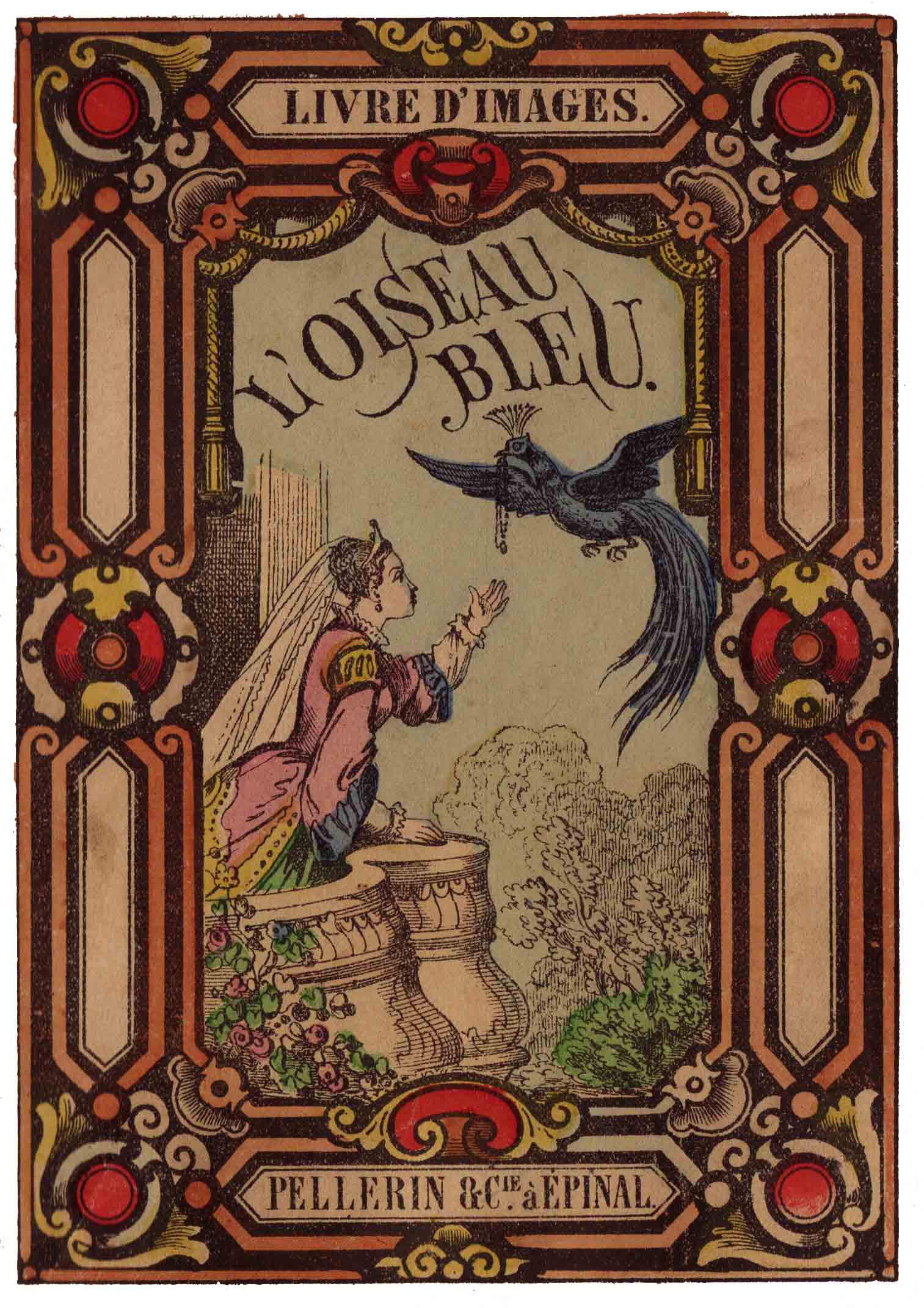
In "The Bluebird," a king marries a malicious woman after his wife dies. The new queen persecutes Florine, the king's kindhearted daughter, and promotes her own wicked daughter, Truitonne, whose face resembles that of a trout and whose conduct is decidedly fishy. The queen wishes the young King Charmant, who loves Florine, to marry Truitonne. Because he refuses to do so, Truitonne's wicked fairy godmother condemns him to be a bluebird. Florine is locked in a tower, where she is discovered by Charmant, who visits her nightly. The Bluebird pas de deux presumably shows Charmant happily fluttering in the presence of Florine. 

 When a spy sees the bird caressing Florine with his claw and kissing her with his bill, the queen places sharp swords on every resting place near the tower so Charmant can no longer easily alight. Fortunately, the people of the kingdom rebel against the queen. Florine, released from the tower, searches for her beloved bird and, after terrible hardships, finds him. He regains human form, but the fish-faced Truitonne becomes a pig -- a linguistically appropriate metamorphosis, for her name derives from the French words "truite" (trout) and "truie" (sow).

Also for fun, here's some more fairy tale variations: Red Riding Hood and Wolf, Puss in Boots and White Cat, Cinderella and Prince:
Illustration
Bluebird clip-Bolshoi Ballet, 2011
Fairy Tale clip

Wednesday, June 24, 2015

The Significance of Shoes in Perrault's Time

"Today, the word Perrault used for Cinderella's footwear, pantoufle, is translated as "slipper," whereas in 1697 a pantoufle worn to a ball was clearly a high-heeled mule."*
"One of the earliest surviving French luxe mules, just the kind of slipper Cinderella wore to the ball"

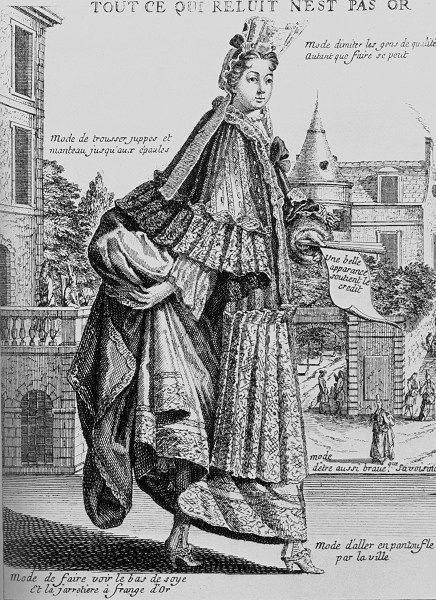
A mule is any shoe that lacks a back, such as the one above from Perrault's time. During the Versaille era, the reign of the Sun King, fashion was undergoing a revolution. The clothes, shoes, and hair worn by the men and ladies at the royal court became trends the like of which had never seen before-their looks were copied and spread throughout the country of France and eventually the world. And a new look was just catching on-one that still seems highly done up to us, but one that at the time was more casual, the "desabiller," or "undressed" look. Clothes that were formally worn only at home were now worn out in public, breaking the previous fashion rules. These clothes were more relaxed, and more figure-conscious.

Similarly, the mule was a shoe once only worn at home, like a house slipper. It was much easier to slip off (important for both the Cinderella tale and the perceived image of the mule)-plus its connotations as a shoe formerly worn in the bedroom gave it sexual overtones. Fashion engravings, the only form of fashion advertising, were getting more and more scandalous-hard as it is for us to imagine, at one time it really was shocking for a woman to reveal her ankles, and the mule allowed that.
THIS IMAGE MIGHT NOT BE SAFE FOR WORK...if you work in 1697

One thing I never realized is that Madame D'Aulnoy's tale "Finette Cindron" was essentially a competition, at the time, for Perrault's "Cendrillon." The two tales were published only months apart, and both were the author's versions of the oral Cinderella tales in circulation. Clearly Perrault's story has won out in popular imagination, but they're interesting to compare and contrast. Some people have already supposed that the Cinderella tale is really one about a foot fetish; Joan deJean makes the case that this is even more likely in "Finette Cindron."

The story is sort of like a mashup of "Cinderella" and "Hansel and Gretel", complete with a mother attempting to abandon her children in the woods, and an ogre wanting to eat them and being outwitted and burned in his own oven. The story is longer and more complicated which is probably partly why it was  never as popular. I noticed upon reading that shoes are prominently featured throughout the story: in poverty at the beginning, the soles of her shoes become worn through from walking to her godmother's; in servitude to her sisters, her job is to polish their shoes. Your relationship to shoes would have determined your status in France back them (as some people might say is also the case today, from the celebrities with closets full of designer heels, to those who can barely afford one pair, if that).

Then enter the fairy shoes: "red velvet mules completely encrusted with pearls," and Finette is the talk of the town. DeJean points out one interesting difference between Perrault's and D'Aulnoy's tales: in Perrault, Cinderella lets her shoe drop, on purpose; in D'Aulnoy, Finette loses it accidentally (easily done with mules). She and the prince have never even met; the Prince becomes obsessed, but it's more clear that it's with the shoe itself. The Prince held it, "turned it this way and that, kissed it, caressed it, and took it home with him." He does agree to marry the woman who fits the shoe, but deJean suggests it's because then he would have access to a closet full of "tiny, lovely" shoes.

And, just as the stepsisters are willing in the Grimm story to mutilate their feet to fit into the coveted shoe, D'Aulnoy gives us another image to make us squirm: "every woman washed her feet with the sorts of waters, pastes, and pomades. Some ladies actually had them peeled, while others starved themselves in order to make their feet smaller and prettier." *Shudder*

(Although...wouldn't it be a lot easier to fit into a shoe a couple sizes smaller if they  were mules?)

"D'Aulnoy's alternate version of the Cinderella story is the perfect icon for what can be seen as the first shoe-obsessed age. In a country ruled by a monarch who never tired of displaying his footwear, shoes became central to every outfit and to many psyches."

*Source: The Essence of Style: How the French Invented High Fashion, Fine Food, Chic Cafes, Style, Sophistication, and Glamour, by Joan deJean (chapter 3-"Cinderella's Slipper and the King's Boots", which also references "Puss in Boots")

Thursday, February 26, 2015

Madame D'Aulnoy: The Origin of the Term "Fairy Tale" and How It Spread like Wildfire

In one of his latest books, The Irresistable Fairy Tale (2012), Jack Zipes builds on what he discusses in his 2006 book, Why Fairy Tales Stick: The Evolution and Relevance of a Genre. I haven't read "Why Fairy Tales Stick" but the former is at my public library so I've gotten a chance to peruse it recently. In both books, Zipes seeks to look into and answer the question of the undeniable long-term popularity of fairy tales. Although they have changed over the years, evolving and adapting according to each culture, fairy tales have managed to remain in public general knowledge and popularity for an impressive longevity. In fact, really the only other thing I can think of that compares to fairy tales in its universal human appeal over completely varied human cultures is religion.

Zipes discusses the science of memetics, or to use a term most people are familiar with, "memes." Memes can be more than pictures of cats with funny captions-a meme is anything that captures the public imagination and spreads in popularity. Memes generally rise and fall over time, but fairy tales have stayed afloat for hundreds of years. What makes a meme stick with us is its relevancy. Therefore, general human consensus for most of known history would indicate that we find fairy tales relevant to our lives. Zipes points to the fact that fairy tales start in conflict, as do our real lives. Although I might point out that basically every story has some form of conflict, so there has to be some other common thread that indicates why fairy tales and not other literature remain so prevalent.

However, tracing the history of fairy tales themselves is incredibly difficult. Zipes says, "Almost all endeavors by scholars to define the fairy tale as a genre have failed. Their failure is predictable because the genre is so volatile and fluid." Not only that, but he goes on to mention that the term "fairy tale" never existed until Madame d'Aulnoy coined it as the title of a book in 1697. Her collection of stories about fairies prompted a trend with far-reaching impact she could not have imagined at the time. For now we use the term to cover a multitude of stories, but most of them don't actually involve actual fairies. How did that specific term explode to cover the undefinable genre we now call fairy tale?

(Fun fact: the original French, conte des fees, was originally translated into English as Tales of the Fairies in 1707. Sound like a certain blog name?!? I wish I could say my blog title was a direct reference to this original French term, but it was really a quick decision made when I impulsively decided to make a fairy tale blog, and I thought the title should simply convey what I would be talking about. I wasn't very creative.)
Adrienne Segur
Illustration for "The Royal Ram" by D'Aulnoy

Although the French fairy tales were very influenced by the Italian collections of Straparola and Basile, those works were only self titled as "tales" and not necessarily associated with, or strongly featuring, fairies (although a few do make an appearance). Yet D'Aulnoy made fairies central characters and put the word in the title of her book, creating an association between a term and a genre that are inseparable today. Why fairies, and why all of a sudden? And what was it about D'Aulnoy's newly coined "fairy tales" that made them so popular?

D'Aulnoy lived in a time when women's rights were severely limited. She created a world of fiction in which human lives and destinies are governed by powerful female fairies-the fairies influence everything from fertility and birth, to arranging destinies and love. Some fairies are more evil and witch-like, others good and just, but they are all powerful and fearsome, and in control of the fate of humans. In a time when women had little to no power either in society or in the home, she created a world where women could vicariously live through fairies to have responsibility, supernatural powers, and control. D'Aulnoy and the other female writers who followed in her footsteps self-identified with the fairies and used them to create alternate ideals for society.
Madame D'Aulnoy

The human characters in the first official fairy tales turned not to government, or the church, to solve their problems-but to the fairies that were a throwback to old mythological dieties and goddesses. For the first French fairy tale writers, "the fairies in their tales signal their actual differences with male writers and resistance to the conditions under which they lived...it was only in a fairy-tale realm, not supervised by the church or subject to the dictates of King Louis XIV, that they could project alternatives stemming from their desires and needs."

Monday, November 11, 2013

Fairy tales and Arranged Marriages

Fairy tales have been intertwined with messages against arranged marriages for hundreds of years now. The French salon fairy tales of the 1700s were largely written by feminists encouraging marriage for love; the whole notion of love at first sight which many people today criticize in fairy tales was a way of promoting the idea that women could marry young men their own ages they considered attractive, instead of older, abusive husbands, as was sadly so often the case. The whole Animal Bridegroom series of fairy tales is thought to have been largely encouragement to girls who were about to be married off to men that might seem monstrous.

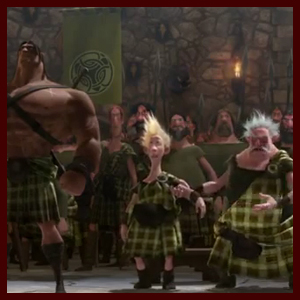
Clearly the world has changed since then. Arranged marriages are getting pretty rare these days, and the average person expects to marry for love (with a few exceptions, like the Indian and Orthodox Jewish cultures, where arranged marriages are more common). Which is why is always surprises me that the message in popular YA novels and other fairy tales seems to have stayed the same. It's no longer a provocative message, but someone merely preaching to the choir. I thought as much when I saw Disney/Pixar's Brave. No, I don't think you should force your daughter to marry, but the movie isn't watched by young princesses being forced to wed princes they don't love, but mostly young girls years away from marriage who were probably planning on choosing a spouse anyway.

I'm not saying parents are perfect these days and don't impose their will inappropriately, but the message can go too far, especially when the media acts like it's giving us this revolutionary message which it's really not. There's still a lot to be said for trusting the wisdom of parents and those who have been around longer. Though parents can make choices selfishly, young and inexperienced people in love can also act very foolishly and make decisions they regret.

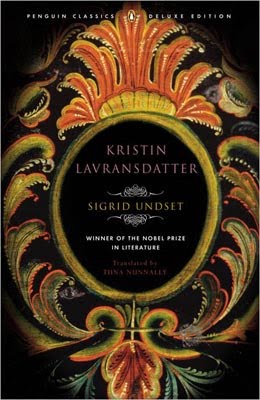
It's not a fairy tale, but I just finished reading Kristin Lavransdatter, a book written in the 1920s but set in medieval Norway. The book is about the life of a woman who rejects the man her parents arrange for her to marry and marries for love instead. I'm so used to the modern "arranged marriage=bad" message that I was expecting the book to have the same message, but it doesn't. In fact what I love about the book is it shows how complex any marriage situation is-the marriages that were approved of and those that were chosen by the couples. Neither is all good and neither is all bad; no character in the book is without flaws yet no one is without redeeming value. The book explores very messy relationships over time, and it's really a good book to have read right before getting married.

It would be nice to get more fairy tale interpretations like this. It seems these days its either the same happily ever after versions for children, which end at the wedding with happiness implied, or the twisted, dark versions being redone for adults. What about versions that are realistic without being entirely depressing or going for shock value? Books and movies that challenge you and encourage young, single people to choose their relationships wisely?

By the way, this interesting article by Ezriel Gelbfish recognizes that while not all arranged marriages are successful (and let's face it, many love marriages aren't either), statistically they tend to work. Fairy tales are cited as one of the reasons love marriages fail: “We grow up on fairy tales and movies in which magical forces help people find their soul mates, with whom they effortlessly live happily ever after...The fairy tales leave us powerless, putting our love lives into the hands of the Fates.”

Tuesday, October 5, 2010

French fairy tales

This spring I have the wonderful opportunity to travel to France and Germany. I'm really excited and I was thinking about trying to do French and German fairy tale-themed posts, but it's kind of impossible to have a fairy tale blog and avoid French and German fairy tales. Just about every well known fairy tale is from either Perrault or the Grimms (Beauty and the Beast is not, but is still French, as we shall see.)

Today I'm focusing on the rise of the French literary fairy tale. France is really where fairy tales became popular with the upper class- a couple Italian collections existed previously, but we have the French to thank for much of fairy tale popularity today. Previous to 1690, fairy tales were thought to be for children and peasants, and scorned by the upper class. Those who did share fairy tales were doing it all orally. Fairy tales became more popular as aristocratic French women formed salons, in which they would gather to discuss important topics to them-art, literature, love, marriage, and freedom. They wanted to set themselves apart as intellectuals and were a bit elitist. One of their goals was to improve their speech and discuss morality and manners, and to do this, they would practice telling each other fairy tales. They would be practicing the art of storytelling, speaking, and instilling their values into the stories at the same time. Telling fairy tales was the thing to do at gatherings back then-guests would take turns telling tales, speaking as if making it up on the spot, but really the tales had been planned out and rehearsed at home.

The attraction to fairy tales was linked to the spirit of the times-Louis XIV wanted his court to be the most radiant in Europe. The French wanted to translate the splendor of their country into splendid stories. The women who told the tales also added their own values-often feminist, their characters would resist male dominance, and their supernatural worlds would be governed by all-powerful female fairies, not male monarchs.


The palace of Louis IV
Fairy tales went through three stages in France. The first was the salon stage. Marie-Catherine d'Aulnoy kicked the whole thing off by including the fairy tale The Island of Happiness in a novel. Other authors (including Charles Perrault) jumped on the bandwagon and published their own collections of fairy tales. For the first time these salon fairy tales were traveling beyond the salon and becoming literary tales. Around 1688, France had its own recession that makes ours look like a walk in the park. Louis XIV continued to live his extravagant lifestyle and taxed all levels of French society, so even the aristocrats felt the sting. Because of censorship, the fairy tale was a way to critique the government subtley, as well as instill hope. Most of the famous authors from this period were aristocrats who got in trouble with the king at some point.


Louis XIV
The tales themselves were not complete inventions, nor were they pure folktales. Tellers would know the folklore of their regions of France, embellish tales in the salons, share ideas and edit with each other. Together they established a common tone for the tales, and really set a lot of standards for fairy tales as we still know to be part of the fairy tale formula. The French salon writers didn't shy away from violence-"in fact, the salon tales of the refined French ladies make the Grimms' tales look prudish." The protagonists of the tales had to suffer in order to demonstrate her nobility (much like many of the authors themselves suffered). The tales in general were very serious in tone-not escapist in the sense we often think of. "The fairy tales were meant to make readers realize how deceived they were if they compared their lives to the events in these tales."


The second stage was the Oriental Fairy Tale. The Translation of 1001 Nights (Arabian Nights) into French in 1704-17 made those tales very popular. Disillusionment with the decline of Louis XIV's court and the appeal of the exotic made the Middle East a more appealing option. Significantly for this period, women played less of a dominant role in the tales, and "the tales were no longer connected to the immediate interests of the aristocracy and haute bourgeoisie."
The final stage was the Comic and Conventional Fairy Tale. (I find this fascinating because we seem to have gone through the same stages-minus the Oriental stage. Wouldn't you say fairy tale parodies are very popular right now?)

In France, the same parodying happened. Once the fairy tale genre had become well known, authors could start playing with it- either through gentle mocking, or by taking themes and expanding on them in a more serious vein. Mlle. de Lubert and Mme. de Villeneuve did the latter. Beauty and the Beast fans, take note! This is the Mme. de Villeneuve who wrote the 1740 long version which is the origin of Beauty and the Beast as we know it today! (Influenced by former tales, as other posts discuss.)

Prior to this, fairy tales had been circulated among adults. Only later, by Mme. Leprince de Beaumont, were fairy tales rewritten exclusively as teaching moments for children. Beauty and the Beast fans should recognize her name as well-she's the one who simplified Villeneuve's tale and made it famous, in 1757. Others also simplified and moralised the tales, distributing them to children and the peasants, where the literary tales once again became integrated into oral folk lore. So even the tales which have not reached universal fame today are influential in the standards they set for the fairy tale genre-each generation molded the tales according to current ideas, handed their creation to the next generation to keep altering and evolving, and the process is still going on today.

Source: Jack Zipes, introduction to Beauties, Beasts, and Enchantment: Classic French Fairy Tales(the link is to the Hardcover version, though it is more expensive, because only it includes the Villeneuve version of batb)

Tuesday, May 11, 2010

Madame D'Aulnoy's "The Ram"

In Madame D'Aulnoy's time (c.1650-1705), it was fashionable for the French to sit in their salons and share fairy tales they had made up. Creating a good fairy tale was an admired skill, and D'Aulnoy was among the best. She hated the way women were treated at the time, and "all her tales are filled with violence and violation of some kind that must be resolved." By making her fairies disagree with one another and making life harder for the humans, she was also making political statements about Louis XIV and his ministers.

Her tale "The Ram," though literary and not oral, is an Animal Bridegroom tale that may have been known to Madame de Villeneuve when she wrote "Beauty and the Beast."

It starts out with a bit of a King Lear theme-a King has three lovely daughters, but the youngest, Marveilleuse, is the most beautiful and his favorite. He returns from war one day and his daughters are overjoyed to see him. He asks each of them why they chose to wear the colors they did, and the oldest daughters have very suck-upy reasons ("your sight to me is like that of Heaven and all the Heavenly Host")-my dad would be very concerned if I told him that but this King loved it. But he was very upset that Marveilleuse just wore white because it suited her, and she thought that would please him. However, he gets over it, only to get infuriated again when she dreamed not that he brought her beautiful gifts like her sisters, but that at her second sister's wedding, he offered her a golden vase in which to wash, like a servant. (This part is similar to the sisters' requests of gifts in BatB.)
Now we get all Snow White, because he is so insulted at Marveilleuse he orders the captain of the guards to take her out into the forest and murder her and bring him back her heart and tongue. Immediately her servant girl and pets offer to give their hearts and tongues instead, where they all committed suicide but the monkey's organs were too small and the servants' (who was a Moor) were too black. So the Princess, all alone, stumbles upon a group of civilized, talking rams living in luxury. The King Ram tells her how he was enchanted by an evil, ugly fairy for not returning her love (just like Villeneuve's Beast). Among the fairy's victims the Princess finds the ghosts of her faithful servant and animals.

The Princess finds herself falling for the Ram. This Animal Bridegroom story is unusual in that she knows that he will transform eventually, and just from paying his sentence to the fairy, not from her declaration of love. Well, they live happily until her eldest sister gets married. She goes to the wedding-anonymous in her supposed death, and in all her new splendor (kind of like Cinderella? How many fairy tale allusions can we fit into this one tale?) everyone is enchanted by her but doesn't know who she is. She slips out, and the King orders that if she ever comes again, the castle doors should be shut and she detained (this tale definitely features Oedipal issues, but mainly the father's).
The second sister gets married and Marveilluese wants to go to the wedding. The Ram can't live long without her, and she promises to return quickly. But her father had locked all the gates to keep her in. He invites her to the banquet, and offers her a gold basin to wash in, just like in her dream. The story comes out, but since this takes a long time, the lovesick Ram comes to the Palace to find her. No one at the palace wanted her to go back, so they refused to let the Ram in. When the Princess finally did leave the Palace, she found her Ram dead by the door.
Hey, this is my hundredth post!