Showing posts with label unhappy endings. Show all posts

Monday, February 8, 2016

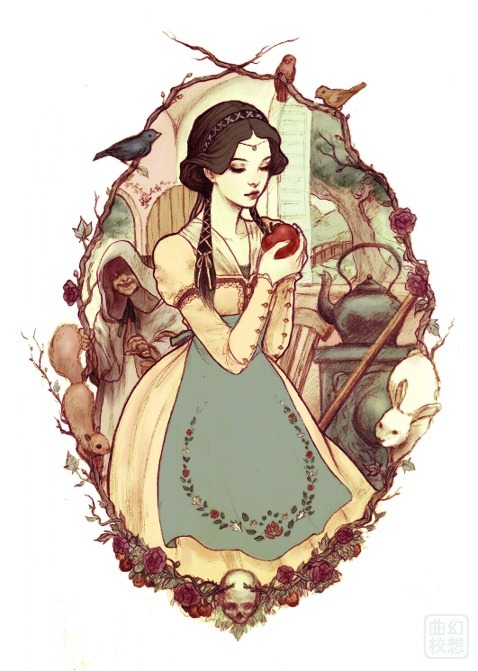
Roses in Fairy Tales: Snow White

Reminds me of President Snow:


When I posted on roses last year, Gypsy of Once Upon a Blog reminded me that roses are also very significant in the history of "Snow White", and referred me to Kate Forsyth's fabulous post on Snow White.

There's a 9th century Norse saga that includes the tale of "Snow Beauty." A king's beautiful wife died, but  her cheeks remained rosy. He became obsessed with the idea that she would come back to life, and neglected his kingly duties, sitting by her side. When his councillor finally suggested he allow them to change the bedclothes, they lifted the body up, "a rank smell of rotting rose with her, the body turned blue, and worms and adders and frogs and toads crawled out. So she was burned, and the King returned to his wits."

In Basile's "The Young Slave" (published 1634), arguably the oldest literary version of Snow White, the mother became pregnant with Snow White after swallowing a rose petal.
Snow White by JDarnell

In the first version of "Snow White" that the Grimms collected (in 1808), there is no hunstman, but the Queen sends the girl into the forest to collect roses and abandons her there. (This is in the Grimms' earlier manuscripts, but by the first edition of tales in 1812 the story had become the version we have now with the huntsman).

I wonder why we've lost all associations with roses and Snow White in our current versions? I found it hard to find any images of Snow White with roses for this post, despite the general association of Princesses with pretty flowers. The stark color contrasts of red and white featured in "Snow White" do recall common rose shades to mind, such as in the fairy tale "Snow White and Rose Red." In that tale, the different shades represent the two sisters and their contrasting personalities.

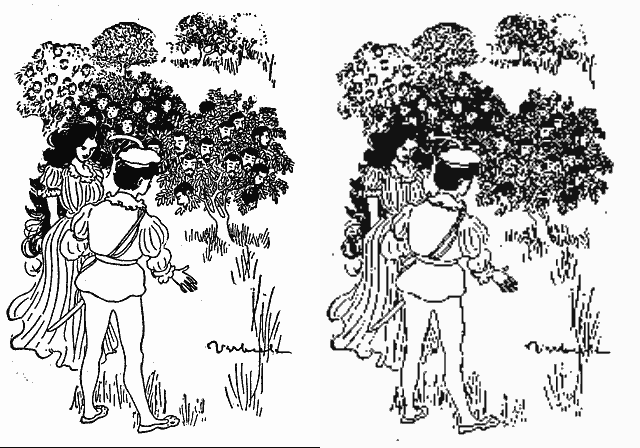
Another interesting tale for comparison is "The Snow, the Crow, and the Blood." Though it  is more similar to Twelve Dancing Princesses than Snow White, it starts off with the motif of a Prince who sees the color combination of white, black, and red and decides he must have a bride of that coloring. Later in that tale, the enchanted princess shows the hero a rosebush-there were three hundred and sixty five rose bushes; all of them had a victim's head as the flower except one, and the Princess told Jack she hoped to have his head on the last rosebush.

It seems that roses, despite being the cliche and overly romantic flower we think of now, often had a history of being very morbid in fairy tales, especially those related to Snow White.


Thursday, December 24, 2015

The Fir Tree and the Snowman

Hans Christian Andersen has some cold weather appropriate fairy tales, but fair warning; they are among his most depressing and pessimistic.
Vintage Postcard

"The Fir Tree" (summary, full text)is a tale about a young tree who can never appreciate the stage of life he is in-he longs to be bigger, and once he is big he wants to be cut down like other trees, and once he is cut down and made into a Christmas tree, his glory lasts for only a night and he is discarded and eventually burned. On the one hand, the importance of being content with your current life situation and appreciating what you do have is something that I need to be reminded of sometimes, but in the tale it comes across as a bit preachy. Scholars say that, although Andersen had already written his share of sad tales, "The Fir Tree" is the first to express the pointlessness of life.

The story, when retold, is sometimes given a more hopeful ending-like following a pine cone from the tree that is thrown into the forest, to perhaps become another tree. It's been made into a children's book and I remember flipping through it once and thinking they made the ending a lot happier but now I don't remember how...


The tale has similarities to a later story of Andersen's, "The Snowman," (summary, full text) in which a snowman falls in love with a stove, and goes the way of all snowmen and melts. The story is thought to express Andersen's frustration in his own love life (which reads like a soap opera...someone should really consider making a tv show out of Andersen's life, you can read a little of the background for "The Snowman" on wikipedia).

This version of "The Snowman" has probably been overshadowed by Raymond Briggs' similarly tragic story, but at least Briggs gives the Snowman a sweet friendship with a little boy, and a magical night's adventure to keep it more bittersweet and less outright tragic. The problem of inevitable melting is solved by Frosty the Snowman, who is made of magical Christmas snow and able to come back every Christmas. Although Frosty began as a song in 1950, he has become a sort of modern folk tale, and he and other characters such as Rudolph have been ingrained into the idea of traditional Christmas lore.

Hopefully this post wasn't too much of a downer-Merry Christmas/happy holidays, dear readers!

Also-for more on Andersen's sadder Christmas tales, check out what Aiyanne Chan wrote about the history of Andersen's "Little Match Girl" over at Fairy Bat Tales!

Monday, December 14, 2015

Aubrey Beardsley's Cinderella

I recently came across some information about Aubrey Beardsley being possibly the most controversial illustrator of the Art Nouveau period, which surprised me because I was familiar with his Cinderella illustration, which seems pretty un-provocative to me:

So I did a little digging to see if he had done any more fairy tale art that might be either subversive, or what significance there might be in his taming down his own fairy tale illustrations. In general he embraced "perverse and grotesque erotica," you can read more/see some of his famous images over on Wikipedia.  However, it turns out that he wrote his own version of the Cinderella story to accompany his illustration, and although the image itself may seem innocent enough, the story is more along the lines of the "dark/twisted" fairy tale interpretations that are popular today.

From victorianweb.org:
Beardsley's own interpretation of the classic Cinderella story, appearing in The Yellow Book of July 1894, clearly personifies the powerful role that fashion has within a society. Beardsley changes the ending of the story to turn happy children's fairytale into a murderous mess of fashion and jealousy. Beardsley's version thus addresses the reader,
You must have heard of the Princess C. with her slim feet and shining slippers. She was beloved by the prince who married her but she died soon afterwards poisoned according to Dr. Gerschovius by her elder sister Arabella, with powdered glass. It was ground I suspect from those very slippers she danced in at the famous ball, for the slippers of Cinderella have never been found since. [Quoted Heyd 123]
Jimmy Choo slippers-$4,595


I can't find the actual full text for the story online, does anyone know where it can be found? On the one hand, many of us are getting a little tired of the whole "let's make fairy tales DARK and VIOLENT and for ADULTS!" movement, but Beardsley's ending was at least original and not jumping on a trend; and there's a sense of realism especially when contrasted with Perrault's Cinderella completely forgiving her stepsisters with no apparent consequences for either their behavior or the tensions in their relationship.

Beardsley was specifically criticizing the world of high fashion, and his works suggest that he "believed that Victorian fashion was a dangerous and powerful means to control and constrict women." (also from victorianweb.org

Monday, August 3, 2015

The Frog Prince: A Sri Lankan Tale

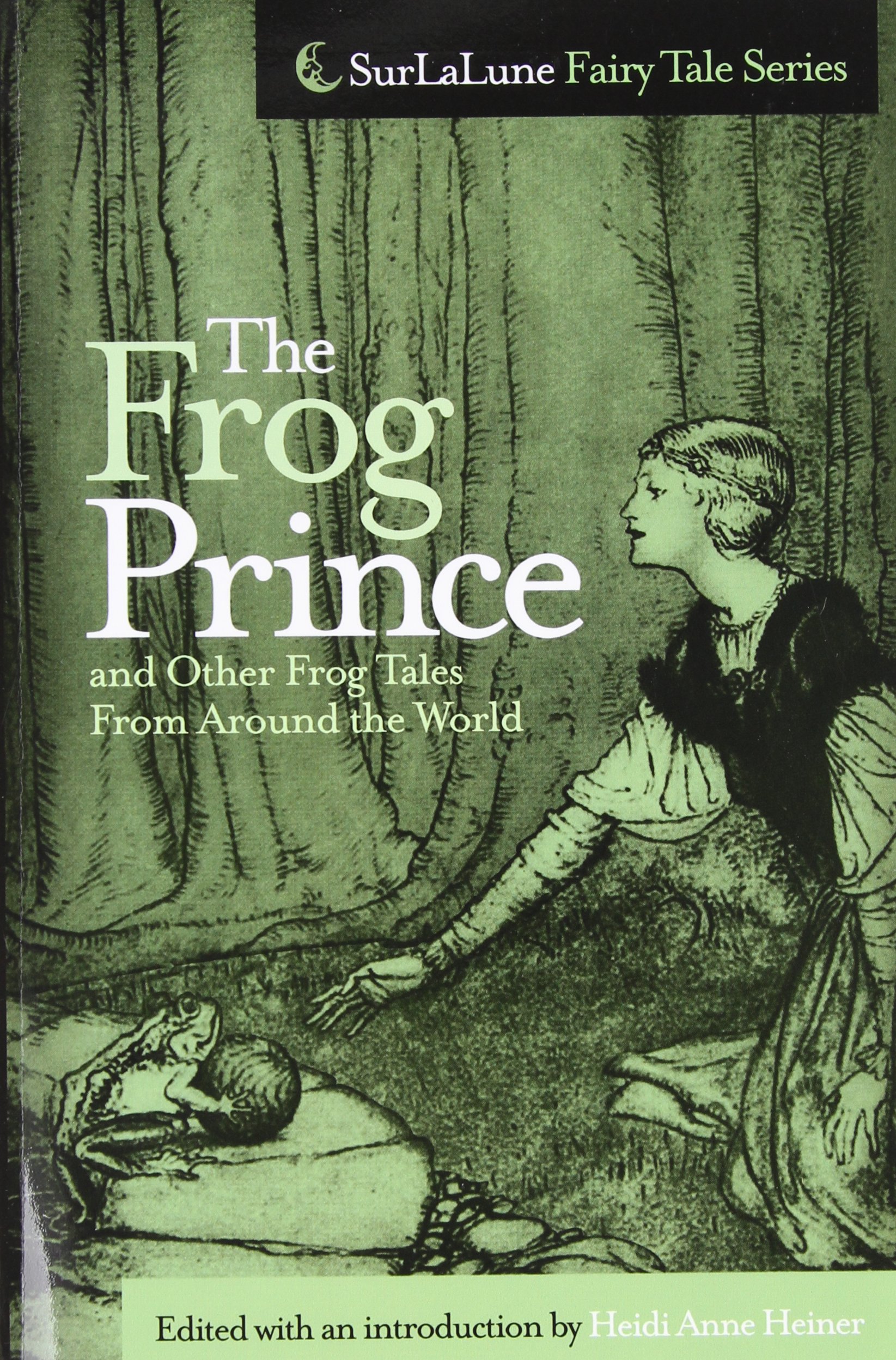
Found this very curious Sri Lankan version of the "Frog Prince" tale in Surlalune's The Frog Prince and Other Frog Tales From Around The World. And although it features a frog who turns into a prince, it's pretty different from our standard, Grimm version of the tale of the same name.

This frog prince was not enchanted or cursed to have a frog form, but was simply born as a frog to a poor widow. One day the King proclaimed that whoever brought him the Jeweled Golden Cock from the home of the Ogress Rakshasi should be given half the kingdom and an elephant's load of goods. His mother pounded rice for a living, and one day he strung some of the rice on a date tree, and became a handsome Prince. (One wonders why he hadn't already done this? And what correlation the action had to the consequence? The mysteries of the fairy tale world...)

From there the tale continues for a while like a typical hero tale-the Prince travels, is given magical gifts from several Kings to help him in times of trouble (a piece of charcoal that will turn into a fire-fence, a stone that becomes a mountain, and a thorn that creates a thorn fence). He arrives at the Rakshasi's home and is hidden and protected by the Rakshasi's daughter. She hides him in a trunk, tells the Ogress that the human flesh she smells must be from elsewhere, and the next day provides a distraction so the Prince can get away with the Jeweled Golden Cock. (The Rakshasi and her daughter seem similar to Baba Yaga, who also sometimes has daughters who tend to fill the same helper functions while Baba Yaga tries to eat the hero).


The ogresses begin to chase the hero, and he uses his magical objects to throw barriers in their way. The thorn fence and mountain don't seem to be too much trouble for him, but they are both burned in the fire (even the daughter who helped him! Although the narration does say she all of a sudden starts running towards him to eat him. I had sort of been hoping that the ogress' daughter would become beautiful and marry the Prince).

Then the ending is surprising and sudden. The frog returned to the string of rice that transformed him, ate the rice, and resumed his former frog form. "After he became a frog, the clothes that he was wearing, and the horse, and the Jeweled Golden Cock vanished. Out of grief on that account, that frog died at that very place."

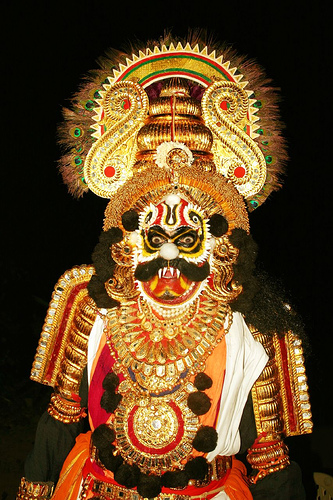
Rakshasa image from Wikipedia
Read the full tale on Surlalune

*Also: I've added the tag "unhappy endings" to this and several older posts. So if you want to find world folklore and/or versions of traditional tales with a tragic twist, they're easier to find in my archives now

Tuesday, May 26, 2015

The Maiden's Tower-Azerbaijan


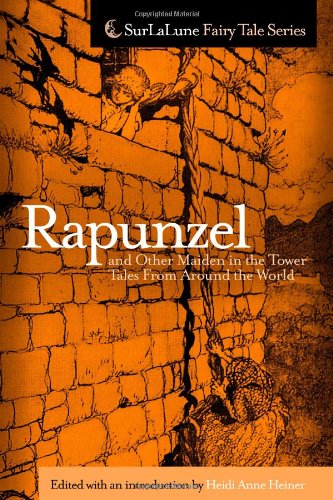
Although Rapunzel is a fairly popular tale, there aren't too many actual folktales that are considered "Rapunzel" tales. In Surlalune's collection, there are only 10 Rapunzel tales, followed by 37 more general "Maiden in the Tower" tales. These vary from folk tales to myths to legends, like this one from Azerbaijan. There is a Maiden Tower in Baku that inspired many tales, including this story, published in 1911 by Abraham Valentine Williams Jackson:
"A brutal old Khan fell in love with his own daughter. She naturally rejected his addresses, until, overwhelmed at last by his importunities, she promised to yield to his desire, provided that he would build her the loftiest tower in the land. On the day when the structure was completed, she flung herself headlong from the parapet into the sea, which at that time washed close to the wall."
The tower entrance

This story, as Heidi Anne Heiner points out, is like a tragic mix of Rapunzel and Donkeyskin. Although the wikipedia entry doesn't cite incest as one of the reasons for the maiden committing suicide from the tower, but a woman being forced to marry against her wishes. Either way, the legends all seem to agree that something horrible caused a young woman to use this tower to commit suicide; a darker alternative to the traditional Rapunzel tale. But when you consider what it must be like to be imprisoned, alone, inside a tower for who knows how many years, it makes sense that the young woman might decide to take more drastic measures.

Although this tale isn't considered a possible "origin" for the Rapunzel tale (it's clearly descendant from Basile's "Petrosinella" and Charlote-Rose de la Force's "Persinette") I love when fairy tale-like stories are linked to history. Europe is full of mysterious towers, many of which were really used as prisons, so it sparks the imagination...

Sunday, September 28, 2014

Fairy Tale Endings: Happy, Bittersweet, Tragic

Roland Risse

Fairy Tales are often criticized for being simplistic, and for providing unrealistic happy endings. Of course, when you begin to familiarize yourself with more fairy tales, you realize this simply isn't true in all cases; however, many of the most well-known fairy tales do end happily, and happy endings remain true to the "fairy tale formula."
John Batten, "Tattercoats"
Beloved stories like "Cinderella," "Jack and the "Beanstalk," "Sleeping Beauty," "Frog Prince," and so many more end in the most traditional way: usually a wedding, while the villain gets punished. Yet even among the favorites, there are exceptions. There are unhappy versions of Cinderella (see here and here), Andersen originally wanted his Little Mermaid to end with her death and had to adjust the story to please his editors, Perrault's "Little Red Riding Hood" is eaten at the end.

Yet still, fairy tales that have become popularized are predominantly happy.

Kay Nielsen

But the "happily ever after" stories aren't the only form of fairy tales. There's another category I would call "bittersweet." Although there is a form of resolution at the end, it isn't perfect; there is still some physical evidence of trauma left after the story is done. For example, in the tale Juniper Tree; while in the Grimms' version the bird is transformed back into a boy, in other versions, such as the English The Rose Tree or the Scottish "Pippety Pew", the child remains a bird. But they aren't completely tragic stories; the bird is a beautiful creature, who sings a song which reveals the truth, rewards the kind father and daughter, and kills the evil mother. There is still life after tragedy, but the life is different than it was before. There's a sort of comfort and realism in this fact-it's not an empty assurance that things will be fine, but hope that a horrible situation can be redeemed.
Eleanore Vere Boyle

Another fairy tale with a bittersweet ending is "The Wild Swans." The princess is united with the good King and her brothers transformed back into humans-all except the last one, who will forever remain with a wing for an arm; a reminder of their enchanted state, and the fact that curses will often have consequences. Andersen's "Little Match Girl" is another very sad tale in which the Match Girl dies, although the story makes it clear that her life is very unhappy, and in her visions she sees her Grandmother welcome her into Heaven, so even in that unfortunate tale, there is hope.
Anne Anderson

Then, there are the fairy tales that are completely tragic. You won't find these in collections of children's tales, but they abound in the collections of Schonwerth, the Grimms, and Andersen. Hans Christian Andersen just loves to feature helpless creatures with no control over their destiny; besides "Little Mermaid," which I mentioned before, "The Steadfast Tin Soldier" ends with him being burned in the furnace. Throughout the whole tale, he never makes a move or utters a word to help himself; I like to think Andersen was playing on the fact that, while he might have had feelings, at least in the eyes of the child who played with him, he was, ultimately, a toy; incapable of actually doing anything to defend himself.
Kay Nielsen

Along the same vein, a random little story of Andersen's called "The Money Pig" is about a toy piggy bank. After describing some of the games the toys played in the nursery, the money pig falls off the shelf, shatters, and his pieces are swept into the dustbin. The tale leaves you with no sense of purpose or hope.

Of all the tales I've ever read, I still think the creepiest is the Grimms' "How children played Butcher with each other." It's not just that there's a tragic death, which happens in other tales-but there's no villain or motive; it's just children being shockingly ignorant and cruel.

Many of the stories in Schonwerth's collection weren't meant as much to entertain, but to warn people about local superstitions. You might find stories about certain events which were interpreted as foretelling doom or death; warnings about how to recognize Drudes or witches, or stories such as "Death of a Woman in Childbed" in which a woman dared to comb her hair after giving birth, on a Sunday while everyone else was in church, and died because of her unbelief. Or this other, very short and sad tale, "Till Death..."

"A girl had committed herself to being eternally faithful to her beloved; he died serving in the war, and she began a new relationship. One night, her former beloved appeared on a white horse and took her away to his grave where she was found dead in the morning."


Edmund Dulac

I think there's a place and purpose for each kind of tale. Sometime we just need an escape: a happy, predictable tale to comfort or give us hope. Other times we want a little more realism, and sometimes we want send warnings, or just to be a little scared, which is a form of challenging ourselves/having fun with friends and giggling at ghost stories. It's unfortunate, though, that few people realize the spectrum of fairy tales that are out there; some people think fairy tales are too violent and old-fashioned and unsuitable entertainment for children; others think they're too simplistic and perfect, and not realistic enough. But whatever your preferences and purposes, there's always some fairy tale, in some version, that could be helpful.

Saturday, May 24, 2014

Schonwerth's Bavarian Folktales: Mermaids


I'm about halfway through this book and have yet to find more than a handful of stories that I would call "fairy tales" rather than legends, or parallels to familiar fairy tales. There was one story that started like Rumpelstiltskin, with a lazy daughter who didn't want to spin, but instead of being told to spin gold and helped by a funny looking little man, she was cursed to go spin in the Moon.

But I'm always fascinated by mermaid tales. And if there's anything we know about mermaid folklore, it's that these mermaids are entirely different than Hans Christian Andersen's suffering, lovesick young girl. Mermaids are dangerous and creepy, known to entice men to their lair below the surface, where the men often forget their families for a time. If they do return to land, they are often cursed, as are the offspring of men and mermaids.
Edmund Dulac

As far as origins, according to the beliefs of the people of Germany's Upper Palatinate, "The Mermaid was once a fair and beautiful princess, but also very cross and fitful, whereupon her own father cursed her and banished her to the sea where she would be able to do whatever she wanted. Thus she became half woman and half fish, living in the sea, where she announces through a very distinct song that a storm will occur in 24 hours."

Here's a shorter mermaid tale from the collection that gives you a good idea of what they are like. Apparently, the Mermaid in this tale demanded some sort of regular human sacrifice from sailors. Although this Mermaid shows mercy there is still a very dark side to interacting with sea maids:
Edmund Dulac

"A ship on the ocean had run out of corpses for the Mermaid, and it had to be decided by lot who among the crew should be sunk into the waters. A handsome young man drew the lot. But the Mermaid had mercy on him because his bride was already waiting for him with longing on the shore of the country nearby, and she carried him to the shore, and gave him as a present three little bags full of gold, silver, and pearls. In return, the bridal couple had to promise her the seventh child born to them.

When that child came into the world, the Mermaid appeared and took delivery of it; for she is allowed to assumed human form on every seventh day of the week; she comforted the grieving parents by assuring them that the little one would be treated well.

A long time had passed, when the oldest son, against his parents' will, chose a poor girl for his wife, and they cast him out. Thereupon the Mermaid reappeared, brought back the seventh child, who had grown up to become a handsome young man, and brought rich presents for the unhappy bridal couple, but once again, in return for their promise that the seventh child of the marriage would belong to her.
Gennady Spirin

To this day, the Mermaid is the kind and protective spirit for this family; when misfortune strikes, she comes to help; but always she has a child from the family circle with her in her palace of glass under the sea, and once this child has grown into a young man, she puts him back and takes another."

Thursday, September 5, 2013

The Two Princesses: An Unhappy Cinderella Variant

"A king has two daughters. The elder is wicked and ugly while the younger is beautiful and good. The elder daughter is beloved and lives with the king in the most gorgeous rooms of the palace. The heroine lives with the servants and shares their work.

A neighboring king arranges a festival to last several days. The elder daughter attends it with the father. The heroine is left in the kitchen. She sits crying in the twilight in her small room. Suddenly, a strange little man appears and offers to fulfill a wish for her. The heroine wishes to see the ball where the father and the sister are. She may go, she is told, on the condition that she returns before midnight.

The man vanishes, and the heroine stands in costly dress, wearing heavy gold chains and a crown of diamonds. At her door is a magnificent coach with four snow-white horses whose golden manes reach the ground. The heroine enters the coach and soon finds herself at the palace, admired by all, and unrecognized by her father and sister. As twelve o'clock strikes, she mounts the coach and is soon back in her shabby clothes in her dark room.

The next day the father and sister talk incessantly of the fair, unknown princess. In the evening they go to the festival, leaving the heroine hard at work. Seeing a red glare in the sky from the illuminated palace, the heroine longs to go. Immediately she is beautifully and magnificently dressed. This time her horses are yellow with jet-black plaited manes. At the ball she is admired and courted beyond measure. As the clock strikes midnight, she leaves in the midst of a dance.

On the third evening, a heavy gale blows. She wears a triple crown of sparkling diamonds. Her coach is drawn by eight flame-coloured horses with manes like shining gold. Everyone wants to dance with her. She stays beyond her given time and leaves in her black working dress, only to find outside, instead of a coach, an old wheelbarrow drawn by four small mice. She weeps bitterly over her forgetfulness and in the future passes her days as a common servant in her father's kitchen."

*Danish fairy tale, found in Surlalune's Cinderella Tales From Around the World
*Illustrations by Errol le Cain

Saturday, April 13, 2013

Hans Christian Andersen on women and vanity

Hans Christian Andersen is quite an interesting person. He is well known for several very sweet fairy tales, such as "The Ugly Duckling", "Princess and the Pea", and "The Emperor's New Clothes"-as well as some more sad and moving stories, such as "Little Mermaid" (most people are surprised to learn how different his story is from Disney's, although the same applies for pretty much any Disney fairy tale) and "The Little Match Girl".

Slightly less well-known is his tale "The Red Shoes" (which I've blogged about before), which speaks out very vehemently against girls who take too much pride in their appearance. I was surprised to read another lesser known tale recently that possibly speaks even more strongly against vanity, "The Girl Who Trod on a Loaf".
Jennie Harbor

Full text is available through the link above, but basically what happens is: a young girl named Inger is a terrible person who tortures insects for fun and refuses to visit her mother, who is in poverty ("she was pretty, and that was her misfortune"). Finally she allows herself to be convinced to go and visit her mother, and she is sent with loaves of bread to give to her. She comes across some mud, and so she doesn't ruin her shoes, she puts the bread on the ground to walk on them, and ends up sinking into the mud anyway and dying and going to hell.

She was found by a devil's grandmother and turned into a statue and put outside of the devil's house. To make sure we get the lesson, ""That's the fruit of wishing to keep one's feet neat and tidy," she said to herself. "Just look how they're all staring at me!" Yes, certainly, the eyes of all were fixed upon her, and their evil thoughts gleamed forth from their eyes, and they spoke to one another, moving their lips, from which no sound whatever came forth: they were very horrible to behold."
Oskar Klever

It goes on an on while Inger suffers as a statue and feels remorse as her earthly mother and mistress weep over her and she realizes she should have been punished. Finally her mother grows old and dies, and weeps for her child, and Inger is turned into a bird. Some children see the bird and it flies away. 
I figured there had to be something in Andersen's life to cause this near-hatred of vain women, or women he perceives to be vain (you could argue that not wanting to ruin your shoes is more practical than vain). A while back I had attempted to read Andersen's autobiography, which I found to be too long-winded and I got a vibe that he was very full of himself. But wikipedia has some interesting and pertinent information:
Ben Kutcher

"Andersen often fell in love with unattainable women and many of his stories are interpreted as references.[18] At one point, he wrote in his diary: "Almighty God, thee only have I; thou steerest my fate, I must give myself up to thee! Give me a livelihood! Give me a bride! My blood wants love, as my heart does!"[19] A girl named Riborg Voigt was the unrequited love of Andersen's youth. A small pouch containing a long letter from Riborg was found on Andersen's chest when he died, several decades after he first fell in love with her, and after he supposedly fell in love with others. Other disappointments in love included Sophie Ørsted, the daughter of the physicist Hans Christian Ørsted, and Louise Collin, the youngest daughter of his benefactor Jonas Collin. The most famous of these was the opera soprano Jenny Lind. One of his stories, The Nightingale, was a written expression of his passion for Lind, and became the inspiration for her nickname, the "Swedish Nightingale". Andersen was often shy around women and had extreme difficulty in proposing to Lind. When Lind was boarding a train to take her to an opera concert, Andersen gave Lind a letter of proposal. Her feelings towards him were not the same; she saw him as a brother, writing to him in 1844 "farewell... God bless and protect my brother is the sincere wish of his affectionate sister, Jenny."[20]
Just as with his interest in women, Andersen would become attracted to nonreciprocating men. For example, Andersen wrote to Edvard Collin:[21] "I languish for you as for a prettyCalabrian wench... my sentiments for you are those of a woman. The femininity of my nature and our friendship must remain a mystery." Collin, who preferred women, wrote in his own memoir: "I found myself unable to respond to this love, and this caused the author much suffering." Likewise, the infatuations of the author for the Danish dancer Harald Scharff[22] and Carl Alexander, the young hereditary duke of Saxe-Weimar-Eisenach,[23] did not result in any relationships."
Hans Christian Andersen

Being rejected by men and women, it's no wonder Andersen might have tried to find other ways to explain why no one was romantically interested in him-maybe he reasoned that if the women who rejected him were all vain and shallow, then it wasn't due to his own faults.

Maria Tatar discusses how Andersen's characters' sufferings differ from other fairy tales in that, while other villains are often forced to undergo grotesque punishments, Andersen seems to delight in making his heroines undergo all sorts of tortures. I don't mind it as much in some tales-to me "Little Match Girl" is like Dickens stories that expose the truth of how children in poverty suffer. But other heroines, like Karen from the Red Shoes, Inger, and even the little Mermaid, undergo extreme pains that are presented as just punishments for their actions.

Tatar quotes John Griffith, who points out that Anderson's main characters are "small, frail, more likely to be female than male-above all, delicate, an embodiment of that innocence which is harmlessness, that purity which is incapacity for lust."

Andersen is a complex man whose writings reveal interesting and sometimes disturbing insights into his mind. I feel like he's the type of person psychologists love to speculate about and write theses on.

Thursday, August 30, 2012

A Native American Cinderella

A Zuni Tale*

Long, long ago, before our ancestors had either sheep or horses, they had various domestic animals, including turkeys. In Matsaki, or the Salt City, there were many wealthy families who owned turkeys, and the slaves and poor people would herd them about. There lived a very poor girl, who was pretty of face but her clothes were tattered and dirty.

But like other poor people, she was humble and kind, and as she herded her turkeys about, she would speak kindly to them. They loved their mistress and were very obedient to her.

One day, as the poor girl drove her turkeys into the plains, she heard the priest proclaiming from the house-top that the Dance of the Sacred Bird would take place in four days. Since this girl was so poor, she had never been permitted to join or watch any of the great festivals, and longed to go. But she knew that, dressed as she was, she would never be able to go. She continued to drive on her turkeys, as she talked to them, never dreaming that they had any idea what she was saying.
Frederick Hall

Each day as the girl drove her turkeys out, she saw the other villagers preparing their garments and cooking and getting ready for the festival. On the fourth day, after the other people had all departed for the festival, one of the big turkeys strutted up to her, spread out his tail and wings, and said, "Maiden mother, we know what your thoughts are, and truly we pity you, and wish that...you might enjoy this holiday." He went on to say that they would help to dress her up prettily, so that all the young men would long to dance with her.

The girl was surprised, but it seemed so natural that her turkeys should be talking to her. She expressed joy that they could talk to each other, but asked how the turkeys could talk of things that were impossible. The turkeys assured her that, being humble, she deserved the happiness of going to the dance, but if she should forget her turkeys, it would prove that she deserved her hard life, because without her poverty she would be as unkind as the rich people were to her. She assured them she would be obedient to them as they were to her.

The turkeys instructed her to give them her articles of clothing, and as she did, one of them would come forward and step on it and peck at it, until it was transformed into beautiful clothes like those the people of the village wore. They also gave her jewelry and ornaments they had colleted for her.

Looking beautiful, the turkeys told her to go, but warned her to leave the wicket open in case she should forget about them, they could leave. She assured them she would remember them, and went to the festival. The people all wondered where the beautiful maiden came from, and she was not without a dancing partner. But in her enjoyment she did not think of her turkeys, but only wondered how she could leave such a place to go back to her turkeys, so she stayed until the dance was nearly over. Only then did she run back, but her turkeys had already left. She returned to the fold and found it empty. She went out in search of her turkeys, calling them, but her clothes returned to her former rags and she remained poor.

*This story is in a collection of Native American folktales, in the section "Tales Borrowed from Europeans"-so don't think that this story happened to originate independantly of our Cinderella with all of its parallels.
To the Perrault/Disney-weaned fairy tale fan, this may not seem to have much connection with Cinderella without the evil stepsisters or fairy godmother, but the animal helper is very common among Cinderella variants as her source of beautiful clothes. What makes this tale so unusual is the non-traditional unhappy ending. I don't like the hint that all poor people deserve to be poor, although it's a good reminder not to let wealth and priviledge curb your compassion-but after reading so many other Cinderella stories I find the ending kind of humorous.

And I am by no means an expert on Native American culture, or the Zuni tribe, but from what I've always understood, Native Americans never had class distinctions, so I wonder if that's purely European influence? Feel free to correct me if I'm wrong in the comments
EDIT: Rosie in the comments has corrected me! Click through to read more about the Zuni culture and how the story reflects it

Friday, October 21, 2011

How children played butcher with each other

The Annotated Brothers Grimm by Maria Tatar has an Adult Tales section in the back, which is intruiguing, especially considering that morbid tales such as The Robber Bridegroom, Fitcher's Bird, and the Juniper Tree are in the regular section. The tales in the adult section aren't necessarily more violent than the above tales, but either racist ("The Jew in the Brambles") or violent in such a way that is condoned because it's a cautionary tale, but such that goes to extremes.

This was actually quite typical for Victorian children's stories, as can be evidenced by Struwwelpeter-a collection of German tales featuring children who suffer drastically for their mistakes, including: a girl who plays with matches and is burned to death, a boy whose thumb sucking results in his thumbs being cut off by giant scissors, a boy who goes outside during the storm and is carried off by the wind, "presumably to his doom"...you get the idea. Struwwelpeter himself is the cautionary tale about the importance of good grooming, the consequences of which are pretty severe, according to this picture on the left.


So maybe it's not just the violence that makes this tale disturbing, but the matter of fact way it's told:

"A man once slaughtered a pig while his children were looking on. When they started playing in the afternoon, one child said to the other: "You be the little pig, and I'll be the butcher," whereupon he took an open blade and thrust it into his brother's neck. Their mother, who was upstairs in a room bathing the youngest child in a tub, heard the cries of her other child, quickly ran downstairs, and when she saw what had happened, drew the knife out of the child's neck, and in a rage, thrust it into the heart of the child who had been the butcher. She then rushed back to the house to see what her other child was doing in the tub, but in the meantime it had drowned in the bath. The woman was so horrified that she fell into a state of utter despair, refused to be consoled by the servants, and hanged herself. When her husband returned home from the fields and saw this, he was so distraught that he died shortly thereafter."


According to Tatar's notes, the Grimms got complaints that this tale was violent and defended it because of its valuable lesson, Wilhelm saying, "My mother used to tell the story about the butchering when I was young, and it made me careful and apprehensive about child's play." Despite this reasoning, the tale didn't make it to later editions of Children and Household Tales.

I have lots of experience watching children play, and I think they have a pretty good sense that their play is not real, and they use imagination and not literal imitations even when copying adult behavior. Yet the concept of the potential for children to be cruel to each other mixed with their ignorance does make this a chilling tale that could possibly be made into a horror film...I'd watch that, if it was made well.


There is another version of this tale also found in Grimms that reads more like a news story-more specific, including the town name and ages of the children, and at the end the child in question is asked to choose between an apple and a coin, and as he chooses an apple, he is deemed innocent. It seems almost more upsetting to let the child get off scot free for murder simply because he didn't know any better. This article by Donald Haase has an interesting interpretation I hadn't considered-some fairy tales were not meant for children but may express adults' fears about parenting and raising children. The choice of apple verses coin represents the division between concrete and abstract thinking-something I understand as a teacher of students with developtmental disabilities who, in general, never go on to abstract thinking. The article discusses other aspects of this tale and is very interesting reading, so I recommend clicking through.

Tuesday, October 26, 2010

Swan Lake Origins-or lack thereof

Swan Lake is a hard story to track down the origins of. Most internet searches lead to Wikipedia, which gives the two most likely origins-the most likely source appears to be "The Stolen Veil," collected German stories by Johann Karl August Musaus, although I can't find text for it online. The other story alluded to is the Russian "The White Duck," (also in Andrew Lang's Yellow Fairy Book) although it has very little in common with Swan Lake. I think far more likely are the many tales from around the world of Selkies (or swans or seals) who shed their skins to become women, or perhaps other European tales where a band of brothers is turned into ravens or swans and their sister has to save them.
For anyone interested in reading on the possible origins of the ballet story, this has some good reading. No matter what the speculated origins, it points out that Tchaikovsky himself had a bit of influence on the ballet story, making it truly unique and not primarily a folk tale.

Surlalune has a Swan Maiden tale. The site is not yet annotated and doesn't include history currently, but this particular tale has a very interesting twist on the story-it has a more typical Swan Maiden beginning, where the man steals the dress of the maiden while she is bathing and won't give it back, insisting she become his wife. She goes with him unwillingly, although these tales always have them happily married after this rather unlikely beginning, which irritates me. As always, the maiden escapes when she has a chance-but then the fairy tale turns into East of Sun, West of the Moon, only with the male doing the searching instead of the woman. Once again, the running away part would imply that she doesn't WANT to be his wife, but once he finds her at the end she goes back with him and they live happily ever after (they must have a REALLY good marriage counselor.)
Speaking of gender role reversals-off of Surlalune you can read more versions on the web. One of Ashliman's collected tales is a German tale, "The Three Swans" (you have to scroll down past a couple other versions to get to it). In the tales about brothers turned into birds I mentioned before, the heroine saves them through a mix of silence and making shirts for them out of painful nettles. Naturally women get all up in arms because this could imply that the ideal female is silent, but in this version the male has to get the female back with suffering and silence! Although, the females who suffer from silence do so for a lot longer...

One more issue that comes up when telling this tale to children is the issue of the happy vs. sad ending. It's a controversial topic that comes up often in fairy tale conversations-which versions should we tell children? The most authentic, most "adult" versions? The Victorian, somewhat authentic, sometimes very morbid versions? Or the modern children's versions that fit our ideals of "child appropriate," which are not authentic at all?

There are those who adamantly claim that children should not be spoon-fed idealized and unrealistically happy stories, yet I wonder if they have ever actually looked a child in the face and told them all the gory details of an old fairy tale, or that the Prince and Odette die at the end of Swan Lake. It's simply different when you have an actual child in front of you. Keeping in mind, of course, that each child is different and has different tolerance levels. But speaking on the teacher side of things-parents get reeeally uptight about what you teach their children. Some of it is understandable and some of it is not (a fellow teacher once got a passive agressive letter starting, "Dear lady, I hear you have been telling kids I don't exist..." and signed "Santa Claus" because she taught a lesson to fourth graders about the history of Santa Claus. My mom has had to stop showing certain movie versions of stories because parents report that it gave their children nightmares.) Basically, when other people's children are in your care, it pays to be extra careful.

I solve the problem of the Swan Lake ending by asking, "Do you want the happy ending or the sad ending?" when telling it to students/children. No one has ever asked for just the sad ending-they either ask for both, or the happy one. Some storybooks, or maybe even ballet productions, have a true love conquers all ending, so it's not entirely made up by me.

Images-Finnish National Ballet, picture by Neil McCartney; Kiev Classical Ballet; Mariinsky Ballet

Saturday, May 8, 2010

The Steadfast Tin Soldier

Hans Christian Andersen's "Steadfast Tin Soldier" gained fame through Disney's Fantasia 2000, set to Shostakovich's 2nd piano concerto.


With Disney, you can expect at least something to be changed from the original source. While the journey through the sewer and all the dangers entailed may seem like movie makers trying to beef up the story a bit to make it more enticing, that's actually all from the fairy tale. In fact, the short follows the story pretty closely until the very end, in which the evil jack-in-the-box (which is really a goblin who lives in a snuff box) does not fall out of the window, and the soldier and the ballerina do not live in perfect bliss. No, true to Disney style, Andersen's more tragic endings have been covered up. In the real story, the child puts the soldier in the oven, for no reason, and the ballerina is carried in as well. The tin soldier burns and melts into a heart, and all that's left of the ballerina is her tinsel rose.

Emily Forgot


Now, backing up-I adore this fairy tale. The reader's heart immediately goes out to the one-legged tin soldier. I love anything that relates to Beauty and the Beast, and there are two levels-there are actual versions of the tale, that involve most of the plot and prop elements, such as the father and the rose and Beauty staying at the castle of the Beast. Then there's a broader level, where any story in which there is an outcast character because of some physical deformity or difference is also distantly related to Beauty and the Beast. So in that way, the Steadfast Tin Soldier is like a Beast figure. He also would like to marry the ballerina, but "she is too grand."


I also love any story in which toys come to life. Everyone knows that this happens when people leave the room, and we have proof from The Christmas Toy and Toy Story. And yet, though the whole thing is from the perspective of the Tin Soldier, there's an eerie juxtaposition between him as a tin toy and him as a thinking being. The whole time, he comes up with reasons for why he doesn't cry out for help (he's too proud as a soldier) or speak to the rat in the sewer, etc. Critics relate this to Andersen's passivity, but you wonder if it's really because, as a toy soldier, he simply can't move, though he thinks he can. The only action he instigates is laying himself down to get a better look at the dancer, but that could possibly be that the soldier was knocked over. It adds to the helplessness of the characters and the pointlessness of the unhappy ending, yet leaving the reader freedom to imagine either circumstance.

Mayken Gonzalez Backlund


The story almost needs the depressing ending to justify the miraculous return of the soldier from the belly of the fish, to the very playroom from which he started. The ending at least gives it more realism, and the shape of the heart and the rose left make it bittersweet and tragically beautiful. Critics seem to view the ballerina as being punished for not returning the soldier's love, but it seemed to me that maybe the wind blowing her into the oven was maybe so that they could die together rather than having her live alone without him. Maybe I'm hopelessly romantic, but she does leave a rose behind, which is very symbolic of love.


This morbid image by Kay Nielsen is my favorite
One more thing-this type of tale, in which the protagonist is a toy or animal, is part of a tradition of insinuating that the ultimate villain is one who is MEAN TO THEIR TOYS or wouldn't go to any length for the sake of a pet. Now I love animals and toys, and I think we should be kind to animals and it's probably a red flag if a young child doesn't show some level of affection for toys that resemble humans and animals, so I don't really mind. But this level of thought reached new levels in the movie The Brave Little Toaster, in which the protagonists are all household appliances. This movie freaked me out when I was little, and it's even pretty horrifying to me now. It's incredible how they make a man who recycles used appliances into evil personified, and how the boy almost dies in an attempt to rescue his childhood toaster. Going back and rewatching this movie made me think about how I perceived it as a child-I only remembered the scary parts, I didn't remember any of the resolutions. I think there's a lot that goes into how a child perceives a story and it's often much different than the intended message-but that's a whole other topic.