Showing posts with label Dickens. Show all posts

Saturday, October 11, 2014

Fairy Tales and Fear

An anonymous commenter recently wrote in response to my post on Fairy Tale Endings that people tend to forget, when criticizing fairy tales for being dark and violent, how dark much of classic children's literature is. And it's true-maybe not picture books on the whole, but I remember having a conversation with a friend years ago about how many children fantasize about being orphans. We see this trend in children's literature, as many childhood heroes are indeed orphans-from Hansel and Gretel in their parents' attempts to abandon them in the woods, to well-loved characters such as the Boxcar children, Mary of "The Secret Garden", or the children who enter Narnia (again not technically orphaned, but separated from their parents and I don't think any reference is ever made to their parents except to explain them away at the beginning of the books).
"Hansel and Gretel", John B. Gruelle

Partly, getting rid of parents is the only way to create a child-centered world; a realistic book about children would be pretty limited if they had to ask their parents for permission before going on spectacular adventures. Through orphaned characters, or characters whose parental figures are the enemy, the children can achieve independence and become the central figures of the story, moving the action along instead of responding to a world where all of their actions are dictated by parents and school teachers.
Dark Chamber of [Snow White's] Evil Queen, Tours Departing Daily

Fairy tales deal with our primal fears, such as abandonment, or being prey to wild creatures. G. K. Chesterton defended the scarier elements of fairy tales by saying, "All this kind of talk [of keeping fairy tales away from children] is based on that complete forgetting of what a child is like...if you kept bogies and goblins away from children they would make them up for themselves...One small child can imagine monsters too big and black to get into any picture, and give them names too unearthly and cacophonous to have occurred in the cries of any lunatic...fairy tales do not tell children the dragons exist. Children already know that dragons exist. Fairy tales tell children the dragons can be killed."

Well known authors have reflected on their remembrances of fairy tales in childhood-Samuel Taylor Coleridge remembered reading is father's copy of Arabian Nights over and over again, and how he looked at the book "with a strange mixture of obscure dread and intense desire." Charles Dickens recalled being terrified by his nurse's tales, yet returned to those same tales by alluding to them repeatedly in his works.

Michael Kotzin discusses Dicken's use of fairy tales in his essay, "Charles Dickens and the Fairy Tale as Social Commentary." He says that, in childhood, Dickens recognized the dual aspect of fairy tales-fun and terrifying-and reused those same ideas in his adult writings as he discovered that the real world was the same way. He saw horrors that were the natural, unavoidable way of things-disease and natural disaster-but also horrors that were inflicted by people, or society in general, and used fairy tales satirically to criticize political beliefs or groups of people.

Dickens used fairy tale images to make the ordinary extraordinary-in writing a personal letter about the beauty of the buildings in Paris, he tells a friend that "the Genius of the Lamp is always building Palaces in the night." Using fairy tales as a common frame of reference, his works can have a childlike wonder to them. But though he used fairy tales in fun, he also used them in serious ways at times, in making social commentary. He saw in fairy tales the potential to connect with real world scenarios. He "drew upon fairy tale motifs, narrative patterns, and fairy tale-type characters and settings to help people sense romance in the everyday world and grasp the need for moral improvement. His popularity then and now owes some legacy to the magic and mystery of the traditional fairy tale." (Remember, Dickens is the one who is often quoted as having wanted to marry Little Red Riding Hood as a child.)
William Christian Symons

But of course, you can go too far; you shouldn't push violent and gory stories at very young children. It's one thing for an academic to argue about the value of preserving folklore the way it originally was, and another thing for a parent to be awakened by a child who had a nightmare because of a story they read before bedtime.

But at the same time, fairy tales are wonderful because they provide us with different ends of the spectrum-the terror of tapping into our fears, but the wonder and enchantment of the supernatural, and the possibility of happy endings.

What are your recollections of reading/watching fairy tales as a child, in terms of how scared you were?

Wednesday, November 20, 2013

Dickens and Bluebeard

Dickens is loved by fairy tale enthusiasts; the fact that he was enamored with Little Red Riding Hood as a child is fairly well known. He also claimed that "it is a matter of grave importance that fairy tales should be respected" and in general advocated for the genre. Yet he also claimed that fairy tales should not be altered from their "original form." Anyone who has studied fairy tales will know there's really no such thing as an "original" version of any tale, and probably most of us also agree there are good reasons to adapt fairy tales to changing cultures. Yet we may understand the same frustration when fairy tales are interpreted in a way we don't think does them justice, or when fairy tale variants become so prevalent the older versions get lost and fewer and fewer people are familiar with a tale's history. Dickens claimed, "With seven Blue Beards in the field, each coming at a gallop from his own platform mounted on a foaming hobby, a generation or two hence would not know which was which, and the great original Blue Beard would be confounded with counterfeits."

Dickens referred to Bluebeard in five of his novels, including Pickwick Papers, Bleak House, and Hard Times, and his journalism. In his The Uncommercial Traveller of 1860, in the essay "Nurse's Stories," Dickens recalls being told the tale of Captain Murderer, a variation of Bluebeard. The story is of the eponymous Captain who, when courting a woman, always asked if she could bake a pie crust, and instructed those who couldn't how to do so. A month after the wedding, he gave her a golden rolling pin and silver pie board, and butter and eggs and everything she needed, except for the pie filling. When his bride would ask why she saw no meat, he would reply, "look in the glass." She would then look up just in time to see her head cut off. Finally one bride, whose twin sister had already fallen victim to Captain Murderer, gained revenge by taking poison before she was killed. When the cannibalistic Captain eats the last pie, he turns blue and spotty and explodes.
Often adults debate as to how harmful it is to tell violent stories to children. Dickens would have landed on the Keep Violence Far From Children side:

"Hundreds of times did I hear this legend of Captain Murderer, in my early youth, and added hundreds of times was there a mental compulsion upon me in bed, to peep in at his window as the dark twin peeped, and to revisit his horrible house, and look at him in his blue and spotty and screaming stage, as he reached from floor to ceiling and from wall to wall. The young woman who brought me acquainted with Captain Murderer had a fiendish enjoyment of my terrors, and used to begin, I remember-as a sort of introductory overture-by clawing the air with both hands, and uttering a long low hollow groan. So acutely did I suffer from this ceremony in combination with this infernal Captain that I sometimes used to plead I thought I was hardly strong enough and old enough to hear the story again just yet. But, she never spared me one word of it...Her name was Mercy, though she had none on me."
Source: Bluebeard: A Reader's Guide to the English Translation by Casie E. Hermansson
Illustrations of Captain Murderer by Rowan Barnes-Murphy

Friday, February 3, 2012

Fairy tales in English literature

In her introduction to "The Classic Fairy Tales," Maria Tatar highlights authors that have been influenced by fairy tales, which then affects their work. Yet there are two different approaches to doing this, as illustrated by Dickens, verses Charlotte Bronte in Jane Eyre.

Dickens was enamored with fairy tales, and embraced all the traditional thought values of his time about them. "Like the Grimms, Dickens hailed the 'simplicity,' 'purity,' and 'innocent extravagance' of fairy tales, yet also praised the tales as powerful instruments of constructive socialization: 'It would be hard to estimate the amount of gentleness and mercy that has made its way among us through these slight channels. Forebearance, courtesy, consideration for the poor and the aged, kind treatment of animals, the love of nature, abhorrance of tyranny and brute force-many such good things have been first nourished in the child's heart by this powerful aid.'"

All of the above are wonderful qualities and I'm pretty sure I've been inspired to demonstrate the characteristics listed above because of reading fairy tales-however, fairy tales may also encourage other negative stereotypes Dickens didn't mention but that were prevalent in the Victorian age.

But this is no reason to throw out fairy tales altogether, or let the negative parts in their history take away from the positive. Charlotte Bronte took fairy tale themes, yet altered the outcomes-her character Jane did not react to her situations as the most passive versions of her fairy tale predecessors did.

In the opening of Jane Eyre, she is mistreated by her stepmother and stepsisters, mocked and made to do menail tasks-much like Cinderella. Though Jane does go through a stage of self pity, which is only natural, she finds the courage to eventually confront her aunt. Rather than accepting her fate, she "rebels against the social reflexes of her world and writes herself out of the script."

In Rochester's house, Jane finds herself in another fairy tale world-the book references Bluebeard's castle, and the house does contain a secret room with a dark secret (SPOILER ALERT: though not a collection of corpses, it does contain a wife). Though Jane loves Rochester, she cannot marry a man who is already married, even if his first wife is mentally insane. Jane's life is not defined by sitting and waiting for a man to come and save her with his love-she leaves him and starts a new life, unlike fairy tale princesses who marry the first prince who comes their way. As I've pointed out before, Jane Eyre also has some allusions to Beauty and the Beast.

Saturday, December 3, 2011

Storytelling at Christmastime

"There'll be scary ghost stories and tales of the glories of Christmases long, long ago"-so goes the lyrics to a part of "The Most Wonderful Time of the Year," a popular Christmas song being played on the radio and in businesses now. I had never really noticed these words before and thought of them as odd. I don't usually associate Christmas with telling ghost stories-in fact, Christmas stories are notorious fpr being especially cheesy.

But as we've seen with fairy tales, often dark and disturbing tales have, over time, been turned into cutesy, "child appropriate" stories which are hardly anything like their ancestors. A lot of things tend to go this direction-that which is truly terrifying loses its power and becomes tamed; vampires, pirates, why not Christmas traditions as well? After all, one of the most popular Christmas stories of all times, Dickens' "A Christmas Carol," features four ghosts-but we now know the happy resolution so well the ghosts don't tend to phase us much.

John Leech

Maybe this year we should tell a few scary stories to balance out the feel good holiday stories we're bound to hear as well (not that feel good holiday stories don't have their place...)

Monday, September 12, 2011

More on Dickens and the Fairy Tale


I found some more on Dickens' use of the fairy tale:


"Dickens himself tended to incorporate fairy-tale motifs and plots primarily in his novels and particularly in his Christmas Books (1843-5). It is almost as though he did not want to tarnish the childlike innocence of the tales that he read as a young boy-tales which incidentally filled him with hope during his difficult childhood-by replacing them with new ones. But Dickens did use the fairy tale to make political and social statements, as in Prince Bull (1855) and The Thousand and One Humbugs (1855), and his regressive longings for the innocent bliss of fairyland are mad most evident in his essay A Christmas Tree (1850)...


"What was to be was Dickens' adult quest for fairy bliss in his novels, and it is not by chance that one of the last works he wrote toward the end of his life was "The Magic Fishbone" (1868)...Here Dickens parodied a helpless king as a salaried worker, who is accustomed to understanding everything with his reason. He becomes totally confused by the actions of his daughter Alicia, who receives a magic fishbone from a strange and brazen fairy named Grandmarina. Alicia does not use the fishbone when one would expect her to. Only when the king reveals to her that he can no longer provide for the family does Alicia make use of the magic fishbone. Suddenly Grandmarina arrives to bring about a comical ending in which the most preposterous changes occur. Nothing can be grasped through logic, and this is exactly Dickens' point: his droll tale-narrated from the viewpoint of a child-depends on the unusual deployment of fairy-tale motifs to question the conventional standards of society and to demonstrate that there is strength and soundness in the creativity of the younhg. The patriarchal figure of authority is at a loss to rule and provide, and the reversal of circumstances points to a need for change in social relations. The realm of genuine happiness that is glimpsed at the end of Dickens' fairy tale is a wish-fulfillment that he himself shared with many Victorians who were dissatisfied with social conditions in English society."

-Jack Zipes, from his introduction to Victorian Fairy Tales: The Revolt of the Fairies and Elves

Friday, April 8, 2011

Dickens and the use of Fairy Tales

I'm a fan of Dickens. Girls are all supposed to be in love with Jane Austen; I don't mind her books but would rather be reading Dickens or the Bronte sisters. Jane Austen has nice romances-the latter authors set out to expose problems in society, like lack of rights for children/the poor (Dickens) or women (Brontes). Dickens clearly loved fairy tales-he loved them as a child and his books are full of references to them. I did a little online research to see if I could learn more about this connection. There is a book on the subject-"Social Dreaming: Dickens and the Use of Fairy Tales," by Elaine Ostry. The publisher's review: "Dickens was known for his incredible imagination and fiery social protest. In "Social Dreaming," Elaine Ostry examines how these two qualities are linked through Dickens's use of the fairy tale, a genre that infuses his work. To many Victorians, the fairy tale was not childish: it promoted the imagination and fancy in a materialistic, utilitarian world. It was a way of criticizing society so that everyone could understand. Like Charles Perrault and the Brothers Grimm, Dickens used the fairy tale to promote his ideology. In this first book length study of Dickens's use of the fairy tale as a social tool, Elaine Ostry applies exciting new criticism by Jack Zipes and Maria Tatar, among others, that examines the fairy tale in a socio-historical light to Dickens's major works but also his periodicals-the most popular middle-class publications in Victorian times." Unfortunately this book isn't available in my local libraries, so I don't know when or if I'll get the chance to read it. But one of my favorite fairy tale blogs, LitScribbles, has an interesting post on the "friendship" between Dickens and Hans Christian Andersen. Basically, Andersen was annoying and insecure and overstayed his welcome once with Dickens. And, to close with, this quote from wikipedia's fairy tale page: " The moralizing strain in the Victorian era altered the classical tales to teach lessons, as when George Cruikshank rewrote Cinderella in 1854 to contain temperance themes. His acquaintance Charles Dickens protested, "In an utilitarian age, of all other times, it is a matter of grave importance that fairy tales should be respected." I'm reading "David Copperfield" right now. In addition to the obvious references to certain fairy tales, the whole issue of Oedipal relationships jumped out at me. In fairy tales, it is very rare to find positive same-sex familial relationships, but it's common to find positive brother/sister or father/daughter relationships. David Copperfield has a dead, good father, a good but passive mother, and an evil stepfather-like a gender-reversed (Grimm version of) Cinderella. He later lives with his aunt, who could be seen as a fairy godmother figure, and gets along really well with his (female) nurse. The main female characters in the book so far (Dora and Agnes) live with their fathers but not their mothers, and one of Agnes' best features is that she is devoted to her father (much like Beauty). Uriah Heep lives with his mother, and they get along pretty well. I wonder how much of this was influenced by the fairy tales Dickens grew up with (or how much is me reading into things too much). This is really opening up a whole other can of worms to start talking about Freudian relationships found in all of literature, not just fairy tales-a subject on which I am much less qualified to discuss. If anyone knows of any good online articles about the connection between Dickens and fairy tales, I'd love a link! Image from here

Friday, December 24, 2010

Charles Dickens-A Christmas Tree


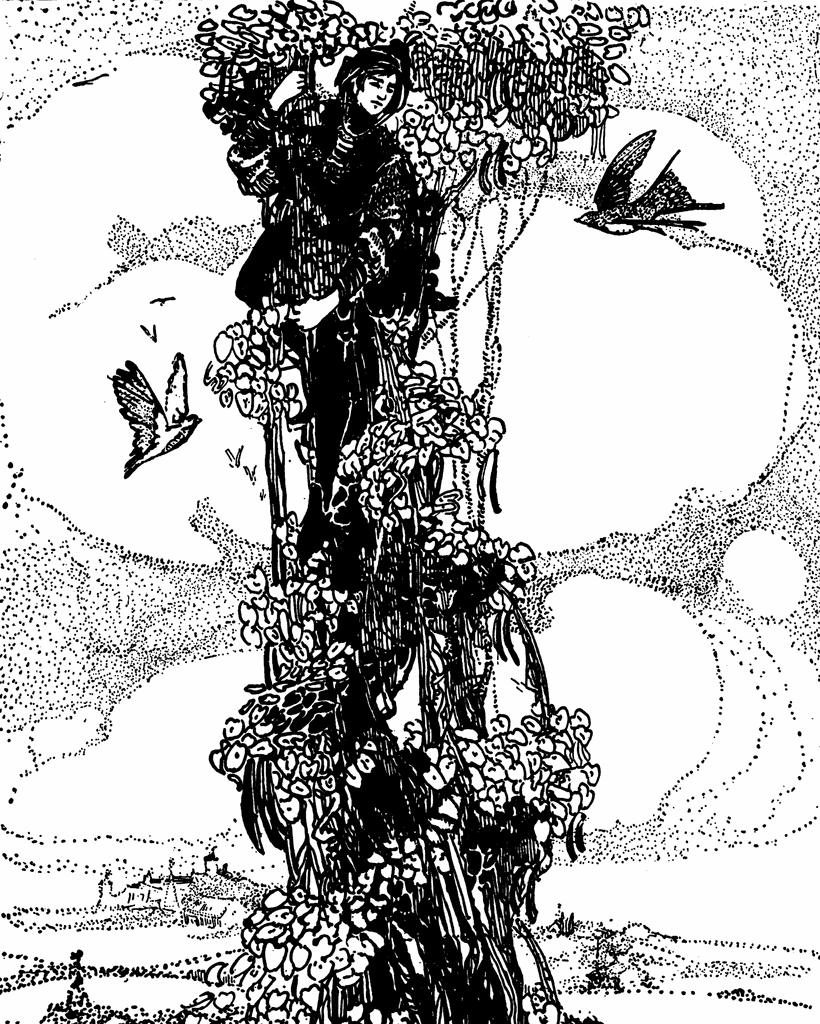
"But, now, the very tree itself changes, and becomes a bean-stalk--the marvellous bean-stalk up which Jack climbed to the Giant's house! And now, those dreadfully interesting, double-headed giants, with their clubs over their shoulders, begin to stride along the boughs in a perfect throng, dragging knights and ladies home for dinner by the hair of thei heads. And Jack-how noble, with his sword of sharpness, and his shoes of swiftness! Again those old meditations come upong me as I gaze up at him; and I debate within myself whether there was more than one Jack (which I am loathe to believe possible), or only one genuine original admirable Jack, who achieved all the recorded exploits.
"Good for Christmas-time is the ruddy colour of the cloak, in which-the tree making a forest of itself for her to trip through, with her basket-Little Red Riding-Hood comes to me one Christmas Eve to give me information of the cruelty and treachery of that dissembling Wolf who ate her grandmother, without making any impression on his appetite, and then ate her, after making that ferocious joke about his teeth. She was my first love. I felt that if I could have married Little Red Riding-Hood, I should have known perfect bliss. But, it was not to be...

"Hush! Again a forest, and somebody up in a tree--not Robin Hood, not Valentine, not the Yellow Dwarf...but an Eastern King with a glittering scimitar and turban. By Allah! two Eastern Kings, for I see another, looking over his shoulder! Down upon the grass, at the tree's foot, lies the full length of a coal-black Giant, stretched asleep, with his head in a lady's lap; and near them is a glass box, fastened with four locks of shining steel, in which he keeps the lady prisoner when he is awake, I see the four keys at his girdle now. The lady makes signs to the two kings in the tree, who softly descend. It is the setting-in of the bright Arabian Nights.
"Oh, now all common things become uncommon and enchanted to me. All lamps are wonderful; all rings are talismans. Common flower-pots are full of treasure, with a little earth scattered on top; trees are for Ali Baba to hide in; beef-steaks are to throw down into the Valley of Diamonds...Any iron ring let into stone is the entrance to a cave which only waits for the magician...all apples are akin to the apple purchased from the Sultan's garden...
"Yes, on every object that I recognise among those upper branches of my Christmas Tree, I see this fairy light! When I wake in bed, at daybreak, on the cold, dark, winter mornings, the white snow dimly beheld, outside, through the frost on the window-pane, I hear Dinarzade. 'Sister, sister, if you are yet awake, I pray you finish the history of the Young King of the Black Islands.' Scheherezade replies, 'If my lord the Sultan will suffer me to live another day, sister, I will not only finish that, but tell you a more wonderful story yet.' Then, the gracious Sultan goes out, giving no orders for execution, and we all three breathe again."

Texts taken from "A Christmas Tree" by Charles Dickens, a delightful piece in which he recalls childhood memories that come to mind in the presence of his Christmas tree. People love to quote the line where Dickens claimed he thought he should have known perfect bliss if he married Little Red Riding Hood, so here is a bit more of the context, which includes other fairy tale references as well. To those of you that celebrate-Merry Christmas!

Images: here, Charles H. Sylvester, llamdorada, Virginia Frances Sterrett, Illustrated London News "Christmas at Windsor Castle" (1848),

Saturday, April 17, 2010

Little Red Riding Hood as Sun Myth


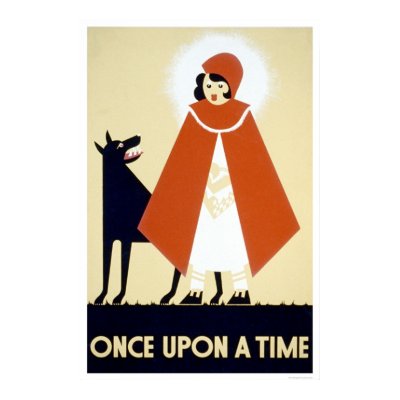
Kenneth Whitley poster

Little Red Riding Hood tends to be over-analyzed, in my opinion. Every branch of folkloric thought believes it has the correct symbolic meaning. Any psychoanalist will tell you the red cloak is OBVIOUSLY blood from menstration and the wolf is OBVIOUSLY a sexual predator. Henry Bett, on the other hand, claims with certainty that Little Red is a myth of sunset and sunrise. Generally sun myths can be applied to anything because anything good is the sun, anything bad is the night. The ultimate triumph of good over evil is the dawn triumphing over night. Congratulations, you have an interpretation for 99% of human stories.

Image by Paul Woodroffe

Yet, after a conclusion that might seem oversimplified, Bett goes on to cite many myths and legends from around the world that are directly related to the moon and sun and have parallels to Little Red-either connecting the color red/red coverings with the sun, or wolves with the night. Even one Melanesian myth where the hero takes a piece of red obsidian and cuts Dawn out of the belly of night. Personally, I can see a red hood as the rising sun more easily than menstration. This would all make a lot more sense if the red cap/hood wasn't added till Perrault's version. But anyone who claims any myth or tale has one specific origin or meaning is making one heck of a claim. Betts himself admits earlier, when critiquing those who interpreted everything as a sun myth, that "It seems to be the fate of every theory in folk-lore to be made ridiculous by being pressed too far." Modern interpretations don't really pay any attention to this sun myth idea and attribute everything to sexual meaning.

Image by Annie Rodriguez

Yet the complex influences of culture and history that created the fairy tales we know today are all fascinating to contemplate. It's true that Little Red has a hold on the imagination-it's one of the few tales that every child knows yet has not been marketed by Disney, with Hansel and Gretel also up there holding it on their own. Folklorists love to quote Dickens when he, reminiscing on his childhood, recalled how he believed that if he should have been married to Little Red Riding Hood, he should have known perfect bliss.