Showing posts with label Snow White. Show all posts

Monday, October 16, 2017

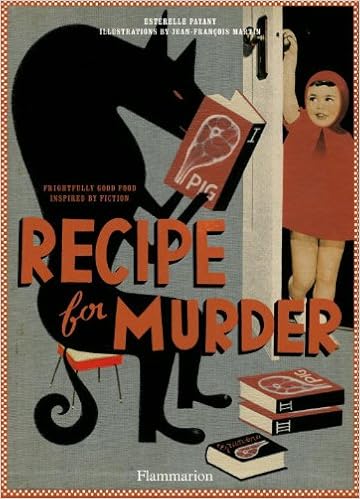
Recipe For Murder

Usually a fairy tale cookbook is a fun way to get kids to experience fairy tales with multiple learning styles, but this cookbook is clearly aimed for more mature audiences. Recipe for Murder: Frightfully Good Food Inspired by Fiction, by Esterelle Payany and illustrations by Jean-Francois Martin, features recipes inspired by morbid parts of literature, not just fairy tales. It features a recipe for Pigs in a Blanket inspired by "Three Little Pigs" and of course, the poisoned apple from Snow White.


Friday, July 14, 2017

Around the Web

Really enjoyed this post on Visualizing Wonder by Heidi Grether, What Are You So Afraid Of? A Rapunzel Analysis. Grether shares that Rapunzel is underrepresented in television compared to other household name Princesses, yet explains how the fairy tale can be very powerful and symbolic even to modern audiences. I've never thought about how the tower can represent fear before.
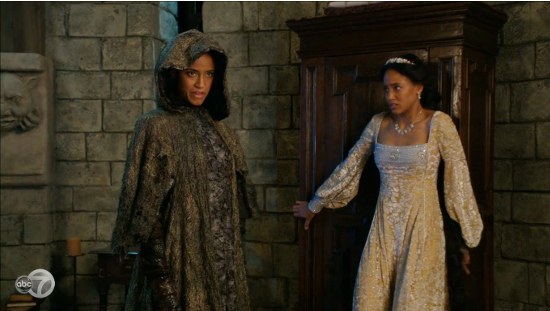
Rapunzel from OUAT

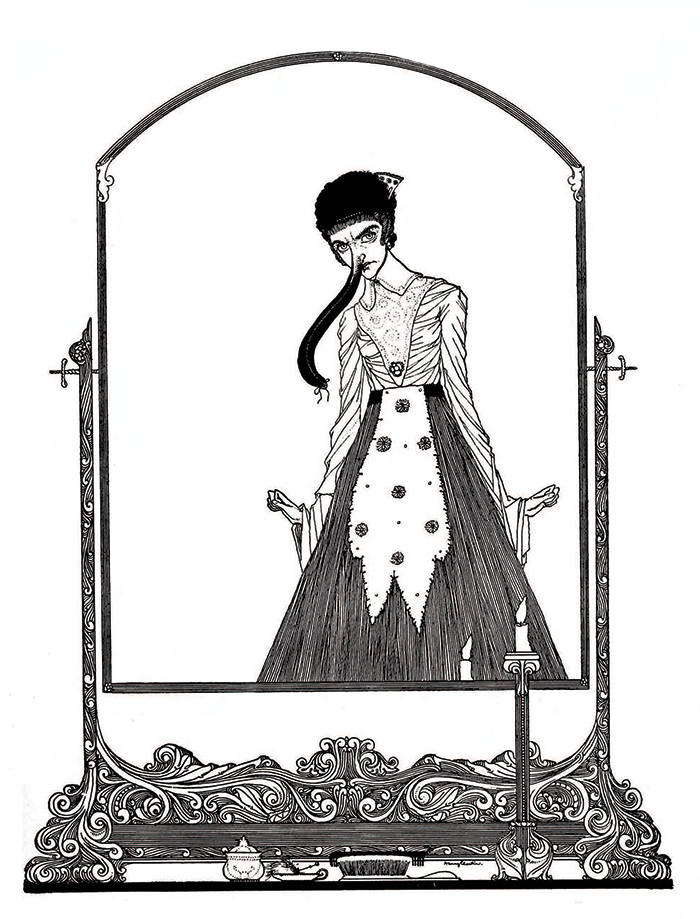
Gorgeous Harry Clarke illustrations for Perrault tales over at Pook Press. Hadn't seen some of these!
"Truth to tell, this new ornament did not set off her beauty"-The Ridiculous Wishes

A friend posted this on Facebook, thought the English fairy tale title parts were interesting:

At Raven's Shire, Nukiuk shares more about the fairies/Zwerg of German traditions that may have been influences on the Dwarves in Snow White.
Carl Offterdinger

And, anyone else looking forward to hearing more about this Swan Lake movie?

Tuesday, February 14, 2017

The Sleeping Prince

In my post on the different ways of Awakening the Sleeping Beauty, reader Nectar Vam shared this fantastic gender swapped version of the tale, The Sleeping Prince. It combines elements of Sleeping Beauty, Snow White, East of the Sun and West of the Moon, and even reminded me a little of Beauty and the Beast with the enchanted castle at the end. A bird tells a Princess of a sleeping Prince, who is white and gold and red, and goes on a dangerous journey even though she knew her parents wouldn't approve. She has to go to the lands of the West Wind, East Wind, and North Wind, where mortals should not go, and follow instructions to get past two lions that guard the gates of the castle, and awaits the time when the Prince's spell will be over.

It very much has the feel of a traditional folk tale to me, and although the sleeping prince trope may be much less common, if you look hard enough you can generally find gender swapped versions of any classic fairy tale-especially since this one bears resemblance to the journey of the heroine in "East of the Sun, West of the Moon." But the only sites I could find the tale at had no source cited-Wikipedia has a tale of the same title but it's clearly different (although also fascinating-in this one the heroine must stay awake watching the sleeping Prince for 3 months, 3 weeks, 3 days, 3 hours, and 3 half hours. She is persuaded to sleep towards the end and then follows a Goose Girl-type episode of mistaken identity). This site says it's Spanish (thanks, Amy Elize!) but has no further information on collection, editor, date, etc. So I can't promise it's authentic folklore but an interesting tale worth reading and sharing! Any further information on it would be welcome! UPDATE: Sarah Allison has more information on the source in the comments. Thanks, Sarah!

Also-in the past I've done features on roses in fairy tales on Valentine's Day. Interestingly, the key to getting past the lions in this tale is to pick two white roses from outside the North Wind's door, and throw them down before the lions when she gets close enough-something that would require lots bravery, since the lions act threatening until she gets close enough to throw down the roses! And the episode also reveals the great amount of power sometimes associated with roses in fairy tales.

Image sources-1 and 2

Wednesday, November 23, 2016

Dancing, Desire, and Death: The Role of Footwear in Fairy Tales


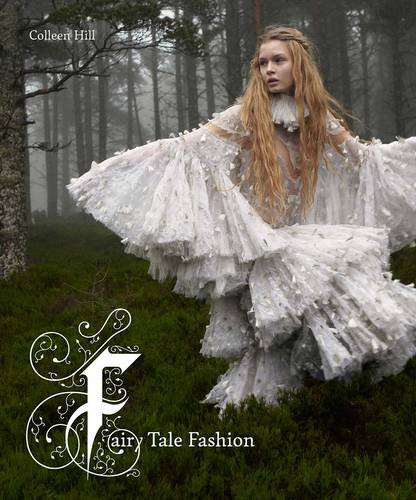
In the last section of Colleen Hill's fabulous Fairy Tale Fashion, she included some essays by other writers. I was really excited to read Ellen Sampson's "Dancing, Desire, and Death: The Role of Footwear in Fairy Tales." Twelve Dancing Princesses is one of my all time favorite tales and it's one I wish would be discussed more often; plus, the role of dancing in fairy tales can be so ambiguous and often contradictory.

There is a section specifically on footwear, although that topic has been discussed before here, so if you're interested in further reading on shoes, you can read about the significance of shoes in Perrault's time, Red shoes in fairy tales and history,  or Kathrine Langrish's excellent essay Slippers of Glass, Slippers of Fur on Seven Miles of Steel Thistles.

The subject of dancing in fairy tales, though, is a pretty bleak one at the outset for feminists. Sampson reminds us that many fairy tales were aimed to promote obedience in women-the Victorian versions we're most familiar with reflected the values of the day. "In fairy tales, women's bodies are strictly regimented and disciplined. They are controlled physically (putting Sleeping Beauty or Snow White to sleep), spatially (locking Rapunzel in a tower), maritally (gifted to Rumpelstiltskin as a reward), or sexually. Their bodies may be transformed (into geese or trees), altered (made handless or footless, smaller or larger) or even consumed, but they are rarely inhabited or possessed by their owners for long." I'm not sure which version of Rumpelstiltskin she's been reading...the protagonist is never given to him in marriage, but the King, but there are plenty of other tales where a princess is also given away in marriage, even against her will, so the point stands.

Sampson also points out that women who stray from the culturally accepted humility and dare to long for beautiful shoes, or to dance the night away, are severely punished. Karen in "The Red Shoes" eventually gets her feet amputated, similar to the stepsisters in Cinderella whose feet are mutilated in an attempt to fit into the slipper. Then, of course, there's the stepmother in Snow White whose punishment is to be danced to death in red hot iron slippers, fresh from the fire. "The animation of the body that shoes induce is punished in the most violent and spectacular manner...The production of stillness and silence is the aim of fairy tale violence-it renders the (female) body docile." Even for Cinderella and the Twelve Dancing Princesses, who may not be directly punished, through marriage they are given to the authority of another man and their dancing is stopped. The essay ends with the uncomfortable description of Karen's confession followed by her amputation.

Yet can that really be the whole symbolism of dancing in folklore? That is just represents women who are rebellious and must be tamed? I had wondered about the different uses of dancing-sometimes it leads to death, but in Cinderella's case it is both her reward and it's the catalyst that leads to another reward, the Prince/escaping a life of servitude. Sampson explains this by saying it's all about the context-women may dance at the proper time, the proper steps, in a formal setting-but must not dance out of passion and desire, like the twelve Princesses who dance the night away in an underground kingdom. Many scholars see the twelve Princesses as symbolic of women who are mobile and capable of rebellion-they spend the night exploring, dancing in a forbidden context, and the fact that their shoes are completely worn through by morning indicates the passion and extent to which they are dancing. They weren't performing a few courtly dances, but having a wild night of excessive dancing. In many fairy tales that feature shoes, it's even ambiguous as to who's controlling shoes-the Red Shoes force Karen to dance, and maybe it's the dancing shoes that brought the twelve sisters to the underground Kingdom and forced them to dance as well.

Scholars also interpret the Princess' underground nightly romps as being sexual in nature. It makes sense, but when I was younger it never occurred to me that you would need any other excuse to sneak out at night than to have access to an enchanted Kingdom in your own bedroom to explore, and fancy balls to attend. And here it  is that we see the often confusing logic of fairy tales-characters (and vicariously through them, the readers) are rewarded with the same things they are punished for desiring. We see many tales in which the main character is rewarded for being unmaterialistic-by being given great material wealth (such as in "Beauty and the Beast"). In Cinderella, the stepsisters must have chunks of their feet cut off for daring to desire the wonderful slipper and the royal life it represents-yet Cinderella is rewarded with both. Karen longs for the red shoes when she sees a count's daughter wearing them. Karen is punished, in a way, not for wanting beautiful things, but for wanting things that don't belong to her station in life-the red shoes are appropriate for the count's daughter, not for Karen; just as the slippers are meant for Cinderella and not her stepsisters. In a way it seems unfair, especially to our modern minds where we view class distinctions as less important than most other cultures.

And, although Sampson briefly mentions "Juniper Tree" as an example of how acquiring new shoes can be satisfactory, I think it's very important to contrast to the other tales, especially "Red Shoes." In that tale, Marlene is rewarded with a pair of red shoes. It's clear that she desires and enjoys them, and they are not seen as inappropriate for her, though she is poor, because she has a good heart. It's also important to remember that "Red Shoes," the most extreme example of a preachy tale concerning shoes and dancing, is not true folklore in the sense that the story has circulated around many cultures for generations with a similar structure, but was a literary invention of one man, Hans Christian Andersen.

Even in the tales in which dancing must be quelled, there is still a level of irony. Even if the Underground Kingdom is destroyed, the reader delights in the women's adventures there each time the tale is read or heard. Even if Cinderella doesn't dance any more after marriage, the descriptions of her dress and her own nightly adventures are the most thrilling part of her story (and frankly, her forbidden journeys to the ball are not that unlike the Twelve Dancing Princesses, and the twelve are hardly ever punished either for their so-called "indiscretions"). The very stories themselves betray their morals, as listeners delight in what is officially termed bad by the "lesson" we supposedly learn afterwards.

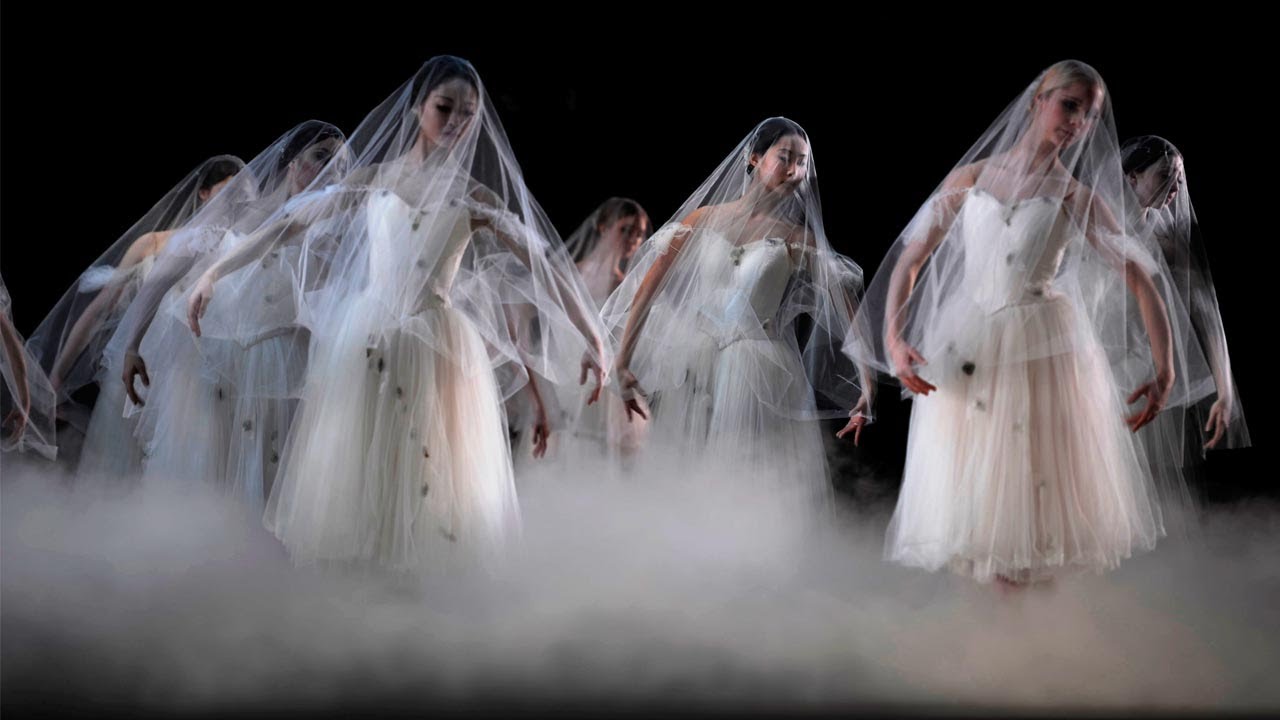
And, one story I wish Sampson had touched on is the ballet "Giselle." It's technically not a fairy tale, but neither is "Wizard of Oz" which she referred to many times. The haunting plot involves a group of Wilis, or supernatural women who force men to dance to their deaths. The idea of Wilis came from a passage by Heinrich Heine, but they are related to the Vila, a Slavic version of nymphs. In the context of the ballet, the women are said to be jilted lovers, and that is why they prey on men. So in a way, although they are the villains, the actions they perform reflect the original wrong, done to them by men-sort of like a gender-swapped version of King Shahryar in 1001 Nights, killing women because his first wife cheated on him. The very image of men being danced to death is a contrast to the popular tales referenced earlier, in which women's dancing is primarily described and their partners merely an afterthought.

How do you see the role of dancing in fairy tales?

Illustrations-"Twelve Dancing Princesses" by Kay Nielsen, "Red Shoes" by Anne Andersen, "Cinderella"-A.H. Watson, "Juniper Tree," by LBarrett, Wilis from "Giselle"-the SF Ballet
Wednesday, November 9, 2016

Alan Turing's Poisoned Apple

I recently watched The Imitation Game on Netflix, which is a really interesting look at the story of Alan Turing and the team that cracked the Nazi enigma code during World War II. I enjoyed the movie, and although parts of it were historically inaccurate, I actually thought it was relatively accurate for a Hollywood movie (more of the relationship between him and Keira Knightly's character was true than I assumed, for example). I don't mind when a historical account has some inaccuracies if it inspires me to look into a topic I never would have before.
So while I was checking out Wikipedia to read up on the real Alan Turing, I found this interesting but tragic possible connection to fairy tales. Turing was found dead just before his 42nd birthday and there is debate as to whether or not it was suicide. It could have been an accidental result of his experiments that involved cyanide, but some have come up with a more dramatic theory based on the half eaten apple that was found by his bed.

"Andrew Hodges and another biographer, David Leavitt, have both suggested that Turing was re-enacting a scene from the Walt Disney film Snow White and the Seven Dwarfs (1937), his favourite fairy tale, both noting that (in Leavitt's words) he took "an especially keen pleasure in the scene where the Wicked Queen immerses her apple in the poisonous brew.""

The movie hints that the death was suicide caused by the humiliation and stigma associated with being homosexual at the time (he was convicted of "gross indecency" and took hormone pills as part of his "therapy"). Either way, it was a tragic event and a great loss. Although I hate to think of fairy tales being acted out for such a sad purpose (if that is really what happened), I do like the fact that this brilliant man not only loved the fairy tale Snow White, but really enjoyed the Disney cartoon. It shows how powerful an influence the early Disney films were, and of course fairy tale imagery in general (can you imagine a current brilliant mathematician admitting to loving a certain scene from Frozen or something?)

Friday, June 10, 2016

Angela Barrett on her Fairy Tale Illustrations

"I was most inspired by pity for the beast’s awful loneliness and self-disgust. His tragedy is to know all about beauty and how to create it in everything around him, but to miss it in himself." — Angela Barrett, on illustrating Max Eilenberg’s ‘Beauty and the Beast’

Quote found on Meagan Kearney's Beauty and the Beast site. Angela Barrett's illustrations have long been some of my absolute favorite for BATB, inlcuding the Tales of Faerie header image

Retold by Max Eilenberg, it is set, at Barrett's request, in the 1860s - "the period when there was the greatest difference between the male and the female silhouette - men were tall and thin while women's skirts were wider than ever".

Barrett on Snow White:
"I always feel that my happy endings are somehow inadequate. I'm wary of perfect conclusions. I'm always disappointed by the way Jane Austen ties things up so easily at the end ... The truth is, I'm more easily moved by distress. I'm no good at jolly scenes of dancing and merriment - laughter can be so sinister."


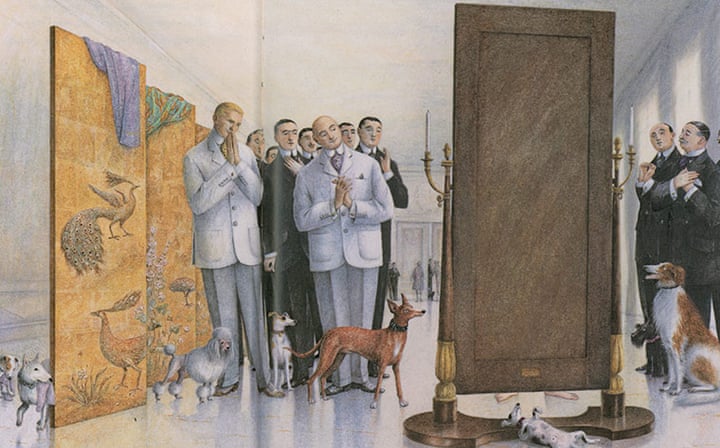
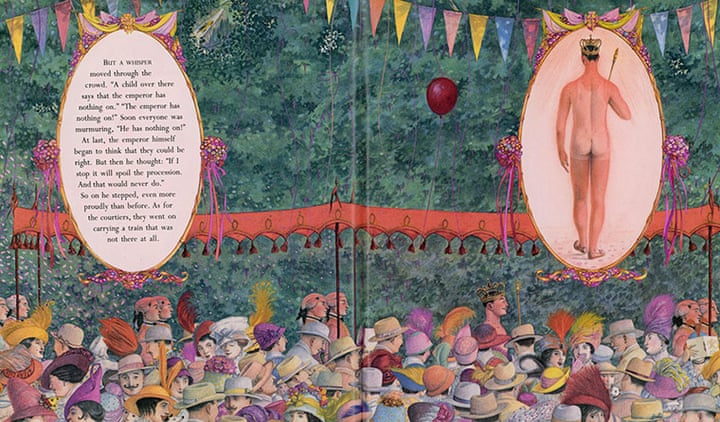
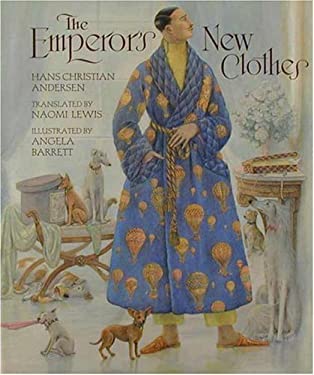
"Naomi Lewis's retelling of The Emperor's New Clothes (Walker Books, 2000) gave Barrett a longed-for opportunity to show some very different talents. It's set in 1913, at the end of the belle epoque, in an imaginary kingdom. The drawing is glorious and only an artist with Barrett's knowledge of fashion, and her hands-on experience of dress-making, could give this story such elegant, wickedly funny authenticity. And because "it's such a one-joke story", she has introduced a host of royal dogs, including a pompadoured poodle (himself half-naked) who blushes with embarrassment at the sight of the emperor's pink bottom."

-All other quotes from This Interview on the Guardian

Sunday, June 5, 2016

Fairy Tale Fashion: Snow White

Snow White is one of the most well known fairy tales, and because it's such a definitive story in the genre, it's easy to forget that it's a tale that actually breaks some typical fairy tale stereotypes, especially when it comes to physical appearance and beauty.

In the world of fairy tales, beauty and goodness are almost always synonymous-physical beauty is usually representative of inner character. The witch is intriguing because she is evil and yet beautiful. She is not only murderous, but cannibalistic, wanting to eat Snow White's heart and liver (perhaps to somehow absorb her youth and beauty through the act).

Snow White herself stands out because of her black hair. When a beautiful fairy tale heroine's hair is described, it is almost always blonde-and not just "blonde" but "golden," so we are reminded of more than fair hair, but also of wealth and royal status. Thus "Snow White embodies a peculiar dichotomy; whereas her stepmother is bad but beautiful, Snow White is good, but raven-haired." So the characters' very appearances, which are integral to the plot, stand out against other fairy tales. (EDIT: Julia Mavroidi mentioned in the comments that Snow White's hair was not always black-in fact, in the first edition of the Grimms, it was her eyes that were ebony!)
A.H. Watson

The apple is the most iconic image of Snow White, but the apple only comes after two other temptations-stay laces and a poisoned comb. Other people have analyzed these objects as representing Snow White's vanity, an observation that chillingly likens her to the witch. And while there are other reasons to suppose that Snow White is potentially in danger of placing too much value on her own beauty, maybe that assessment of the temptation objects is a little unfair.

First of all, in my opinion, we have to remember that the disguised witch offered the goods to Snow White. There's a difference between seeking things out and accepting what is offered-she is not like the sisters in Beauty and the Beast who seek out dresses and jewels.
Dolce and Gabbana Fall 2014
Fairy tale inspired line

But Colleen Hill also reminds us that Snow White was a princess. She was used to having a vast wardrobe of the latest fashions, and also probably someone to dress her. Even though the story doesn't indicate she is discontent with her new life with the dwarfs, it's safe to assume she might miss some of her old pleasures from the castle. In fact, the witch begins by a not-so-subtle insult; "Oh, my child, what a sight you are. Come, let me lace you up properly." In addition to that immediate pressure to improve on her looks, Hill says, corsetry "had other connotations as well, such as beauty, social rank, and morality." We know that Snow White values neatness and cleanliness in her new duties as housekeeper for the dwarfs, so it's natural that the desire to have a tidy home would also extend to a desire for a well kept appearance.

Probably the thing that most hints towards Snow White's vanity is the fact that the apple is described as being appealing to look at-"white with red cheeks"-just like Snow White. Yet those who condemn Snow White for desiring a pretty apple don't condemn the Prince for desiring Snow White for that same feature (while dead/in a coma)-although in the Grimms' version he really should be.
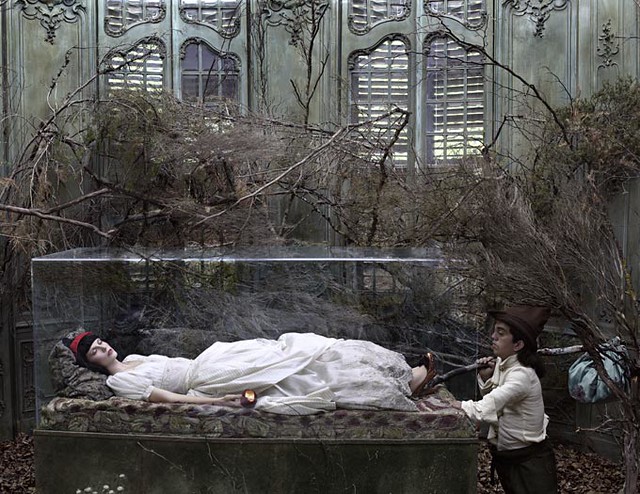
Eugene Recuenco

Hill also points out how much pressure was put on royal females to appear beautiful. Queens would be sharply critiqued for perceived flaws in appearance, yet paradoxically also condemned for being too vain. You could say that the Queen witch was really a product of her culture, just as young Snow White's desires for pretty things came not only naturally but through passed down values. In fact, this pressure contributed towards historical figures who were more or less real life evil Queens-Catherine de Medici supposedly tried to eliminate Louis de Conde with a poisoned apple, and St. Ludmila (the grandmother of King Wenceslaus) was strangled with a veil by her mother in law.

The pressure to look beautiful is not an archaic relic from a misogynist past, but alive and well today, as women are continually pressured by media to find value in their looks, and told that men will only love them if they adhere to certain standards. Which is why Snow White is still such a powerful tale, and just as it indicates that the desire for beauty is passed down through generations, so it is hundreds of years later...

Thursday, May 19, 2016

New book: Dreamless

Sleeping Beauty never had troubles like this
 
For most princesses, a sleeping curse means a few inconvenient weeks unconscious followed by a happily-ever-after with their true love. Seventeen-year-old Elena's curse, however, was designed without a cure, which means that she's getting a century-long nap for her 18th birthday whether she wants it or not. After years of study she's still no closer to finding a cure, even with the help of an undead godfather and an enchanted mirror-turned-therapist. With only a year until the deadline she's learned to accept her fate. Sadly, there's one prince who doesn't seem to have gotten the memo and who’s continually trying to activate the curse so he can be the one to wake her up again. Only slightly less annoying is Cam, her new bodyguard and former childhood acquaintance who disagrees with Elena at pretty much every turn. When the curse threatens to come early, however, they both realize that fate is a lot more complicated than they'd ever imagined.


Although it's a Sleeping Beauty retelling, I'm tagging it as "Snow White" as well because of hte enchanted mirror. Jenniffer Wardell is also the author of other fairy tale themed books: Beast Charming, Fairy Godmothers, Inc., and Huff and Puff. Amazon reviewers largely tend to rate her books highly, calling them fun, witty, and humorous.

Sunday, May 8, 2016

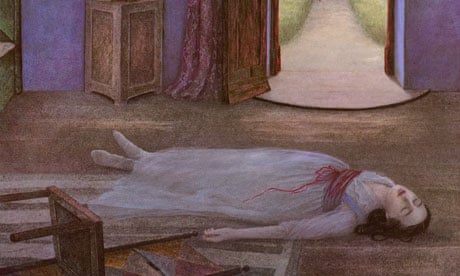
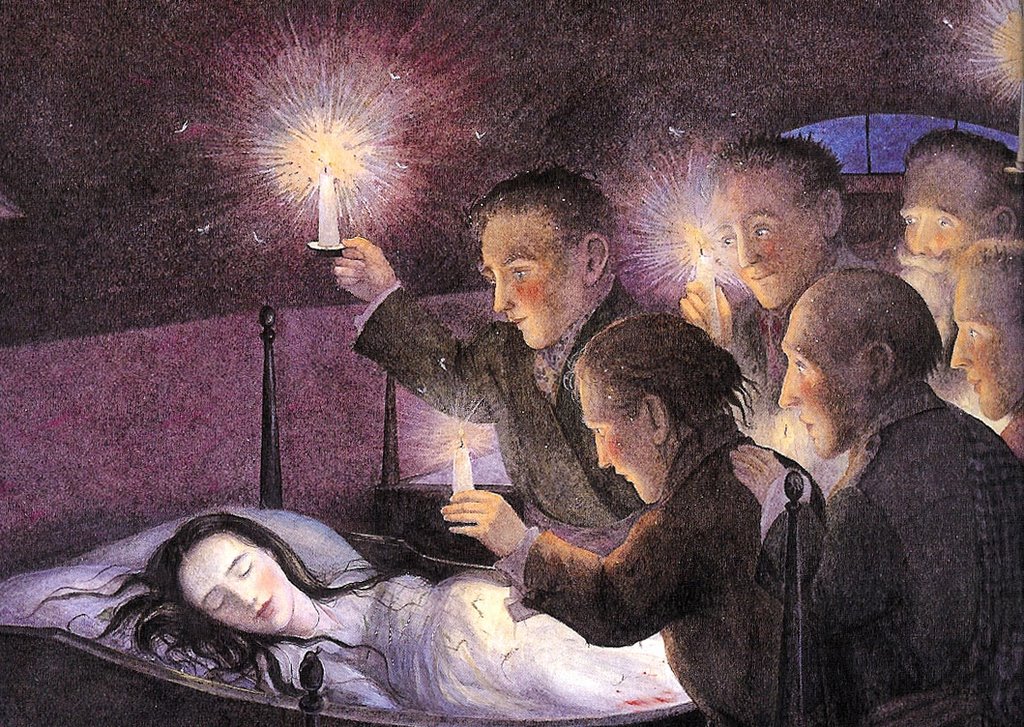
Snow White Picture Book Illustrations

Two picture book versions of Snow White with absolutely stunning illustrations-the first by artist Nancy Ekholm Burkert:


And these by Manuel Sumberac and Zdenko Basic:


(More from this book can be viewed here)