Wednesday, March 31, 2010

East of the Sun, West of the Moon: Gender roles

The Surlalune fairy tales blog has a poll at the bottom where people can vote on their favorite fairy tale. I was happily surprised that Beauty and the Beast came out with an impressive lead, but even more surprising to me was that "East of the Sun, West of the Moon," came in second at 15%. Not only is is lesser known than many other tales on the list, but I think of it as part of the Beauty and the Beast/Animal Bridegroom cycle of tales. Most surprising to me was that Cinderella was pretty far down the list, at 9%. I'm pretty sure if you polled people off the street, and not fairy tale enthusiasts, Cinderella would be first or second place.
As I reread "East of the Sun, West of the Moon," the subject of gender kept popping out at me.

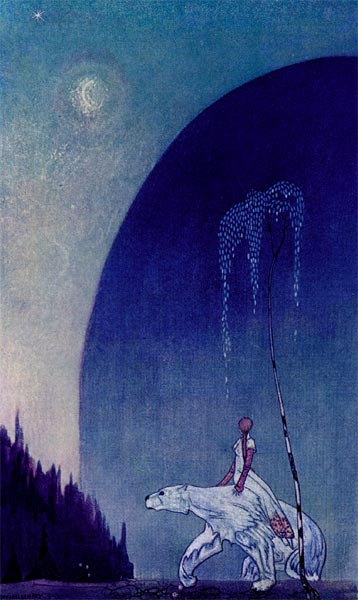
The father in this tale is definitely one who has his own best interests in mind rather than those of his daughter, as he pressures her to become the wife of a white bear so that the family can have money. No judgement is ever made on the father for doing this, but as his advice turns out to be true, one tends to forget how selfish this really was. Yet that was the reality for a lot of girls who were given away in marriage for no purpose other than help their family's financial situation.

Illustrations by Kay Nielsen

The mother gives advice too-but this advice the bear warns the daughter ahead of time not to listen to the mother's advice. Immediately the reader perceives negative things about the mother, when really her advice is much more sound--to know who you're sleeping with at night. Yet the mother is also never punished, like many fairy tale women whose punishments seem too extreme compared to how the men get off. And technically, if the daughter had followed her mother's advice all the way and been careful not to let the tallow get on the Prince's shirt, she may have been able to avoid all the trouble.
Image by Elizabeth Hoyle

Well, the Prince disappears and the heroine is left to search for him. Yet, just as both parents gave advice, which may or may not be considered helpful advice by the reader, the heroine is aided in her task by males and females alike-the four winds, which are represented as males, and three old kind hags. The hags are the ones that give her the amazing trinkets she needs to eventually win back her Prince from his new betrothed.
The Prince's new fiancee has a nose three ells long. The word has the same root as "elbow" and is meant to be the length of a man's arm. The measurements differ from country to country but could have been between 25 to 45 inches long.
As is so often the case, the villains are females. Though the whole country is supposedly inhabited by trolls, the only trolls we meet are the long-nosed fiancee and her mother.
Then, the task that wins back the Prince is washing the tallow from his shirt. People say this is an example of women only gaining salvation by housework. Yet there is also the implication that the secret to success is the difference between human and Troll, and that the heroine's success may be because it was she herself who dropped the tallow. Either way, I don't see a problem with women adding a little imagination to a chore which they were destined to do over and over again.
Although, speaking of gender roles in Norwegain tales, "The Husband who was to Mind the House" makes fun of a man who attempts to switch roles with his wife for a day and majorly messes everything up. This may make you more angry for further cementing the "men work in the fields, women work in the home" stereotype, or may make you glad that it acknowledges that keeping a house is not a walk in the park. Especially back before running water, refridgerators, etc. Although, the woman seems to do just fine doing her husband's work in the fields. Either way, I like to think of it as a good reminder to everyone not to criticize something about which you have no experience.

Just go here


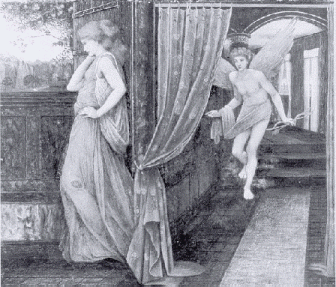
Susie Bubble's post "Enter the Enchanted" takes you on a visual tour of the renovations of Kensington Palace in London. Apparantly it's something like a museum of seven famous Princesses, yet an art display at the same time. Whatever it is, the pictures alone are truly creepy and magical at the same time. Some reminded me of specific fairy tales (Princess and the Pea, above, is obvious) and while others may not be inspired by a specific fairy tale, they all seem to belong in the realm of the magical and mysterious. Hop over and read the whole post for more details and pictures.


The Princess on the Glass Hill: A Norwegian male Cinderella

Get ready for a lot of Norwegian fairy tales coming up. I've been reading the collection of Asbjornsen and Moe, which I got to look up the original version of Peer Gynt, and have been fascinated by many of the other tales as well.
In my copy of the story, the youngest son is named Boots (which, sadly, makes me picture the character from Dora the Explorer. One of the disadvantages to babysitting), but in other versions he's called Cinderlad.

Well, Boots's father's grassfields keep getting eaten on St. John's night by an unknown source. Boots' older brothers try to stay the night and catch the culprit, but are frightened away by earthquakes. Only Boots is brave enough to wait them out, and three years in a row, he finds three grand horses with full sets of armor right by them. One brass, one silver, one gold-much like the three dresses the Grimms' Cinderella requests from her mother's grave. Though the materials of those dresses don't get grander every night (although the last night has her dancing in gold shoes,) Donkeyskin's gowns are colored as the weather, the moon, and the sun (Donkeyskin is often categorized with Cinderella, as the oppressed-maiden-whose-true-worth-is-eventually-recognized).
Now the king of the land has a daughter that sits at the top of a glass mountain with three golden apples. The only one who can win her is the one who can climb the mountain and be given the gold apples. There are three days in which Boots goes out each day, each time with the next nicest horse and armor, and goes partway up the mountain (a little farther each time) and then back. The people are all wondering about this mysterious knight who has found favor to win a golden apple each day yet leaves. Boots' brothers leave him home (sitting in the cinders and ashes) while they go and then tell Boots all about the festivities. Boots feigns ignorance and interest, just like Cinderella.

All the knights of the land present themselves to the king, so he can find the one who has the golden apples. No one does, so he sends notice for all the men to appear before him. This still yeilds apples, so the king asks if there is anyone else. Boots' brothers say there's no need to ask Boots, who has been home in the ashes, but the king insists. (Much like the parents of Cinderella, who insist she cannot be the woman the Prince seeks, until the Prince insists.) Boots, of course, produces the apples and the king and Princess are overjoyed. I like the ending-"and all I can say is, if they haven't let off their merry-making yet, why, they're still at it."

Gail Carson Levine has written a story about "Princess on the Glass Hill." I haven't read it, and I like her novels more than her short stories, but I'm sure it's a great read.

Disney's Beauty and the Beast onstage: My take

Well, I finally did see Broadway in Chicago's "Beauty and the Beast".

Secret to automatically enjoying any stage production you see in Chicago: see a jr. high do a production of the same show a week or two before, then the professional version will instantly be better.

But, I'm pretty sure I would have loved it anyway. You can read my review of the musical version in general here.
Here's my take on this production: the costumes, sets, special effects, everything was amazing live (especially compared to the jr. high version. Sorry to be hating on jr. high). I thought Nathaniel Hackman as Gaston was especially funny. Lumiere and Cogsworth (Merritt David Janes and Keith Kirkwood) were funny too but hard to understand sometimes.
 
The musical starts out strong. In the scene when Belle goes to the castle to rescue her father, the Beast was especially scary-more violent and creepy than in the movie. But then, like I said before, Belle's song "Home" is just such a letdown at that point in the plot. The movie Belle's flinging herself across her bed and sobbing is way better. The song is in a major key, guys. Even my students with developmental disabilities know that a song about losing your home, family, and freedom and being at the mercy of an angry, heartless monster should definitely be in minor.
 
From this point on, the musical becomes more unrealistic. It's largely the way the script is written, and I understand it's for kids and they're trying to lighten things up and everything, but the Beast becomes less of this tortured soul and more of a comic figure as we laugh at his attempts to woo Belle, who ends up being far too cheeky. While bravery is one thing, realism is another.

I still also hate the song "A Change in Me." Pointless words and music, and yet another slow solo when the audience just wants the plot to start wrapping up. At least Elizabeth Shivener does have the pipes for it. (Justin Glazer as Beast had a great voice too. I automatically fall in love with any Beast character so my opinion of him hardly even counts.)
They made some other minor changes to the script-cutting out a couple scenes (like the battle between the townspeople and enchanted objects, that surprised me) and there were parts I'm pretty sure they added some of their own lines to, but I think that's the beauty of live theater and making each production unique.
By the way, the special effects for the transformation scene were really cool. With my little experience in school theater, I was amazed he could get off the complicated Beast costume while never leaving the stage.
 
Overall I'm so glad I went, and I'm glad I have this production in my head now to replace the school versions I was in/just saw.

Monday, March 29, 2010

Peter Pan collars


Images by Carrie of Wishwishwish

My introduction into the blogging world was through style and fashion blogs, not fairy tale blogs. I (stupidly) had never even looked for or read any fairy tale blogs before I started this on a whim one day.

Anyway, the style blogs I prefer are usually girls who love vintage. Peter Pan collars are a favorite among some of my favorite bloggers, though not really "in" right now. I wondered what relation the collars had with the character Peter Pan and found this information on Retroland:

"When Disney got a hold of Peter Pan in 1953, they made some distinct wardrobe changes - notably, a jagged V-neck replaced the delicate, rounded collar that had come to be known for decades as the Peter Pan collar. But up until that time, this simple and sweet collar named in the honor of the boy who never grew up found its way around the neck of many a boy and girl who wanted to grow up to be just like their hero.
"The Peter Pan collar wasn’t always called such. In the late 1800s, it was referred to as the Little Lord Fauntleroy suit collar, and was designed out of either plain white cotton or frilly lace. When J. M. Barrie’s famous play hit the stage in 1904, however, the collar would be renamed forever in Peter’s honor. Little boys everywhere, who wanted to emulate their flying friend, embraced the fashion. In the 40s, it was incorporated into the Eton suits worn by angelic tykes, and a decade later, little girls had taken to the style as well, carefully folding the collars over their cardigans. For the older girl, a string of pearls completed the look. While not exactly on the fashion forefront these days, an occasional Peter Pan collar can still be seen from time to time, harkening back to flying adventures to faraway lands and representing all that is innocent and good in the world. Jagged V-necks, not so much."

Image of Emily on Some Girls Wander

Another Frog Prince movie

The Princess and the Frog the other day reminded me of this version (youtube link)(imdb), from 1986, which I'd sort of forgotten about until now. I love youtube so much (even when they don't have an embedding code). The huge frog always freaked me out.

I noticed similarities to Beauty and the Beast as I re watched it (although I see Beauty and the Beast everywhere). It is technically an Animal Bridegroom tale, and therefore related anyway, but some alterations they made were even more like Beauty and the Beast.
In the Grimm tale, the frog asks to share the Princess' plate and bed in return for fetching the ball, to which the Princess agrees, but later has to be forced to keep her promised by her father. In this version, the frog doesn't make any requests (although I do notice now that in the Grimm he also wants to be her "companion and playfellow," which is the most this children's version hints at). This Princess, Zora, has no problem being a friend to a frog-more like Beauty than Zora's predecessors. And then the near-death of the Frog near the end? Totally like Beauty and the Beast. Also, in one of the few fairy tales that doesn't have an evil same-sex sibling to contrast the hero, they added one.
And the scene at the end? From rags (sort of) to a poofy blue ball gown and dancing with a prince? Totally Cinderella.

Yet with the insistence on keeping promises over and over, that reflects the Grimms' moral (even though Zora doesn't specifically keep a promise she had made to Ribbit). The golden ball is also unique to The Frog Prince. I must have loved this movie as a kid because my sister and I watched it over and over. Though low-budget and slightly bizarre, it was still fun to re watch.

Sunday, March 28, 2010

Cupid and Psyche

No study of Beauty and the Beast would be complete without a look into Cupid and Psyche.

Though the two stories at first glance may not seem to have all that much in common, Cupid and Psyche is the earliest known story that influenced the Animal Bridegroom tales which evolved over time and culture to become the story we know today as Beauty and the Beast. Learning the oral versions that came in between helps you see the progression.

The plot:

Psyche is so beautiful she becomes famous and makes the god Venus jealous. Venus gives Psyches' father a prophecy that Psyche must be set on a rock and wed a Serpent. Psyche goes bravely, only to find herself in an exquisite palace where she recieves all sorts of luxuries. A lover comes to her at night, whom she is forbidden to see.

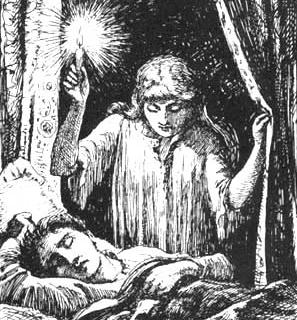
Naturally, any prohibition in fairy tales is violated, so Psyche does look on her husband, after her sisters convinced her she must be married to a monster. Turns out her husband was Cupid, the son of Venus, who was sent to kill her but fell in love instead (woops). Because she looked, Cupid is sent away and Psyche is sent to fulfill many dangerous/impossible tasks by Venus before she can be reunited with Cupid.

Illustration by Errol Le Cain

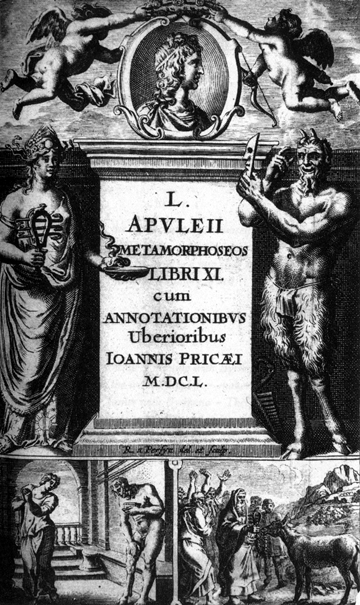
The story of Cupid and Psyche is found within the larger work Metamorphosis, or The Golden Asse, by Lucius Apuleies, from the 2nd century A.D. Psyche's tale is told as a story within a story, which reflects the larger frame story. This is important, because Psyche's big sin in the tale is curiosity. The pattern in fairy tales is for women to be severely punished for their curiosity while men are often rewarded (think Bluebeard). Yet, this story is a parallel to the narrator of the larger story, Lucius (probably Apuleius himself), who was too curious about magic and ended up accidentally turning himself into a donkey. So this time, the curiosity is not reprimanded only in females. Yet, Benjamin Slade points out that even though the two characters suffer from their curiosity, they are both rewarded in the end. (You could argue the same about Bluebeard's wife, but not her predecessors).

So in this tale we have the precedent for the selfish sisters, and though the groom turns out not to be an actual animal, don't they all in the end turn out to be princes in disguise? Other elements of the story that were weeded out eventually include the violition of the prohibition to look on the husband, and that was often replaced by the prohibition of staying home too long, because of mean sisters/mothers as well. The series of tasks the heroine must go through disappeared by the Villeneuve/Beament version but are still there in some other versions.

Note that, although this is the first known version, it's not the authoritative. This was (likely)based off of earler work by Lucius of Patrae, which is based off of earlier oral stories... maybe this is what Disney meant by "Tale as old as time."

An EXCELLENT retelling of this story is C.S. Lewis' Till We Have Faces. My personal favorite of C.S. Lewis, he tells the tale from the perspective of the sister, but with some twists--the sister doesn't pressure Psyche to violate the prohibition out of jealousy, but out of genuine concern. The main character, Orual, is incredibly ugly, as opposed to Psyche's overwhelming beauty, but not evil. The book is a fascinating look into trust, beauty vs. ugliness, and different forms of love.

Eye Spy

Can you spot the Beauty and the Beast characters?
This was drawn for me by a little girl who just saw the stage version.

Answer key: top row: Gaston (holding a knife) (the line drawn from him to the Beast below was drawn as the little girl told me how he was trying to hurt the Beast), Mrs. Potts

next row: the rose, the Prince (holding the Magic Mirror), Chip

third row: the Beast, the father (in a dungeon), Belle (in her yellow dress), Cogsworth (very tiny), audience (including the artist herself, Christy)

bottom: the Beast, after he's hurt

I don't know what the letters are supposed to mean. She hasn't mastered the art of spelling yet.

Saturday, March 27, 2010

Princess and the Frog

I caught parts of Disney's The Princess and the Frog today while babysitting. I hadn't been especially enthusiastic about it and hadn't planned on ever spending money to see it, but was still curious.
A lot of fairy tale enthusiasts hadn't been crazy about this movie, since the plot (which was all pretty much given away in the previews anyway) was so completely unlike the fairy tale it should hardly share the same title (basically the same, anyway). But this is the only Disney fairy tale to acknowledge the existence of itself-it really isn't a retelling of the Frog Prince, but a story that is influenced by the older tale, which helped me forgive all the creative liberties.

I noticed they were deliberately trying not to fall into the typical Disney Princess stereotypes-this young woman had business ambitions and didn't care about romance (just like BELLE was smart and loved to read and wanted adventure and not a jerk husband like Gaston).

The first thing the heroine does after she meets the frog-besides scream-is throw things at him and slam a book on his head. I wondered if this was a subtle nod to earlier versions where the Princess didn't bring about the frog's transformation by a kiss, but a violent act, such as throwing him against the wall.

By the way, the concept of the girl turning into a frog instead of the other way around has already been done in The Frog Prince Continued by Jon Scieszka, who has done some really great fairy tale parodies for kids.

Fairy tale references in Jane Eyre

Jane Eyre by Charlotte Bronte has been a favorite novel of mine since I was young. I think it was the first real "adult" book I read, and though a lot of it went over my head at the time I loved it then, and have loved each time I revisited it.
So I was fascinated to learn that Jane Eyre is full of fairy tale references. Not only is there a running theme that Mr. Rochester suspects Jane to be from the faerie world and not the human world, but Karen E. Rowe has written on the patterns seen from Cinderella, Sleeping Beauty, Bluebeard, and Beauty and the Beast.
Unfortunately I haven't been able to read what Karen E. Rowe has actually written--I can't find the whole text online, if anyone knows of a link I'd love to have it. I can see some of the themes on my own (don't read on if you don't want spoilers)-Jane Eyre goes from being orphaned and then to a place as governess, which was a form of servitude, and ends up well-off and happily married. But this general rags-to-riches theme is pretty universal-usually stories end up with the characters better off than when they started. I wouldn't have necessarily thought of Cinderella.
I don't really see how Sleeping Beauty fits in, other than...she only lived with females till she was 18? Or, maybe when she runs away and stays with her cousins, that's a form of enchanted sleep since she's hidden from the normal world for a while? I'd welcome other guesses on that one.
Charlotte Bronte

Bluebeard is more obvious. Mr. Rochester isn't murderous like the infamous husband himself, but a secret wife in a secret room isn't standard romance fare. The tables are turned as Bertha ends up being the crazy one and not the husband (although, hard as it is to imagine, some people apparently don't see Bluebeard as being out of line *cough Perrault cough*).

And I had already made the connection to Beauty and the Beast myself, but I tend to have a one-track mind. In fact anything I find romantic I realize ends up being (at least) indirectly a BatB theme. In Jane Eyre the characters switch places, with Rochester starting off being the Prince Charming and Jane being almost like an understated female beast. Called "plain" over and over again, and also being a servant, any prospects of being loved by her Master were pretty bleak. By the end, though, he's an old hermit who is blind and deformed, and she has a respectable place in society, compared to him. Some versions of Beauty and the Beast have this flipping of roles as well, notably Robin McKinley's Beauty. Beauty has the advantage at first, but she, like Jane, is also supposedly "very plain." After the Beast transforms, Beauty assumes he would no longer want to marry a poor, plain country girl such as herself. Yet, like Jane and Rochester, their love for each other supersedes all obstacles.