
Wednesday, April 21, 2010
Hansel and Gretel overture
Overture to the opera Hansel and Gretel. Composed by Engelbert Humperdinck.

Monday, April 19, 2010
Historical Bluebeard
Usually when we talk about the history of a fairy tale, we mean how the story evolved over time, but not a historical event on which the tale was based. With one of the creepiest fairy tales, Bluebeard, there are actually a couple possible historical precedents.

Kay Nielsen
Henry Bett claims that Gilles de Retz, Sieur de Laval, Marshal of France, was nicknamed "Barbe Bleue," "because of his blue-black beard," and that he believed he could restore his strength by bathing in the blood of young children (an awful resemblance to Countess Elisabeth Bathory bathing in the blood of young virgins to retain her beauty).
I haven't found any concurrence on the nickname or the bloodbaths, but he was a serial killer of young boys who gained pleasure from their pain and humiliation. More about him on wikipedia.

Matt Mahurin
Conomor the Cursed is the other possible candidate for the "real" Bluebeard. Once again, history becomes intertwined with legend. We do know he existed and killed his wives-I can't tell from my sources what are the exact known facts, but there's a whole legend about killing his wives once they got pregnant and how the last one was murdered but brought back to life and became a saint.

Edmund Dulac
If you want to know more about the tale, read the annotated version on Surlalune, or Terri Windling's article. Windling explores the various folkloric versions that predate Charles Perrault's tale, and how many of the heroines were able to outwit their murderous husband on their own, saving their sisters who had been victims-a stark contrast to Perrault's heroine who can do nothing but wait for her brothers to save her. And the moral (Perrault's) which condemns the woman for disobedience, and not the serial killer husband.

Art by Frederic Theodore Lix

Kay Nielsen
Henry Bett claims that Gilles de Retz, Sieur de Laval, Marshal of France, was nicknamed "Barbe Bleue," "because of his blue-black beard," and that he believed he could restore his strength by bathing in the blood of young children (an awful resemblance to Countess Elisabeth Bathory bathing in the blood of young virgins to retain her beauty).
I haven't found any concurrence on the nickname or the bloodbaths, but he was a serial killer of young boys who gained pleasure from their pain and humiliation. More about him on wikipedia.

Matt Mahurin
Conomor the Cursed is the other possible candidate for the "real" Bluebeard. Once again, history becomes intertwined with legend. We do know he existed and killed his wives-I can't tell from my sources what are the exact known facts, but there's a whole legend about killing his wives once they got pregnant and how the last one was murdered but brought back to life and became a saint.

Edmund Dulac
If you want to know more about the tale, read the annotated version on Surlalune, or Terri Windling's article. Windling explores the various folkloric versions that predate Charles Perrault's tale, and how many of the heroines were able to outwit their murderous husband on their own, saving their sisters who had been victims-a stark contrast to Perrault's heroine who can do nothing but wait for her brothers to save her. And the moral (Perrault's) which condemns the woman for disobedience, and not the serial killer husband.

Art by Frederic Theodore Lix
Tanith Lee's Red as Blood
Sometimes when I read fairy tales I try to recreate what it might have felt like to read them for the first time-the fear of the villain, the uncertainty of the ending. Reading the stories from Tanith Lee's Red as Blood: Tales from the Sisters Grimmer, I don't have to try to feel fear or curiosity. She blends tradional fairy tale plots with truly horrifying twists.

It's hard to pick a favorite, because they're all excellent, but I couldn't help wishing some filmmaker would make a short version of "Thorns," the Sleeping Beauty, because it has such delightfully macabre descriptions that have the potentially to be visually stunning. I also thought "When the Clock Strikes," the Cinderella tale, was particularly genious. The plot was actually more convincing than the traditional tale.
But, as Beauty and the Beast tales will always be close to my heart, I adored "Beauty." The first time I read this book, I was terrified by the time I got to this last story that it would be twisted beyond recognition like the other tales. I enjoy speculating about Snow White and Rapunzel being Satanic, but Beauty and the Beast is too personal to me-I would hate for Beauty to cast the spell on the Beast, or for the Beast to be a true monster of nightmares. Yet the story, though definitely with a twist, is beautiful and won't offend Batb freaks like me. It is set in the future and is my favorite short story version of Beauty and the Beast, which is saying a LOT, because of all the genres, there are a lot of short story versions out there.
This book isn't for everyone-those who don't like scary movies or having the plots of their favorite tales turned upside down on their heads should stay away. But as far as quality and creativity goes I can't recommend it highly enough-each time I read this book I can hardly put it down.

It's hard to pick a favorite, because they're all excellent, but I couldn't help wishing some filmmaker would make a short version of "Thorns," the Sleeping Beauty, because it has such delightfully macabre descriptions that have the potentially to be visually stunning. I also thought "When the Clock Strikes," the Cinderella tale, was particularly genious. The plot was actually more convincing than the traditional tale.
But, as Beauty and the Beast tales will always be close to my heart, I adored "Beauty." The first time I read this book, I was terrified by the time I got to this last story that it would be twisted beyond recognition like the other tales. I enjoy speculating about Snow White and Rapunzel being Satanic, but Beauty and the Beast is too personal to me-I would hate for Beauty to cast the spell on the Beast, or for the Beast to be a true monster of nightmares. Yet the story, though definitely with a twist, is beautiful and won't offend Batb freaks like me. It is set in the future and is my favorite short story version of Beauty and the Beast, which is saying a LOT, because of all the genres, there are a lot of short story versions out there.
This book isn't for everyone-those who don't like scary movies or having the plots of their favorite tales turned upside down on their heads should stay away. But as far as quality and creativity goes I can't recommend it highly enough-each time I read this book I can hardly put it down.
Saturday, April 17, 2010
Little Red Riding Hood as Sun Myth
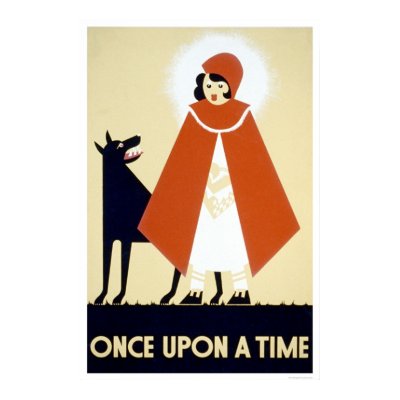
Kenneth Whitley poster
Little Red Riding Hood tends to be over-analyzed, in my opinion. Every branch of folkloric thought believes it has the correct symbolic meaning. Any psychoanalist will tell you the red cloak is OBVIOUSLY blood from menstration and the wolf is OBVIOUSLY a sexual predator. Henry Bett, on the other hand, claims with certainty that Little Red is a myth of sunset and sunrise. Generally sun myths can be applied to anything because anything good is the sun, anything bad is the night. The ultimate triumph of good over evil is the dawn triumphing over night. Congratulations, you have an interpretation for 99% of human stories.

Image by Paul Woodroffe
Yet, after a conclusion that might seem oversimplified, Bett goes on to cite many myths and legends from around the world that are directly related to the moon and sun and have parallels to Little Red-either connecting the color red/red coverings with the sun, or wolves with the night. Even one Melanesian myth where the hero takes a piece of red obsidian and cuts Dawn out of the belly of night. Personally, I can see a red hood as the rising sun more easily than menstration. This would all make a lot more sense if the red cap/hood wasn't added till Perrault's version. But anyone who claims any myth or tale has one specific origin or meaning is making one heck of a claim. Betts himself admits earlier, when critiquing those who interpreted everything as a sun myth, that "It seems to be the fate of every theory in folk-lore to be made ridiculous by being pressed too far." Modern interpretations don't really pay any attention to this sun myth idea and attribute everything to sexual meaning.

Image by Annie Rodriguez

Yet the complex influences of culture and history that created the fairy tales we know today are all fascinating to contemplate. It's true that Little Red has a hold on the imagination-it's one of the few tales that every child knows yet has not been marketed by Disney, with Hansel and Gretel also up there holding it on their own. Folklorists love to quote Dickens when he, reminiscing on his childhood, recalled how he believed that if he should have been married to Little Red Riding Hood, he should have known perfect bliss.
Friday, April 16, 2010
Beauty and the Beast of Cultural Expectations: Prince Desir
Forgive the lame title. I was never really good at coming up with clever titles so I just do whatever comes to mind first.

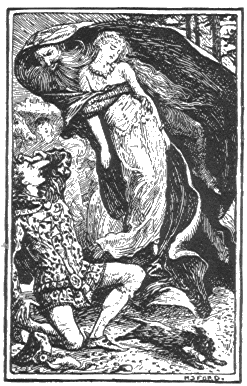
Madame LePrince de Beaument (of Beauty and the Beast fame) has another tale called Le Prince Desir et la Princess Mignonne, in which the Prince is cursed to have a huge nose until he realizes that his nose is unusual. Andrew Lang simplified the tale for his Blue Fairy Book, renaming it Prince Hyacinth, and it can be read online here. (Image from Blue Fairy Book, illustrated by H. G. Ford and G. P. Jacomb Hood).
His whole life, the Prince is surrounded by people and pictures of people with long noses. His nurses and teachers tell him that all the great historical figures had long noses, that a long nose is a sign of beauty, and that a short nose is a horrible thing to have. He falls in love with a princess' portrait despite her short nose, and it's not until he meets a fairy in disguise on his way to save his Princess and tries to kiss the fairy's hand that he realizes how inconvenient his nose really is.
I find this tale very intriguing. Today many people (myself included) believe in the power of embracing your natural, healthy body. While it may seem that to say every woman is beautiful is simply untrue, or that we must at least concede that some women are surely more beautiful than others, I truly believe that there are different forms of beauty and it's up to the viewer to learn to see it, rather than putting all the pressure on girls to conform to our rather narrow cultural standards of what is beautiful.
Yet in this tale, the Prince's salvation isn't embracing his unique nose-because for most of his life he is truly proud of his nose-but the moral is supposedly that pride can blind us to our faults. Which may be true of character, but is a long nose a fault? But the Prince is easily convinced that long noses are beautiful. If long noses were the majority, would we not all also be swayed? Cultures through time and around the world have considered things beautiful that modern Americans don't:

Full, round figures (painting by Titian)

Black teeth

Filed teeth

The tragic bound feet of Asian women
Madame LePrince de Beaument (of Beauty and the Beast fame) has another tale called Le Prince Desir et la Princess Mignonne, in which the Prince is cursed to have a huge nose until he realizes that his nose is unusual. Andrew Lang simplified the tale for his Blue Fairy Book, renaming it Prince Hyacinth, and it can be read online here. (Image from Blue Fairy Book, illustrated by H. G. Ford and G. P. Jacomb Hood).
His whole life, the Prince is surrounded by people and pictures of people with long noses. His nurses and teachers tell him that all the great historical figures had long noses, that a long nose is a sign of beauty, and that a short nose is a horrible thing to have. He falls in love with a princess' portrait despite her short nose, and it's not until he meets a fairy in disguise on his way to save his Princess and tries to kiss the fairy's hand that he realizes how inconvenient his nose really is.
I find this tale very intriguing. Today many people (myself included) believe in the power of embracing your natural, healthy body. While it may seem that to say every woman is beautiful is simply untrue, or that we must at least concede that some women are surely more beautiful than others, I truly believe that there are different forms of beauty and it's up to the viewer to learn to see it, rather than putting all the pressure on girls to conform to our rather narrow cultural standards of what is beautiful.
Yet in this tale, the Prince's salvation isn't embracing his unique nose-because for most of his life he is truly proud of his nose-but the moral is supposedly that pride can blind us to our faults. Which may be true of character, but is a long nose a fault? But the Prince is easily convinced that long noses are beautiful. If long noses were the majority, would we not all also be swayed? Cultures through time and around the world have considered things beautiful that modern Americans don't:

Full, round figures (painting by Titian)

Black teeth

Filed teeth

The tragic bound feet of Asian women
Beaument's story brings up a theme that I love to explore in reading and writing versions of Beauty and the Beast: not only Beauty verses ugliness, but how we perceive each. Tanith Lee explores this expertly in her version, which I will post about very soon. I've come up with a concept on my own (that was probably sunconsciously influenced by Lee) but have never been able to successfully turn it into a story, in which a girl like any of us inhabits a world of hairy beasts, in which long, thick fur is the sign of beauty. We never know if this girl would have been considered beautiful to us or not, because her hairlessness sets her apart as being the beast of that culture. So though Beauty and the Beast don't physically change from our story, their roles flip because of their beauty standards.
Dark music
I love dark fairy tales. Many fairy tale enthusiasts will insist that true fairy tales really were dark in their origins, therefore to describe them as dark is redundant. But in our culture, we definitely have a prevailing view of fairy tales as innocent and specifically for children, even though before many a happy ending are many gruesome trials. Even in the Disney versions, considered by most to be the epitome of fairy tales reduced and simplified, there are scary moments too!
However, for anyone to admit to loving fairy tales enough to research their origins and their "true" nature, there still has to be a sense of vulnerability and childlike appreciation of the magical aspect of the tales as well. Yet the darker, adult versions of these traditional themes and tales provides an interesting juxtaposition of dark and light.
I've found that I like this same juxtaposition in music. I love basically any music in minor, but especially in minor 3/4. Music in 3 has a lilt to it, usually thought of as being waltz-like. Yet with a minor melody, that waltz can become more sinister- a waltz of vampires, or a demented circus-something childlike or innocent gone awry. Any story-or music-that tries too hard to be hardcore without leaving any vulnerability takes away much of the realism and the personal connection.
I adore the waltz from Prokofiev's Cinderella ballet. In minor 3/4, it takes a beautiful waltz but gives it a sinister sense of foreboding. And listen to how he creates the ominous clock ticking and then chiming midnight with a symphonic orchestra!
I love Ravel's "La Valse." (This is only part 2 of 2). It starts off bright and cheery, but towards the end gets wilder and wilder. It makes me think of a dream that starts off pleasant and turns more absurd and perhaps nightmarish. I also think it would be perfect to accompany the Cinderella-at-the-ball scene.
However, for anyone to admit to loving fairy tales enough to research their origins and their "true" nature, there still has to be a sense of vulnerability and childlike appreciation of the magical aspect of the tales as well. Yet the darker, adult versions of these traditional themes and tales provides an interesting juxtaposition of dark and light.
I've found that I like this same juxtaposition in music. I love basically any music in minor, but especially in minor 3/4. Music in 3 has a lilt to it, usually thought of as being waltz-like. Yet with a minor melody, that waltz can become more sinister- a waltz of vampires, or a demented circus-something childlike or innocent gone awry. Any story-or music-that tries too hard to be hardcore without leaving any vulnerability takes away much of the realism and the personal connection.
I adore the waltz from Prokofiev's Cinderella ballet. In minor 3/4, it takes a beautiful waltz but gives it a sinister sense of foreboding. And listen to how he creates the ominous clock ticking and then chiming midnight with a symphonic orchestra!
I love Ravel's "La Valse." (This is only part 2 of 2). It starts off bright and cheery, but towards the end gets wilder and wilder. It makes me think of a dream that starts off pleasant and turns more absurd and perhaps nightmarish. I also think it would be perfect to accompany the Cinderella-at-the-ball scene.
Thursday, April 15, 2010
Beauty and the Beast tv show

I've been sharing some of my favorite versions of Beauty and the Beast, and this show isn't exactly a favorite, it's the only one in the television genre (that I've come across, enlighten me if I'm wrong. Aside from the Syfy version I haven't seen and probably never will).

Ron Perlman and Linda Hamilton star in this modern interpretation from the 80s. The Beast lives underground and saves Catherine (the Beauty) from some thugs one day. They fall in love and run around saving people, mostly each other. A lot of people really like this show, so I hope I don't offend anyone when I say, this show is pretty terrible, it's just so bad it's funny. The Beast (Vincent) has a bond with Catherine such that he can sense whenever she's in trouble and will immediately come to her aid.

Although, I'd be totally lying if I denied that, in between laughing at the script, I secretly enjoy it. It didn't help that my first introduction to this little treasure was a movie version that was edited terribly so that they would make references to past experiences that were in the shows but not in the movie, therefore the audience had no idea what they were talking about.
This isn't Linda Hamilton's only brush with Beauty and the Beast. Embedding has been disabled by request (grrr...) but check out this rather genious recut version of the Terminator movies, entitled "Beauty and the Beastinator".
Wednesday, April 14, 2010
Wooden Tony
Taken from Beyond the Looking Glass, edited by Jonathan Cott. "Wooden Tony" was written by Lucy Lane Clifford and tells the story of an autistic child, which is especially relevant to my work, as several of my students have autism. The story is very sad and moving. I find it strangely beautiful, and yet it's more like a horror story than a traditional fairy tale. As always, you can read my summary, but the original story is infinitely better.

Tony was a lazy boy who would sit by the fire. He never did chores, and his eyes often had a blank expression, and the neighbors would call him "Wooden Tony." He noticed that, when people were far away, they were smaller, and he told his mother he wished he could be far off so that he would be small again and people would stop demanding things of him and scolding him when he didn't do them.
But Tony loved to sing. When he would go out to pick eidelweiss, he would come back with no flowers but with a new song no one had heard before. Tony also liked to watch his father carve little figurines out of wood during the winter; these he would sell in town for money.
One morning a dealer came to buy Tony's father's figures. He had heard Tony's song and wanted to share it with the world. He took Tony with him to Geneva. He told Tony to sing, and he did, and as Tony sang, the dealer wrote down the notes of his song. As they walked past mountains and trees, Tony sang and sang, and the dealer copied. Yet as he went, "his song was different, it seemed no longer to come from his heart but only from his lips, and as he sang he heard the notes repeated. The song was going out of him and on to the dealer's wire. He did not look towards it, he did not care; he felt nothing keenly. His legs were growing stiff and his feet were hard...He was not tired, or warm, or cold, or glad, or sorry, but only in a dream."
Tony and the dealer arrived at the town, but the town felt strange to Tony, who was used to nature. He could no longer sing anything. The dealer put Tony in a little wooden house and told him to go upstairs. He did, and saw a wooden figurine his father had carved before, that he had been afraid of, but no longer was. Tony waited in the dark with the woman figurine. Sometimes he would hear the notes of his song, twanged back on wire, and he and the woman would catch a glimpse of light.
One day, Tony's mother and father were in town. His mother saw a cuckoo clock and Tony as the wooden figurine. His father insisted that could not be Tony, but his mother knew him. "His song has gone into the world, but Tony is there," she insisted. His father wondered if, since Tony's head had been wooden, the rest of him had turned wooden too.
His mother wanted him back, but when the song was finished, Tony was jerked back into the darkness.

"Life is not only in nodding heads, and work is not only for hands that move and feet that walk; it is in many other things."

Tony was a lazy boy who would sit by the fire. He never did chores, and his eyes often had a blank expression, and the neighbors would call him "Wooden Tony." He noticed that, when people were far away, they were smaller, and he told his mother he wished he could be far off so that he would be small again and people would stop demanding things of him and scolding him when he didn't do them.
But Tony loved to sing. When he would go out to pick eidelweiss, he would come back with no flowers but with a new song no one had heard before. Tony also liked to watch his father carve little figurines out of wood during the winter; these he would sell in town for money.
One morning a dealer came to buy Tony's father's figures. He had heard Tony's song and wanted to share it with the world. He took Tony with him to Geneva. He told Tony to sing, and he did, and as Tony sang, the dealer wrote down the notes of his song. As they walked past mountains and trees, Tony sang and sang, and the dealer copied. Yet as he went, "his song was different, it seemed no longer to come from his heart but only from his lips, and as he sang he heard the notes repeated. The song was going out of him and on to the dealer's wire. He did not look towards it, he did not care; he felt nothing keenly. His legs were growing stiff and his feet were hard...He was not tired, or warm, or cold, or glad, or sorry, but only in a dream."
Tony and the dealer arrived at the town, but the town felt strange to Tony, who was used to nature. He could no longer sing anything. The dealer put Tony in a little wooden house and told him to go upstairs. He did, and saw a wooden figurine his father had carved before, that he had been afraid of, but no longer was. Tony waited in the dark with the woman figurine. Sometimes he would hear the notes of his song, twanged back on wire, and he and the woman would catch a glimpse of light.
One day, Tony's mother and father were in town. His mother saw a cuckoo clock and Tony as the wooden figurine. His father insisted that could not be Tony, but his mother knew him. "His song has gone into the world, but Tony is there," she insisted. His father wondered if, since Tony's head had been wooden, the rest of him had turned wooden too.
His mother wanted him back, but when the song was finished, Tony was jerked back into the darkness.

"Life is not only in nodding heads, and work is not only for hands that move and feet that walk; it is in many other things."
Monday, April 12, 2010
Undine Sonata
My musical selections will tend to be more flute-centric because I'm a flute player, but here's an excellent example of more classical music inspired by a fairy tale-Carl Reinecke's "Undine" flute sonata.

John William Waterhouse
An Undine, or Ondine, was a water nymph. The German legend goes that she married a man to gain a soul, but he was unfaithful, and she cursed him to stay alive only as long as he stayed awake; when he fell asleep next, he would die. Friedrich de la Motte Fouque turned it into a novel in the nineteenth century which became very popular.
The first movement depicts Undine as a water nymph. Eventually she comes to land, and is raised by human parents, who don't understand her. The fast, chase-like notes of the second movement describe her relationship with her foster parents., who perceive her as impulsive and naughty.
The slow third movement is when Undine finds love. Yet her naivete leads her to bring her husband's former fiancee into their home. He is drawn back to his former love, and Undine is unwillingly forced to give him the curse of death, yet comes secretly to attend the funeral-all this is portrayed in the fourth movement.
I find it interesting-traditional fairy bride tales such as this usually consist of human men kidnapping supernatural female characters, who escape as soon as they find a chance. These fairy creatures are other than human, and cannot be happy when confined to human life. Yet in two very popular water spirit tales written by men-Fouque's Undine and Andersen's Little Mermaid-the supernatural female will do anything for the love of the man. This Undine still mourns for her unfaithful husband, unlike the folkloric Undine who curses her husband of her own will.
Disney Couture

Beauty and the Beast Cogsworth Pendant Necklace

Magic Castle Necklace

Beauty and the Beast class ring

Snow White "Fairest of them all" necklace

Snow White two-sided cameo necklace

Snow White Mirror necklace (you could also say this was the Beast's magic mirror)

Beauty and the Beast Lumiere necklace
I would like all of the above, please. There's more where they came from at amazon. Just search for "Disney Couture."
Items here are priced between $40 and $85.
Subscribe to:
Posts (Atom)