Saturday, March 20, 2010

Beaument's illustrated Beauty and the Beast

Once upon a time...
A merchant lived happily with his sons and daughters. He was very wealthy, and they were very happy. The two elder daughters were spoiled and mean, but the youngest was good and kind. She was so beautiful that everyone called her Beauty.
One sad day, the merchant lost several ships carrying his cargo. In no time, the family had gone from riches to poverty. They were forced to move from their grand home in the city and to a small country cottage.

The elder girls greatly lamented the loss of their wealth. Rather than help with the work, they would sit around the cottage and mope, leaving Beauty, her father, and their brothers to do all the work.

Though the work was tiring for Beauty, she did the best she could to help her father and appear cheerful.

Then, one day, the family recieved news that one of the merchant's ships had been recovered. The family's fortune may be restored! Very excitedly, the father packed his bags to travel back to the city. Before he left, the oldest girls begged for expensive clothes and jewels such as the ones they had had to leave behind. The father asked Beauty if she would like anything.

"I don't need anything, Father. I only hope for your safe return."

Beauty's sisters scoffed at this. Her father was touched, but seemed a bit sad. Finally, Beauty admitted she would love to have a rose if her Father could find one. Gladly, he promised to bring her the best rose money could buy.

Their father set off with high hopes, but Beauty was anxious for him to return. He did not come back till much later than he had anticipated. Beauty was waiting for him when he did.

Though very glad to see her father again, Beauty noticed he seemed very sad and tired. He had not returned with money or gifts, but he did have Beauty's rose. "Little do you know how much that rose has cost me," he told Beauty.
The father told his story. In town, the money he had recieved from his ship was barely enough to pay off old debts, and he didn't have enough to buy presents for his family. On his way home, there was a terrible snowstorm, and he became lost in the woods. He despaired of ever finding his way out, when he saw a large castle, untouched by the storm.
Completely wearied from his journey, the merchant took refuge inside the castle. He saw the most luxurious riches, but no people. A dinner fit for a King was laid out, but no one caim to claim it. After waiting and still seeing no one, the merchant ate the dinner and found a bed laid out for him. He fell into a deep, restful sleep and woke refreshed, finding a new suit. Assuming the castle belonged to a kind fairy, he thanked her and set off on his way.

On leaving the castle, the merchant passed a magnificent rose garden. Remembering Beauty's request, he picked a rose for her.

Suddenly, he heard a great roar. "Why have you stolen my roses?"

Stunned, the merchant turned to behold a great beast, dressed and walking like a man. He was furious. "I feed and shelter you, and you repay me by stealing my roses? Ungrateful man! You must die!"

Trembling, the merchant pleaded for his life. He explained that he only wanted the rose for his daughter. The Beast considered, and offered the merchant this option: "Very well. I will allow you to return home to say goodbye to your daughters, but you must return in a month to pay for your crime--unless one of your daughters will willingly come in your place."

With that, the Beast left, and the brokenhearted merchant was left to find his way home and say goodbye to his family.
Beauty's sisters chided her. "You had to be special, didn't you?" Beauty's brothers insisted they would fight the Beast and kill him, but their father knew the Beast was too powerful to be defeated. Beauty surprised everyone by saying, "I requested the rose-I will return in Father's place."

Since no one could persuade her otherwise, Beauty and her father returned to the palace one month later.
Beauty was truly frightened, but put on a brave face. She and her father arrived and found the palace just as her father had described it, with dinner laid out for them. While they were eating, they heard the Beast approaching.

"Good evening, Beauty. Have you come here willingly?"
"Yes."
"Good. I am obliged to you."

And the Beast left. Tearfully, Beauty and her father said their goodbyes, and in the morning, the father was gone and Beauty found herself alone.

Expecting to be eaten by the Beast that evening, Beauty decided to explore the castle while she still could. To her surprise, she found a room labeled "Beauty's room," fit for a Princess.
Beauty spent the day enjoying the castle and her room. When evening came, she went down to dinner, and was once again joined by the Beast.
"May I join you, Beauty?"
"You are master here."
"No, Beauty, it is you who are mistress. Am I ugly?"
"I cannot lie, Beast, you are very ugly, but I believe you are also kind."
"But I'm also stupid," sighed the Beast.
"Stupid people never realize they're stupid," Beauty replied with a smile. "But I think a kind heart is best of all."
Beauty continued to eat. At the end of the meal, the Beast asked, "Beauty, will you marry me?"

Beauty was shocked. "No, Beast," she said, and fled back to her room.

The days passed quickly for Beauty. The castle was so large and had much to explore. Each night she dined with the Beast. She grew to look forward to his company, even though each evening he would ask her to marry him. As time went by, Beauty became fond of the Beast, but could never imagine herself married to him.
Although she no longer feared the Beast, Beauty greatly missed her family. One day, Beauty saw in her magic mirror that her father was ill. The Beast could tell something was bothering her. When she told him she would like to be home to nurse her father, the Beast reluctantly allowed her to go. "But you must return within the week, or I will have died of grief."

Beauty was overjoyed at the thought of seeing her father again and eagerly promised to return. Beauty woke up in her Father's house, and nursed him back to health.
However, when her father discovered Beauty intended to return to the Beast, he was very upset. Beauty's sisters, who had been glad to be rid of her, could not believe she had been living like a queen the whole time they had been living as paupers and wanted to have revenge. They plotted to be extra nice to Beauty and convince her to stay, hoping to anger the Beast so he would finally eat her.
Amazed at her sisters' kindness, and moved by her father's worry, Beauty decided to stay another week with her family. One night, Beauty dreamt she saw the Beast, lying unmoving in the garden. She woke up and thought, "What have I done? Have I killed the Beast who treated me so kindly?"
Beauty placed her magic ring on her bedside table that the Beast had given her for when she chose to come back to the castle. Beauty anxiously waited to see the Beast, but he did not come to dinner at the usual time. Beauty ran out to the garden to see if her dream was true, and there he was lying, as if he was lifeless. Beauty ran to him, weeping, crying, "Don't die, Beast! I thought I was merely your friend, but now I realize how much I love you, and I wish to marry you!"
Suddenly, the air was filled with music and fireworks, and instead of her dear Beast, a handsome Prince stood! "Where is Beast?" cried Beauty.
"I was the Beast!" exclaimed the Prince. "I was cursed to remain in the form of a monster until a beautiful girl would love me for who I am and not for beauty or wit. You have broken the spell and will share my crown."
Beauty and her Prince were married, with much rejoicing from the Prince's subjects and Beauty's family...except for her sisters, who were transformed into statues until they learned to care for others other than themselves. As for the rest of them, they all lived happily ever after.

Friday, March 19, 2010

I think I'm in love


"La Belle et la bete: Beauty and the Beast necklace" available here

Firebird ballet

The story for the "Firebird" ballet comes from a different pieces of Russian folklore--as if someone made a Western tale in which a girl wears a red hood, loses her glass slipper and falls into a deep sleep because of an enchanted apple, to be awakened by the kiss of a Prince.

The story follows Prince Ivan as he tries to find the culprit who keeps stealing his father's golden apples. This turns out to be the Firebird, who gives him one of her feathers to use in time of need in reward for releasing her. The Prince then discovers a group of Princesses all kept captive by the evil Katschei, who can only be defeated when someone breaks the egg which holds his heart. With the help of the Firebird to tame Katschei's evil minions, and of course true love, Ivan succeeds in freeing the maidens and securing the most beautiful Princess for himself.


The music for the ballet was composed by Igor Stravinsky. One of his earlier works, there isn't the avant garde aspect of his later music, but this makes it more accessible to the average listener--which is not at all to say the music is boring. Stravinsky used diatonic music (music that uses the regular notes of a traditional major or minor scale) to represent normal, earthly things, and chromatic music (using all the notes available) to represent the world of magical creatures. Listen to Katschei's slithering, evil theme at the beginning. This version seems to have more emphasis on their beautiful set than on dance, but the Firebird comes in and dances around 6:30 (to a wicked hard flute part!). Listen to the violin harmonics (a very high and eerie sounding effect) around 2:00.

You can follow the links to watch the complete ballet. I'm including the last section as well. This starts with the Firebird's lullaby as she enchants the evil minions into a deep sleep and goes into the joyful finale, one of my favorite moments in classical music. Listeners might recognize the music as also being featured in Disney's Fantasia 2000, as the Spring Fairy overcomes the obstacles to spread spring throughout the land (how appropriate for this time of year).


Enjoy!

Thursday, March 18, 2010

Brian and Wendy Froud


Image from here

After flipping through this library book, the pictures of faeries and goblins looked familiar to me, because I recognized the artwork of Brian Froud, who was the conceptual artist for one of my all time favorite movies, Labyrinth (as well as The Dark Crystal, another Jim Henson). This movie isn't exactly for anyone, but if a bizarre 80s fantasy starring David Bowie, a young Jennifer Connelly, and Jim Henson creatures sounds up your alley...you've probably already seen it. (But if not, go watch it now!)
Brian has researched fairy folklore and mythology, especially that around his home county of Devon, England, and according to his website, World of Froud, he believes in fairies and his artwork represents the fairies he's seen. World of Froud is a family affair, as his wife Wendy is also involved with creating fantastic artwork (she was one of the collaborators who created Star Wars' Yoda) and their son, Toby, who was the baby Toby in "Labyrinth," is now also interested in puppet making.
Poor kid. (Fun fact: the baby's name was supposed to be "Freddie" all through the script, but Toby would only respond to his name.)
Image from here

"Dreamweaver Fairy"
"Black Elf Woman"
Above images copyrighted by Brian Froud

The book ("Faeries") itself is a delightful read. The enchanting pictures are accompanied by text--some in regular type, some in handwritten script, which makes it seem more like a scrapbook or diary than a textbook, even though the stories written are actual lore.

I love this excerpt from the Foreward-

"And here we must make one thing very clear. The real faerie experience is very diffrent from the general view of faerie built up by clouds of sentimental fiction with legions of inevitable happily-ever-after endings. The world of "Once Upon a Time-" delightful as it is and highly as we value it, is not the real world of Faerie. Faerie represents Power, magical power, incomprehensible to humans, and hence, inimical. ...Faerie is a world of dark enchantments, of captivating beauty, of enormous ugliness, of callous superficiality, of humour, mischief, joy and inspiration, of terror, laughter, love and tragedy. It is far richer than fiction would generally lead one to believe and, beyond that, it is a world to enter with extreme caution, for of all things that faeries resent the most it is curious humans blundering about their private domains like so many ill-mannered tourists. So go softly-where the rewards are enchanting, the dangers are real."

-Betty Ballantine

Wednesday, March 17, 2010

Alice-inspired jewelry

I was wandering around Etsy and was intrigued by this pendant, entitled "the real Alice in Wonderland":

which can be found here.
The seller justbedesigns includes this fascinating information:

"I was curious as to what influenced Lewis Carroll to write Alice in Wonderland. All of the research that I did led to Alice Liddell - a five year old girl whose family Lewis Carroll befriended. He was quite taken by little Alice and even referred to her as his "muse." His affections for Alice became more of an obsession and he was banned from seeing or speaking to her and her sisters. Carroll actually wanted to marry Alice but the family forbade it, citing his age as a huge factor -- he was more than thirty years her senior. Nobody knows if the above is for sure true -- it is all speculation. But, the more that I read about the events; the more I became intrigued. I also came to learn that parts of his diaries were torn out and pages were just missing that chronicled the trips that he took with Alice and her sisters."

Is it just me, or is there a huge increase in Alice in Wonderland-inspired products since the Burton movie started being advertised? I have been drooling over daileedose's Alice in Wonderland jewelry collection. If no one's bought me anything for my birthday (though I guess my unbirthday would be more appropriate...) I might have to snag something for myself...

Disney's Beauty and the Beast onstage


I may be going to see the musical version of Disney's "Beauty and the Beast" next week.

As much as I love Beauty and the Beast, and the Disney version, the musical is actually one of my least favorite versions of the story. Maybe it partly has to do with having been in the musical in high school and I have other associations that go along with it; however, I don't like a lot of the changes they made to the movie.

The pluses to the musical: the song "Human Again," which was originally written for the movie but cut out (and included later in the collector's dvd edition) is fun and helps develop the characters of the enchanted objects. Also, the song "If I Can't Love Her," sung by the Beast at the end of Act I, is very touching.

When I was a kid, I thought Lumiere especially was the funniest thing ever, but as I grew I found his humor more slapstick and not quite as hilarious as I once did. But who knows, this time around maybe I'll find it funny again, I'm sure his part depends largely on the actor and director.

Image from here

Additions to the movie that are not so hot:

Belle's extra songs are just cheesy. They threw them in, I'm sure, to give her plenty of solos, but the music and the words are disappointing. In one song she claims she had, "No change in heart-a change in me." What does that actually mean? How is your heart separate from yourself?

Gaston's song includes these lyrics: "You've been dreaming just one dream/nearly all your life/hoping, scheming, just one thing/will you be a wife?/will you be some he-man's property?/Good news, that he-man's me." Yes, I'm sure there's an element of humor in it, and certainly no one can go away from the show thinking he's not incredibly self-centered, but the song overexaggerates his character to the point where it's unbelievable. (Sadly, I didn't have to look up those lyrics, I still remember them from being in the play years ago).

Overall, it's like the musical targets an even younger audience than the Disney movie. Everything that should be obvious is spelled out anyway. Instead of the audience seeing Belle give up her freedom in place of her father's and letting the situation and acting relate emotion, she has to sing a song about how the castle doesn't feel like home and if the Beast thinks that what he's done is right, then he's a fool. It just trivializes what could be a very powerful situation.

Plus, the Disney movie implies that Belle stays at the castle for at least several days (although if you compare it to the timeline of the Father, it can't be very long, but I don't think the creators of the Disney movie were super careful in thinking through how much time elapses--for example, in the movie, the narrator says at the beginning that the rose would bloom till the Beast's 21st year. First of all, that's really young to be expected to have found true love for life. Secondly, Lumiere sings in "Be Our Guest" that for ten years he's been rusting, meaning the Beast was a 10-year-old kid when cursed, if you follow the logic. Which is why, in the musical, they change the rose to blooming "for many years.") But the musical makes it appear that the entire plot happens in about a day. It's harder for Belle to switch costumes in a stage version, but to have the Beast go from totally selfish and cruel to kind and gentle in a day, and for Belle to go from revulsion to being in love, is completely unrealistic. And that's the strongest asset of the fairy tale--love that is not love at first sight, but developed over time and based on character.

Another minor detraction in the live version is the costumes themselves--though often very elaborate and beautifully made, there's only so much you can do to make a human into a believable teapot, wardrobe, plate, etc. At least in animation, the characters can be the right size for their object and move appropriately. I guess that's where imagination comes in--I am a firm believer in imagination--but just compare the stage characters to the real ones:

Monday, March 15, 2010

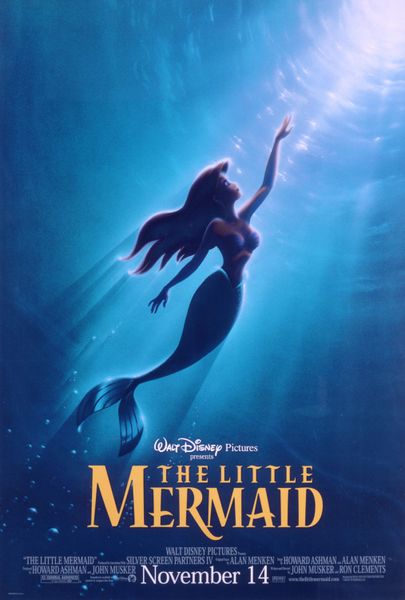
The Little Mermaid


Image from this post at Once Upon a Blog

"The Little Sea Maid" is a fairy tale written by Hans Christian Andersen. Though inspired by mermaid folklore, it is an original story, not a reworking of oral tales.


I'm trying not to start every post by comparing a fairy tale to the Disney version, but Disney is so prevalent in our culture's thinking about fairy tales as well as my own personal knowledge of fairy tales, so it's hard to avoid. So, Ariel is officially my least favorite Disney princess (aside from Pocahontas, who doesn't even count. I have a friend who wasn't allowed to watch Pocahontas or Anastasia as a kid because they were historically inaccurate, which I find simultaneously sad and awesome).

The Disney version comes across as saying: a) don't listen to your parents, they're old and narrow-minded and don't know what they're talking about. b) not only is love at first sight true, but you should risk everything--including your safety, your future, and your family, to pursue your first crush.
The Andersen version starts very similarly, with the Little Sea Maid growing lovesick over a human prince, and eventually seeking the Sea Witch to give her legs. But not only must she give up her voice, but entered into a state of constant pain ("every step you take will be as if you trod upon sharp knives, and as if your blood must flow") and give up all chances of being a mermaid or seeing her family again. She is expected to woo the prince with her "beautiful form...graceful walk, and speaking eyes." And she doesn't succeed. The Prince isn't put under an evil spell to fall in love with the witch in disguise, but some other nice and pretty Princess. Given the chance to kill the Prince to save her own life, she declines. In the end she jumps into the sea, becomes sea foam, and then joins the "daughters of the air."
Critics have pointed out that this is more of a reward for her steadfastness than a punishment, since she enters into the afterlife, but I never read it that way (even though I do believe in the afterlife). Yet I find this ending much more satisfying than the stereotypical happy ending. She made a stupid decision as a young girl and paid for it, yet there is a glimmer of hope. It may seem that, after a broken relationship, there's nothing to live for any more, but life does go on, even if it can never be quite the same as it was before. I take the fairy tale as a message against becoming passionately attatched to someone prematurely.

Which is interesting, because at the beginning of the story, when the Sea Maid reaches her fifteenth year and is finally allowed to go above the surface of the sea, oysters are attatched to the Princess' tail, to show her high rank. The Sea Maid protested, "But that hurts so!" but the reply is, "Yes, pride must suffer pain." Later, the Sea Maid endures much more pain because of her love for a human. I don't know if I would call lovesickness "pride," per se, hers is more foolishness than anything else, or the fact that she was forced to wear oysters, for that matter. Andersen had his own moral agenda, which Maria Tatar elaborates on more in this book.
To be honest, I think the main reason Ariel is so popular among little girls today is because she is a mermaid, and mermaids are cool, not so much because of her story. Lore about sea maidens generally tells a very different story--sirens who lure men to their deaths, or women kidnapped and forced to marry mortal men, but who escape as soon as they recover their seal skins. Mermaids have been made innocent and harmless much like fairies have.

Saturday, March 13, 2010

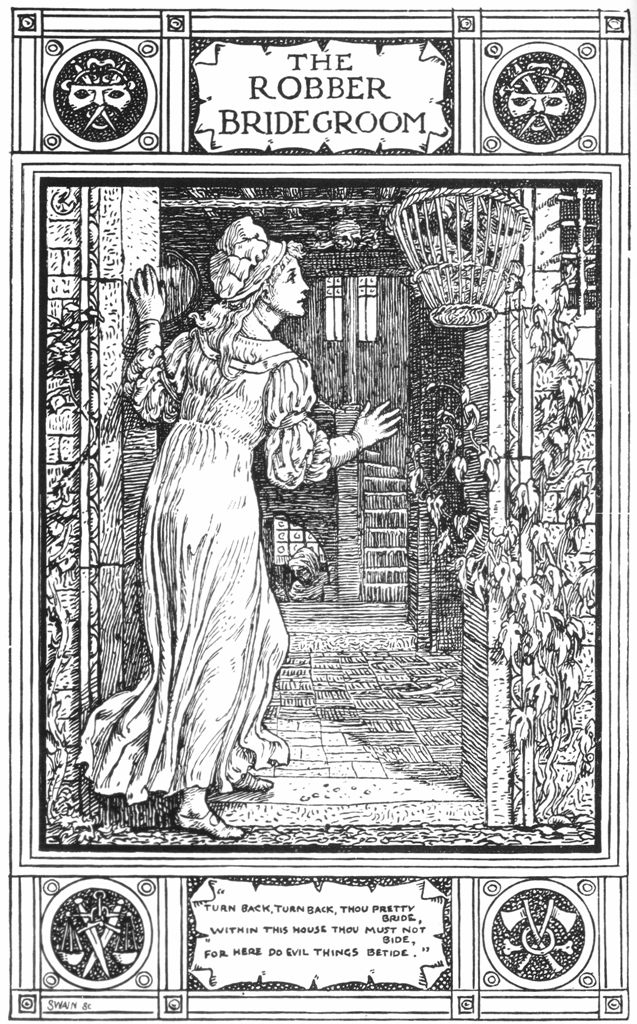
The Robber Bridegroom

This lesser known Grimm fairy tale is very dark. I love hunting through my Grimm books to find treasures like this--Cinderella and Red Riding Hood and all the classics are wonderful but there are so many other fascinating tales.
Here is Wikipedia's summary, although read the full text if you can, it's so much better--

"A miller wished to marry his daughter off, and so when a rich suitor appeared, he betrothed her to him. One day the suitor complained that the daughter never visited him, told her that he lived in the forest, and overrode her reluctance by telling her he would leave a trail of ashes so she could find his home. She filled her pockets with peas and lentils and marked the trail with them as she followed the ashes.
They led her to a dark and silent house. A bird in a cage called out to warn her that she entered a murderer's house. An old woman in a cellar kitchen told her that the people there would kill and eat her unless the old woman protected her and hid her behind a barrel. A band of robbers arrived with a young woman, and they killed her and prepared to eat her. When one chopped off a finger to get at the golden ring on it, the finger and ring flew through the air and landed in the bodice of the hiding woman. The old woman discouraged them from searching, because the finger nor the ring were likely to run away: they'd find it in the morning.


The old woman drugged the robbers' wine. As soon as they fell asleep, the two living women fled. Wind had blown the ashes away, but the peas and lentils had sprung up into seedlings: the two followed the path of plants and reached the young woman's home.
When the wedding day arrived and the guests were telling stories, the young woman said that she would tell a dream she had had, and told of her visit to the robbers' den, her bridegroom punctuating it with "My darling, you only dreamed this." -- or the robber punctuating with exclamations that it was not so in the Mr. Fox variant -- until she produced the finger of the dead girl and showed it to the company.
The robber bridegroom and all his band were put to death."
Second image from Surlalune Fairy tales. First from here.

Wednesday, March 10, 2010

The Twelve Dancing Princesses-Ruth Sanderson


Ruth Sanderson's retold and illustrated "The Twelve Dancing Princesses" is full of exquisitely detailed oil paintings that kept me staring at the pictures as a child...and as an adult.


My sister had put these gold leaves in the page where Lina (Sanderson's name for the heroine) approaches Michael (the soldier/commoner of this version) with the leaves from the gold forest he put in her flower bouquet (Michael gets work as the Royal Gardener. Overall the story is pretty true to the Grimms', though.)

Once, I was telling this fairy tale as a bedtime story to some little girls I babysit. When I got to the part where the eldest Princess claps her hands and the trapdoor in their room opens (although in one of my Grimm translations, she doesn't clap her hands, but just taps the bed), the oldest girl, who was then about 6, got all excited and said, "If WE clapped our hands, maybe a door will open up in OUR room!" Sadly, it didn't work. I love the optimism and enthusiasm of children, though.

Monday, March 8, 2010

Maria Tatar: Off With Their Heads!: Fairy Tales and the Culture of Childhood

To sum up this book very quickly: Life in the Victorian times sucked if you were a woman or child because men had complete authority. The fairy tales collected and published during this time were not the "authentic" versions of the tales, as we often think they are today, but altered from the oral tales to encourage complete submission to authority (children to adults, women to men.)
First of all, let me preface by saying: I've heard feminist arguments before that I thought were weak and/or failed to take into account the culture and context in which the tales were created. Things like "the fact that Sleeping Beauty and Snow White are in coma-like-death clearly indicates that men want their women passive." Which I didn't buy into. First of all, a couple tales in which women are immobile for a while doesn't indicate that those circumstances are set as the ideal for all women everywhere. Secondly, the sleep is clearly a curse, not the desired state of being. The happy ending occurs only after the heroine has been awakened, therefore giving mixed signals at best.

Another slightly better argument I've heard: "Since females in fairy tales do domestic chores and then have a happy ending, this means that domesticity is a trait of the desirable female in the eyes of the storyteller." But again, nearly always, the chores are represented as an undeserved punishment imposed by (usually) a cruel mother/stepmother. The happy ending includes the female, generally, as married to a Prince and therefore never in need of doing housework again. But consider it as well in the context of the culture--in a time when most people were living off the land, women did housework. Housework itself is not demoralizing or degrading, someone has to do it. I think it totally natural that women would pass the time cooking or cleaning by telling stories and imagining that someone hardworking like them would be rewarded so richly. Plus, at the time, men weren't going into the office and leaving all the chores to the women, they were probably working in the fields or doing their part to supply the family with their needs. But the interesting thing about this argument is the fact that there is a notable lack of males who ever do their own chores in tales. Males tend to go on supernatural quests, while females end up doing chores somewhere in their adventure. But one more thing--Cinderella often gets accused of being too passive. But what options did she have? She couldn't go out, get a GED, and work her way through school. Back then women could be wives, be servants, be a teacher if they were educated themselves, or be prostitutes. Those were pretty much their only options. If Cinderella had run away, it would have been to be a servant to someone else who probably would have treated her about the same.
All that to say, I think Maria Tatar has the best arguments I've read to describe the reality of gender roles in folktales. She does take into account the cultural context, and also analyzes the trend of the tales through different cultures and time periods, rather than picking apart details of a certain version and assigning them meaning, even if it's a meaning most educated people wouldn't necessarily pick up on, much less uneducated peasants telling tales among themselves.

Chapters 1-4

The Victorian age witnessed the birth of children's literature as its own genre. Stories for children were made specifically to induce fear of disobeying. While this summary may not seem to surprising--as an educator myself, I know firsthand the need for obedience in the classroom--but the many specific examples she quotes of excerpts from literature or actual childrearing practice are shocking. In stories, one disobedient act by a child would be punished by often a painful death, if not the deaths of others around them. Parents were encouraged to beat and whip their children for mild offenses, even infants. Tatar gives examples of oral fairy tales, and then the written Victorian versions (mainly the Grimms), and it's clear that the tales were altered to fit in with this harsh trend in childrearing. (What I really wish someone would publish is the complete original notes the Grimms took while listening to their oral sources, then the first edition, and the subsequent versions, to trace the evolution even within the Grimms themselves. Some revisions are surprising, but some tales have very little editing.)

Tatar also refers often to Maurice Sendak as a more modern contrast to the Grimms, which was very enlightening, since I was only familiar with his "Where the Wild Things Are."


From chapter 4-"This simple fact of children's literature as a product of adult reconstructions of childhood's realities does much to unravel on of the mysteries of fairy tales...whenever a book is written by adults for children, there is a way in which it becomes relentlessly educational" (p.92)

Chapters 5-7

The next section of the book deals with women and girls. I had known life wasn't ideal for women in Victorian times, but the more I learn the more horrified I am. Women now tend to long for the old-fashioned man with manners and chivalry, and I think we think every man back in the day was a Mr. Darcy from Jane Austen's "Pride and Prejudice." I've always preferred the Bronte sisters to Jane Austen--their novels introduce a slightly darker side to Victorian life. Especially Anne Bronte's "The Tenant of Wildfell Hall," the lesser known of the Bronte novels, but probably more indicative of what life was really like for a typical woman. If anyone wants to learn about life for women in Victorian times through a novel, read this book. Warning: you will get very angry while reading this book.

That had nothing to do with Tatar, by the way. Tatar again cites cultural views of women and their role, as well as lesser-known tales and versions to give a more complete picture. Like children in the didactic tales, women are often severely punished for things like disobeying their husbands. "Even the harshest penalties remain unchallenged when women begin breaking all the rules in the book of feminine behavior by taking steps in the direction of acquiring knowledge and power" (p.119). Males actually get off pretty easily for more severe sins--think of the father in Donkeyskin, most versions of that tale end with the Princess reconciled and living happily with him. Daughters are expected to be completely devoted to their fathers, then transfer that total (even blind) devotion to their husband--while, of course, still remaining on good, obedient terms with their father. "Never once do these stories show a heroine making a move in the direction of autonomy--the tales ceaselessly turn on the question of retargeting the object of the woman's devotion."

Tatar points out a very interesting contradiction existing in most tales--characters are applauded for disdaining worldy wealth and then rewarded with...worldly wealth. I had noticed this in "Beauty and the Beast," that the sister that wants a simple rose rather than the jewels and expensive clothes of her sisters is given more dresses and jewels than she could ever wear, as well as a complete life of luxury. Tatar explains this as the affect of didactic morals being placed into a tale that was not originally didactic, therefore has competing messages. I definitely agree, but I think another way to view this would be to think of the riches (or even the handsome prince at the end of Beauty and the Beast) as symbolic: to those who appreciate the simple things in life and are content rather than always wanting more, those simple things provide genuine pleasure. The Beast, which is initally seen as ugly, ceases to be ugly once Beauty gets to know him because she sees the beauty of his character.

Chapters 8-10-Violence, Cannibalism, and the Juniper Tree

Tatar explores the surprising amount of violence found in most tales, especially the un-moralized oral tales, but also the extemity of the violence found in moralizing tales when punishing the villain. Food itself also plays a very significant role in folktales. Tatar again alludes to culture--to a people often exposed to starvation, infant deaths, deaths of mothers giving birth, and child abandonment, some of the more dark themes explored in fairy tales make more sense. Returning again to the subject of gender roles, she talks about how a "happy ending" often consists of father and children living happily without the mother. A lot of this could be attributed to the reality of stepmothers stepping in after a mother had died in childbirth, who would desire for her own children to have what inheritance there was. Or, it could be attributed to the fact that these tales were largely collected and published by men, who felt more comfortable with female than male villains.

The epilogue contains a very interesting critique of Disney's "Snow White." I don't think Disney consciously knew he was, as Tatar claims, creating "a complete absorption of maternal figures into the realm of evil" (232)--as Tatar does point out, he was really just following the trend the Grimms before him paved the way for. And for those who attack Disney as being chauvenist, while there are good arguments against him, consider again the context--Snow White came out in the 1930s, Cinderella and Sleeping Beauty in the 1950s. American notions towards women were very different then than they are now. Not that that completely excuses Disney, but people back then weren't aware of what messages they were implying as much as they are today.


To close, a quote from the epilogue:
"No fairy tale text is sacred. Every printed version is just another variation on a theme--the rewriting of a cultural story in a certain time and place for a specific audience." (229)