Sunday, April 11, 2010

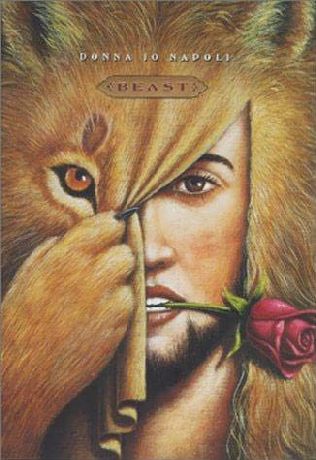
Donna Jo Napoli's Beast


I feel ashamed to admit I had never read Donna Jo Napoli's Beast before now. My mom had read it and told me it wasn't good. I can see why she wouldn't want me to read a story where the enchanted Prince has sex with a lion. I kept thinking about Beauty and wondering if she would ever know that the man she would eventually marry had once "recieved a lioness," as Napoli puts it.

Overall I liked it. The writing style is a bit choppy, and in present tense, which at first takes some time to get used to. Plus, in the beginning section, she throws a lot of foreign words in which she has to then define, or spends a lot of time describing Persian culture or aspects of the Mulsim religion. It bogged down the reader a bit because the action was slowed down and it was harder to picture in my head.

The story starts in Persia and the Prince is named Orasmyn-taken from the Charles Lamb poem. So I expected the story to be more original than the traditional details of the French version, but it was actually really cool how everything made sense in the end and became the story we all know.

This story is unique for taking the perspective of the Beast. He starts off as the Prince of Persia, a very disciplined and religious man, who seems almost too much like a woman's ideal of a "perfect man" to be realistic-he doesn't like violence or hunting, he likes roses instead, etc. But then when the fairy curses him (for making an improper sacrifice in a religious ceremony) he becomes a lion. And not just a man in a lion's skin, as if he were wearing a costume he couldn't take off-like we often think of the Beast-but the mind of a man conflicting with the mind of a lion, inside a lion's body, with all of a lion's instincts and desires. This aspect of the plot helped deepen his character a lot. As disciplined and perfect as he was before, even he has trouble keeping the human side of him in tact. And it's a lesson we could all learn-we all tend to put our stomache, or our lust or other instinctive desires before what we know is good for ourselves, or for others.

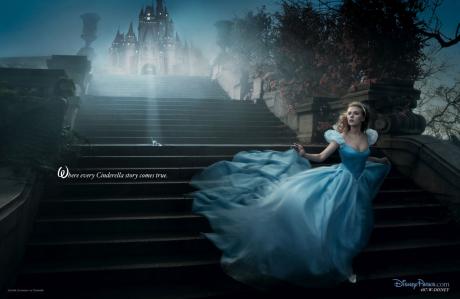
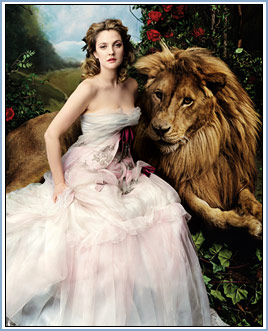
I chose to illustrate this post with pictures from Vogue of Drew Barrymore as Beauty because that version also has the Beast as a literal lion. Most Beasts tend to be a conglomeration of animals (bears are common for the Beast though), but Orasmyn became fully lion. He couldn't even talk or walk on his hind legs, like most Beasts.

The middle section of the book deals with Orasmyn trying to live as a lion-adapting to his new body and living in the wild. I can't imagine the research that went into this book, but aside from the educational value, I kept wanting it to get to the part where Beauty would show up.
She finally did. And like Orasmyn's original character, she also came off as a bit too perfect to me. Yet it also made me realize how Beauty-centric most versions are. Everyone loves to imagine themselves in a castle that immediately grants every desire. Since the Beast also has invisible magical servants, there's no need for Beauty to do anything for him. In Napoli's version, there are no magical servants. He has to feed himself as well as creates gardens suitable for Belle's food and provide for her human needs, which is difficult enough for a human, more difficult for a lion. In fact I kept wishing I could hear the story from Belle's perspective, and then being like, oh yeah...that's pretty much every other version.

But, each author gives Beauty and the Beast their own unique spin, and I wouldn't mind reading Napoli's Beauty's backstory too. Though it isn't my favorite version (no one can hold a candle to Robin McKinley's Beauty in my opinion,) it gives the reader a lot to think about and chew on long after the book is finished, which is one thing I really like in a book.

Excerpt:

"Belle is human. I am lion. Belle is human. I am lion. Belle is human. I am lion.
The chant rolls in my head.
She hums.
The chant dissipates.
Belle hums as she eats.
Like a lioness.
Is this the work of the pari [fairy] who distorts every moment, makes every moment a source of temptation?"

Saturday, April 10, 2010

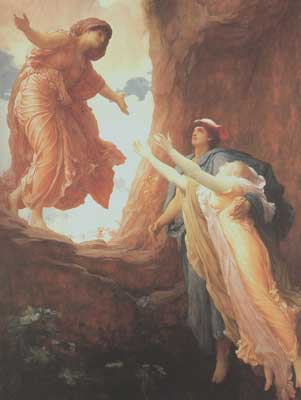
Persephone

While reading Donna Jo Napoli's Beast, which I will have a full post on shortly, I came across a reference comparing Beauty and the Beast to the Greek myth of Persephone.
Leighton painting

Persephone was the goddess of the Underworld-but not by choice. While out picking flowers one day, she was abducted by Hades. Her father Zeus demanded her return, but before he returned her, Hades tricked Persephone into eating six pomegranate seeds. Food from the Underworld is powerful and will keep the eater there (much like fairy food). So Persephone spends six months of the year in the Underworld, as payment for the six seeds she ate.
The flowers Persephone was picking reminds us of Beauty's innocent request for a rose, which ultimately brought her to the Beast. Donna Jo Napoli's Beast makes the observation that Belle probably thought she was going to live with someone who was more or less the lord of the Underworld. And Beauty does go back and forth between her strange lover and her family- though not as much as Persephone.
Tile art by William Morris

Yet the Persephone myth is also similar to the tale of Little Red Riding Hood, who also got into trouble for straying off the path to pick flowers. She and Persephone are punished for this, while Beauty is usually commended for her appreciation of nature over materialistic goods. Yet, as critics have pointed out (Maria Tatar is freshest in my mind,) Little Red wasn't really a story about the importance of obeying parents or staying on the path until the Grimms got ahold of it. In fact, in older versions, Red would often perform a striptease for the wolf instead of the "My, what big (insert body part here) you have!" Not the Little Red we fell asleep listening to...

Friday, April 9, 2010

Every little girl is a Princess


There once was a little princess who-
"But, Mr. Author, why do you always write about princesses?"
"Because every little girl is a princess."
"You will make them vain if you tell them that."
"Not if they understand what I mean."
"Then what do you mean?"
"What do you mean by a princess?"
"The daughter of a king."
"Very well, then every little girl is a princess, and there would be no need to say anything about it, except that she is always in danger of forgetting her rank, and behaving as if she had grown out of the mud. I have seen little princesses behave like the children of thieves and lying beggars, and that is why they need to be told they are princesses. And that is why, when I tell a story of this kind, I like to tell it about a princess. Then I can say better what I mean, because I can give her every beautiful thing I want her to have."
"Please go on."


George Macdonald, opening of The Princess and the Goblin

Thursday, April 8, 2010

Underwater symphony

A gorgeous piece of music, "Aquarium," from Camille Saint-Saens' Carnival of the Animals:


Saint-Saens depicted underwater life as mysterious and ethereal.

Does it remind you of anything else?


Some people think Alan Menken was influenced by "Aquarium" when he composed the introduction to Beauty and the Beast. They do sound similar.

Menken (and Sebastian) took underwater life in a different direction in The Little Mermaid:


And one more underwater masterpiece. The Moldau, by Czech composer Smetena, describes:
"the course of the Vltava, starting from the two small springs, the Cold and Warm Vltava, to the unification of both streams into a single current, the course of the Vltava through woods and meadows, through landscapes where a farmer's wedding is celebrated, the round dance of the mermaids in the night's moonshine: on the nearby rocks loom proud castles, palaces and ruins aloft. The Vltava swirls into the St. John's Rapids; then it widens and flows toward Prague, past the Vyšehrad, and then majestically vanishes into the distance, ending at the Labe (or Elbe, in German)."


This video starts at the section that describes the mermaids. Definitely more on the ethereal side of water life, like Saint-Saens.

Wednesday, April 7, 2010

Designer Princess

One of my favorite fashion bloggers is Alix, The Cherry Blossom Girl. If you go through her archives, she's put together several modern and designer clothes and accessories to create outfits modeled after certain fairy tale characters.


As a peasant:


As a Princess whose dress color is being fought over by fairies:


A dress the color of weather:


A dress the color of the moon:


A dress the color of the sun:


Follow the links for more information on the individual peices, or in some cases, more accessories and outfits.

The Princesses of the Blue Mountain and the Rule of Threes

Things tend to happen in threes in fairy tales, and the Norwegian tale "The Three Princesses of the Blue Mountain" is a perfect illustration.


A King and a Queen longed for children. A beggar woman told them they would have THREE daughters, but must not be out under the open air until they were all FIFTEEN years old. Prohibition=violation-they were let outside just before the youngest one's fifteenth birthday and were carried away by a snowdrift.


The King sets up a reward-half the kingdom and a princess of choice to anyone who could free the Princesses. Many tried and failed. Finally a Captain and a Lieutenant set on their way, followed by a Soldier who had dreamt the way to find the Princesses. His mother told him not to go yet-only if he dreamt the same dream THREE times would he know it was true. However, he did, and set off to find the Princesses.


He met up with the Captain and Lieutenant, making their company THREE. The Soldier had gotten meat from the King before his journey and used it THREE times-twice to distract hungry animals, and once to feed themselves.


While staying at a house, each hero was tricked by an old man who beat them with his crutches, except the Soldier, making it the THIRD time, who tricked the old man into telling him the rest of the way to the Blue Mountain. There were trials of fire and water-the Captain couldn't make it past the water, the Lieutenant couldn't make it past the fire, but the Soldier, the THIRD, made it past both and into pitch darkness-THREE trials. Once out of there, he found the first Princess, spinning copper yarn.


They concoct a plan to save her from the THREE headed monster. He takes a drink from a flask, weilds the Troll's sword, and cuts them off. On to the second Princess, spinning silver, and the same trick to cut off the SIX headed monster, but only after taking two sets of THREE draughts of drink. The THIRD Princess spins gold. THREE sets of THREE drinks enabled him to cut off the NINE headed monster, though each time it got more difficult.


Above illustrations by Kay Nielsen


The Soldier leads the Princesses back to the well he had come down, but the trecherous Captain and Lieutenant cut off the rope when they think they are hauling up the soldier. Left alone, the soldier searches and finds a whistle, which summons a flock of birds and a large eagle, who will transport him out once she has eaten TWELVE oxen.


Meanwhile the Princesses are dismayed at the thought of marrying the Captain and Lieutenant and say they will only marry when they can have a set of gold checkers just like the one in the mountains. The Soldier calls on the eagle to get it for him, and he and the Princesses reveal the truth. He marries the youngest-the THIRD-Princess.


So not only do these stories contain threes and multiples, but there's a sense of building up to the third as the climax. Many other well-known stories have this pattern too.

-Cinderella attends the ball THREE nights in a row (ignore the cheesy saying and just look at the pretty picture.)

-The two stepsisters plus Cinderella make THREE sisters


Illustration by Henry J. Ford, from Andrew Lang's Blue Fairy Book


-The maiden in Rumpelstiltskin has THREE nights on which she must spin gold.

-The Grimm's version even repeats that the bobbin goes "whirr, whirr, whirr! THREE times around"

-On the THIRD night, the baby is bargained-the climax

-The maiden has THREE nights to guess Rumpelstiltskin's true name


Illustration by Katherine Cameron


-There are TWELVE dancing Princesses, a multiple of three

-Each night they pass through THREE forests that get grander and grander-silver, gold, and diamonds

-They danced till THREE in the morning

-This happened THREE nights in a row-on the THIRD night the soldier takes a cup with him as well as the twigs
Willy Planck


The Goose Girl

-The Princess' mother gives her a handkercheif with THREE drops of blood on it

-The Princess goes out to tend the geese THREE times before she is revealed

Long ago, people thought that as they had children, each time the children improved-like each was the "newest model," so to speak-and that helps to explain all the emphasis on the youngest siblings in fairy tales. The patterns of threes may have made them, easier to remember, although it makes reading them tiresome. Some versions spell out all the details three times and some just say "And the same thing happened again." It's very similar to the phrase we still use, "Third time's the charm." Yet in modern retellings of tales, we want a faster pace so we cut out the repetitions. Anyone reading the Grimm Snow White for the first time is schocked at her stupidity, accepting gifts from the Queen three times in a row, when they are obviously meant to be deadly. But this isn't a commentary on Snow White so much as following the traditional story-telling pattern.


From Surlalune's annotations to Goose Girl: "The reasons and theories behind three's popularity are numerous and diverse. The number has been considered powerful across history in different cultures and religions, but not all of them. Christians have the Trinity, the Chinese have the Great Triad (man, heaven, earth), and the Buddhists have the Triple Jewel (Buddha, Dharma, Sanga). The Greeks had the Three Fates. Pythagoras considered three to be the perfect number because it represented everything: the beginning, middle, and end. Some cultures have different powerful numbers, often favoring seven, four and twelve."


Also:"The number and/or pattern of three often appears in fairy tales to provide rhythm and suspense. The pattern adds drama and suspense while making the story easy to remember and follow. The third event often signals a change and/or ending for the listener/reader. A third time also disallows coincidence such as two repetitive events would suggest."

Tuesday, April 6, 2010

A Dress of Dreams

Anyone have a lifelong desire to vicariously live out Disney's Beauty and the Beast and have an extra $450 to spend? There is a solution-
You can get Belle's gold gown custom made for you here.

(Although, seriously, I have considered starting a business as a birthday party Belle. A little more attainable than becoming a Disneyland Belle. Although with this price, I'd probably never earn enough to make up for the cost of the dress.)

Forbidden Journeys

No, not this forbidden journey:
This image is a promo for "Harry Potter and the Forbidden Journey," a ride at the new Universal Studios Harry Potter land. I'd like to go on that too. But today we're talking about these fobidden journeys:
Specifically, women writers of fantasy in the Victorian period who strayed from what was expected of women in their day. Auerbach and Knoepflmacher (that latter last name would be even harder to pronounce than my own) gathered a sampling of fantasy from several authors and provide introductions to each section: Refashoining fairy tales, Subversions, A Fantasy Novel, and A Trio of Antifantasies.

The introduction to the book describes the difference between male Victorian writers, whose "obsessive nostalgia for their own idealized childhoods inspired them to imagine dream countries in which no one had to grow up." Whereas women of the time were treated like children their whole lives, but in the most negative ways, they perceived childhood darker and less innocent and playful. Interesting note about children's literature in the Victorian period: "Since Victorian children were perceived as secure in their innocence, there was no felt need to expurgate anger, subversion, or literary experimentation from their reading." This explains why many fairy tales from the period are surprisingly dark for our sensibilities.

Yet, given this introduction, I didn't find the tales all that dark. They were very sweet, I thought, with one of Rosetti's stories being the only tale that was truly a dark social satire. But what to us seems mild was often more shocking at the time.

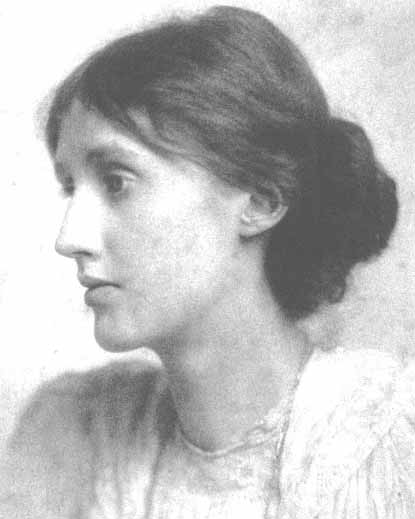
Some highlights: the stories of Anne Thackeray Ritchie (daughter of W.M. Thackeray), pictured above. She retells Beauty and the Beast and Sleeping Beauty very closely to the traditional plots, yet without the magical elements. Her characters discuss, at the beginning of each story, how fairy tale themes can be seen in everyday life. I love this theme-it's very empowering to the listener. What is the true miracle of the fairy tales-that a kiss awakens a female, or that a sheltered woman finds love and blossoms? That a Beast is transformed, or that a Beauty is able to love despite negative circumstances and appearances?

I also enjoyed Maria Louisa Molesworth's "The Brown Bull of Norrowa," a retelling of an Animal Bridegroom tale.

The "Subversions" section featured two parodies of Dickens' "A Christmas Carol," which were supposed to be very dark but I didn't think were especially dark. They were nice but not something I'd want to read again, the same as E. Nesbit's stories (although I love her novels). I did enjoy Frances Hodgson Burnett's "Behind the White Brick"-a young girl's dream journey into another world. But again, I didn't think a sarcastic talking baby was any darker than a queen who wants everyone's heads cut off. The introduction describes how Burnett's writing was limited by her fans' fear of her being a "new woman," so she uses the baby as "a perfect vehicle for the expression of emotions forbidden to a Victorian lady."

Confession: I never finished Jean Ingelow's "Mopsa the Fairy," the short novel. I just never grabbed my attention. The whole thing was designed as sort of the anti-Alice in Wonderland. The plots are parallel, yet opposite in some areas. Noteably, the female starts off being the innocent fairy dependant on the boy, who one would assume is the hero of the story, but the fairy (Mopsa) eventually gains authority as the human boy loses it and is eventually sent home unwillingly, to be back in the authority of his parents. The concept is interesting, but in order for a fantasy world to be good, it must be either believable, or humorous (like Alice's world), and for whatever reason I thought this story to be neither especially. Although I can't judge authoritatively since I didn't get very far (but for me to not enjoy a work of fantasy is very rare!)
The last section of the book features a set of stories told by an aunt to her neices, called "antifantasies," written by Christina Rosetti (pictured above). The first story features a birthday girl disappointed by the unrelenting realism of her birthday party compared to a little girl's ideal, followed by another dreamworld episode where she visits another birthday party where the children play cruel games with each other. These games mirror the cruelties-subtle and not-that women and children were already subjected to by society. The second features a girl who never accomplishes the task she set out to (to boil water)- an anti-heroine. The third is sort of a cross between The Little Match Girl and Little Red Riding Hood, only unlike Red, this underpriviledged girl resists temptations, which turn into pets she rescues and ends with a happy reunion at home for all of her troubles.

It's impossible for a modern mind to read the stories like a Victorian mind would, but I appreciate the concept of this book. As one commenter said on the back of the book called it: "A rival to masculinist histories of the 'golden age' in children's literature." (Margaret R. Higonnet, former editor, Children's Literature).

Sunday, April 4, 2010

Beatrix Potter

I saw the movie "Miss Potter" with my mom tonight. A sweet period romance. People don't think of Peter Rabbit as a fairy tale, but we consider other classic Victorian imaginative children's books to be fairy tales, like Alice in Wonderland and Peter Pan, so there's no reason to exclude Peter Rabbit.

Renee Zelwegger as Beatrix Potter

But in addition to that, there were several fairy tale references in the movie I noted: a story about a changeling, "Fairy-beasts" as an example of adults using supernatural creatures to frighten children into obedience, a reference to Vlad the Impaler (the figure behind the legend of Dracula). Also some themes that come up in fairy tale studies: oppression of women in the Victorian period, and a Freudian good father/bad mother relationship (Sidenote: the Chicago Tribune had an article a while back about how many movies we see now have this strong father-daughter relationship, from The Lovely Bones to the Hannah Montana movie. The writer's conclusion suggested the examples our last three Presidents have had of being fathers to daughters and not the Electra complex, but the father/daughter relationship has been prevalent in tales and folklore long before modern media.)


I wondered how accurate the movie was, and was surprised to learn it was pretty faithful to the facts, with a few minor omissions. Not only did Beatrix Potter become a famous author/artist, but previously she had been well-respected in the field of mycology (having to do with fungi, I guess-science is NOT my forte). Despite her respected work, because she was a woman, she was denied entrance to school or having any papers published. Quote from wikipedia:"When Potter came of age, her parents appointed her as their housekeeper and discouraged any intellectual development, instead requiring her to supervise the household." How sad. (By the way, wikipedia didn't suggest any special relationship with her father as opposed to her mother, as the movie suggests.)

As far as her literary career is concerned, it was a former governess who encouraged her to publish, and her first books were self-published. Her fiancee was, in fact, her publisher, like in the movie. And also as the movie states, she spent her royalties preserving the countryside and left her fortune to the National Trust. What a perfect role model for the modern audience-a strong-willed, single female (well, for most of the movie) who makes a name for herself despite many obstacles, and she was Green way before that became fashionable.
Interestingly, Walt Disney tried to get the rights to Potter's works and she declined. Also, she kept her journals in code-and so do I!